
Traffic rulesItaly
Learn the traffic rules of Italy with lots of pictures, clear traffic signs and interactive quizzes. Simple, visual and easy to follow.



The driving-licence system in Italy
Who issues driving licences in Italy?
Driving licences are issued through the Uffici della Motorizzazione Civile, commonly called UMC offices, under the Ministry of Infrastructure and Transport.
Which national authority regulates driving licences?
The Ministry of Infrastructure and Transport (MIT) establishes national licensing, examination and driver-training rules.
Can a driving school manage the application?
Yes. An authorised autoscuola can submit the application, organise training and arrange examinations for the candidate.
Can a person apply as a private candidate?
Yes. A candidate may apply directly to the competent UMC, although professional lessons and certified driving sessions remain compulsory where required.
Is an Italian licence valid throughout Italy?
Yes. A valid Italian licence is recognised throughout Italy, subject to its categories, restrictions and current legal status.
Is an Italian licence recognised elsewhere in the European Union?
Yes. A valid Italian EU-format licence is generally recognised throughout the EU and European Economic Area.
What is the Portale dell’Automobilista?
It is the official online portal for driver records, licence points, examination sheets, UMC information and other vehicle and licensing services.
Can one person hold two EU driving licences?
No. EU rules generally permit only one valid EU or EEA driving licence at a time.
What is the national driver register?
It is the electronic system recording driving entitlements, licence categories, points, restrictions, suspensions and other administrative information.
Do driving-school prices differ?
Yes. Ministry fees and legal requirements are national, while tuition, practical lessons, vehicle use and administrative charges vary between schools.
Eligibility, applications and medical fitness
What is the minimum age for category B?
The minimum age is 18 years.
Can category B preparation begin before age 18?
Yes. A candidate may begin theory preparation and submit the application within the timing permitted by the UMC before reaching the minimum practical-test age.
What identification is normally required?
The applicant normally provides a valid identity document, tax code, photographs and the residence or immigration documents required for the person’s status.
Must the applicant be resident in Italy?
The applicant must normally have residence in Italy or satisfy the EU normal-residence or student conditions applicable to licence issue.
Can a foreign resident apply for an Italian licence?
Yes. A lawfully resident foreign national can apply when the identity, residence, medical, age, training and examination requirements are met.
Can a person apply while disqualified from driving?
No. A current suspension, revocation, court prohibition or incompatible EU licence status must be resolved.
Which application form is commonly used?
The standard application for issue of a driving licence is made using form TT 2112.
Who certifies medical fitness for an ordinary category B application?
An authorised medical examiner issues the certificate, using the medical procedure applicable to the applicant.
When is a Local Medical Commission required?
A Commissione Medica Locale is required in specified cases involving disability, serious medical conditions, alcohol or drug issues, certain sanctions or complex fitness questions.
Can glasses, hearing assistance or an adapted vehicle be required?
Yes. Harmonised restriction codes can require corrective lenses, hearing support, an automatic transmission, hand controls or another adaptation.
Does a disability automatically prevent licensing?
No. The person may qualify for a special licence with suitable vehicle adaptations and individual restrictions.
Can medical fitness shorten licence validity or affect an existing licence?
Yes. The authority can impose earlier review, restrict the licence, suspend it or revoke it when fitness is not established.
Theory preparation and the category B examination
Must a candidate attend a driving school for theory preparation?
No. A private candidate may study independently, although a driving school can provide structured teaching and manage the application.
What subjects are covered?
The syllabus includes traffic rules, road signs, priority, safe behaviour, vehicle safety, alcohol, drugs, first aid, environmental driving and collision duties.
Is the official question bank public?
Yes. The Ministry publishes the official true-or-false question list used for category B preparation.
How is the category B theory test delivered?
It is a computer-based true-or-false examination at the UMC or another authorised test location.
How many questions are in the test?
There are 30 questions.
How long does the test last?
The candidate has a maximum of 20 minutes.
How many errors are allowed?
No more than three errors are allowed.
What happens after four or more errors?
The examination is failed.
Can the candidate view the completed examination sheet?
Yes. From the following day, a registered user can request the official examination sheet through the Portale dell’Automobilista.
How many theory attempts are allowed in one application?
The candidate normally has two theory attempts within the application-validity period.
How soon can a failed or missed theory test be retaken?
The next examination is normally scheduled no earlier than one month and one day after the previous test or absence.
What happens after passing theory?
The UMC issues the learner authorisation known as the foglio rosa.
The foglio rosa and supervised practice
What is the foglio rosa?
It is the official learner authorisation permitting supervised practice for the requested licence category.
How long is a category B foglio rosa valid?
It is valid for 12 months.
How many practical tests are allowed during its validity?
The candidate may take the practical test up to three times.
Can a learner drive alone?
No. A category B learner must be accompanied by an eligible supervising driver.
How old can the supervising driver be?
The accompanying driver must normally be no older than 65.
How long must the supervisor have held the licence?
The person must have held category B for at least 10 years, or hold a higher category without the 10-year requirement.
Where must the supervisor sit?
The supervisor must sit beside the learner and remain able to intervene.
Must P signs be displayed?
Yes. A white P on a black background must be displayed clearly at the front and rear during practice.
Can a learner practise on motorways?
Yes, under the supervision and training conditions applicable to category B.
Can a learner carry passengers?
Yes, unless a particular practice situation, instructor lesson or vehicle condition imposes a restriction.
Can the learner practise abroad?
No. The foglio rosa is a domestic learner authorisation and is not generally recognised abroad.
Can the passed theory result be transferred after the foglio rosa expires?
A one-time transfer to a new application may be requested within the statutory period when the conditions are met.
Compulsory practical training
Are professional practical lessons compulsory?
Yes. A category B candidate must complete the certified practical sessions required by law with an authorised driving instructor.
How many certified hours are required under the established category B rule?
At least six hours of special driving practice are required.
How are the six hours divided?
They include at least two hours on motorways or equivalent high-speed roads, two hours on extra-urban roads and two hours in night-time conditions.
Can private practice replace these certified hours?
No. The special hours must be certified by an authorised instructor.
Can the candidate take additional ordinary lessons?
Yes. There is no general maximum, and additional instruction is often necessary.
What counts as night-time practice?
It is conducted during the legally defined night conditions, including the times specified by the current ministerial rules.
Must motorway and extra-urban lessons use an appropriate vehicle?
Yes. The training vehicle must comply with the category B school-vehicle and safety requirements.
How is completion documented?
The driving school or instructor records and certifies the required sessions for the examination file.
Can the practical test be taken before the required training is certified?
No. The candidate must satisfy the compulsory-practice requirement first.
Can an automatic car be used for training?
Yes. The candidate can train and test in an automatic vehicle, but the resulting licence normally carries code 78.
The category B practical examination
When can the first practical test be taken?
It cannot normally be taken until at least one month after the foglio rosa is issued.
Who conducts the practical test?
An authorised UMC examiner conducts it.
Which vehicle is used?
The candidate uses a category B vehicle that meets the examination, insurance, registration and dual-control requirements.
What happens before driving in traffic?
The examiner can assess vehicle preparation, safety checks, controls, documents and basic technical knowledge.
What does the driving phase assess?
It assesses vehicle control, observation, priority, signs, speed, lane position, manoeuvres and safe interaction with other road users.
Which manoeuvres may be included?
They can include reversing, parking, turning, hill starts and other category B control tasks.
Can one dangerous error cause failure?
Yes. Serious rule violations, loss of control or instructor or examiner intervention can cause immediate failure.
Can a failed candidate retake the practical test?
Yes, while the foglio rosa remains valid and the three-attempt limit has not been exhausted.
How soon can a failed practical test be repeated?
Normally at least one month must pass between a failed test and the next attempt.
What happens after passing?
The examiner records the pass and the driving licence is issued or made available through the administrative procedure.
New drivers and three-year restrictions
How long is a category B holder treated as a new driver for the principal restrictions?
The principal restrictions apply during the first three years after category B is obtained.
What maximum speed applies on motorways?
A new driver may not exceed 100 km/h.
What maximum speed applies on main extra-urban roads?
A new driver may not exceed 90 km/h.
What vehicle power-to-weight limit applies to licences issued from 14 December 2024?
The driver may not operate an automobile with a specific power above 75 kW per tonne.
What additional maximum power applies to M1 passenger cars?
The maximum is 105 kW, including the passenger vehicles covered by the amended rule.
How long do the vehicle-power restrictions apply?
They apply for the first three years after category B issue.
Is any alcohol permitted during the first three years?
No. The legal alcohol limit is zero.
Does zero alcohol also apply to drivers under 21?
Yes. A driver under 21 is subject to the zero-alcohol rule even where the three-year period is not the only basis.
Are deducted points doubled for new drivers?
Yes. During the first three years, points deducted for each violation are doubled.
Can a new driver operate a more powerful car with an eligible supervisor?
A statutory exception permits supervised driving in specified circumstances when an eligible experienced driver is seated beside the new driver.
How can a vehicle’s eligibility be checked?
The Portale dell’Automobilista provides a service for checking whether a vehicle complies with new-driver power limits.
Do the restrictions end automatically after three years?
Yes, provided no separate restriction, suspension or category condition applies.
Driving-licence categories
What does category AM cover?
It covers mopeds and light quadricycles within the statutory speed, engine and power limits.
What is the minimum age for AM?
The minimum age is 14.
What does category A1 cover?
It covers motorcycles up to 125 cm³, 11 kW and the prescribed power-to-weight ratio.
What is the minimum age for A1?
The minimum age is 16.
What does category A2 cover?
It covers motorcycles up to 35 kW with the prescribed power-to-weight and derivation limits.
What does category A cover?
It covers unrestricted motorcycles, normally from age 24 or from age 20 after holding A2 for at least two years.
What does category B1 cover?
It covers specified heavy quadricycles.
What does category B cover?
It covers vehicles up to 3,500 kg with no more than eight passenger seats in addition to the driver.
What trailer can category B tow?
A trailer up to 750 kg, or a heavier trailer where the combination remains within the category B limit.
What does B with code 96 cover?
It covers a category B combination above 3,500 kg but not exceeding 4,250 kg.
What does category BE cover?
It covers a category B towing vehicle with a trailer or semi-trailer within the BE limits.
What do categories C1, C, D1 and D cover?
C1 and C cover medium and heavy goods vehicles; D1 and D cover smaller and larger passenger vehicles.
Professional and specialised driving
Is a heavy-vehicle licence enough for professional transport?
Not always. Many professional goods and passenger drivers also need a Carta di Qualificazione del Conducente (CQC).
What is CQC?
It is the professional driver qualification required for many commercial lorry and bus operations.
Is initial CQC training required?
Yes, unless an acquired-rights or activity exemption applies.
Is periodic CQC training required?
Yes. The driver normally completes 35 hours of periodic training every five years.
How long is CQC valid?
It is normally valid for five years.
What is CAP KB?
It is the professional certificate commonly required with category B for taxi and chauffeur-driven hire-car work.
Does CAP KB replace the underlying licence?
No. The driver must hold the appropriate valid licence and the professional certificate.
What is ADR authorisation?
It is the additional certificate required for transporting dangerous goods in vehicles covered by ADR.
Do heavy and professional categories require more frequent medical renewal?
Yes. C and D categories and professional certificates have shorter validity and stricter medical requirements.
Are professional drivers subject to zero alcohol?
Yes. Drivers professionally transporting persons or goods are subject to the zero-alcohol rule.
Validity, renewal and replacement
How long are AM, A1, A2, A, B1, B and BE normally valid below age 50?
They are normally valid for 10 years.
How long are they valid from age 50 to 70?
Normally five years.
How long are they valid from age 70 to 80?
Normally three years.
How long are they valid after age 80?
Normally two years.
Can medical fitness shorten these periods?
Yes. An authorised doctor or Local Medical Commission can set an earlier expiry.
How is an ordinary licence renewed?
The driver completes the required medical examination and the new card is produced through the Ministry system.
How early can renewal normally begin?
Renewal can generally be arranged during the months before expiry.
Can an expired licence still be renewed?
Yes, subject to medical fitness and any additional checks required after a long expiry.
What happens after loss, theft or destruction?
The holder reports the event where required and requests a duplicate through the competent police or licensing procedure.
Does a duplicate restore a suspended or revoked licence?
No. The electronic driver record controls the legal entitlement.
Foreign licences and International Driving Permits
Can an EU or EEA licence be used in Italy?
Yes. A valid EU or EEA licence is generally recognised.
Must an EU or EEA licence always be exchanged?
No. Exchange is generally voluntary, although Italian renewal or exchange becomes necessary in specified expiry, residence or administrative cases.
Can a visitor use a non-EU licence?
Yes. The driver must carry the valid foreign licence together with an International Driving Permit or official Italian translation where required.
How long can a non-EU resident use the foreign licence?
Normally for up to one year after becoming resident in Italy.
What happens after one year?
The resident must exchange the licence where a valid reciprocity agreement permits it or obtain an Italian licence through examinations.
Can every non-EU licence be exchanged?
No. Exchange depends on a current bilateral reciprocity agreement and the individual document and residence conditions.
Must the foreign licence be surrendered during exchange?
Yes. The original licence is normally surrendered and handled under the agreement procedure.
Does Italy issue International Driving Permits?
Yes. UMC offices issue permits under the 1949 Geneva and 1968 Vienna conventions.
How long are the two permit models valid?
The Geneva model is valid for one year; the Vienna model is valid for up to three years.
Does an International Driving Permit replace the Italian licence?
No. It must be carried together with the valid national licence.
Points, alcohol, drugs and loss of entitlement
How many points does a new Italian licence start with?
It starts with 20 points.
Can the balance exceed 20 points?
Yes. Two points can be added after each qualifying two-year offence-free period, up to a maximum of 30 points.
How many points can one offence remove?
The amount depends on the offence and can be as high as 10 points before any new-driver multiplier.
What happens when the balance reaches zero?
The driver must undergo a licence-review procedure and pass the required theory and practical examinations.
Can points be recovered through courses?
Yes. Approved recovery courses can restore points within the statutory limits.
What is the general alcohol limit?
The general maximum is 0.5 grams per litre of blood.
Who is subject to zero alcohol?
Drivers under 21, category B holders during their first three years and specified professional drivers.
Can refusing an alcohol or drug test be punished?
Yes. Refusal can lead to criminal penalties, licence suspension and other consequences.
Can drug use lead to licence action even without a points total reaching zero?
Yes. Drug-driving offences can lead to immediate criminal, administrative and licence consequences.
Can a suspension or revocation be avoided by obtaining another physical card?
No. The national driver record determines whether the person may legally drive.
Sources and methodology
How was this FAQ prepared?
This FAQ was prepared from current Ministry of Infrastructure and Transport material, the Portale dell’Automobilista, the consolidated Highway Code and ACI guidance.
Which source explains the foglio rosa and examination attempts?
Portale dell’Automobilista: foglio rosa and examination attemptsWhich source explains the current category B theory-test format?
Ministry information: obtaining a driving licenceWhich source explains certified motorway, extra-urban and night practice?
Ministry decree: compulsory category B practiceWhich source explains the current new-driver power limits?
ACI: new-driver vehicle-power restrictionsWhich source defines licence validity periods?
ACI: Highway Code article 126Which source explains the points system?
ACI: Highway Code article 126-bisWhich source explains foreign licences and reciprocity agreements?
Ministry of Foreign Affairs: driving licencesWhen was this FAQ reviewed?
Last reviewed: 4 August 2026.
Is this website affiliated with an Italian authority?
This website is an independent educational resource and is not affiliated with MIT, a UMC office, ACI, an examination centre, medical commission or driving school.
Official legislation and instructions from the competent authority always take precedence.
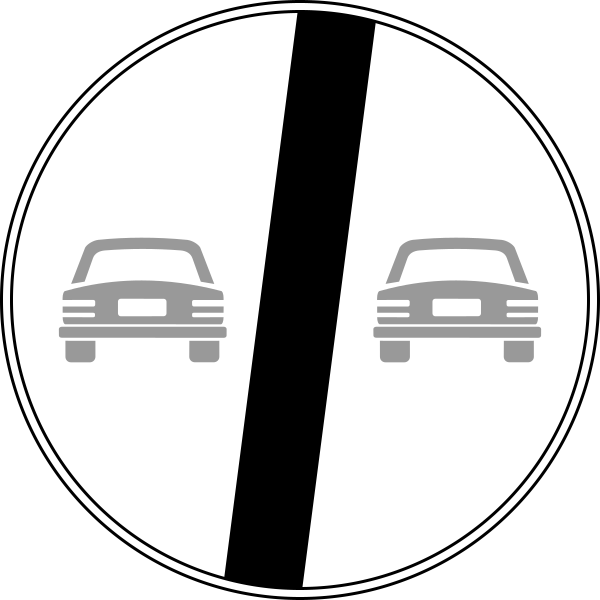
1. What does this traffic sign mean?
This traffic sign indicates the end of the overtaking prohibition. The preceding overtaking restriction ends at this point. Overtaking remains subject to the applicable traffic rules and any other restrictions.
English • Traffic sign II.72 • End of overtaking prohibition. Marks the end of the overtaking prohibition for all vehicles.
Italiano • Figura II.72 • Fine divieto di sorpasso. Indica la fine del divieto di sorpasso per tutti i veicoli.
Sources
🔗 Commons.wikimedia.org (F l a n k e r • CC BY-SA 3.0)
🔗 Normattiva.it • D.P.R. 495/1992 • testo vigente • art. 119, comma 1(c)
🔗 Gazzettaufficiale.it • Gazzetta Ufficiale • Figura II.72 • pagina 266
SVG source: F l a n k e r • CC BY-SA 3.0 • Original revision 2010-07-17. Wikimedia original unmodified.
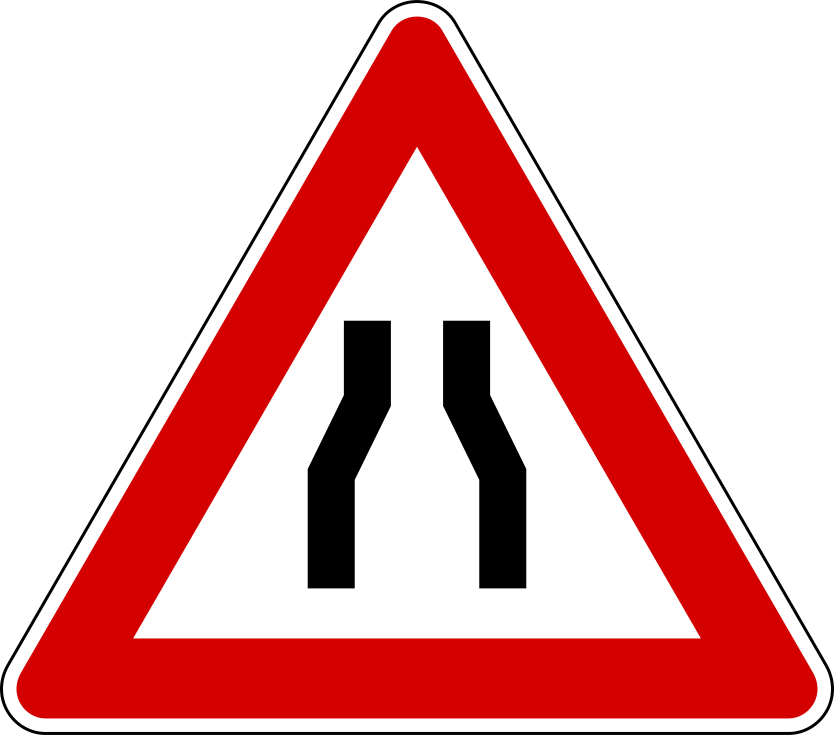
2. What does this traffic sign mean?
This traffic sign indicates a warning for a road narrowing. The available width of the road or carriageway decreases ahead. Reduce speed, maintain sufficient lateral clearance and watch carefully for approaching or adjacent traffic.
English • Traffic sign II.17 • Road narrows on both sides. Warns of a symmetrical narrowing of the carriageway that is dangerous for traffic.
Italiano • Figura II.17 • Strettoia simmetrica. Presegnala un restringimento simmetrico della carreggiata pericoloso per la circolazione.
Sources
🔗 Commons.wikimedia.org (F l a n k e r • CC BY-SA 3.0)
🔗 Normattiva.it • D.P.R. 495/1992 • testo vigente • art. 90, comma 1–2
🔗 Gazzettaufficiale.it • Gazzetta Ufficiale • Figura II.17 • pagina 249
SVG source: F l a n k e r • CC BY-SA 3.0 • Original revision 2012-06-11. Wikimedia original unmodified.
Artwork verified against Gazzettaufficiale.it • official published diagram II.17.
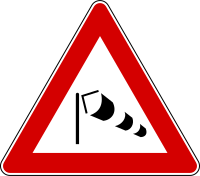
3. What does this traffic sign mean?
This traffic sign indicates a warning for strong crosswinds. Side winds may suddenly affect vehicle stability and steering. Reduce speed, keep a firm but controlled grip on the steering wheel and take extra care with high-sided vehicles, motorcycles and trailers.
English • Traffic sign II.33 • Strong crosswinds. Warns of a section where strong lateral gusts may occur.
Italiano • Figura II.33 • Forte vento laterale. Presegnala un tratto nel quale possono verificarsi forti raffiche di vento laterale.
Sources
🔗 Commons.wikimedia.org
🔗 Normattiva.it • D.P.R. 495/1992 • testo vigente • art. 101, comma 1
🔗 Gazzettaufficiale.it • Gazzetta Ufficiale • Figura II.33 • pagina 254
SVG source: F l a n k e r • Public domain • Original revision 2011-02-05. Wikimedia original unmodified.

4. What does this traffic sign mean?
This traffic sign indicates that snow chains are mandatory. Vehicles covered by the sign must use snow chains from this point as required by the applicable rules. Follow any supplementary signs or local instructions specifying the affected vehicles, wheels or conditions.
English • Traffic sign II.87 • Snow chains compulsory. From the sign onwards, vehicles must use snow chains or winter tyres.
Italiano • Figura II.87 • Catene per neve obbligatorie. Dal punto in cui il segnale è posto, obbliga a circolare con catene da neve o pneumatici invernali.
Sources
🔗 Commons.wikimedia.org (F l a n k e r • CC BY-SA 3.0)
🔗 Normattiva.it • D.P.R. 495/1992 • testo vigente • art. 122, comma 8
🔗 Gazzettaufficiale.it • Gazzetta Ufficiale • Figura II.87 • pagina 272
🔗 Normattiva.it • D.P.R. 495/1992 • allegati e successive modifiche
SVG source: F l a n k e r • CC BY-SA 3.0 • Original revision 2010-09-01. Wikimedia original unmodified.
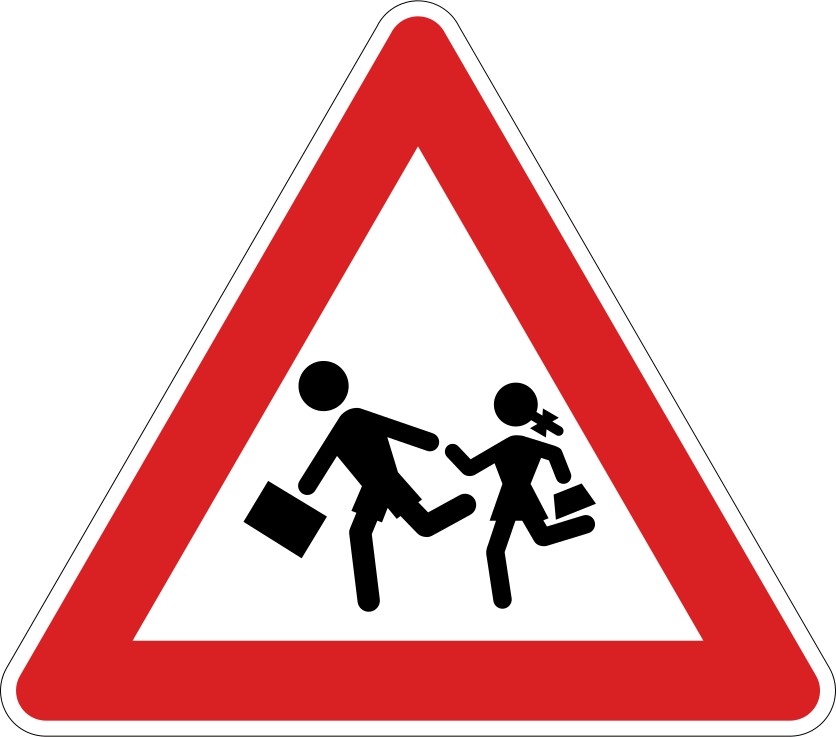
5. What does this traffic sign mean?
This traffic sign indicates a warning for children. Children may be present on or near the road and may cross unexpectedly. Reduce speed, scan both sides of the road carefully and be prepared to stop.
English • Traffic sign II.23 • Children. Warns of places frequented by children, such as schools, public gardens and playgrounds.
Italiano • Figura II.23 • Bambini. Presegnala luoghi frequentati da bambini, come scuole, giardini pubblici e campi di gioco.
Sources
🔗 Commons.wikimedia.org (F l a n k e r • CC BY-SA 3.0)
🔗 Normattiva.it • D.P.R. 495/1992 • testo vigente • art. 94, comma 1
🔗 Gazzettaufficiale.it • Gazzetta Ufficiale • Figura II.23 • pagina 251
Image via Commons.wikimedia.org
F l a n k e r • CC BY-SA 3.0 • Source revision 2025-02-23. Wikimedia original unmodified.
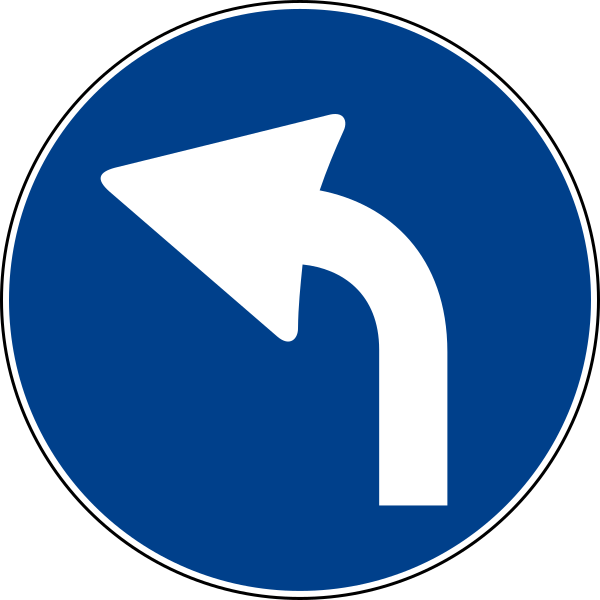
6. What does this traffic sign mean?
This traffic sign indicates that turning left is mandatory at the junction ahead. Traffic must turn left and may not continue straight ahead or turn right.
English • Traffic sign II.80/e • Advance indication of compulsory left turn. Warns that turning left is compulsory.
Italiano • Figura II.80/e • Preavviso di direzione obbligatoria a sinistra. Preavvisa l’obbligo di svoltare a sinistra.
Sources
🔗 Commons.wikimedia.org (F l a n k e r • CC BY-SA 3.0)
🔗 Normattiva.it • D.P.R. 495/1992 • testo vigente • art. 122, comma 2
🔗 Gazzettaufficiale.it • Gazzetta Ufficiale • Figura II.80/e • pagina 270
SVG source: F l a n k e r • CC BY-SA 3.0 • Original revision 2010-07-17. Wikimedia original unmodified.
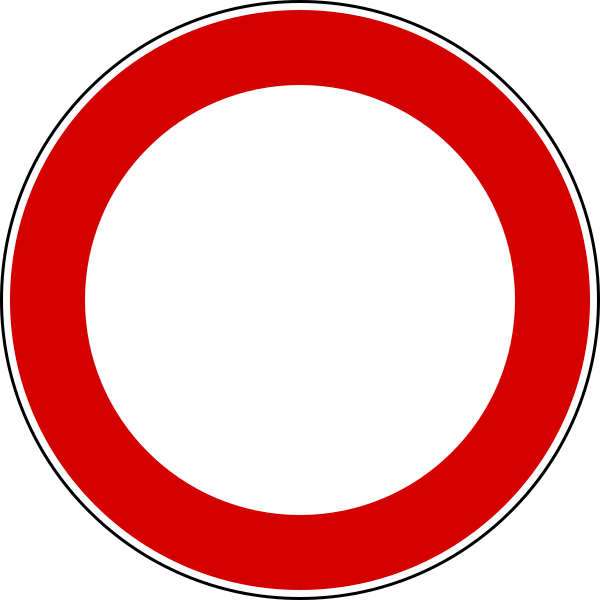
7. What does this traffic sign mean?
This traffic sign indicates that drivers may not enter the road from either direction.
English • Traffic sign II.46 • No vehicles. Vehicles are prohibited in both directions.
Italiano • Figura II.46 • Divieto di transito. Vieta il transito dei veicoli nei due sensi di marcia.
Sources
🔗 Commons.wikimedia.org
🔗 Normattiva.it • D.P.R. 495/1992 • testo vigente • art. 116, comma 1(a)
🔗 Gazzettaufficiale.it • Gazzetta Ufficiale • Figura II.46 • pagina 259
SVG source: F l a n k e r • Public domain • Original revision 2023-11-19. Wikimedia original unmodified.
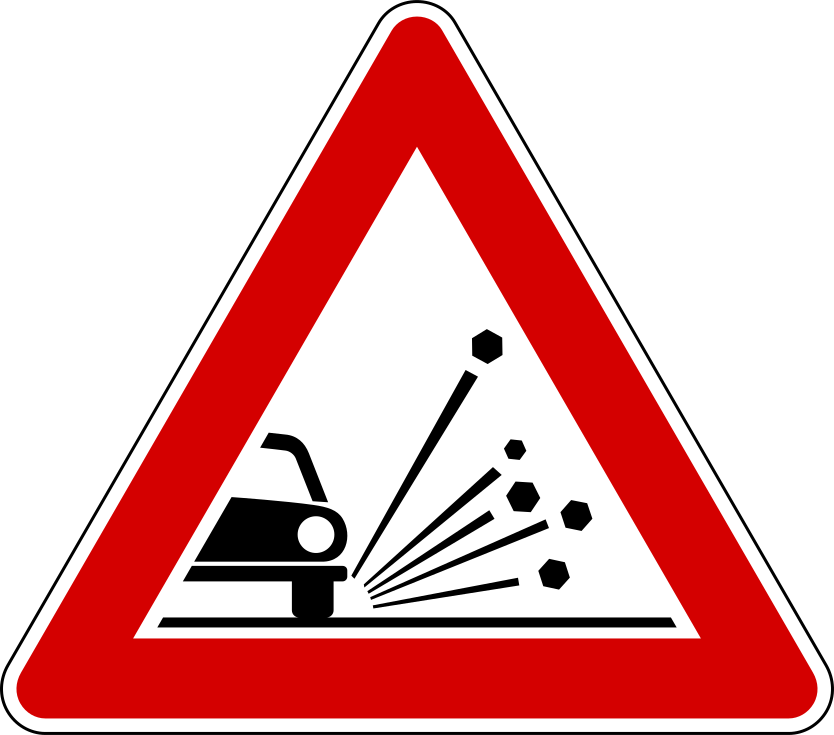
8. What does this traffic sign mean?
This traffic sign indicates a warning for loose chippings. Loose stones or gravel may reduce tyre grip and can be thrown up by passing vehicles. Reduce speed, increase your following distance and avoid sudden braking, acceleration or steering movements.
English • Traffic sign II.29 • Loose material on the road. Warns of gravel, crushed stone, chippings or other material that vehicles may throw up or that may reduce grip.
Italiano • Figura II.29 • Materiale instabile sulla strada. Presegnala ghiaia, pietrisco, graniglia o altro materiale sulla pavimentazione che può essere proiettato dai veicoli o ridurre l’aderenza.
Sources
🔗 Commons.wikimedia.org (F l a n k e r • CC BY-SA 3.0)
🔗 Normattiva.it • D.P.R. 495/1992 • testo vigente • art. 98, comma 1
🔗 Gazzettaufficiale.it • Gazzetta Ufficiale • Figura II.29 • pagina 253
SVG source: F l a n k e r • CC BY-SA 3.0 • Original revision 2011-02-05. Wikimedia original unmodified.
Current figure reference verified in Normattiva.it • Normattiva, current article 98.
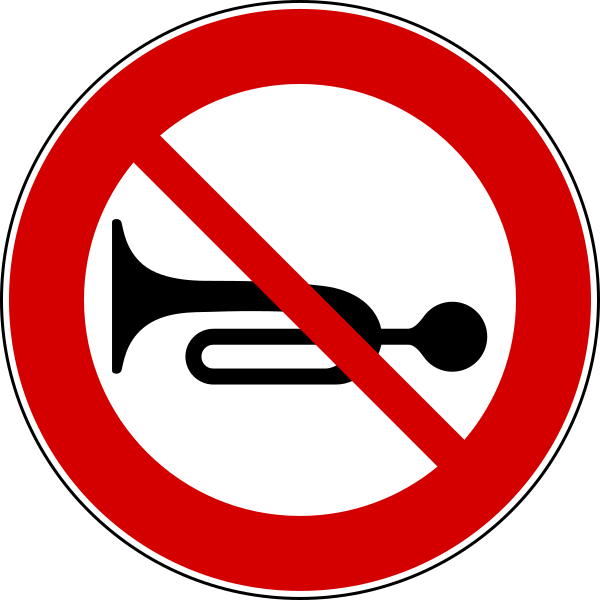
9. What does this traffic sign mean?
This traffic sign indicates that using the horn is prohibited. The horn or other audible warning device may not be used where the prohibition applies, except where an applicable local rule permits or requires it.
English • Traffic sign II.51 • Sound signals prohibited. Use of horns is prohibited except in immediate danger.
Italiano • Figura II.51 • Divieto di segnalazioni acustiche. Vieta l’uso degli avvisatori acustici, salvo in caso di pericolo immediato.
Sources
🔗 Commons.wikimedia.org (F l a n k e r • CC BY-SA 3.0)
🔗 Normattiva.it • D.P.R. 495/1992 • testo vigente • art. 116, comma 1(f)
🔗 Gazzettaufficiale.it • Gazzetta Ufficiale • Figura II.51 • pagina 260
SVG source: F l a n k e r • CC BY-SA 3.0 • Original revision 2010-07-17. Wikimedia original unmodified.
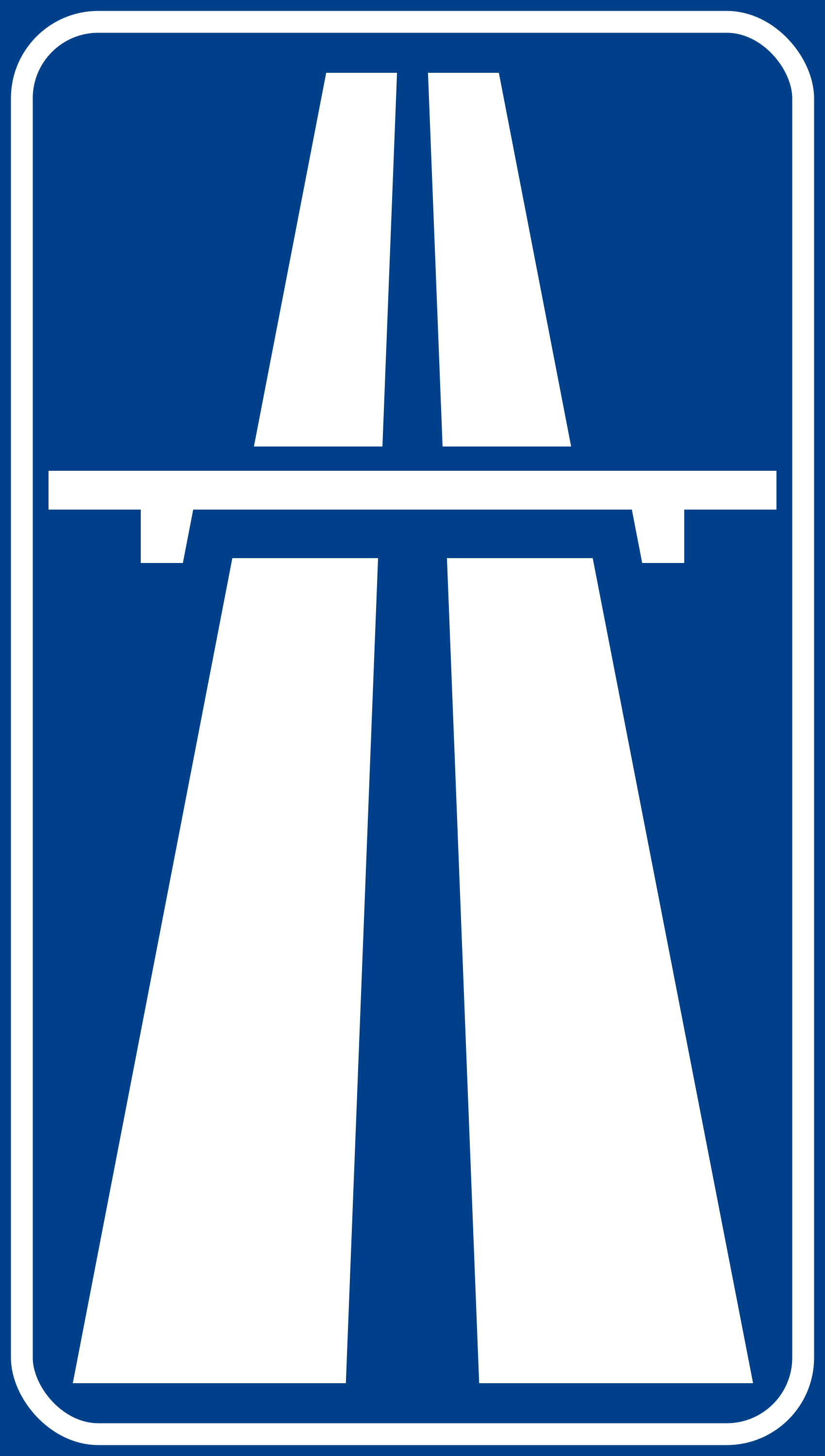
10. What does this traffic sign mean?
This traffic sign indicates the start of a motorway. From this point, special motorway rules apply, including restrictions on which road users may enter and on stopping, reversing and other manoeuvres. Follow the applicable speed limits, lane rules and local motorway regulations.
English • Traffic sign II.345 — blue background • Beginning of a principal extra-urban road. The symbol on a blue background marks the beginning of a principal extra-urban road. The same symbol has a green background for a motorway.
Italiano • Figura II.345 — fondo blu • Inizio strada extraurbana principale. Il simbolo con fondo blu indica l’inizio di una strada extraurbana principale. Per l’autostrada lo stesso simbolo ha fondo verde.
Sources
🔗 Commons.wikimedia.org
🔗 Normattiva.it • D.P.R. 495/1992 • testo vigente • art. 135, comma 23
🔗 Gazzettaufficiale.it • Gazzetta Ufficiale • Figura II.345 — fondo blu • pagina 322
SVG source: ColdShine • Public domain • Original revision 2023-09-10. Wikimedia original unmodified.
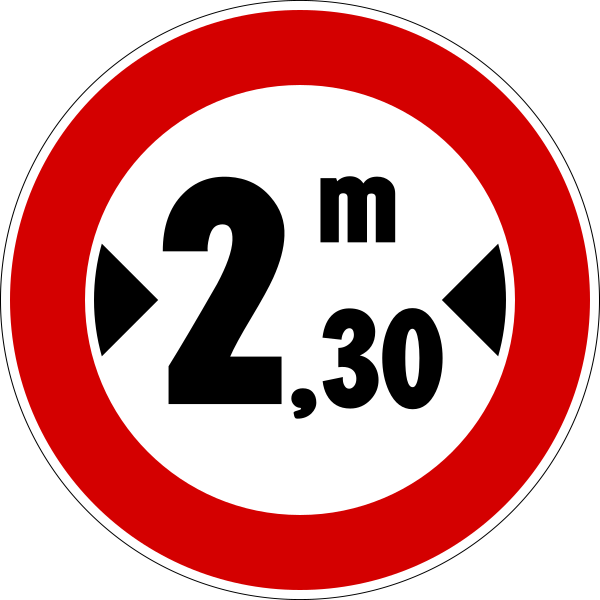
11. What does this traffic sign mean?
This traffic sign indicates that vehicles wider than indicated are prohibited. A vehicle or vehicle combination whose overall width, including its load, exceeds the displayed limit may not continue beyond the sign.
English • Traffic sign II.65 • No vehicles wider than indicated. The prohibition applies where the vehicle's actual width at the time of passage exceeds the value shown in metres.
Italiano • Figura II.65 • Transito vietato ai veicoli aventi larghezza superiore a quella indicata. Vieta il transito ai veicoli la cui larghezza effettiva al momento del passaggio supera il valore indicato in metri.
Sources
🔗 Commons.wikimedia.org
🔗 Normattiva.it • D.P.R. 495/1992 • testo vigente • art. 118, comma 1(a), 3
🔗 Gazzettaufficiale.it • Gazzetta Ufficiale • Figura II.65 • pagina 264
SVG source: Original: Ministero dei Lavori Pubblici Vectorization: Arbalete • Public domain • Original revision 2024-09-18. Wikimedia original unmodified.
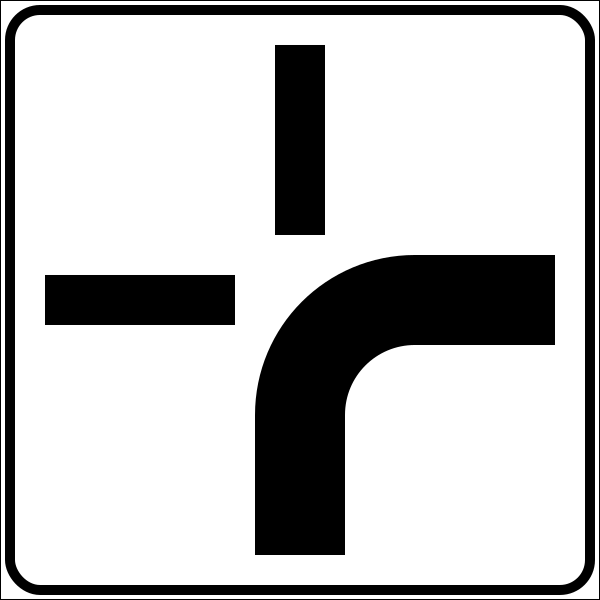
12. What does this traffic sign mean?
This traffic sign shows the shape or layout of an upcoming junction. The diagram indicates how the approaching road and connecting roads are arranged.
English • Model II.7 • Course of the priority road. The thicker line represents the road with priority over the narrower branches. Read the plate together with the priority sign. The plate supplements the main sign and must be read together with it.
Italiano • Modello II.7 • Andamento della strada principale. La striscia più larga rappresenta la strada che gode della precedenza rispetto ai rami più stretti. Il pannello va interpretato insieme al segnale di precedenza. Il pannello integra il segnale principale e deve essere interpretato insieme a esso.
Sources
🔗 Commons.wikimedia.org
🔗 Normattiva.it • D.P.R. 495/1992 • testo vigente • art. 83, comma 11
🔗 Gazzettaufficiale.it • Gazzetta Ufficiale • Modello II.7 • pagina 243
SVG source: Original: Ministero dei Lavori Pubblici Vectorization: Arbalete • Public domain • Original revision 2024-07-12. Wikimedia original unmodified.

13. What does this traffic sign mean?
This traffic sign indicates that traffic must pass an obstacle on either the left or the right. Use either permitted side while following the road layout and any accompanying signs or markings.
English • Traffic sign II.83 • Passing permitted on either side. Drivers may pass on either side of the obstacle.
Italiano • Figura II.83 • Passaggi consentiti. Consente di passare da uno dei due lati dell’ostacolo.
Sources
🔗 Commons.wikimedia.org (F l a n k e r • CC BY-SA 3.0)
🔗 Normattiva.it • D.P.R. 495/1992 • testo vigente • art. 122, comma 4
🔗 Gazzettaufficiale.it • Gazzetta Ufficiale • Figura II.83 • pagina 271
SVG source: F l a n k e r • CC BY-SA 3.0 • Original revision 2010-07-17. Wikimedia original unmodified.
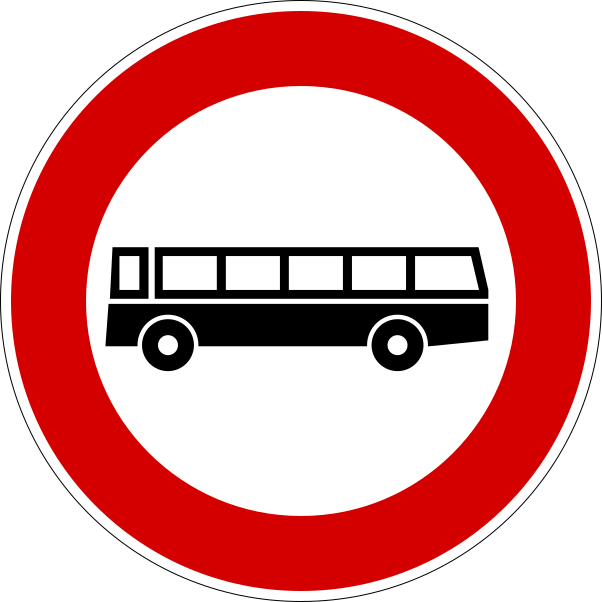
14. What does this traffic sign mean?
This traffic sign indicates that buses are prohibited. Buses covered by the sign may not enter or continue beyond it. Other road users may still be permitted unless another restriction applies.
English • Traffic sign II.59 • No buses or coaches. Buses and coaches are prohibited.
Italiano • Figura II.59 • Transito vietato agli autobus. Vieta il transito agli autobus.
Sources
🔗 Commons.wikimedia.org
🔗 Normattiva.it • D.P.R. 495/1992 • testo vigente • art. 117, comma 1(h)
🔗 Gazzettaufficiale.it • Gazzetta Ufficiale • Figura II.59 • pagina 262
SVG source: F l a n k e r • Public domain • Original revision 2023-12-07. Wikimedia original unmodified.
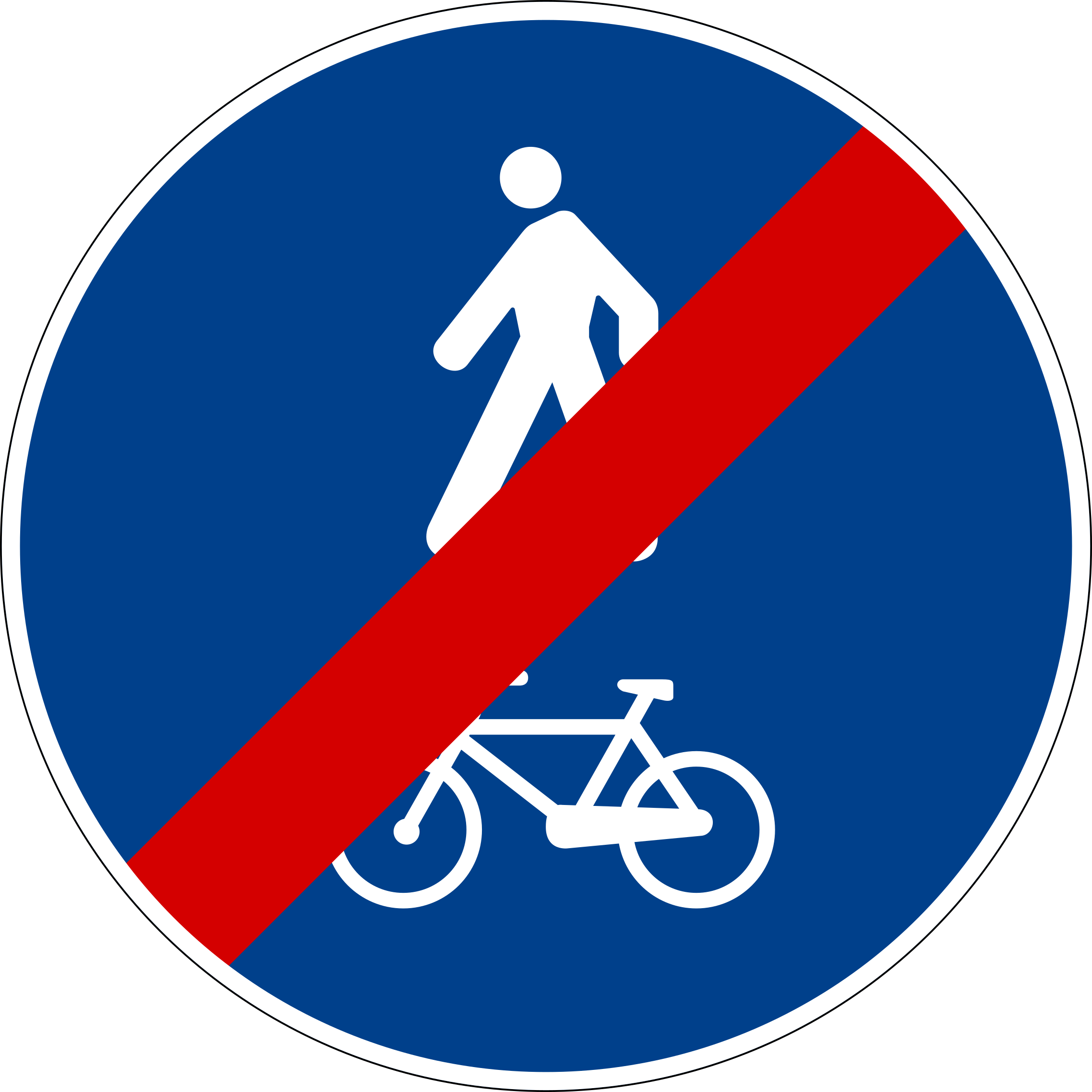
15. What does this traffic sign mean?
This traffic sign indicates the end of the mandatory shared path for pedestrians and cyclists. The shared-path requirement ends at this point. Pedestrians and cyclists must continue according to the subsequent path or road layout and applicable local rules.
English • Traffic sign II.93/b • End of pedestrian and cycle route. Marks the end of the route reserved for pedestrians and cycles.
Italiano • Figura II.93/b • Fine percorso pedonale e ciclabile. Indica la fine del percorso riservato ai pedoni e ai velocipedi.
Sources
🔗 Commons.wikimedia.org
🔗 Normattiva.it • D.P.R. 495/1992 • testo vigente • art. 122, comma 10
🔗 Gazzettaufficiale.it • Gazzetta Ufficiale • Figura II.93/b • pagina 275
🔗 Normattiva.it • D.P.R. 495/1992 • allegati e successive modifiche
SVG source: F l a n k e r • Public domain • Original revision 2026-06-15. Wikimedia original unmodified.
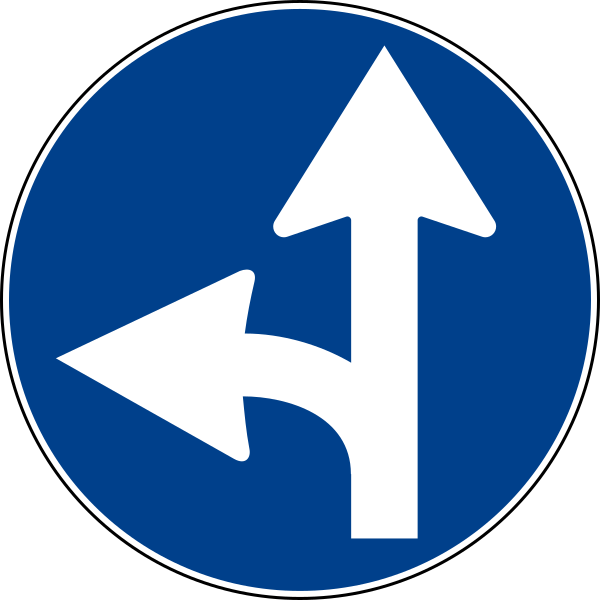
16. What does this traffic sign mean?
This traffic sign indicates that traffic must continue straight ahead or turn left. One of the indicated directions must be followed; turning right is prohibited.
English • Traffic sign II.81/c • Straight ahead or left only. These are the only permitted directions.
Italiano • Figura II.81/c • Direzioni consentite diritto e sinistra. Indica che le sole direzioni consentite sono diritto e sinistra.
Sources
🔗 Commons.wikimedia.org (F l a n k e r • CC BY-SA 3.0)
🔗 Normattiva.it • D.P.R. 495/1992 • testo vigente • art. 122, comma 3
🔗 Gazzettaufficiale.it • Gazzetta Ufficiale • Figura II.81/c • pagina 270
SVG source: F l a n k e r • CC BY-SA 3.0 • Original revision 2010-07-17. Wikimedia original unmodified.
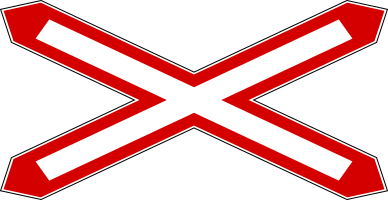
17. What does this traffic sign mean?
This traffic sign indicates a warning for a railway crossing with one track. It alerts drivers to a level crossing where a single railway track crosses the road. Drivers should approach with caution and be prepared to stop, even if no barriers or warning lights are active.
English • Traffic sign II.10/a • Crossbuck. Marks a nearby level crossing without barriers and the obligation to stop at the stop line.
Italiano • Figura II.10/a • Croce di S. Andrea. Segnala nelle immediate vicinanze un passaggio a livello senza barriere e l’obbligo di fermarsi in corrispondenza della striscia di arresto.
Sources
🔗 Commons.wikimedia.org
🔗 Normattiva.it • D.P.R. 495/1992 • testo vigente • art. 87, comma 2
🔗 Gazzettaufficiale.it • Gazzetta Ufficiale • Figura II.10/a • pagina 247
SVG source: F l a n k e r • Public domain • Original revision 2012-12-27. Wikimedia original unmodified.
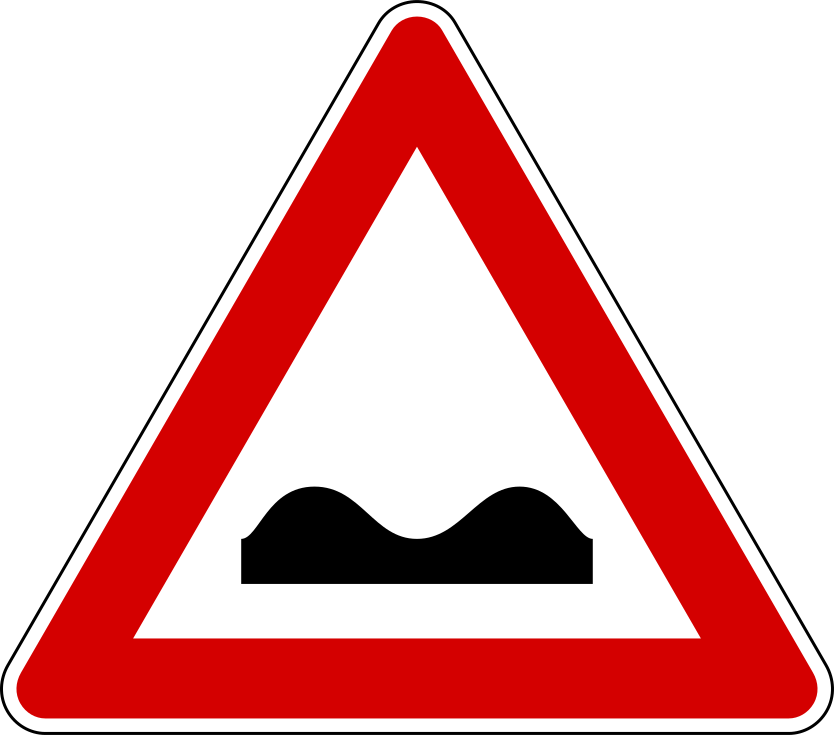
18. What does this traffic sign mean?
This traffic sign indicates a warning for a bad or uneven road surface. Potholes, bumps, depressions or other surface irregularities may affect vehicle stability and braking. Reduce speed and avoid sudden manoeuvres.
English • Traffic sign II.1 • Uneven road. Warns of a road section in poor condition or with an uneven surface.
Italiano • Figura II.1 • Strada deformata. Presegnala un tratto di strada in cattivo stato o con pavimentazione irregolare.
Sources
🔗 Commons.wikimedia.org
🔗 Normattiva.it • D.P.R. 495/1992 • testo vigente • art. 85, comma 1
🔗 Gazzettaufficiale.it • Gazzetta Ufficiale • Figura II.1 • pagina 245
Image via Commons.wikimedia.org
F l a n k e r • Public domain • Source revision 2011-04-07. Wikimedia original unmodified.
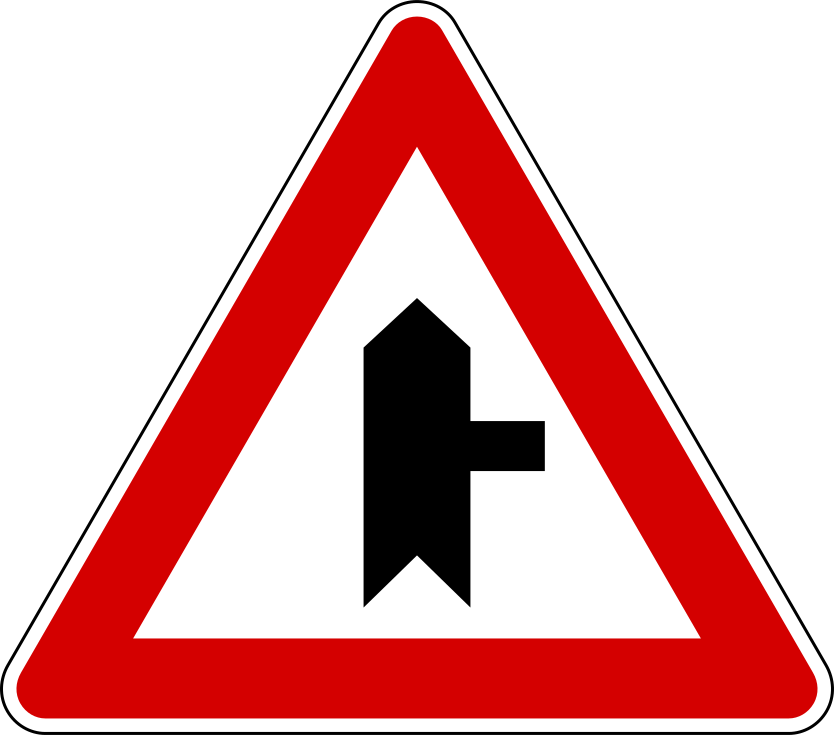
19. What does this traffic sign mean?
This traffic sign indicates that you have priority at the next intersection. A side road joins from the right, and traffic entering from that side road must give way.
English • Traffic sign II.43/b • T-junction with priority. Warns of a non-priority road joining from the right. Vehicles from that road must give way.
Italiano • Figura II.43/b • Intersezione a T con diritto di precedenza. Presegnala un’intersezione con una strada subordinata che si immette da destra. I veicoli provenienti dalla strada subordinata devono dare precedenza.
Sources
🔗 Commons.wikimedia.org (F l a n k e r • CC BY-SA 3.0)
🔗 Normattiva.it • D.P.R. 495/1992 • testo vigente • art. 112, comma 2
🔗 Gazzettaufficiale.it • Gazzetta Ufficiale • Figura II.43/b • pagina 257
SVG source: F l a n k e r • CC BY-SA 3.0 • Original revision 2011-02-05. Wikimedia original unmodified.
Current figure reference verified in Normattiva.it • Normattiva, current article 112.
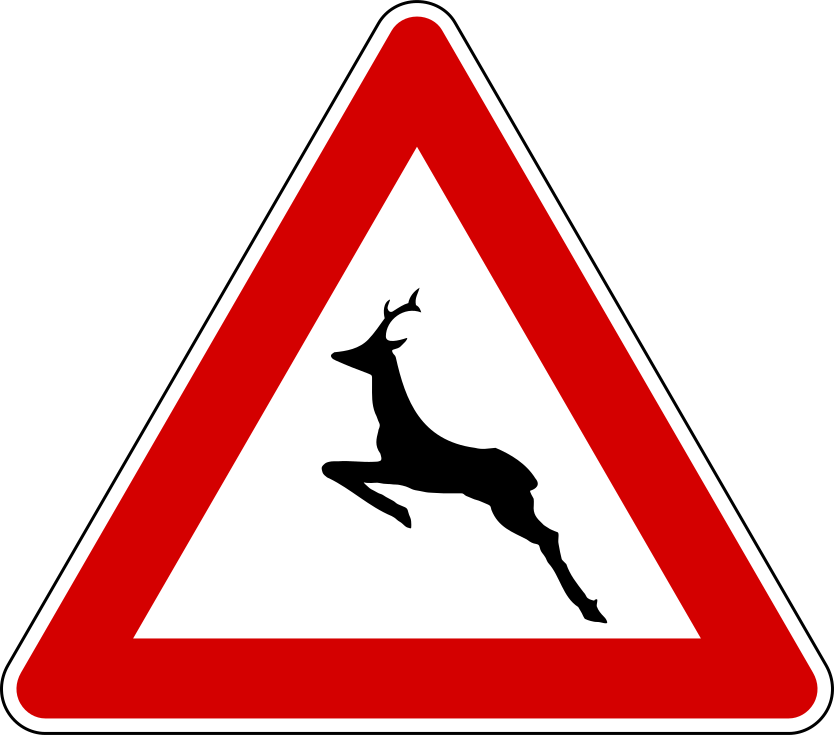
20. What does this traffic sign mean?
This traffic sign indicates a warning for crossing deer. Deer or other wild animals may enter the road unexpectedly, especially around dawn or dusk. Reduce speed, watch the roadside carefully and be prepared for more than one animal to cross.
English • Traffic sign II.25 • Wild animals. Warns of a road section where wild animals are likely to cross.
Italiano • Figura II.25 • Animali selvatici. Presegnala un tratto di strada con probabile attraversamento di animali selvatici.
Sources
🔗 Commons.wikimedia.org (F l a n k e r • CC BY-SA 3.0)
🔗 Normattiva.it • D.P.R. 495/1992 • testo vigente • art. 95, comma 1
🔗 Gazzettaufficiale.it • Gazzetta Ufficiale • Figura II.25 • pagina 251
SVG source: F l a n k e r • CC BY-SA 3.0 • Original revision 2011-02-05. Wikimedia original unmodified.
Artwork verified against Gazzettaufficiale.it • official published diagram II.25.
Current figure reference verified in Normattiva.it • Normattiva, current article 95.
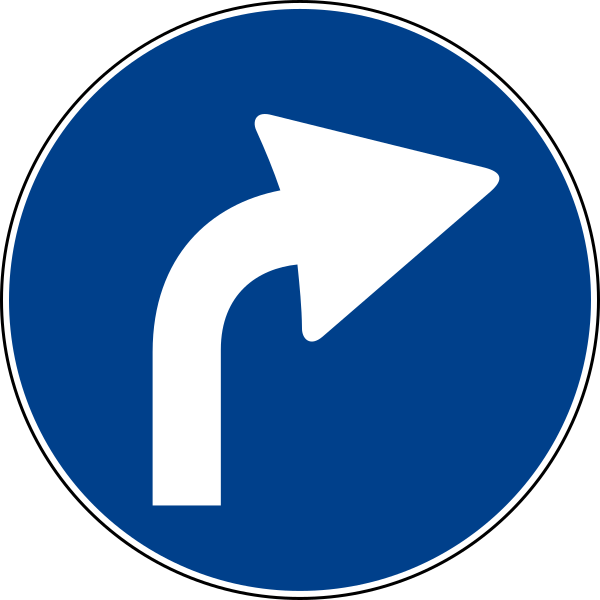
21. What does this traffic sign mean?
This traffic sign indicates that turning right is mandatory at the junction ahead. Traffic must turn right and may not continue straight ahead or turn left.
English • Traffic sign II.80/d • Advance indication of compulsory right turn. Warns that turning right is compulsory.
Italiano • Figura II.80/d • Preavviso di direzione obbligatoria a destra. Preavvisa l’obbligo di svoltare a destra.
Sources
🔗 Commons.wikimedia.org (F l a n k e r • CC BY-SA 3.0)
🔗 Normattiva.it • D.P.R. 495/1992 • testo vigente • art. 122, comma 2
🔗 Gazzettaufficiale.it • Gazzetta Ufficiale • Figura II.80/d • pagina 269
SVG source: F l a n k e r • CC BY-SA 3.0 • Original revision 2010-07-17. Wikimedia original unmodified.
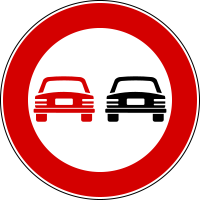
22. What does this traffic sign mean?
This traffic sign indicates that overtaking is prohibited. The vehicles covered by the prohibition and any categories that may still be overtaken depend on the applicable local rules.
English • Traffic sign II.48 • No overtaking. Overtaking motor vehicles other than mopeds and motorcycles is prohibited, even if the manoeuvre can be completed within your own half of the carriageway, with or without a continuous line.
Italiano • Figura II.48 • Divieto di sorpasso. Vieta di sorpassare i veicoli a motore, eccetto i ciclomotori e i motocicli, anche quando la manovra può compiersi entro la propria semicarreggiata, con o senza striscia continua.
Sources
🔗 Commons.wikimedia.org (F l a n k e r • CC BY-SA 3.0)
🔗 Normattiva.it • D.P.R. 495/1992 • testo vigente • art. 116, comma 1(c)
🔗 Gazzettaufficiale.it • Gazzetta Ufficiale • Figura II.48 • pagina 259
SVG source: F l a n k e r • CC BY-SA 3.0 • Original revision 2010-07-15. Wikimedia original unmodified.
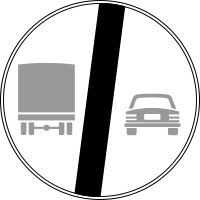
23. What does this traffic sign mean?
This traffic sign indicates the end of the overtaking prohibition for trucks. The preceding truck overtaking restriction ends at this point. Other overtaking rules and restrictions may still apply.
English • Traffic sign II.73 • End of overtaking prohibition for vehicles with a fully laden mass exceeding 3.5 t. Ends the prohibition for vehicles not used for passenger transport whose fully laden mass recorded in the registration document exceeds 3.5 t.
Italiano • Figura II.73 • Fine divieto di sorpasso per i veicoli di massa a pieno carico superiore a 3,5 t. Indica la fine del divieto di sorpasso per i veicoli non adibiti al trasporto di persone con massa a pieno carico superiore a 3,5 t indicata nella carta di circolazione.
Sources
🔗 Commons.wikimedia.org
🔗 Normattiva.it • D.P.R. 495/1992 • testo vigente • art. 119, comma 1(d)
🔗 Gazzettaufficiale.it • Gazzetta Ufficiale • Figura II.73 • pagina 266
SVG source: F l a n k e r • Public domain • Original revision 2006-12-02. Wikimedia original unmodified.
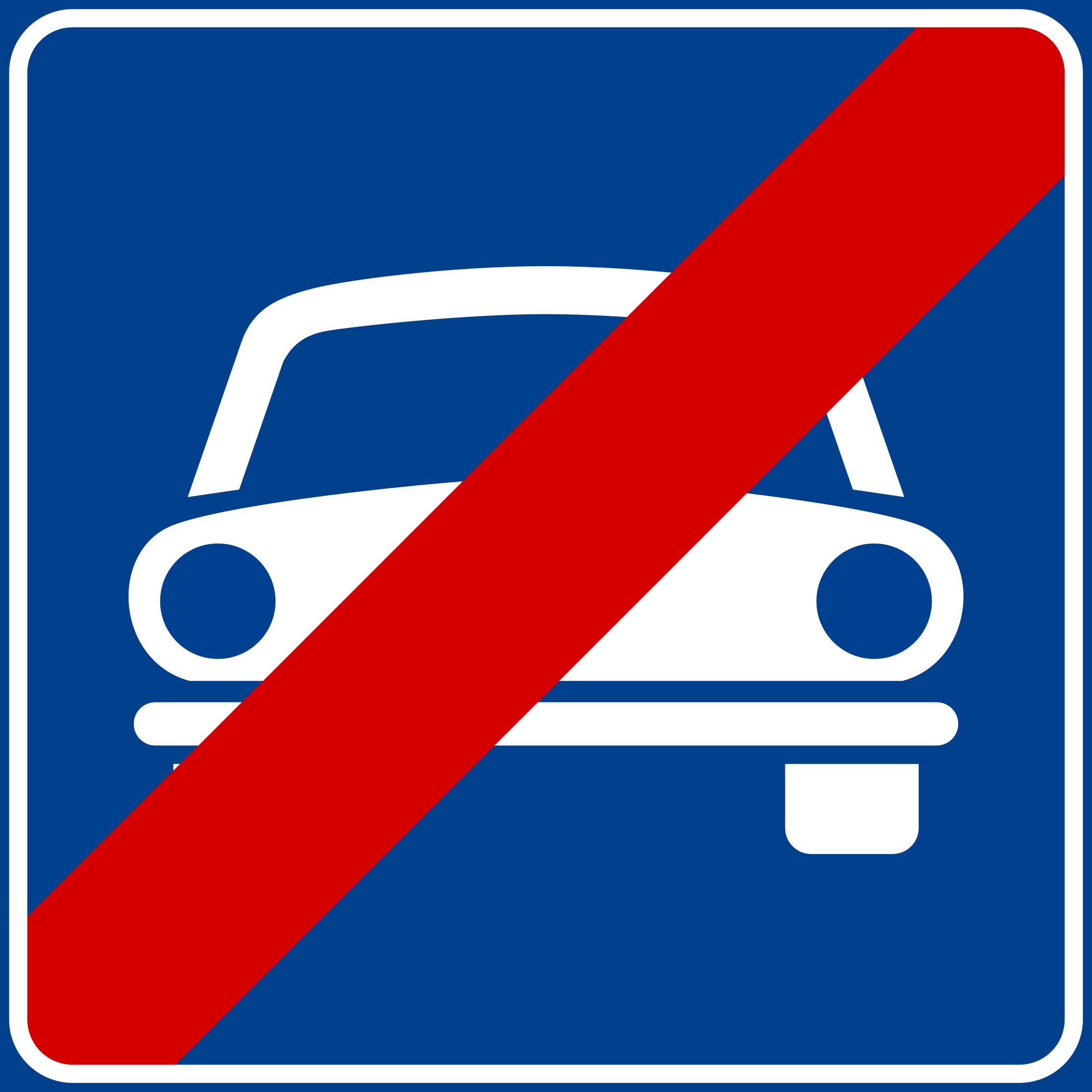
24. What does this traffic sign mean?
This traffic sign indicates the end of the expressway. The special traffic rules associated with the expressway end at this point. Follow the rules and traffic signs that apply to the road ahead.
English • Traffic sign II.315 • End of road reserved for motor vehicles. Marks the end of the reserved road.
Italiano • Figura II.315 • Fine strada riservata ai veicoli a motore. Indica la fine della strada riservata ai veicoli a motore.
Sources
🔗 Commons.wikimedia.org
🔗 Normattiva.it • D.P.R. 495/1992 • testo vigente • art. 135, comma 9
🔗 Gazzettaufficiale.it • Gazzetta Ufficiale • Figura II.315 • pagina 314
SVG source: F l a n k e r • Public domain • Original revision 2023-06-30. Wikimedia original unmodified.
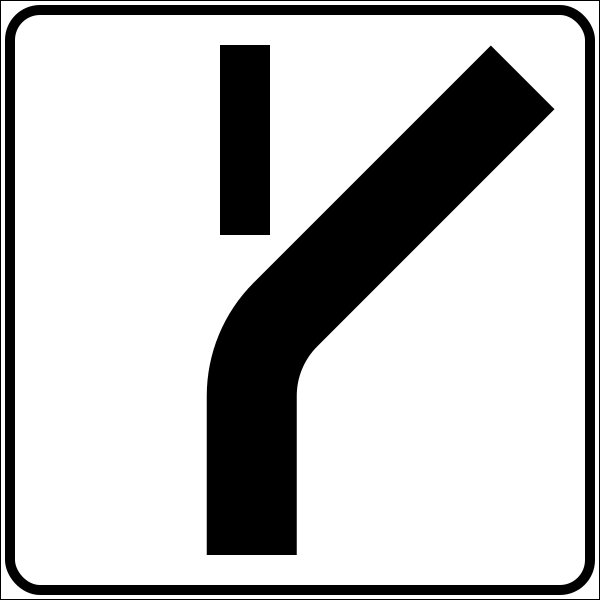
25. What does this traffic sign mean?
This traffic sign shows the shape or layout of an upcoming junction. The diagram indicates how the approaching road and connecting roads are arranged.
English • Model II.7 • Course of the priority road. The thicker line represents the road with priority over the narrower branches. Read the plate together with the priority sign. The plate supplements the main sign and must be read together with it.
Italiano • Modello II.7 • Andamento della strada principale. La striscia più larga rappresenta la strada che gode della precedenza rispetto ai rami più stretti. Il pannello va interpretato insieme al segnale di precedenza. Il pannello integra il segnale principale e deve essere interpretato insieme a esso.
Sources
🔗 Commons.wikimedia.org
🔗 Normattiva.it • D.P.R. 495/1992 • testo vigente • art. 83, comma 11
🔗 Gazzettaufficiale.it • Gazzetta Ufficiale • Modello II.7 • pagina 243
SVG source: Original: Ministero dei Lavori Pubblici Vectorization: Arbalete • Public domain • Original revision 2024-07-12. Wikimedia original unmodified.
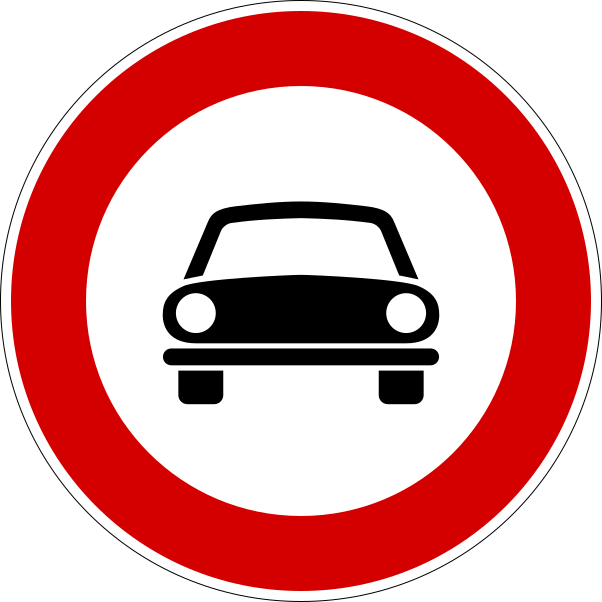
26. What does this traffic sign mean?
This traffic sign indicates that cars are prohibited. Cars may not enter or continue beyond the sign. Other road users may still be permitted unless another restriction applies.
English • Traffic sign II.58 • No motor vehicles other than two-wheeled motorcycles. The prohibition includes three-wheeled motor vehicles and motor quadricycles.
Italiano • Figura II.58 • Transito vietato a tutti gli autoveicoli. Vieta il transito a tutti gli autoveicoli, compresi i motoveicoli a tre ruote e i quadricicli a motore.
Sources
🔗 Commons.wikimedia.org
🔗 Normattiva.it • D.P.R. 495/1992 • testo vigente • art. 117, comma 1(g)
🔗 Gazzettaufficiale.it • Gazzetta Ufficiale • Figura II.58 • pagina 262
SVG source: F l a n k e r • Public domain • Original revision 2023-12-07. Wikimedia original unmodified.
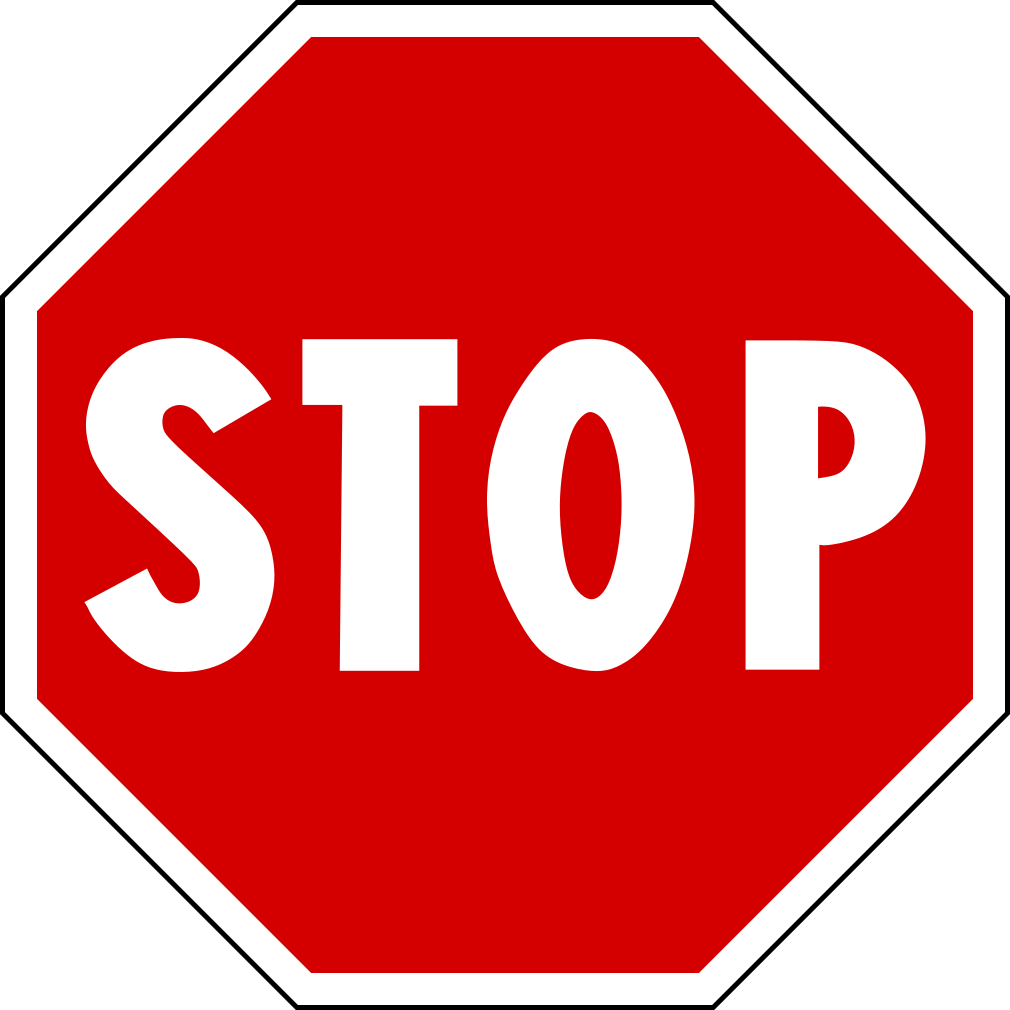
27. What does this traffic sign mean?
This traffic sign means stop and give way. You must come to a complete stop before entering the intersection and give way to traffic that has priority. Proceed only when it is safe.
English • Traffic sign II.37 • Stop and give way. Drivers must stop at the stop line and give way before entering the junction or joining the traffic flow.
Italiano • Figura II.37 • Fermarsi e dare precedenza. Obbliga a fermarsi in corrispondenza della striscia di arresto e a dare la precedenza prima di entrare nell’intersezione o di immettersi nel flusso della circolazione.
Sources
🔗 Commons.wikimedia.org (F l a n k e r • CC BY-SA 3.0)
🔗 Normattiva.it • D.P.R. 495/1992 • testo vigente • art. 107, comma 1
🔗 Gazzettaufficiale.it • Gazzetta Ufficiale • Figura II.37 • pagina 255
Image via Commons.wikimedia.org
F l a n k e r • CC BY-SA 3.0 • Source revision 2025-08-24. Wikimedia original unmodified.
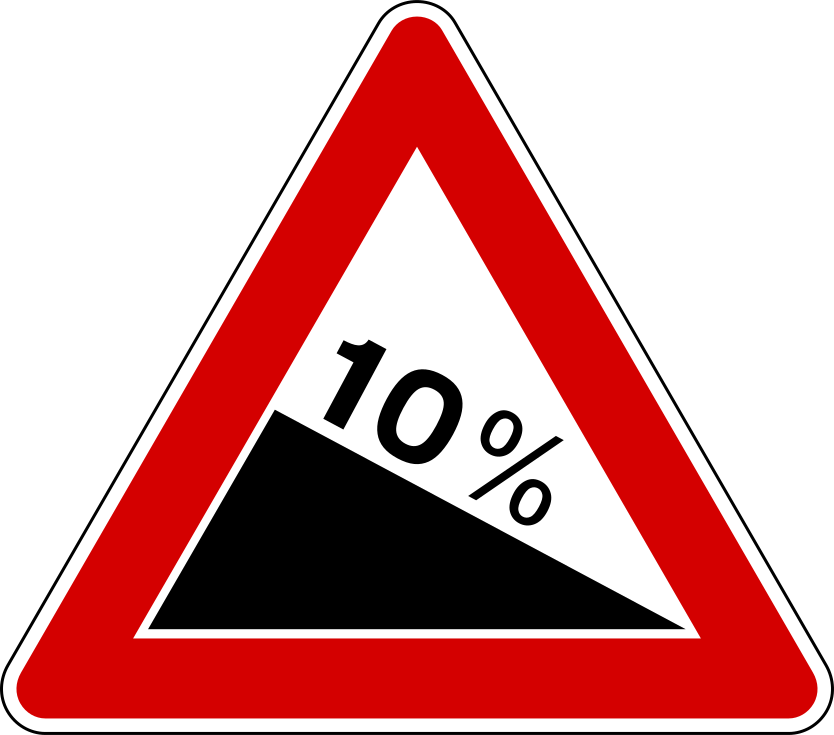
28. What does this traffic sign mean?
This traffic sign indicates a warning for a steep descent. A steep downhill gradient lies ahead and the vehicle may gain speed quickly. Reduce speed before the descent, select a suitable gear and use engine braking where appropriate. Allow extra distance for heavy or towing vehicles.
English • Traffic sign II.15 • Dangerous descent. Warns of a dangerous downhill gradient. The figure gives the gradient as a percentage.
Italiano • Figura II.15 • Discesa pericolosa. Presegnala un tratto con pendenza discendente pericolosa. La cifra esprime la pendenza in percentuale.
Sources
🔗 Commons.wikimedia.org
🔗 Normattiva.it • D.P.R. 495/1992 • testo vigente • art. 89, comma 1–2
🔗 Gazzettaufficiale.it • Gazzetta Ufficiale • Figura II.15 • pagina 249
SVG source: F l a n k e r • Public domain • Original revision 2011-02-05. Wikimedia original unmodified.
Current figure reference verified in Normattiva.it • Normattiva, current article 89.
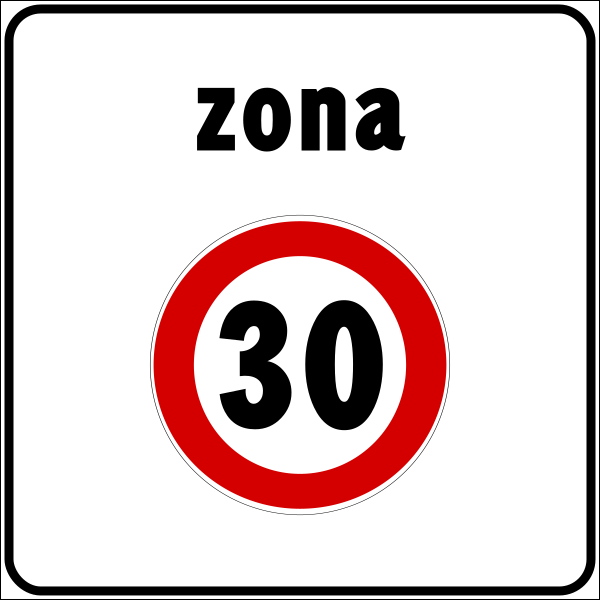
29. What does this traffic sign mean?
This traffic sign indicates the start of a zone with a speed limit. The displayed speed limit applies throughout the zone according to the applicable zonal rules, until the zone is ended or another rule replaces it.
English • Traffic sign II.323/a • Speed limit zone. Marks the beginning of an area where the indicated speed must not be exceeded.
Italiano • Figura II.323/a • Zona a velocità limitata. Indica l’inizio di un’area nella quale non è consentito superare la velocità indicata nel cartello.
Sources
🔗 Commons.wikimedia.org
🔗 Normattiva.it • D.P.R. 495/1992 • testo vigente • art. 135, comma 14
🔗 Normattiva.it • Allegati ufficiali aggiornati • Figura II.323/a
SVG source: Original: Ministero dei Lavori Pubblici Vectorization: Arbalete • Public domain • Original revision 2023-06-19. Wikimedia original unmodified.
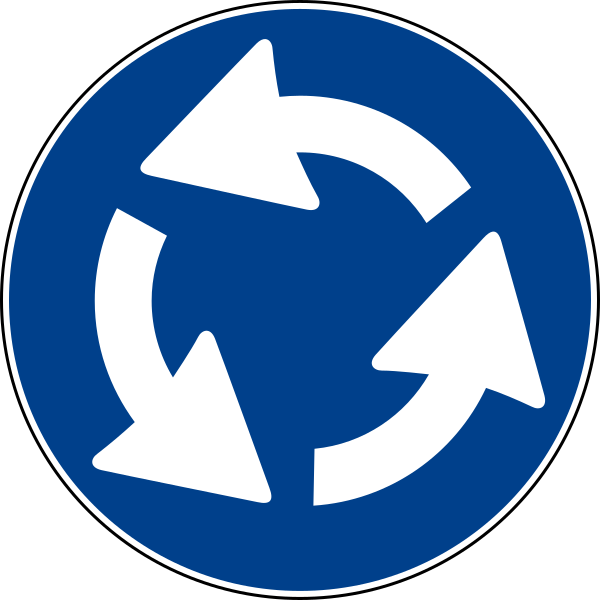
30. What does this traffic sign mean?
This traffic sign indicates the mandatory direction around a roundabout. Traffic must circulate in the direction shown by the arrows. The sign does not itself determine priority; follow the applicable priority signs, traffic signals and local rules.
English • Traffic sign II.84 • Roundabout. Drivers must circulate in the direction shown by the arrows within the roundabout area.
Italiano • Figura II.84 • Rotatoria. Obbliga a circolare nel verso indicato dalle frecce, in corrispondenza dell’area con circolazione rotatoria.
Sources
🔗 Commons.wikimedia.org (F l a n k e r • CC BY-SA 3.0)
🔗 Normattiva.it • D.P.R. 495/1992 • testo vigente • art. 122, comma 6
🔗 Gazzettaufficiale.it • Gazzetta Ufficiale • Figura II.84 • pagina 271
SVG source: F l a n k e r • CC BY-SA 3.0 • Original revision 2010-07-17. Wikimedia original unmodified.
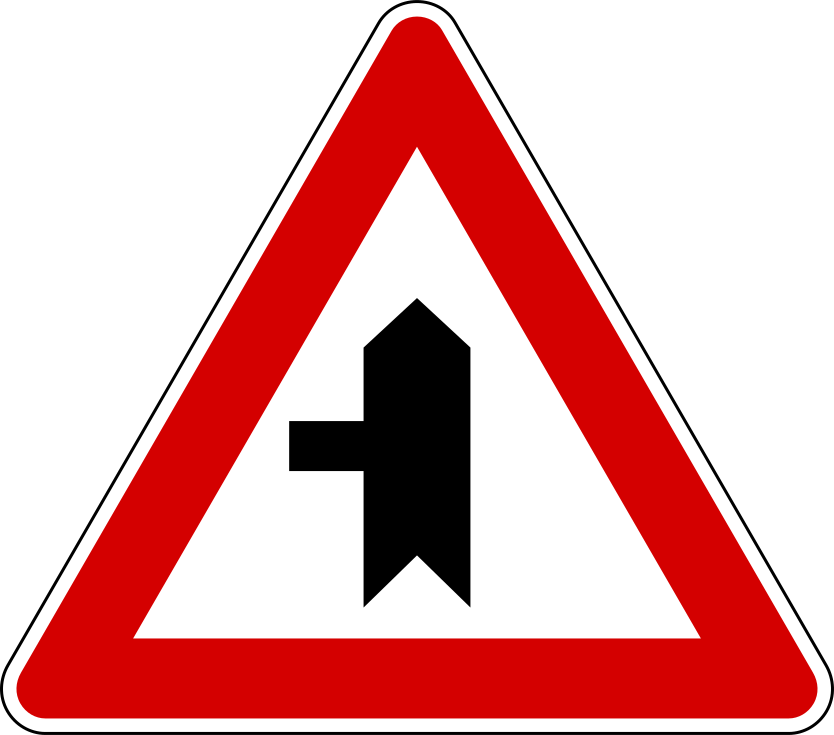
31. What does this traffic sign mean?
This traffic sign indicates that you have priority at the next intersection. A side road joins from the left, and traffic entering from that side road must give way.
English • Traffic sign II.43/c • T-junction with priority. Warns of a non-priority road joining from the left. Vehicles from that road must give way.
Italiano • Figura II.43/c • Intersezione a T con diritto di precedenza. Presegnala un’intersezione con una strada subordinata che si immette da sinistra. I veicoli provenienti dalla strada subordinata devono dare precedenza.
Sources
🔗 Commons.wikimedia.org (F l a n k e r • CC BY-SA 3.0)
🔗 Normattiva.it • D.P.R. 495/1992 • testo vigente • art. 112, comma 2
🔗 Gazzettaufficiale.it • Gazzetta Ufficiale • Figura II.43/c • pagina 257
SVG source: F l a n k e r • CC BY-SA 3.0 • Original revision 2011-02-05. Wikimedia original unmodified.
Current figure reference verified in Normattiva.it • Normattiva, current article 112.
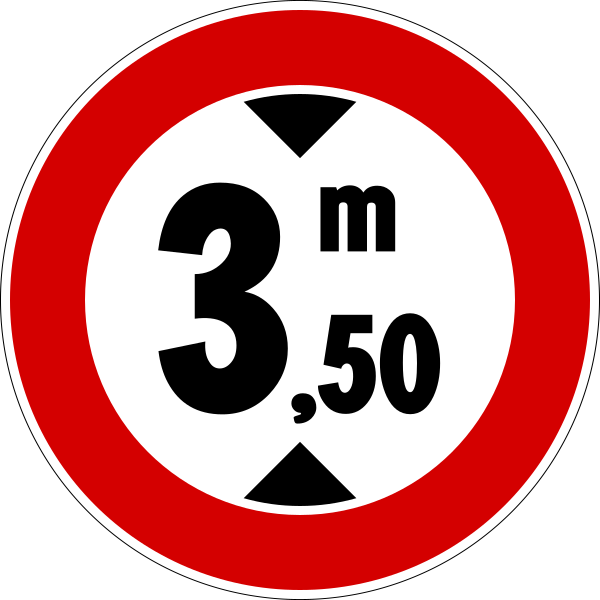
32. What does this traffic sign mean?
This traffic sign indicates that vehicles higher than indicated are prohibited. A vehicle or vehicle combination whose overall height, including its load, exceeds the displayed limit may not continue beyond the sign.
English • Traffic sign II.66 • No vehicles higher than indicated. The prohibition applies where the vehicle's actual overall height at the time of passage exceeds the value shown in metres.
Italiano • Figura II.66 • Transito vietato ai veicoli aventi altezza complessiva superiore a quella indicata. Vieta il transito ai veicoli la cui altezza complessiva effettiva al momento del passaggio supera il valore indicato in metri.
Sources
🔗 Commons.wikimedia.org
🔗 Normattiva.it • D.P.R. 495/1992 • testo vigente • art. 118, comma 1(b), 3
🔗 Gazzettaufficiale.it • Gazzetta Ufficiale • Figura II.66 • pagina 264
SVG source: Original: Ministero dei Lavori Pubblici Vectorization: Arbalete • Public domain • Original revision 2024-09-18. Wikimedia original unmodified.
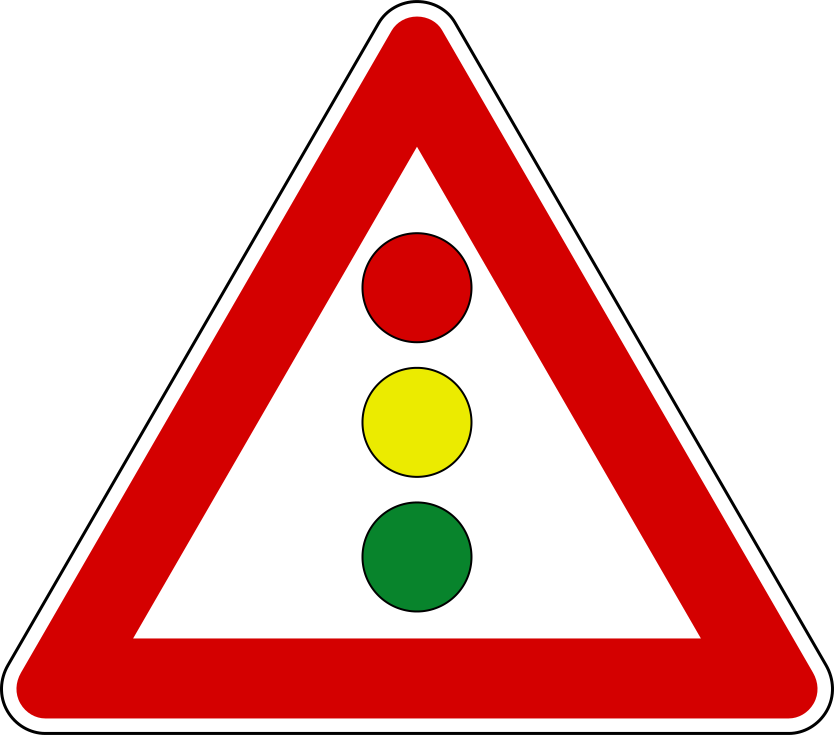
33. What does this traffic sign mean?
This traffic sign indicates a warning for traffic lights ahead. Traffic signals are located ahead and may not be visible early enough without advance warning. Reduce speed and be prepared to stop if the signal requires it.
English • Traffic sign II.31/a • Traffic signals. Warns of signals with the lights arranged vertically.
Italiano • Figura II.31/a • Semaforo. Presegnala un impianto semaforico con le luci disposte verticalmente.
Sources
🔗 Commons.wikimedia.org
🔗 Normattiva.it • D.P.R. 495/1992 • testo vigente • art. 99, comma 1–3
🔗 Gazzettaufficiale.it • Gazzetta Ufficiale • Figura II.31/a • pagina 254
Image via Commons.wikimedia.org
F l a n k e r • Public domain • Source revision 2011-02-05. Wikimedia original unmodified.
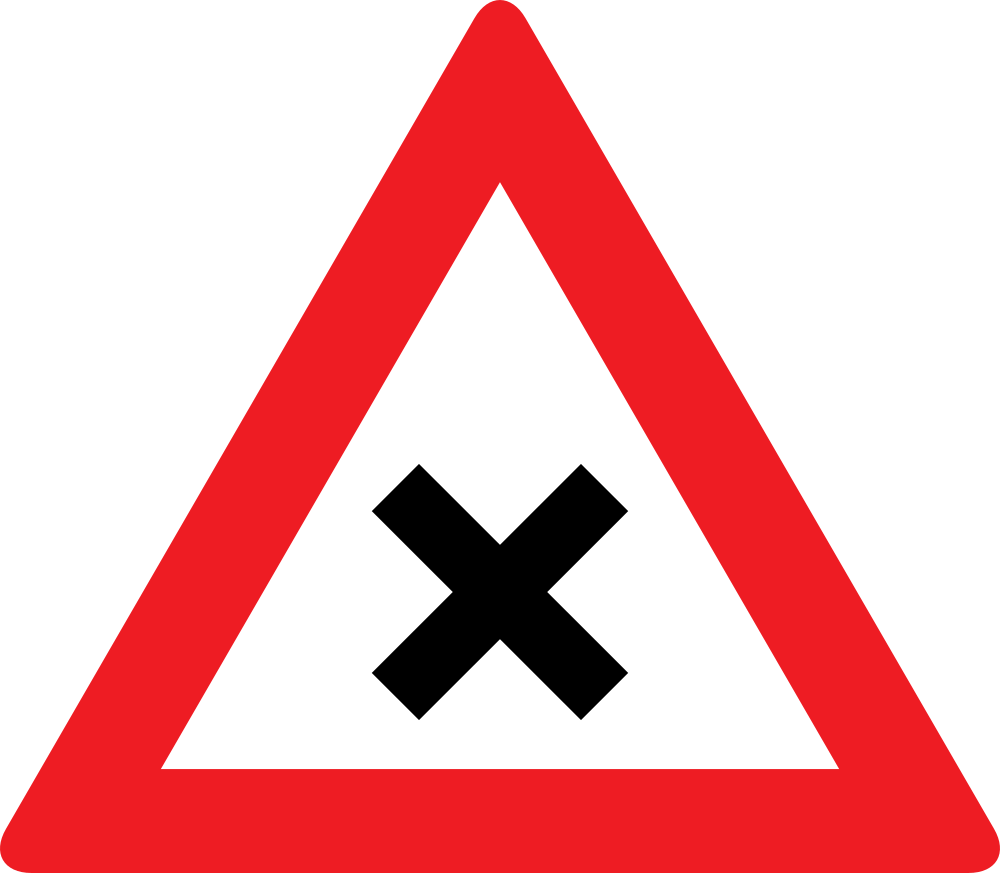
34. What does this traffic sign mean?
This traffic sign indicates a warning for an uncontrolled crossroad. An intersection without traffic signals or signs assigning priority lies ahead. Reduce speed, watch for traffic approaching from other directions and follow the applicable local priority rules.
English • Traffic sign II.40 • Junction with priority to the right. Warns of a junction where the general rule of priority to the right applies.
Italiano • Figura II.40 • Intersezione con precedenza a destra. Presegnala un’intersezione nella quale vige la regola generale della precedenza a destra.
Sources
🔗 Commons.wikimedia.org (F l a n k e r • CC BY-SA 3.0)
🔗 Normattiva.it • D.P.R. 495/1992 • testo vigente • art. 109, comma 1
🔗 Gazzettaufficiale.it • Gazzetta Ufficiale • Figura II.40 • pagina 256
Replacement SVG: Commons.wikimedia.org • Wikimedia Commons original • 3247 • Public domain • Original revision 2006-08-27. Wikimedia original unmodified.
Image via Commons.wikimedia.org
3247 • Public domain • Source revision 2006-08-27. Wikimedia original unmodified.
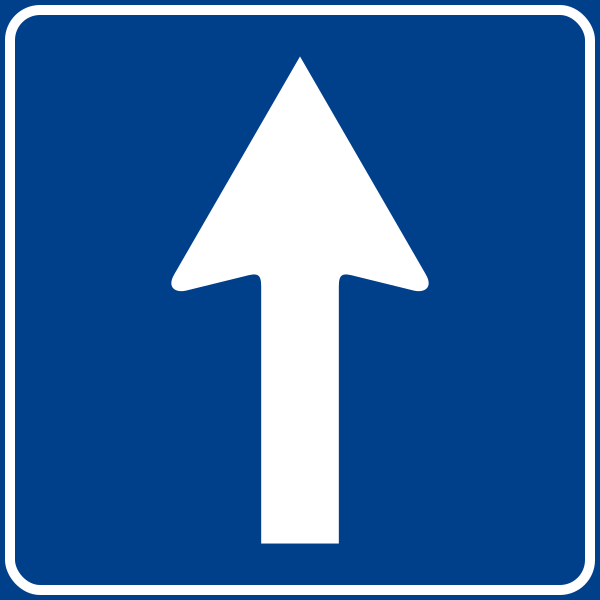
35. What does this traffic sign mean?
This traffic sign indicates a road with one-way traffic. Vehicular traffic may travel only in the permitted direction, subject to any exceptions indicated by traffic signs or local rules.
English • Traffic sign II.349 • One-way road ahead. Indicates that the road is one-way and drivers may use its full width in the indicated direction.
Italiano • Figura II.349 • Senso unico frontale. Indica che la strada è a senso unico e che i conducenti possono utilizzarne l’intera larghezza nel senso indicato.
Sources
🔗 Commons.wikimedia.org
🔗 Normattiva.it • D.P.R. 495/1992 • testo vigente • art. 135, comma 25
🔗 Gazzettaufficiale.it • Gazzetta Ufficiale • Figura II.349 • pagina 322
SVG source: F l a n k e r • Public domain • Original revision 2022-09-21. Wikimedia original unmodified.
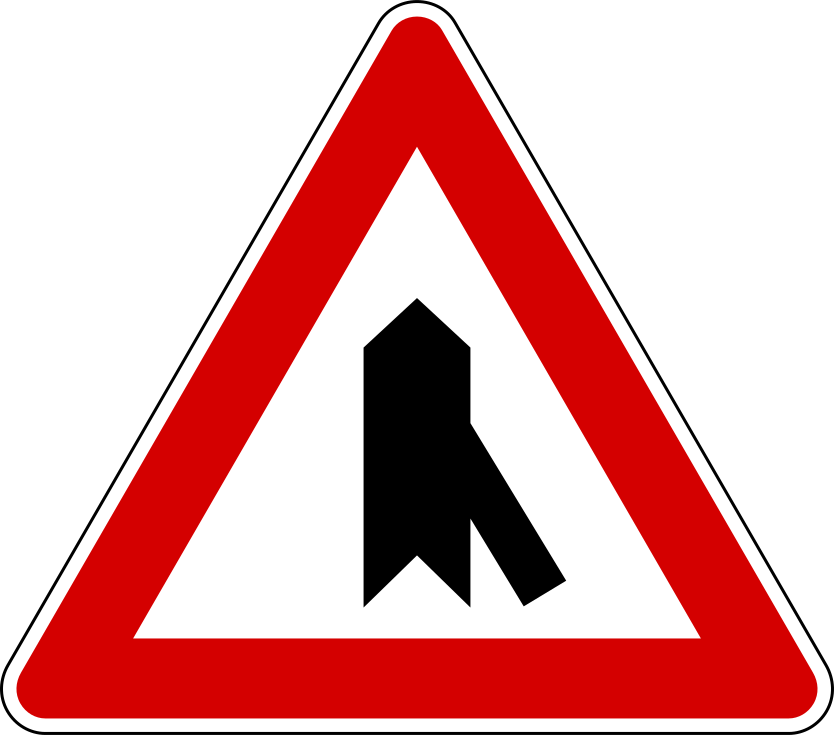
36. What does this traffic sign mean?
This traffic sign indicates a warning for merging traffic from the right. Traffic travelling in the same general direction may join your traffic stream from the right. Stay alert and adjust your speed or position when necessary to allow traffic to merge safely.
English • Traffic sign II.43/d • Merging traffic from the right. Warns of a non-priority road joining via an acceleration lane from the right.
Italiano • Figura II.43/d • Confluenza a destra. Presegnala l’immissione di una strada subordinata con corsia di accelerazione da destra.
Sources
🔗 Commons.wikimedia.org (F l a n k e r • CC BY-SA 3.0)
🔗 Normattiva.it • D.P.R. 495/1992 • testo vigente • art. 112, comma 2
🔗 Gazzettaufficiale.it • Gazzetta Ufficiale • Figura II.43/d • pagina 258
SVG source: F l a n k e r • CC BY-SA 3.0 • Original revision 2011-02-05. Wikimedia original unmodified.
Current figure reference verified in Normattiva.it • Normattiva, current article 112.

37. What does this traffic sign mean?
This traffic sign indicates the end of the mandatory path for cyclists. The requirement associated with the designated path ends at this point. Cyclists must continue according to the road layout, other traffic signs and applicable local rules.
English • Traffic sign II.91 • End of cycle path. Marks the end of the track reserved for cycles.
Italiano • Figura II.91 • Fine pista ciclabile. Indica la fine della pista riservata ai velocipedi.
Sources
🔗 Commons.wikimedia.org
🔗 Normattiva.it • D.P.R. 495/1992 • testo vigente • art. 122, comma 10
🔗 Gazzettaufficiale.it • Gazzetta Ufficiale • Figura II.91 • pagina 273
🔗 Normattiva.it • D.P.R. 495/1992 • allegati e successive modifiche
Replacement SVG: Commons.wikimedia.org • Wikimedia Commons original • Gigillo83 • CC BY-SA 3.0 • Original revision 2014-10-02. Wikimedia original unmodified.
Image via Commons.wikimedia.org
Gigillo83 • CC BY-SA 3.0 • Source revision 2014-10-02. Wikimedia original unmodified.
38. What does this traffic sign mean?
This traffic sign indicates a warning for low-flying aircraft. Aircraft may pass over the road at low altitude and can create sudden noise or visual distraction. Keep your attention on the road and maintain control of the vehicle.
English • Traffic sign II.32 • Aircraft. Warns of possible sudden loud noises or dazzling from low-flying aircraft near airfields or landing grounds.
Italiano • Figura II.32 • Aeromobili. Presegnala la possibilità di rumori improvvisi e forti o di abbagliamenti causati da aeromobili a bassa quota, in prossimità di aerodromi o aviosuperfici.
Sources
🔗 Commons.wikimedia.org
🔗 Normattiva.it • D.P.R. 495/1992 • testo vigente • art. 100, comma 1
🔗 Gazzettaufficiale.it • Gazzetta Ufficiale • Figura II.32 • pagina 254
SVG source: F l a n k e r • Public domain • Original revision 2011-02-05. Wikimedia original unmodified.
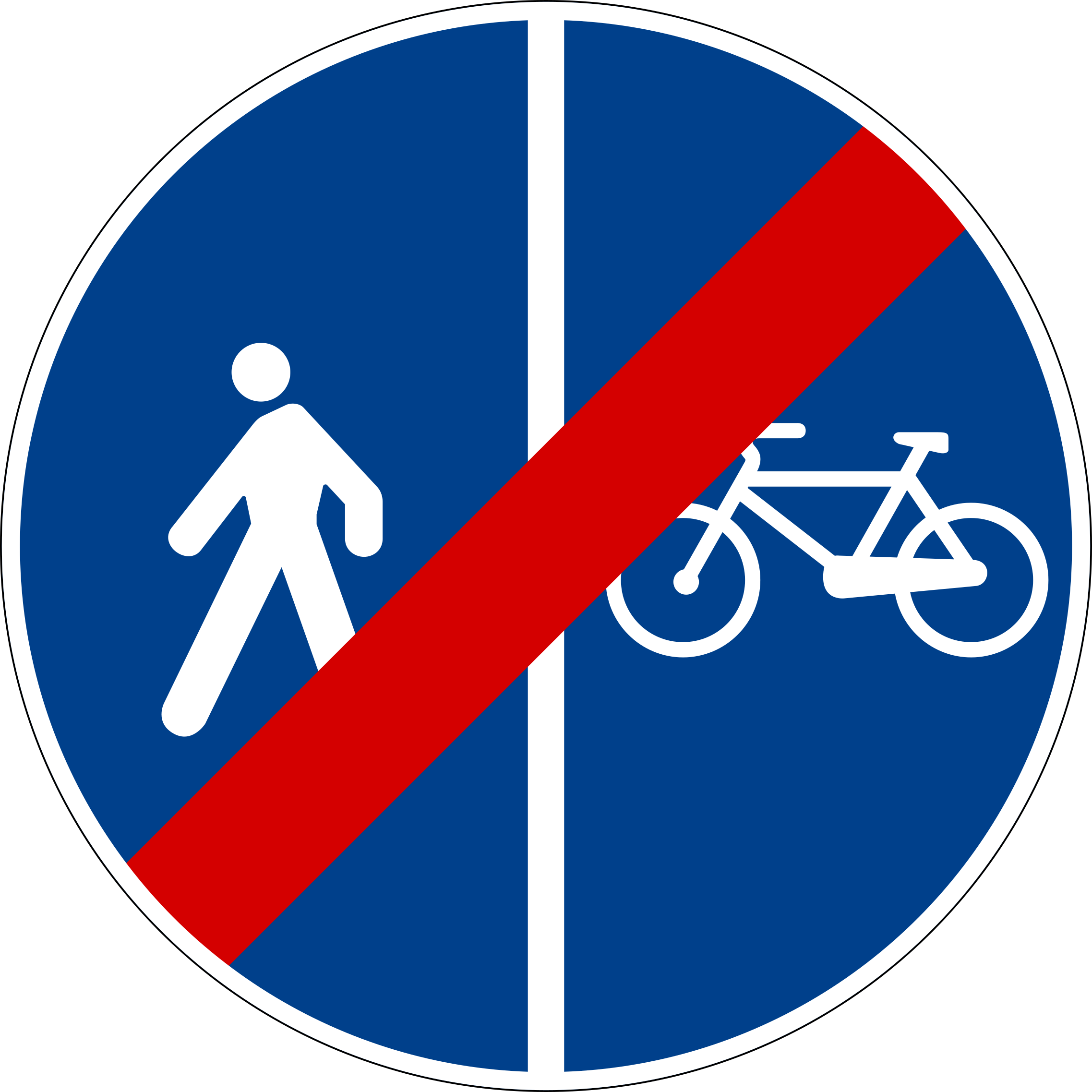
39. What does this traffic sign mean?
This traffic sign indicates the end of the mandatory divided path for pedestrians and cyclists. The requirement to use the separately designated sections ends at this point. Continue according to the subsequent path or road layout and applicable local rules.
English • Traffic sign II.93/a • End of cycle path alongside a pavement. Marks the end of the adjoining cycle path.
Italiano • Figura II.93/a • Fine pista ciclabile contigua al marciapiede. Indica la fine della pista ciclabile contigua al marciapiede.
Sources
🔗 Commons.wikimedia.org
🔗 Normattiva.it • D.P.R. 495/1992 • testo vigente • art. 122, comma 10
🔗 Gazzettaufficiale.it • Gazzetta Ufficiale • Figura II.93/a • pagina 274
🔗 Normattiva.it • D.P.R. 495/1992 • allegati e successive modifiche
SVG source: F l a n k e r • Public domain • Original revision 2026-06-15. Wikimedia original unmodified.
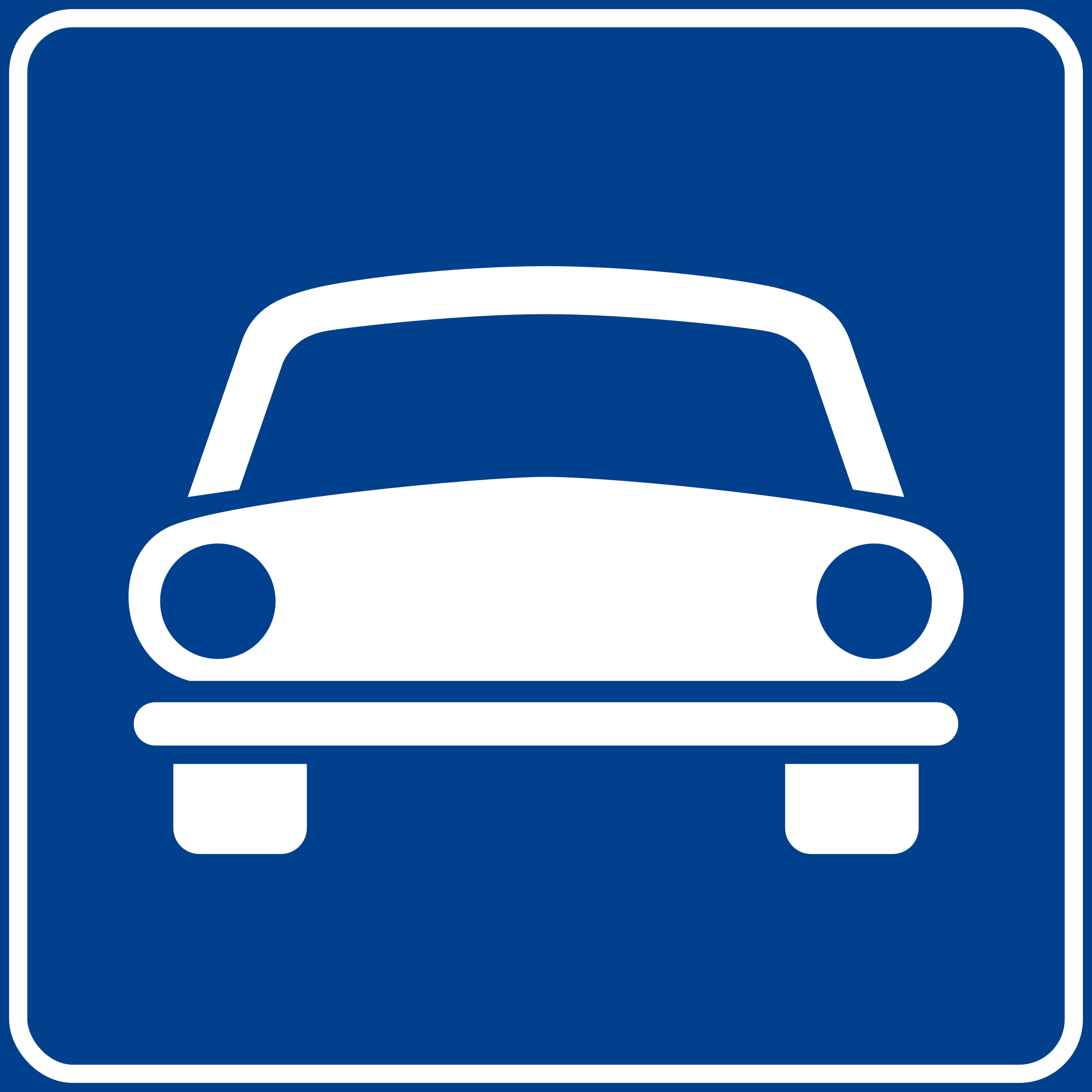
40. What does this traffic sign mean?
This traffic sign indicates the start of an expressway. From this point, the traffic rules and access conditions that apply to expressways take effect according to the applicable local regulations.
English • Traffic sign II.314 • Road reserved for motor vehicles. Marks the beginning of a road other than a motorway reserved for motor vehicles, on which the same traffic rules as on motorways apply.
Italiano • Figura II.314 • Strada riservata ai veicoli a motore. Indica l’inizio di una strada diversa dall’autostrada riservata ai veicoli a motore, nella quale si osservano le stesse norme che regolano la circolazione sulle autostrade.
Sources
🔗 Commons.wikimedia.org
🔗 Normattiva.it • D.P.R. 495/1992 • testo vigente • art. 135, comma 9
🔗 Gazzettaufficiale.it • Gazzetta Ufficiale • Figura II.314 • pagina 314
SVG source: F l a n k e r • Public domain • Original revision 2023-06-30. Wikimedia original unmodified.
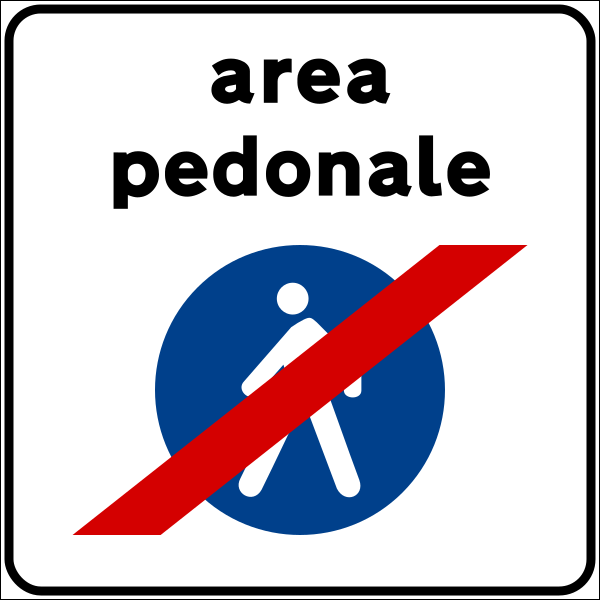
41. What does this traffic sign mean?
This traffic sign indicates the end of the pedestrian zone. The special traffic rules associated with the pedestrian zone end at this point. Follow the traffic signs and rules that apply beyond the zone.
English • Traffic sign II.321 • End of pedestrian area. Marks the exit from the previously signposted pedestrian area.
Italiano • Figura II.321 • Fine area pedonale. Indica l’uscita dall’area pedonale precedentemente segnalata.
Sources
🔗 Commons.wikimedia.org
🔗 Normattiva.it • D.P.R. 495/1992 • testo vigente • art. 135, comma 13
🔗 Normattiva.it • Allegati ufficiali aggiornati • Figura II.321
Image via Commons.wikimedia.org
Official design: Ministero dei Lavori Pubblici; vectorisation: Arbalete; incorporated elements by Pav03 • CC BY-SA 4.0 • Source revision 2024-09-15. Wikimedia original unmodified.
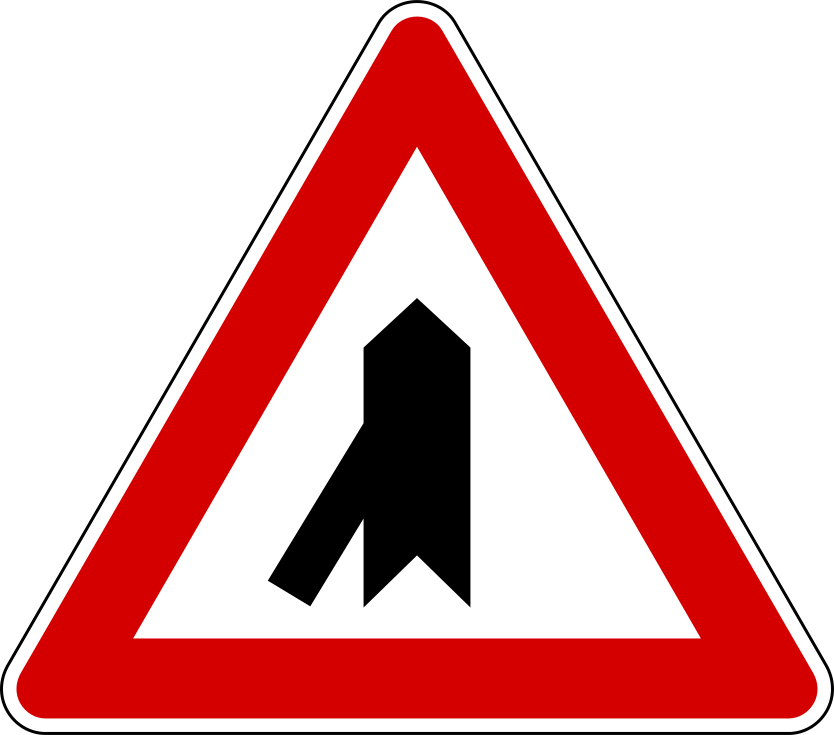
42. What does this traffic sign mean?
This traffic sign indicates a warning for merging traffic from the left. Traffic travelling in the same general direction may join your traffic stream from the left. Stay alert and adjust your speed or position when necessary to allow traffic to merge safely.
English • Traffic sign II.43/e • Merging traffic from the left. Warns of a non-priority road joining via an acceleration lane from the left.
Italiano • Figura II.43/e • Confluenza a sinistra. Presegnala l’immissione di una strada subordinata con corsia di accelerazione da sinistra.
Sources
🔗 Commons.wikimedia.org (F l a n k e r • CC BY-SA 3.0)
🔗 Normattiva.it • D.P.R. 495/1992 • testo vigente • art. 112, comma 2
🔗 Gazzettaufficiale.it • Gazzetta Ufficiale • Figura II.43/e • pagina 258
SVG source: F l a n k e r • CC BY-SA 3.0 • Original revision 2011-02-05. Wikimedia original unmodified.
Current figure reference verified in Normattiva.it • Normattiva, current article 112.
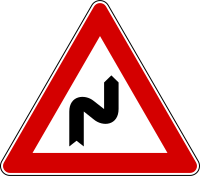
43. What does this traffic sign mean?
This traffic sign indicates a warning for successive curves, with the first curve to the right. Reduce speed before entering the winding section, maintain your lane position and be prepared for further changes in direction.
English • Traffic sign II.6 • Double bend, first to the right. Warns of a dangerous double bend, first to the right. A supplementary plate may show the length of a series of bends.
Italiano • Figura II.6 • Doppia curva, la prima a destra. Presegnala una doppia curva pericolosa, la prima a destra. Una serie di curve può essere indicata con un pannello che riporta la lunghezza del tratto.
Sources
🔗 Commons.wikimedia.org
🔗 Normattiva.it • D.P.R. 495/1992 • testo vigente • art. 86, comma 1–2
🔗 Gazzettaufficiale.it • Gazzetta Ufficiale • Figura II.6 • pagina 246
SVG source: F l a n k e r • Public domain • Original revision 2011-02-05. Wikimedia original unmodified.
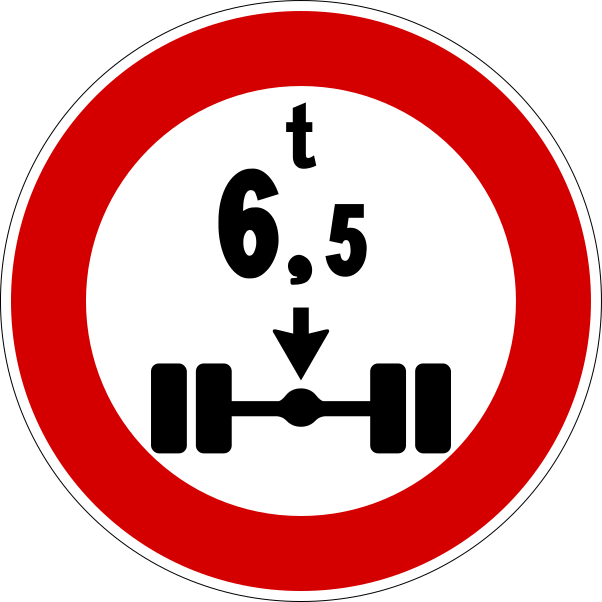
44. What does this traffic sign mean?
This traffic sign indicates that vehicles exceeding the indicated axle-load limit are prohibited. A vehicle whose load on an axle exceeds the displayed limit may not continue beyond the sign.
English • Traffic sign II.69 • No vehicles with an axle load exceeding the indicated value. The prohibition applies where the actual load on the most heavily loaded axle exceeds the value shown in tonnes.
Italiano • Figura II.69 • Transito vietato ai veicoli aventi massa per asse superiore a quella indicata. Vieta il transito ai veicoli la cui massa effettiva sull’asse più caricato supera il valore indicato in tonnellate.
Sources
🔗 Commons.wikimedia.org
🔗 Normattiva.it • D.P.R. 495/1992 • testo vigente • art. 118, comma 1(e), 3
🔗 Gazzettaufficiale.it • Gazzetta Ufficiale • Figura II.69 • pagina 265
Image via Commons.wikimedia.org
F l a n k e r • Public domain • Source revision 2024-01-13. Wikimedia original unmodified.
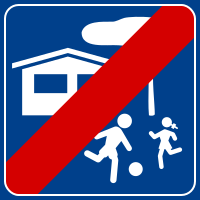
45. What does this traffic sign mean?
This traffic sign indicates the end of the residential area. The special traffic rules associated with the residential area end at this point. Follow the traffic signs and rules that apply beyond the area.
English • Traffic sign II.319 • End of residential area. Marks the exit from the previously signposted residential area.
Italiano • Figura II.319 • Fine zona residenziale. Indica l’uscita dalla zona residenziale precedentemente segnalata.
Sources
🔗 Commons.wikimedia.org
🔗 Normattiva.it • D.P.R. 495/1992 • testo vigente • art. 135, comma 12
🔗 Gazzettaufficiale.it • Gazzetta Ufficiale • Figura II.319 • pagina 315
Image via Commons.wikimedia.org
F l a n k e r • Public domain • Source revision 2014-03-29. Wikimedia original unmodified.
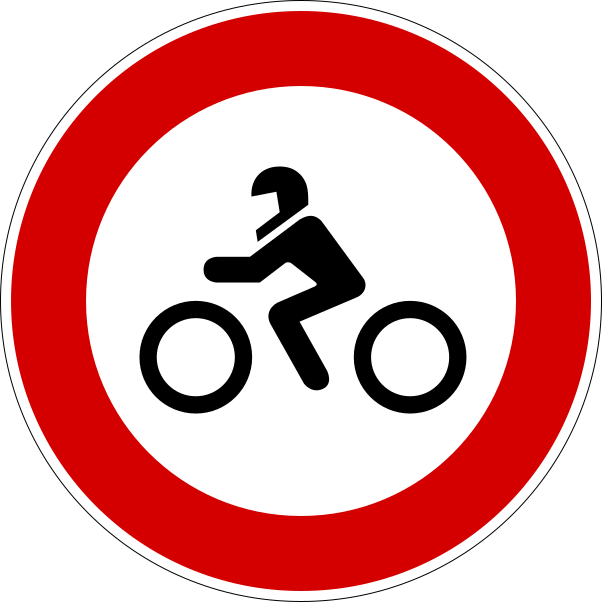
46. What does this traffic sign mean?
This traffic sign indicates that motorcycles are prohibited. Motorcyclists may not enter or continue beyond the sign. Other road users may still be permitted unless another restriction applies.
English • Traffic sign II.56 • No motorcycles. Motorcycles are prohibited.
Italiano • Figura II.56 • Transito vietato ai motocicli. Vieta il transito ai motocicli.
Sources
🔗 Commons.wikimedia.org
🔗 Normattiva.it • D.P.R. 495/1992 • testo vigente • art. 117, comma 1(e)
🔗 Gazzettaufficiale.it • Gazzetta Ufficiale • Figura II.56 • pagina 261
SVG source: F l a n k e r • Public domain • Original revision 2024-01-13. Wikimedia original unmodified.
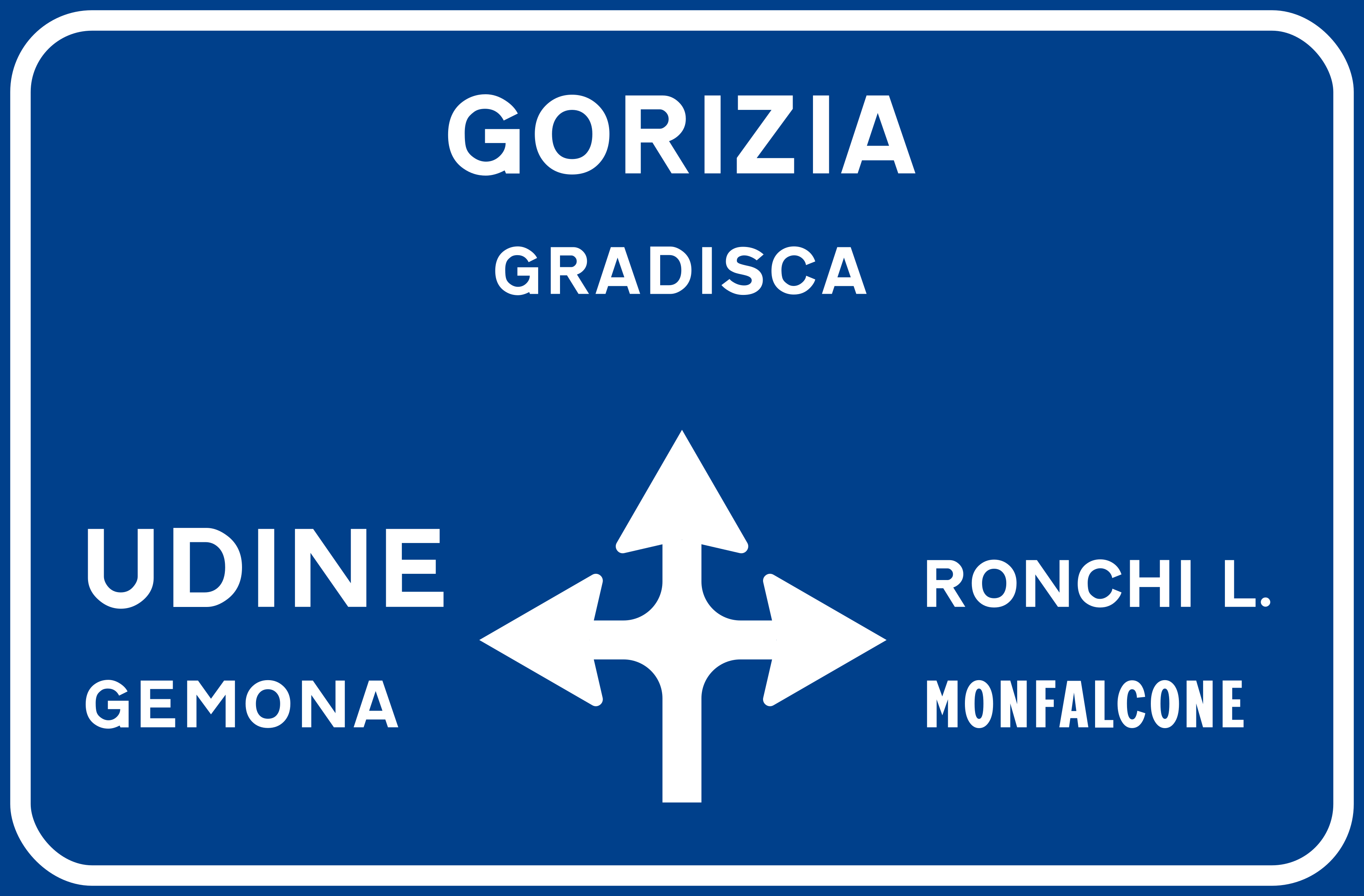
47. What does this traffic sign mean?
This traffic sign shows the junction layout, directions and destinations. The diagram shows how the roads are arranged and which direction leads to each indicated destination or route.
English • Traffic sign II.234 • Advance junction sign outside built-up areas. Shows the junction layout and the places reachable via its branches.
Italiano • Figura II.234 • Preavviso di intersezione extraurbana. Preavvisa la configurazione dell’intersezione e indica le località raggiungibili attraverso i diversi rami.
Sources
🔗 Commons.wikimedia.org
🔗 Normattiva.it • D.P.R. 495/1992 • testo vigente • art. 127, comma 2
🔗 Gazzettaufficiale.it • Gazzetta Ufficiale • Figura II.234 • pagina 292
SVG source: Original: Ministero dei Lavori Pubblici Vectorization: Arbalete • Public domain • Original revision 2024-05-14. Wikimedia original unmodified.
Current figure reference verified in Normattiva.it • Normattiva, current article 127.
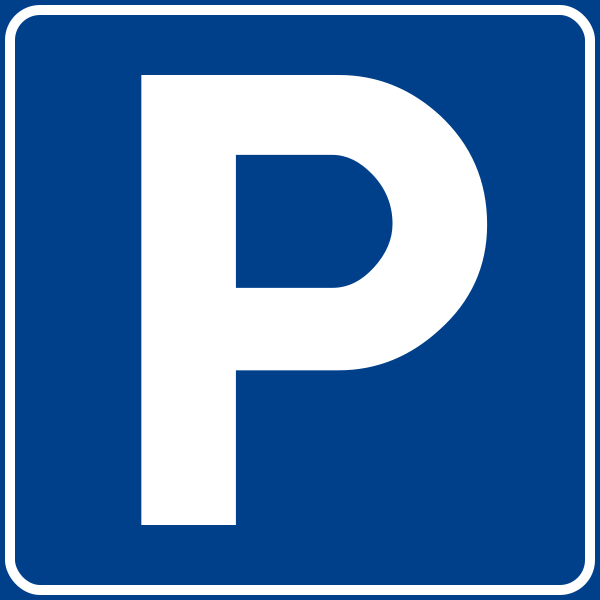
48. What does this traffic sign mean?
This traffic sign indicates that parking is allowed. Vehicles may be parked in the area covered by the sign subject to any indicated conditions, restrictions or local parking rules.
English • Traffic sign II.76 • Car park. Marks an organised or equipped parking area with no time limit unless otherwise indicated. Plates may specify times, charges, vehicle positioning and permitted or excluded categories.
Italiano • Figura II.76 • Parcheggio. Indica un’area organizzata o attrezzata per la sosta, senza limite di tempo salvo diversa indicazione. I pannelli possono stabilire tempi, tariffe, disposizione dei veicoli e categorie ammesse o escluse.
Sources
🔗 Commons.wikimedia.org
🔗 Normattiva.it • D.P.R. 495/1992 • testo vigente • art. 120, comma 1(c)
🔗 Gazzettaufficiale.it • Gazzetta Ufficiale • Figura II.76 • pagina 267
SVG source: Original: Ministero dei Lavori Pubblici Vectorization: Arbalete • Public domain • Original revision 2024-07-13. Wikimedia original unmodified.
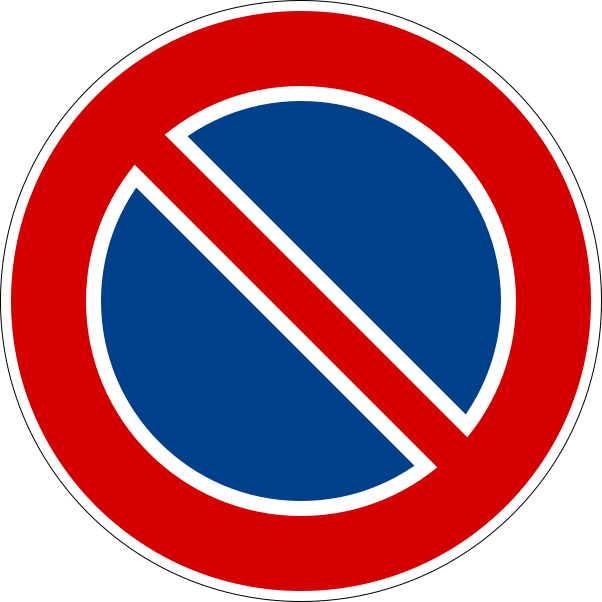
49. What does this traffic sign mean?
This traffic sign indicates that parking is prohibited. Vehicles may not be parked in the area covered by the sign unless an exception applies. Brief stopping to pick up or drop off passengers or to load or unload goods may still be permitted where local rules allow it.
English • Traffic sign II.74 • No parking. Without supplementary information, the prohibition is permanent outside built-up areas and applies from 8 to 20 h on urban roads. Plates may specify times, categories or street-cleaning operations.
Italiano • Figura II.74 • Divieto di sosta. Indica il divieto di sosta. In assenza di indicazioni integrative è permanente sulle strade extraurbane; sulle strade urbane vale dalle ore 8 alle ore 20. I pannelli possono precisare tempi, categorie o operazioni di pulizia.
Sources
🔗 Commons.wikimedia.org
🔗 Normattiva.it • D.P.R. 495/1992 • testo vigente • art. 120, comma 1(a)
🔗 Gazzettaufficiale.it • Gazzetta Ufficiale • Figura II.74 • pagina 266
SVG source: F l a n k e r • Public domain • Original revision 2024-01-14. Wikimedia original unmodified.
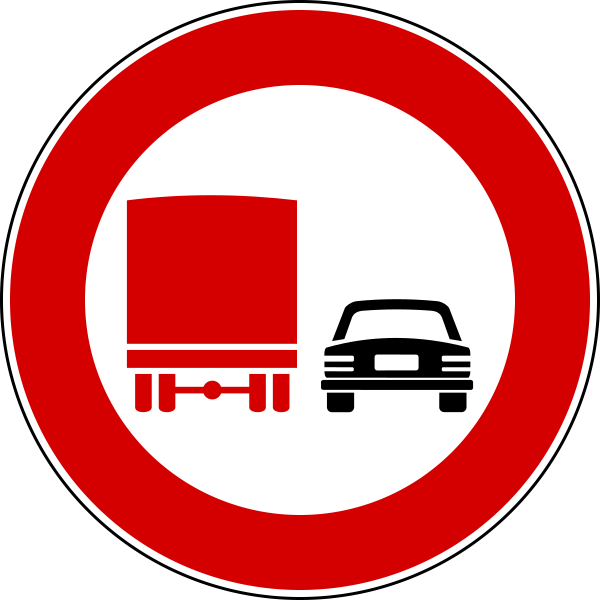
50. What does this traffic sign mean?
This traffic sign indicates that overtaking is prohibited for trucks. Trucks covered by the sign may not overtake where the prohibition applies. The affected truck categories and any exceptions depend on the applicable local rules.
English • Traffic sign II.52 • No overtaking by vehicles with a fully laden mass exceeding 3.5 t. Vehicles not used for passenger transport whose fully laden mass recorded in the registration document exceeds 3.5 t must not overtake motor vehicles. Non-motorised vehicles may be overtaken only within the driver's own half of the carriageway. A supplementary plate may specify a different mass.
Italiano • Figura II.52 • Divieto di sorpasso per i veicoli di massa a pieno carico superiore a 3,5 t. Vieta di sorpassare veicoli a motore ai veicoli non adibiti al trasporto di persone con massa a pieno carico superiore a 3,5 t indicata nella carta di circolazione. Il sorpasso di veicoli senza motore è consentito soltanto entro la propria semicarreggiata. Un pannello può precisare una massa diversa.
Sources
🔗 Commons.wikimedia.org
🔗 Normattiva.it • D.P.R. 495/1992 • testo vigente • art. 117, comma 1(a)
🔗 Gazzettaufficiale.it • Gazzetta Ufficiale • Figura II.52 • pagina 260
SVG source: F l a n k e r • Public domain • Original revision 2010-07-17. Wikimedia original unmodified.