RichtungstafelWallonien

Lerne Verkehrsregeln mit klaren Erklärungen und visuellen Beispielen in unserem illustrierten Buch – einfach, verständlich und anschaulich.


33. Richtungstafel

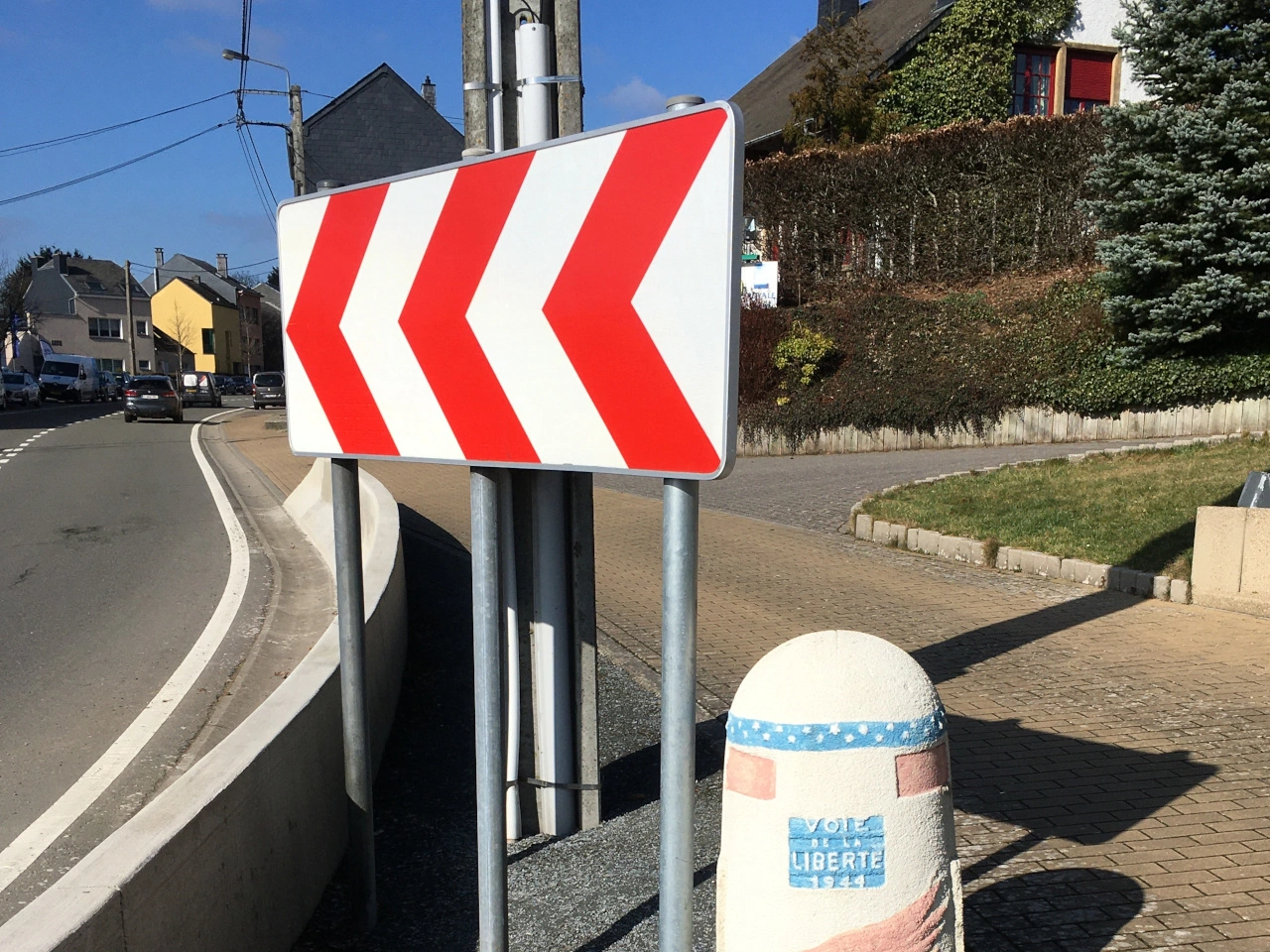
Eine Richtungstafel ist eine V- oder pfeilförmige Straßenmarkierung bzw. Tafel, die eine starke Richtungsänderung der Straße hervorhebt. Solche Tafeln stehen normalerweise entlang der Außenseite einer Kurve, wobei ihre Spitzen in die Richtung zeigen, in der die Straße weiterführt.

Richtungstafeln verbessern Sichtbarkeit und Verlauf einer Kurve, insbesondere bei Dunkelheit oder schlechtem Wetter. Sie legen normalerweise weder eine Geschwindigkeitsbegrenzung noch Vorfahrt fest; Fahrer müssen daher vor der Kurve die Geschwindigkeit verringern und alle übrigen Verkehrszeichen und Fahrbahnmarkierungen beachten.
Richtungstafel
What is a chevron board in Belgium?

A Belgian chevron board is a rectangular road-alignment panel displaying a large red chevron on a contrasting light background. It helps drivers follow the direction of a curve.

Which direction does a Belgian chevron point?

The point of the red chevron indicates the direction in which the curve continues. A left-pointing chevron marks a curve to the left and a right-pointing chevron marks a curve to the right.

Is a Belgian chevron an official A1 curve-warning sign?

No. The official dangerous-curve warning signs are A1a, A1b, A1c and A1d. Chevron boards are road-alignment devices used to make the curve itself more visible.

What is the difference between A1 and chevron boards?

An A1 sign warns before the dangerous curve. Chevron boards are placed in or around the curve to show its alignment and guide drivers while they negotiate it.

Do Belgian chevrons have a traffic-sign number?

No separate Highway Code number is assigned to them like A1a or A1b. They are technical road-signing and delineation equipment installed by the road authority.

Where are Belgian chevrons placed?

They are normally positioned along the outside of the curve so that approaching drivers can clearly see the direction of the road.

Must the first chevrons be visible before the curve?

Yes. Belgian regional guidance recommends that the first chevrons be visible while drivers are still approaching the curve.

Are chevrons normally repeated throughout the curve?

Yes. They generally guide drivers along the full length of the curve and continue towards its exit, unless the danger is limited to only part of it.

What is a single-chevron board?

A single-chevron board displays one large chevron. Several individual boards may be spaced along the curve to trace its alignment.

What is a multiple-chevron board?

A multiple-chevron board displays several chevrons on one longer panel. In Belgian regional practice, these are used less frequently than separate single-chevron boards.

When may a multiple-chevron board be useful?

It may be useful at a short curve, beside a particular obstacle or immediately before a critical tightening of the curve.

Does the spacing between Belgian chevrons remain constant?

Not always. Their spacing depends on the radius and layout of the curve. Sharper curves may require the boards to be placed closer together.

How large are Belgian single-chevron boards?

The normal basic format used in Walloon technical guidance is approximately 900 × 900 mm. Smaller formats may be used on lower-speed roads, inside built-up areas or where available space is limited.

Can Belgian chevrons have a fluorescent border?

Yes. On a particularly high-risk curve, a fluorescent yellow surround may be used to increase their visibility.

Can Belgian chevrons be illuminated?

Yes. Illuminated chevrons may be used as an additional measure at curves with a significant safety risk.

Do Belgian chevrons impose a speed limit?

No. They guide drivers through the curve. Only an applicable C43 sign, speed zone or general road rule establishes the legal maximum speed.

Must you still reduce speed?

Yes, when necessary. Belgian drivers must adapt their speed to the road layout, visibility, weather, traffic and vehicle condition and remain able to stop before a foreseeable obstruction.

Do chevrons give you priority?

No. They do not change priority at an intersection or against oncoming traffic.

May you cross a continuous centre line beside chevrons?

No. Drivers may not cross a continuous white line or drive to its left when it separates opposing directions of traffic.

May you overtake in a curve marked by chevrons?

Specified left-side overtaking is prohibited when visibility in the curve is insufficient. The chevrons themselves do not create the prohibition, but they often identify a location where overtaking would be unsafe.

May you stop or park in a chevron-marked curve?

Stopping and parking on the carriageway are prohibited where visibility in the curve is insufficient. A vehicle may also not create danger or unnecessary obstruction.

How should motorcyclists follow Belgian chevrons?

Look through the curve, select a suitable speed beforehand and maintain a stable line. Both the rider and motorcycle must remain within the correct part of the carriageway.

Does a chevron show the exact shape of the curve?

No. It provides directional guidance. Drivers must still observe the road because the curve may tighten, open out or change gradient.

Will Belgium’s new road code change the meaning of chevrons?

Chevron boards remain road-alignment equipment rather than a separate numbered regulatory sign. The general obligations to adapt speed, remain within the correct road position and obey curve signs and markings continue to apply.

1 Wallonien 2 Autobahn 3 Schnellstraße 4 Wohngebiet 5 Geschlossene Ortschaft 6 Zone 7 Geschwindigkeitsbegrenzung 8 Radweg 9 Fahrradstraße 10 Fußgängerzone 11 Bremsschwelle 12 Zoll 13 Einbahnverkehr 14 Kaianlage 15 Steigung oder Gefälle 16 Busspur 17 Sackgasse 18 Stoppschild 19 Vorfahrt gewähren 20 Kreisverkehr 21 Vorfahrtstraße 22 Fahrbahnverengung 23 Vorrang vor dem Gegenverkehr 24 Gegenverkehr Vorrang gewähren 25 Fußgängerüberweg 26 Bahnübergang 27 Vorgeschriebene Fahrtrichtung 28 Abbiegeverbot 29 Schulbereich 30 Wild- oder Viehwechsel 31 Steinschlag 32 Kurve 33 Richtungstafel 34 Falschfahrt 35 Straßenarbeiten 36 Höhenbegrenzung 37 Breitenbegrenzung 38 Gewichtsbeschränkung 39 Geschwindigkeitskontrolle 40 Selektive Sperren 41 Wegweiser an einer Kreuzung 42 Vorfahrt an der nächsten Kreuzung 43 Ampeln 44 Fußgängerampeln 45 Führerschein 46 Kilometrierungsmarkierung 47 Verkehrsspiegel 48 Staatsgrenze 49 Radroute 50 Parken 51 Parkverbot 52 Kiss and Ride 53 Parkuhr 54 Verkehrsmanagement 55 Rückwärtsfahren 56 Ungeregelte Kreuzung 57 Fahrbahnschäden 58 Ringstraße 59 Radschnellweg 60 Kennzeichen 61 Ladestation 62 Allgemeine Gefahr 63 Abbiegen bei Rot 64 Personalausweis 65 Brandgefahr 66 Fußgänger 67 Moped 68 Pkw 69 Lkw 70 Bus 71 Polizei 72 Krankenwagen 73 Straßenbahnsignale 74 Europäische Abgasnorm 75 Schlagloch 76 Platz 77 Weg 78 Feinstaub 79 Luftverschmutzung 80 Hauptverkehrszeit 81 Straßenverkehrsordnung 82 Straßenrinne 83 Lastenfahrrad 84 Forstfahrzeug 85 Baufahrzeug 86 Sattelzug 87 Oberleitungsbus 88 Speed-Pedelec 89 Lieferfahrzeug 90 Leerlauf 91 Abschleppwagen 92 Allradantrieb 93 Verbot für Fahrzeuge 94 Fahrrad 95 Motorradausrüstung 96 Triebwagen 97 Gleis 98 Öffentlicher Verkehr 99 Wohnwagen 100 Anhänger ...