


Residential areaAustria
 Traffic rules
 Austria
4. Residential area
A residential area is a street or group of streets where housing and access to local properties are the main functions. Drivers should expect pedestrians, cyclists, children, parked vehicles and vehicles entering or leaving driveways.
Some countries identify particular residential areas with traffic signs and apply special low-speed and residential-area rules. The speed limit, pedestrian rights, parking rules and permitted road users therefore depend on local signs and regulations.
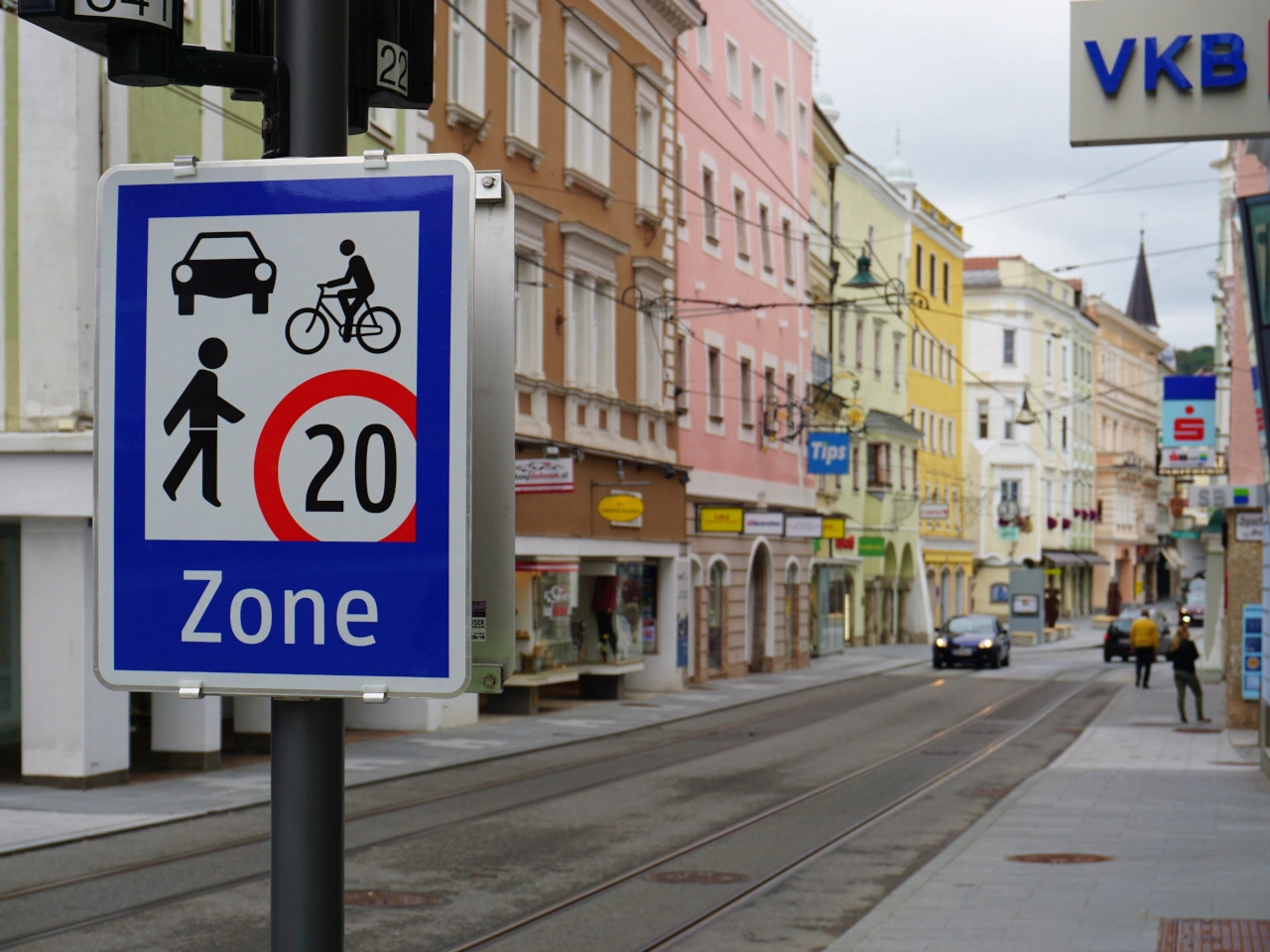
🔗 Sources
Image credit: Wikimedia.org • Simon Legner • CC BY-SA
How do people refer to a residential area in Austria?
A specially signposted residential street is a Wohnstraße. A Begegnungszone is a separate signed category with different speed and through-traffic rules.
🔗 ris.bka.gv.at • Austrian RIS, StVO — sections 76b–76c
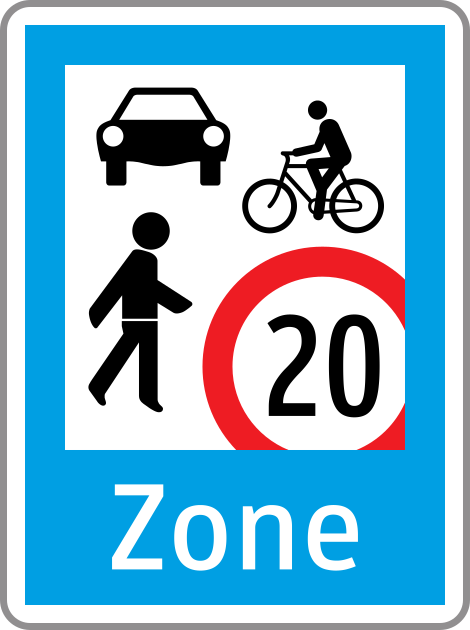 Start of a residential area.
Traffic sign StVO § 53 Z 9e • Residential area. The sign indicates the beginning of a residential area where the special provisions of section 76c apply. If the maximum permitted speed has been increased to 30 km/h under section 76c(6), the number 20 on the sign must be replaced by 30.
Sources
🔗 Commons.wikimedia.org
🔗 Ris.bka.gv.at • StVO § 53 Z 9e
Image via Commons.wikimedia.org
Gigillo83 • Public domain • Source revision 2024-01-26. Wikimedia original unmodified.
Deutsch • StVO § 53 Z 9e • BEGEGNUNGSZONE. Dieses Zeichen zeigt den Beginn einer Begegnungszone an und bedeutet, dass hier die besonderen Bestimmungen des § 76c gelten. Wurde in der Begegnungszone die erlaubte Höchstgeschwindigkeit gemäß § 76c Abs. 6 auf 30 km/h erhöht, ist auf dem Zeichen die Zahl „20“ durch die Zahl „30“ zu ersetzen.
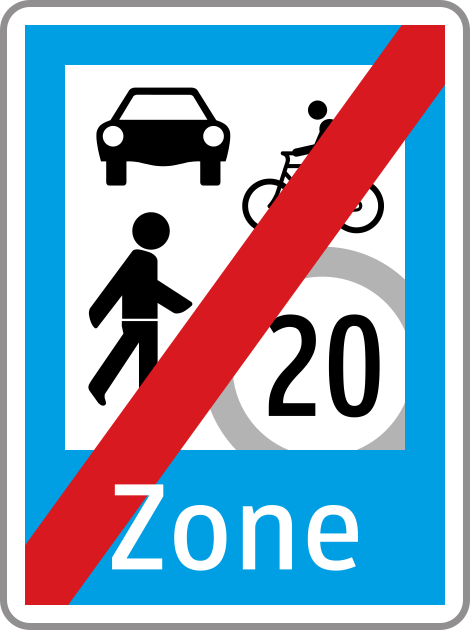 End of the residential area.
Traffic sign StVO § 53 Z 9f • End of the residential area. The sign indicates the end of a residential area, where the special provisions of section 76c cease to apply. If the maximum permitted speed in the area has been increased to 30 km/h under section 76c(6), the number 20 on the sign must be replaced by 30.
Sources
🔗 Commons.wikimedia.org
🔗 Ris.bka.gv.at • StVO § 53 Z 9f
Image via Commons.wikimedia.org
Gigillo83 • Public domain • Source revision 2024-01-26. Wikimedia original unmodified.
Deutsch • StVO § 53 Z 9f • ENDE EINER BEGEGNUNGSZONE. Dieses Zeichen zeigt das Ende einer Begegnungszone an und bedeutet, dass die besonderen Bestimmungen des § 76c nun nicht mehr gelten. Wurde in der Begegnungszone die erlaubte Höchstgeschwindigkeit gemäß § 76c Abs. 6 auf 30 km/h erhöht, ist auf dem Zeichen die Zahl „20“ durch die Zahl „30“ zu ersetzen.
What speed limit applies in a residential area in Austria?
In the specially signposted residential-street category, vehicles must travel at walking pace. This is different from the separate category normally limited to 20 km/h, where 30 km/h may be specifically authorised and signed.
What rights do pedestrians have in a signposted residential area in Austria?
People may use the street and children may play there. Drivers must not endanger or hinder pedestrians or cyclists and must stop if necessary. Pedestrians must not obstruct permitted vehicle traffic unnecessarily.
May I use a signposted Austrian residential street as a shortcut?
Ordinary through-driving is prohibited in this category. Access to and from properties is permitted, alongside statutory exceptions. When leaving, give way to traffic outside the residential street.


