

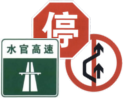
Turn prohibitionChina
 Traffic rules
 China
China
20. Turn prohibition
A turn prohibition prevents drivers from turning in the direction indicated by a traffic sign. It may prohibit a left turn, a right turn or a U-turn at an intersection or along a specified section of road.
Drivers must continue along a permitted route and follow any lane arrows or mandatory-direction signs. A turn prohibition does not itself determine priority or speed, and any exemption for cyclists, public transport or other road users must be expressly indicated.

Wikimedia.org • MspreilsCN • CC0
What is a turn prohibition?
A turn prohibition prevents drivers from making a particular turn or change of direction indicated by a traffic sign.
How can you recognise a turn-prohibition sign?
It is commonly a circular sign with a red border showing a crossed or barred turning arrow. The arrow indicates the movement that is prohibited.
What does a no-left-turn sign mean?
It prohibits drivers from turning left at the location or intersection to which the sign applies.
What does a no-right-turn sign mean?
It prohibits drivers from turning right at the location or intersection to which the sign applies.
What does a no-U-turn sign mean?
It prohibits drivers from turning around to travel in the opposite direction.
Is a prohibited turn the same as a mandatory direction?
No. A prohibition sign identifies a movement that may not be made. A mandatory-direction sign identifies the direction or directions that must be followed.
Is a turn prohibition the same as a no-entry sign?
No. A turn prohibition prevents a particular approach from turning into a road. A no-entry sign prohibits vehicles from entering the road from the direction where it is displayed.
Is a turn prohibition the same as one-way traffic?
No. A one-way rule controls the permitted direction along a road. A turn prohibition controls a particular movement at or near an intersection.
When does a turn prohibition apply?
It may apply at the sign, at the next intersection or throughout a stated section. Drivers must follow the sign design and the rules of the country concerned.
Can a turn prohibition be announced in advance?
Yes. An advance sign or supplementary distance panel may warn drivers that the prohibited turn is farther ahead.
Can the sign apply to only one lane?
Yes. A sign positioned above or clearly associated with one lane may apply only to drivers using that lane.
Do lane arrows also restrict turning?
Yes. Drivers must choose the correct lane and follow one of the directions displayed by its legally binding arrows.
Does a green traffic light permit a prohibited turn?
No. A green light permits traffic to proceed, but drivers must still respect turn prohibitions, lane arrows and other regulatory signs.
Does a turn prohibition change priority?
No. Drivers making another permitted movement must still follow traffic lights, priority signs and the ordinary rules concerning pedestrians, cyclists and other vehicles.
Does a turn prohibition impose a speed limit?
No. The applicable general, zonal or posted speed limit remains in force.
Must you use an indicator for a permitted turn?
Yes, where local law requires it. Signal early enough to communicate your intention and stop signalling after completing the movement.
Does signalling make a prohibited turn legal?
No. An indicator communicates an intention but cannot authorise a movement prohibited by a traffic sign.
May cyclists be exempted?
Yes. A supplementary sign may allow cyclists or other specified road users to make a turn that remains prohibited for general traffic.
May buses or taxis be exempted?
Public transport, taxis or other authorised vehicles may be exempted where a supplementary sign or local rule expressly permits the movement.
Does a no-left-turn sign also prohibit a U-turn?
Not universally. Some countries treat these as separate prohibitions. Drivers must check whether a separate no-U-turn sign or general rule applies.
May you turn into a driveway before the prohibited intersection?
This depends on the exact legal scope of the sign. A sign applying specifically to the next intersection may not regulate an earlier property entrance, but another sign or road marking may still prohibit the movement.
May you reverse to avoid the turn prohibition?
No. Do not reverse through traffic or into an intersection to evade the sign. Continue along a permitted route and change direction later where it is legal and safe.
What should you do after entering the wrong lane?
Follow the movement permitted from that lane. Do not turn suddenly across another lane or ignore the sign; continue and choose another legal route.
Can a temporary turn prohibition be binding?
Yes. Properly placed temporary signs near roadworks, incidents or events must be obeyed.
Do instructions from an authorised officer override the sign?
Yes. Follow instructions from an authorised traffic officer even when they differ from the displayed turn prohibition.


