


Built-up areaFinland
 Traffic rules
 Finland
3. Built-up area
A built-up area is an area containing concentrated buildings, streets and regular local activity. Drivers should expect more pedestrians, cyclists, intersections, parked vehicles, public transport and vehicles entering or leaving properties.
Many countries apply special traffic rules and lower default speed limits within built-up areas. The area may be identified by entrance and exit signs, street lighting or other legal criteria, so drivers must follow local signs and regulations.
Wikimedia.org • Santeri Viinamäki • CC BY-SA
How do people refer to a built-up area in Finland?
In mainland Finland, the Finnish term is taajama; the Swedish term used in Finland is tätort. Traffic law defines this as an area with buildings whose entrances and exits are marked by built-up-area signs.
🔗 finlex.fi • Finlex, Finnish Road Traffic Act 729/2018 — 2, 9, 26, 80–81; Annex 3 E22–E23
🔗 finlex.fi • Finlex — corresponding current Finnish statutory text
 Start of a built-up area.
English • Traffic sign E22 • Built-up area. Built-up-area traffic rules apply within E22 and E23. Placed on the right; if the approach has two or more lanes, an identical sign also stands on the left of the carriageway or approach.
Suomi • Liikennemerkki E22 • Taajama. Merkkien E22 ja E23 rajoittamalla alueella on noudatettava taajamassa voimassa olevia liikennesääntöjä. Merkki sijoitetaan ajoradan oikealle puolelle. Jos tulosuunnassa on kaksi tai useampia ajokaistoja, sijoitetaan samanlainen merkki lisäksi ajoradan tai tulosuunnan vasemmalle puolelle.
Svenska • Vägmärke E22 • Tätort. Inom det område som begränsas av märkena E22 och E23 ska gällande trafikregler för tätorter iakttas. Märket placeras på högra sidan av körbanan. Om det finns två eller flera körfält för färd i en och samma riktning, ska ett likadant märke dessutom placeras till vänster om körbanan eller färdriktningen.
Sources
🔗 Commons.wikimedia.org
🔗 Finlex.fi • Tieliikennelaki 729/2018 • liite 3.5 (FI)
🔗 Commons.wikimedia.org
🔗 Finlex.fi • Vägtrafiklag 729/2018 • bilaga 3.5 (SV)
SVG source: Commons.wikimedia.org • Wikimedia original
Republic of Finland • Public domain • Original revision 2020-06-29. Wikimedia original unmodified.
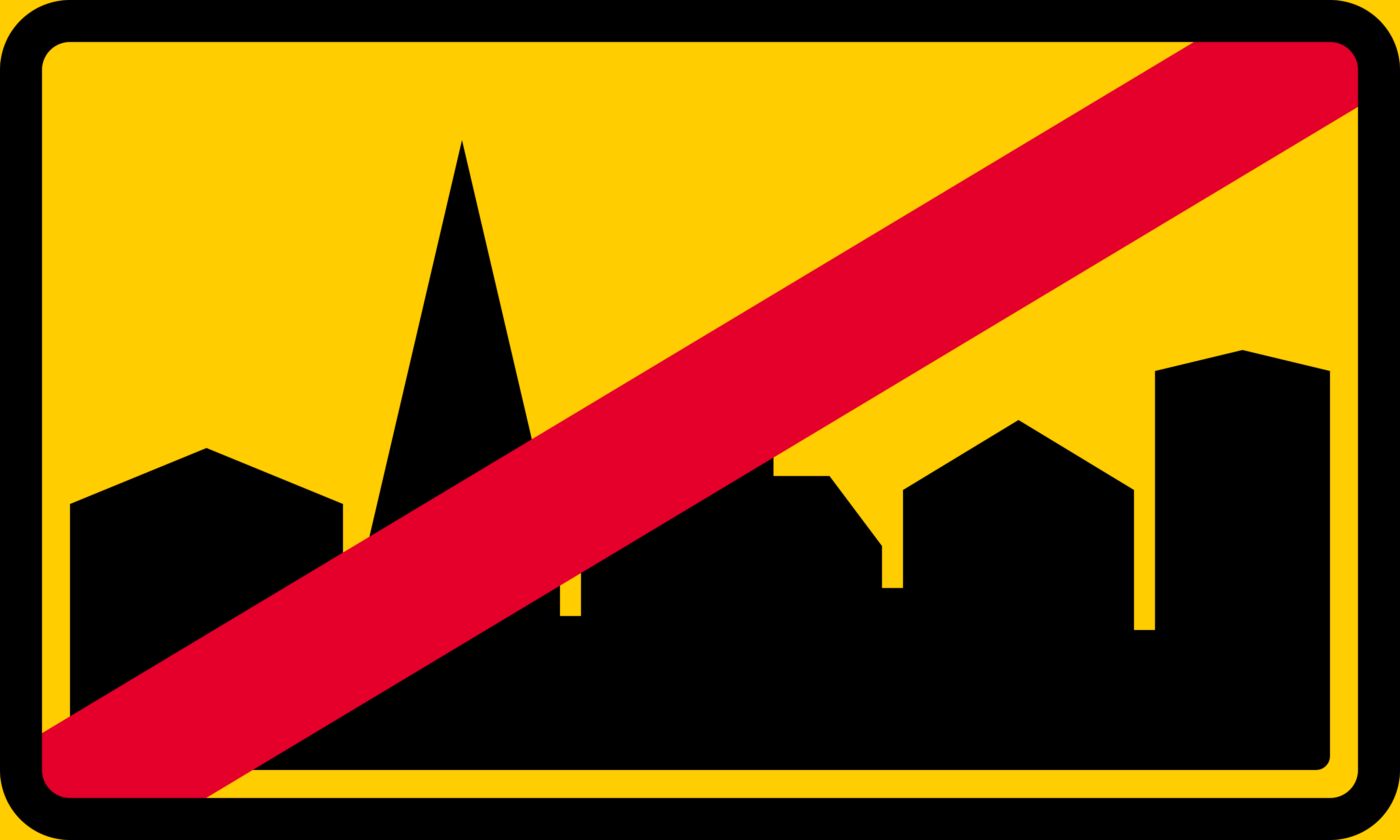 End of the built-up area.
English • Traffic sign E23 • End of built-up area. On a two-way, two-lane road with a single carriageway, may stand solely on the left.
Suomi • Liikennemerkki E23 • Taajama päättyy. Yksiajorataisella, kaksiajokaistaisella, kaksisuuntaisella tiellä merkki voidaan sijoittaa yksinomaan ajoradan vasemmalle puolelle.
Svenska • Vägmärke E23 • Tätort upphör. På en väg med en körbana och två körfält samt dubbelriktad trafik får märket också placeras enbart till vänster om körbanan.
Sources
🔗 Commons.wikimedia.org
🔗 Finlex.fi • Tieliikennelaki 729/2018 • liite 3.5 (FI)
🔗 Commons.wikimedia.org
🔗 Finlex.fi • Vägtrafiklag 729/2018 • bilaga 3.5 (SV)
SVG source: Commons.wikimedia.org • Wikimedia original
Republic of Finland • Public domain • Original revision 2020-06-29. Wikimedia original unmodified.
How can you recognise a built-up area in Finland?
In mainland Finland, look for the official built-up-area entrance sign showing buildings and the corresponding end sign. A place-name sign and a built-up-area sign do not necessarily serve the same purpose.
🔗 finlex.fi • Finlex, Finnish Road Traffic Act 729/2018 — 2, 9, 26, 80–81; Annex 3 E22–E23
🔗 finlex.fi • Finlex — corresponding current Finnish statutory text
What speed limit applies to cars in a built-up area in Finland?
For an ordinary passenger car, the general maximum is 50 km/h unless signs establish another limit. A lower signed limit or zone still applies, and you must slow further when conditions require it.
🔗 finlex.fi • Finlex, Finnish Road Traffic Act 729/2018 — 2, 9, 26, 80–81; Annex 3 E22–E23
🔗 finlex.fi • Finlex — corresponding current Finnish statutory text
Must I allow a bus to leave its stop in a Finnish built-up area?
On a road limited to 60 km/h or less, traffic approaching a bus from behind in the same or adjacent lane must give way when its driver signals departure from a stop. If the adjacent lane is a cycle lane, this also applies to the next traffic lane. The rule depends on the road’s speed limit, rather than solely on whether it is urban.
🔗 finlex.fi • Finlex, Finnish Road Traffic Act 729/2018 — 2, 9, 26, 80–81; Annex 3 E22–E23
🔗 finlex.fi • Finlex — corresponding current Finnish statutory text


