


Shared-use pathFinland
 Traffic rules
 Finland
7. Shared-use path
A shared-use path is a path or part of a road intended for use by both pedestrians and cyclists. Unlike facilities where pedestrians and cyclists have clearly separated sections, users of a shared-use path normally travel within the same general space.
Because users may travel at very different speeds, cyclists should approach pedestrians carefully, adapt their speed and leave sufficient space when passing. The permitted users, priority rules and any speed restrictions depend on the local traffic signs and regulations.

What does Finland call a shared walking and cycling path?
The official term is yhdistetty pyörätie ja jalkakäytävä. The blue circular sign combines pedestrian and bicycle symbols without allocating separate side-by-side sections. A sign with a dividing line indicates a different, divided arrangement.
🔗 finlex.fi • Finlex, Finnish Road Traffic Act 729/2018 — 13, 18, 29; Annex 3 D4–D7
🔗 finlex.fi • Finlex — corresponding current Finnish statutory text
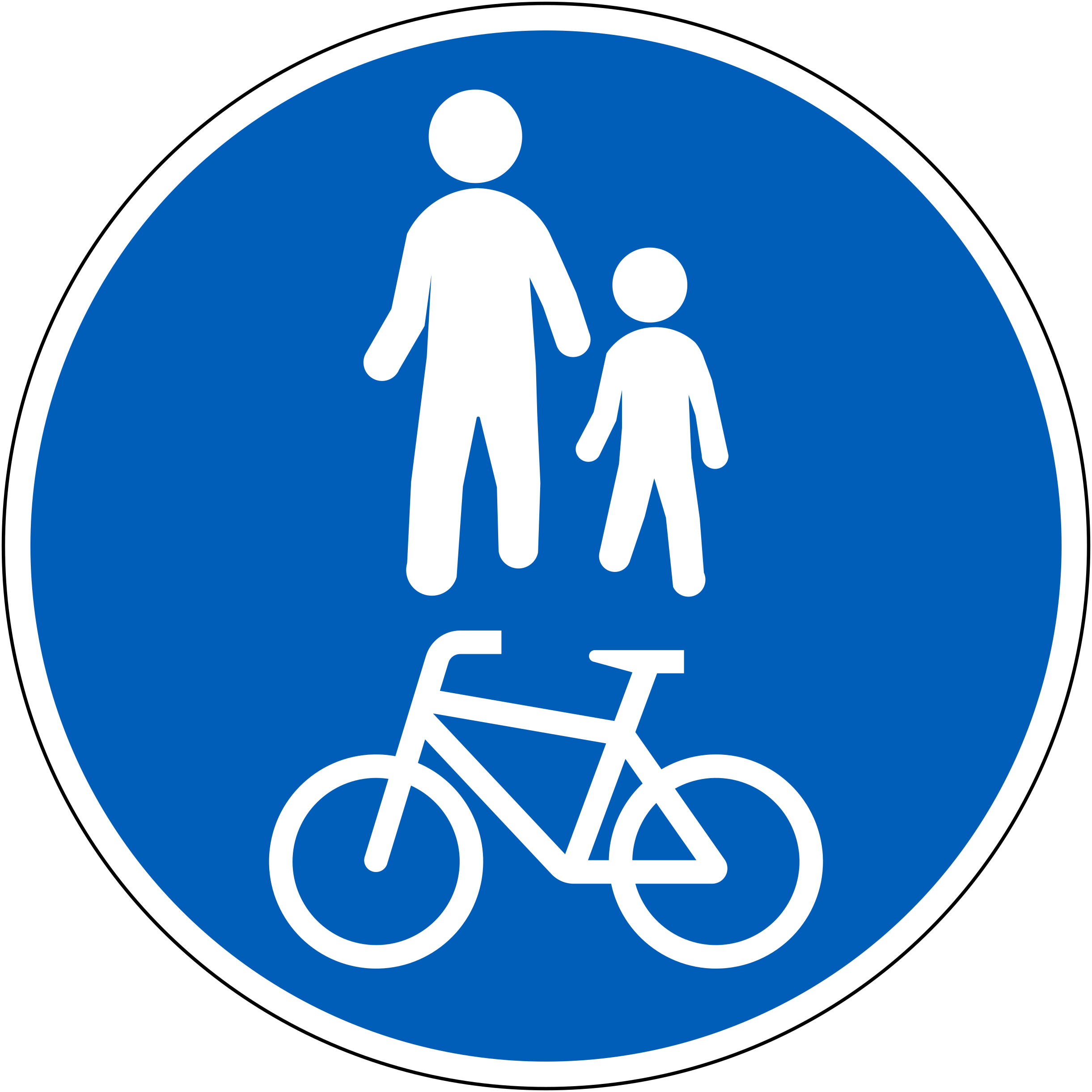 Mandatory shared pedestrian and cycle path.
English • Traffic sign D6 • Combined cycle path and footpath. Cyclists and pedestrians travelling in the relevant direction must use it. Otherwise the provisions for D4 and D5 apply.
Suomi • Liikennemerkki D6 • Yhdistetty pyörätie ja jalkakäytävä. Merkillä osoitetaan yhdistetty pyörätie ja jalkakäytävä, jota polkupyöräilijän ja jalankulkijan on käytettävä kulkiessaan asianomaiseen suuntaan. Muuten on pyörätiestä ja jalkakäytävästä voimassa, mitä merkeistä D4 ja D5 säädetään.
Svenska • Vägmärke D6 • Kombinerad cykel- och gångbana. Märket anger en kombinerad cykel- och gångbana som cyklister och gående ska använda vid färd i riktningen i fråga. I fråga om cykelbanan och gångbanan gäller i övrigt det som föreskrivs om märkena D4 och D5.
Sources
🔗 Commons.wikimedia.org
🔗 Finlex.fi • Tieliikennelaki 729/2018 • liite 3.4 (FI)
🔗 Commons.wikimedia.org
🔗 Finlex.fi • Vägtrafiklag 729/2018 • bilaga 3.4 (SV)
SVG source: Commons.wikimedia.org • Wikimedia original
Republic of Finland • Public domain • Original revision 2020-06-13. Wikimedia original unmodified.
Must walkers and cyclists use a designated Finnish combined path?
Yes, when travelling in the relevant direction, subject to the applicable statutory exceptions. The combined-path sign applies the relevant pedestrian-path and cycle-path rules. It does not reserve the entire surface solely for faster cycling traffic.
🔗 finlex.fi • Finlex, Finnish Road Traffic Act 729/2018 — 13, 18, 29; Annex 3 D4–D7
🔗 finlex.fi • Finlex — corresponding current Finnish statutory text
Which side should pedestrians use on a Finnish shared walking and cycling path?
Pedestrians using a cycle path must generally keep to an edge; either edge can be used. Finland does not impose a universal left-side walking rule on every combined path. Cyclists should expect walkers at either edge and pass safely.
🔗 finlex.fi • Finlex, Finnish Road Traffic Act 729/2018 — 13, 18, 29; Annex 3 D4–D7
🔗 finlex.fi • Finlex — corresponding current Finnish statutory text


