


Width limitJapan
 Traffic rules
 Japan
Japan
35. Width limit
A width limit prohibits vehicles or vehicle combinations whose total width exceeds the value shown from entering or passing a road section, bridge, tunnel, gateway or other narrow passage. The width includes the vehicle’s load and any equipment or objects extending from its sides.
Drivers must know the maximum travelling width of their vehicle and load, observe advance warnings and use an alternative route when necessary. They should never enter when sufficient lateral clearance is uncertain.
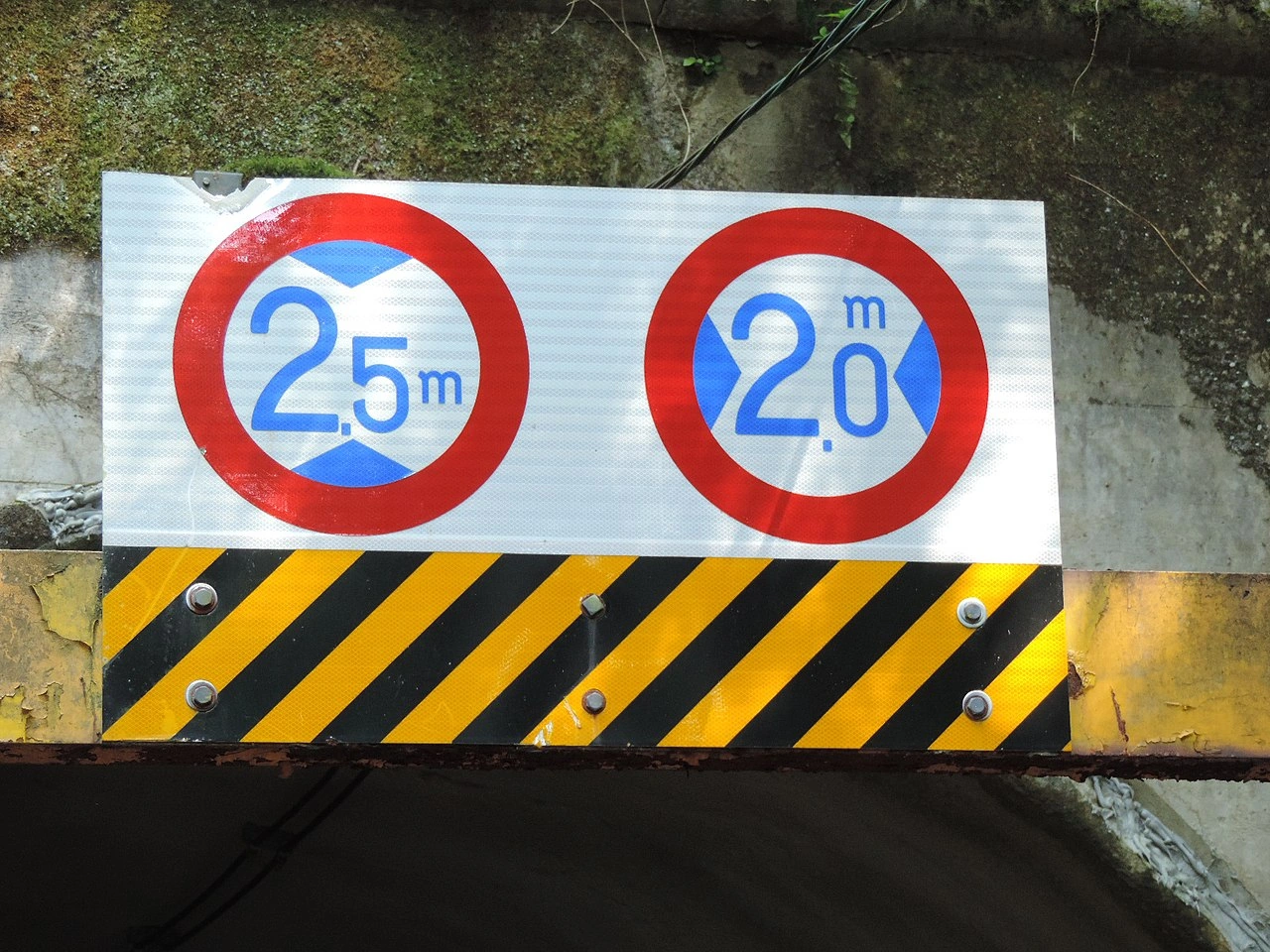
Wikimedia.org • 運動会プロテインパワー • CC BY-SA
What does a width-limit sign mean?
It prohibits vehicles or vehicle combinations whose total width exceeds the displayed value from continuing beyond the sign.
How can you recognise a width-limit sign?
It is commonly a circular regulatory sign showing a width in metres, feet or another local unit between horizontal arrowheads.
What is included in the vehicle’s total width?
The width includes the vehicle, its load and attached equipment or objects that extend from either side.
Does the width of a trailer count?
Yes. Every part of the vehicle combination must comply, including the towing vehicle, trailer and load.
Do roof-mounted bicycles or equipment count?
Yes, when they extend beyond the sides of the vehicle. Drivers must consider the widest point of the complete travelling vehicle.
Does an open vehicle door affect the legal width?
Doors should be closed while driving. The ordinary travelling width is measured with the vehicle properly configured for road use.
Does the sign show the exact width of the passage?
Not necessarily. It shows the maximum legally permitted vehicle width. The physical passage may be wider, but drivers should not assume that additional clearance is available.
May a vehicle exactly as wide as the displayed value pass?
The sign normally prohibits vehicles wider than the displayed value. However, drivers should not attempt to pass without a practical safety margin because measurements and vehicle movement may vary.
Why is additional clearance important?
A vehicle may move sideways because of steering corrections, road camber, wind, suspension movement or an uneven surface.
Can the available width vary along the passage?
Yes. Walls, barriers, columns, bends, kerbs and protruding structures may make one part narrower than another.
Can different lanes have different width limits?
Yes. Lane-specific signs may impose different restrictions where the available width varies between lanes.
Can roadworks introduce a temporary width limit?
Yes. Barriers, machinery and shifted lanes may reduce the usable width. Temporary width-limit signs must be obeyed.
Is a width-limit sign a warning or a prohibition?
It is normally a prohibition. A vehicle that exceeds the displayed width may not pass.
Does a width-limit sign impose a speed limit?
No. The applicable general, zonal or posted speed limit remains in force, although drivers should approach narrow passages slowly.
Does the sign change priority?
No. Traffic lights, priority signs and the ordinary priority rules remain applicable.
Can a width restriction be announced in advance?
Yes. An advance sign may show the restriction and the distance to it so that wide vehicles can choose another route.
What should you do when your vehicle is too wide?
Do not continue. Stop where safe and use the signed diversion or another suitable route.
Should you rely on a navigation system?
No. Navigation information may be outdated or incomplete. Traffic signs and actual road conditions always take precedence.
Should professional drivers know their vehicle’s width?
Yes. Drivers of trucks, buses, agricultural vehicles, motorhomes and vehicles carrying wide loads should know the maximum travelling width before beginning the journey.
How should the width be measured?
Measure the widest part of the vehicle and load in its normal travelling configuration. Consider equipment, securing devices and any load extending beyond the bodywork.
Can folding equipment reduce the width?
Yes. Mirrors, arms, steps or machinery designed to be folded or retracted should be placed in the legally required travelling position before driving.
May you change lanes to use a wider passage?
Only when signs and markings permit it and the manoeuvre can be completed safely. Do not cross a closed lane, continuous line or opposing traffic to avoid the restriction.
What should you do when uncertain about the width?
Stop before the restriction in a safe place and verify the vehicle’s dimensions. Choose another route when adequate clearance cannot be confirmed.
Should another person guide a wide vehicle?
A guide may help during a slow manoeuvre in a controlled location, but the driver remains responsible. The guide must remain visible and stay away from moving traffic and crushing hazards.
What should you do if the vehicle strikes a structure?
Stop immediately where safe, activate the hazard warning lights and contact the police or emergency services. Do not continue when the vehicle, load or structure may be damaged or unstable.


