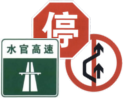
Vorgeschriebene FahrtrichtungChina

Lerne Verkehrsregeln mit klaren Erklärungen und visuellen Beispielen in unserem illustrierten Buch – einfach, verständlich und anschaulich.


19. Vorgeschriebene Fahrtrichtung

Ein Gebotszeichen zur Fahrtrichtung verpflichtet Fahrer, nur in die durch einen oder mehrere Pfeile angezeigte Richtung zu fahren. Es kann vorschreiben, geradeaus zu fahren, abzubiegen oder ein Hindernis auf einer bestimmten Seite zu passieren.

Das Zeichen bestimmt für sich allein weder Vorfahrt noch Geschwindigkeit. Fahrer müssen weiterhin den richtigen Fahrstreifen benutzen, bei Bedarf blinken und gemäß den örtlichen Verkehrszeichen und Vorschriften Vorfahrt gewähren.

What does a mandatory-direction sign mean?

It requires drivers to follow the direction or one of the directions shown by the arrow or arrows.

How can you recognise a mandatory-direction sign?

It is commonly a blue circular sign with one or more white arrows. Colours and designs may differ in some countries.

What does an upward arrow mean?

It normally means that drivers must continue straight ahead and may not turn in another direction at that location.

What does a left or right arrow mean?

It normally requires drivers to turn or proceed in the direction shown by the arrow.

What do two arrows mean?

Drivers may choose one of the displayed directions. Any direction not shown is prohibited.

What does an arrow beside an obstacle mean?

It requires drivers to pass the traffic island, barrier, roadworks equipment or other obstruction on the side indicated by the arrow.

Is a mandatory-direction sign the same as a one-way sign?

No. A mandatory-direction sign prescribes a movement at a particular location. A one-way sign indicates the permitted direction along a road or carriageway.

Is it the same as a no-turn sign?

No. A mandatory sign states which direction must be followed, while a prohibition sign states which movement is forbidden. Both may produce a similar practical result.

Does the sign impose a speed limit?

No. Drivers must follow the applicable general, zonal or posted speed limit and reduce speed when necessary to complete the required movement safely.

Does the sign give you priority?

No. You must still obey traffic lights, priority signs and the ordinary rules concerning oncoming traffic, pedestrians, cyclists and other road users.

When does the obligation begin?

It normally applies at the sign, intersection or obstacle associated with it. An advance sign may indicate that the obligation begins farther ahead.

Can a mandatory-direction sign apply to only one lane?

Yes. When it is positioned above a particular lane or clearly associated with that lane, it normally applies only to traffic using that lane.

Can road arrows also prescribe a direction?

Yes. Lane arrows may require drivers to use a particular lane and follow one of the directions displayed within that lane.

Must you use an indicator?

Yes, when the required movement involves turning or changing position and local law requires signalling. The sign does not replace the obligation to indicate.

Does signalling give you priority?

No. An indicator communicates your intention but does not allow you to force another road user to brake or change direction.

May you make a U-turn?

Not when doing so would conflict with the mandatory direction or another prohibition. Drivers must follow the permitted route shown by the signs and markings.

May you reverse to avoid following the sign?

No. Reversing must not be used to evade a mandatory direction. Continue along a lawful route and turn around later where permitted.

Does the sign apply to cyclists?

Cyclists are normally treated as drivers and must obey the sign unless a supplementary panel or local rule expressly exempts them.

Can other road users be exempted?

Yes. Supplementary signs may exempt or separately regulate cyclists, public transport or other specified categories where local law permits this.

What if the required route is blocked?

Do not enter a closed or unsafe route. Stop where safe and follow temporary signs, traffic lights or instructions from authorised personnel.

Do traffic lights cancel a mandatory-direction sign?

Not normally. Traffic lights determine when traffic may proceed, while the mandatory-direction sign determines which movement is permitted.

Do police instructions override the sign?

Yes. Instructions from an authorised traffic officer normally take precedence over traffic signs and ordinary traffic rules.

Can a temporary mandatory-direction sign be binding?

Yes. Properly placed temporary signs at roadworks, incidents or events must be obeyed.

What is a mandatory route for dangerous-goods vehicles?

It requires vehicles carrying specified dangerous goods to follow a designated route suitable for their cargo and any applicable tunnel restrictions.

When does the mandatory direction end?

The obligation is normally completed after the driver has followed the required direction at the intersection or passed the obstacle on the indicated side.

1 China 2 Autobahn 3 Schnellstraße 4 Wohngebiet 5 Geschwindigkeitsbegrenzung 6 Gehweg 7 Radweg 8 Tunnel 9 Mautstraße 10 Steigung oder Gefälle 11 Busspur 12 Bushaltestelle 13 Stoppschild 14 Vorfahrt gewähren 15 Kreisverkehr 16 Fahrbahnverengung 17 Fußgängerüberweg 18 Bahnübergang 19 Vorgeschriebene Fahrtrichtung 20 Abbiegeverbot 21 Schulbereich 22 Steinschlag 23 Kurve 24 Richtungstafel 25 Falschfahrt 26 Straßenarbeiten 27 Seitenwind 28 Höhenbegrenzung 29 Gewichtsbeschränkung 30 Geschwindigkeitskontrolle 31 Vorfahrt an der nächsten Kreuzung 32 Ampeln 33 Warnung vor Ampeln 34 Fußgängerampeln 35 Führerschein 36 Kilometrierungsmarkierung 37 Verkehrsspiegel 38 Parken 39 Parkverbot 40 Halteverbot 41 Behindertenparkplatz 42 Rückwärtsfahren 43 Wenden 44 Ungeregelte Kreuzung 45 Vorläufiger Führerschein 46 Notausgang 47 Notfall-Auslaufspur 48 Hupe 49 Achslastbegrenzung 50 Ladestation 51 Fußgänger 52 Motorrad 53 Pkw 54 Lkw 55 Bus 56 Polizei 57 Krankenwagen 58 Taxi 59 Polizeizeichen 60 Schlagloch 61 Weg 62 Feinstaub 63 Luftverschmutzung 64 Hauptverkehrszeit 65 Straßenverkehrsordnung 66 Straßenrinne 67 Lastenfahrrad 68 Forstfahrzeug 69 Baufahrzeug 70 Sattelzug 71 Oberleitungsbus 72 Speed-Pedelec 73 Lieferfahrzeug 74 Leerlauf 75 Abschleppwagen 76 Allradantrieb 77 Fahrrad 78 Motorradausrüstung 79 Gleis 80 Wohnwagen 81 Anhänger 82 Anhängerkupplung 83 Feuerwehrfahrzeug 84 Sirene 85 Konvoi 86 Warnbeleuchtung von Einsatzfahrzeugen 87 Landwirtschaftliche Maschinen 88 Elektrofahrrad 89 Elektrofahrzeug 90 Pedelec 91 Leichtkraftfahrzeug 92 Microcar 93 Geländefahrzeug 94 Lieferwagen 95 Freizeitfahrzeug 96 Motorroller 97 Trikke 98 Persönliches Mobilitätsgerät 99 Skateboard 100 Segway ...