Priorité au prochain carrefourBelgique
42. Priorité au prochain carrefour
La priorité au prochain carrefour signifie que les conducteurs circulant sur une route déterminée ont priorité sur le trafic arrivant des routes qui la croisent au prochain carrefour. Le régime de priorité est normalement indiqué par des panneaux faisant face à la fois au trafic prioritaire et à celui qui doit céder le passage.
Contrairement à une route prioritaire continue, cette priorité ne s’applique qu’à l’intersection indiquée. Les conducteurs doivent néanmoins approcher avec prudence et respecter les feux de circulation, agents habilités, passages, règles de changement de direction et autres panneaux applicables.
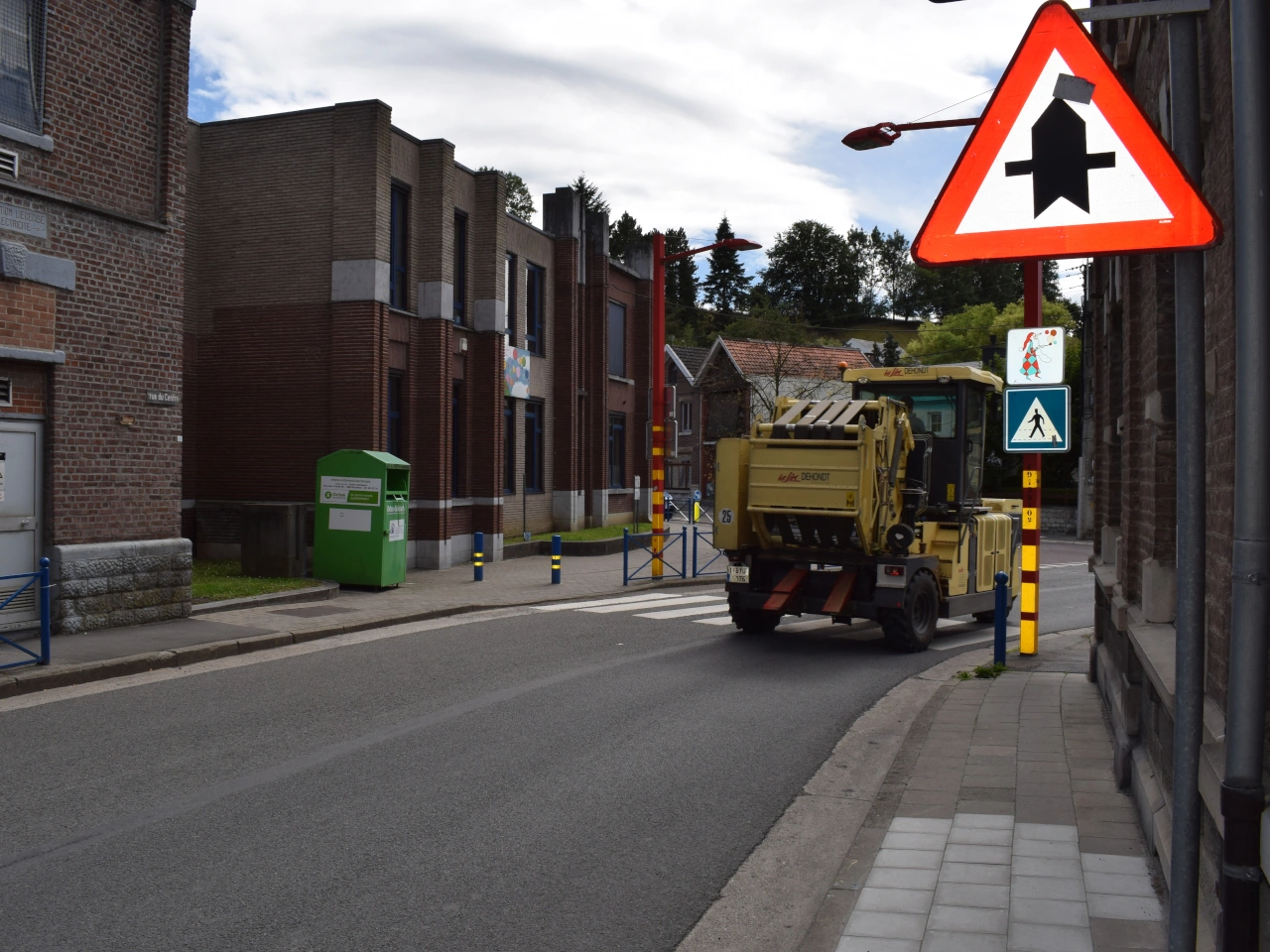
Which Belgian sign gives priority at the next junction?
Traffic sign B15 indicates that drivers have priority at the next junction.
Priorité au carrefour.
Signal routier B15 • Priorité de passage. La barre horizontale du symbole peut être modifiée de façon à représenter plus clairement la disposition des lieux.
Verkeersbord B15 • Voorrang. De horizontale streep van het symbool mag worden gewijzigd om duidelijker plaatsgesteldheid weer te geven.
Priorité au carrefour.
Signal routier B15 • Priorité de passage. La barre horizontale du symbole peut être modifiée de façon à représenter plus clairement la disposition des lieux.
Verkeersbord B15 • Voorrang. De horizontale streep van het symbool mag worden gewijzigd om duidelijker plaatsgesteldheid weer te geven.
Priorité au carrefour.
Signal routier B15 • Priorité de passage. La barre horizontale du symbole peut être modifiée de façon à représenter plus clairement la disposition des lieux.
Verkeersbord B15 • Voorrang. De horizontale streep van het symbool mag worden gewijzigd om duidelijker plaatsgesteldheid weer te geven.
What is the difference between B15 and B9?
B15 gives priority at one junction. B9 indicates a continuing priority road whose status remains in force until sign B11.
Is a road marked with B15 legally a priority road?
No. It has priority at the indicated junction but is not a continuing B9 priority road.
Can B9 and B15 be used along the same priority route?
Belgian placement rules distinguish the two systems. B9 is used for a continuing priority road, while B15 is used for priority at an individual junction.
How can you recognise Belgian sign B15?
B15 is a triangular priority sign showing a thick vertical line crossed by one or more thinner lines. The thick line represents the route with priority.
Can the B15 diagram be adapted to the junction?
Yes. The horizontal or side lines may be modified so that the symbol more clearly represents the actual road layout.
Does B15 always mean the priority route continues straight ahead?
No. A supplementary diagram may indicate that the route with priority turns left or right at the junction.
What signs do drivers on the side roads normally face?
Drivers who must give way normally face traffic sign B1 or B5.
What does B1 require?
B1 requires drivers to give way. They must stop only when necessary.
What does B5 require?
B5 requires drivers to stop completely and give way.
Must B15 be paired with B1 or B5?
Normally, yes. Belgian placement rules require B1 or B5 on the road followed by drivers who must give way, except where traffic from that road is prohibited in the relevant direction.
Where is B15 placed?
B15 is placed in the immediate vicinity of the junction where its drivers have priority.
Does B15 give priority at later junctions?
No. Its effect concerns the next junction only. Priority at a later junction must be established separately.
Does a junction end the effect of B15?
Yes. Once the indicated junction has been passed, the B15 priority arrangement has been completed.
Does priority from the right apply to side-road traffic?
No. Drivers facing B1 or B5 must give way to traffic on the B15 road, including traffic approaching from their left.
Does B15 give you priority over traffic from both sides?
Yes. Drivers entering from the controlled side roads must give way regardless of whether they approach from the left or right.
Does B15 give you priority over oncoming traffic when turning left?
No. A driver turning left must still give way to oncoming drivers travelling straight ahead or turning right, unless another traffic control provides otherwise.
Must you signal when the B15 priority route turns?
Yes, when your movement constitutes a change of direction. Signal in time even though you retain priority over traffic entering from the side roads.
Does using the indicator give you priority?
No. You must still complete the movement safely and respect oncoming traffic, pedestrians, cyclists and other road users with priority.
Does B15 give priority over pedestrians?
No. Drivers must still respect pedestrian crossings and give way to pedestrians crossing the road they enter when turning.
What if a bike path continues across a side road?
A driver crossing a continuing bike path must give way to its lawful users. B15 does not remove that duty.
Can a B15 panel warn of two-way cycle traffic?
Yes. A supplementary panel may indicate the route of the priority road or warn that cyclists and certain mopeds may approach in both directions.
Must cyclists obey B15?
Yes. Cyclists travelling on the road controlled by B15 benefit from its priority arrangement, subject to all other applicable cycle-path, crossing and turning rules.
Does B15 impose a speed limit?
No. The applicable regional, zonal, posted and vehicle-specific speed limits remain in force.
May you approach B15 at the maximum speed without slowing?
Only when that remains safe. Drivers must adapt their speed to visibility, traffic, road layout and foreseeable hazards and remain able to stop before an obstruction.
May you enter the junction when it is blocked?
No. Having priority does not allow a driver to enter when congestion would probably leave the vehicle stopped inside the junction.
Does B15 prohibit overtaking?
No. The ordinary overtaking rules, road markings and separate prohibition signs remain applicable.
Does B15 prohibit parking?
No. Unlike the specific rule for B9 roads outside built-up areas, B15 itself does not create a general parking prohibition.
Does B15 apply while traffic lights are operating?
No, when functioning traffic lights control the same road at that junction. Drivers must then follow the traffic signals.
What if the traffic light flashes orange-yellow?
An orange-yellow flashing light requires additional caution but does not change the priority arrangement. The B15 sign remains applicable.
What if an authorised person directs traffic?
Follow the authorised person’s instructions. These take precedence over traffic lights, signs, road markings and ordinary traffic rules.
What is the difference between B15 and B17?
B15 gives priority at the next junction. B17 warns that priority from the right applies at the next junction.
Why is B15 used?
Belgian placement rules allow B15 where retaining priority from the right would interfere with the safe or efficient flow of traffic because of traffic conditions or the road layout.
Will B15 remain under Belgium’s new road code?
Yes. From 1 June 2027, B15 retains the meaning priority at the next junction.

Règles de circulation
Belgique