

DouaneFlandre
 Règles de circulation
 Flandre
12. Douane
La douane est l’autorité publique chargée de contrôler les marchandises entrant ou sortant d’un pays ou territoire douanier. Dans la circulation routière, un poste douanier est un lieu où les conducteurs peuvent être tenus de s’arrêter afin que les agents inspectent le véhicule, les bagages, le chargement et les documents pertinents.
Les contrôles douaniers peuvent avoir lieu aux frontières, ports, terminaux de ferry, aéroports ou points de contrôle intérieurs. Les conducteurs doivent respecter tous les panneaux, signaux de voie, barrières et instructions des agents des douanes. Les obligations de déclaration dépendent des pays concernés ainsi que du type, de la valeur, de la quantité et de l’usage prévu des marchandises transportées.

Which authority is responsible for customs in Belgium?
Customs controls are performed by the Belgian General Administration of Customs and Excise, which forms part of the Federal Public Service Finance.
What does Belgian customs control?
Belgian customs supervises goods entering or leaving the European Union customs territory, collects applicable import duties, excise duties and import VAT, and helps prevent illegal or unsafe trade.
Are there routine customs controls at Belgium’s borders with other EU countries?
No. There are no customs duties or routine customs controls at borders between EU Member States because they form one customs union. Specific checks concerning excise goods, prohibited goods, commercial activity or fraud may still occur.
Can goods bought in another EU country be brought into Belgium?
Generally, yes. Goods on which the required taxes have been paid in another EU Member State may normally be brought into Belgium without additional customs duties. Special rules continue to apply to excise goods, vehicles, protected goods and prohibited or restricted products.
Do goods arriving from outside the EU require customs formalities?
Yes. Goods entering Belgium from outside the EU customs territory are subject to EU customs rules. Travellers may benefit from personal allowances, but goods exceeding those allowances or subject to restrictions must be declared.
Is the Schengen Area the same as the EU customs union?
No. Schengen concerns controls on people crossing internal borders, while the customs union concerns goods and customs duties. Some Schengen countries are outside the EU customs union, and customs formalities may therefore still apply.
Where might you encounter Belgian customs?
Customs controls may take place at seaports, airports, ferry terminals, freight facilities, parcel centres or inland road-control locations. Controls are not limited to a visible national border.
Must you obey instructions from Belgian customs officers?
Yes. Customs personnel acting in the course of their duties are competent persons under the Belgian Highway Code. Road users must immediately obey their orders, which take precedence over traffic signs and ordinary traffic rules.
How should you respond when a customs officer signals you to stop?
Reduce speed safely, stop at the indicated location and follow the officer’s instructions. Present the requested identity, vehicle, travel, goods or transport documents and do not continue until permitted.
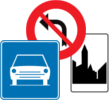
Does Belgium still have a customs version of traffic sign C47?
No. The former C47 image bearing the words Douane-Zoll was abolished on 16 July 2026.
What does Belgian traffic sign C47 mean now?
Traffic sign C47 now indicates a toll post. Drivers are prohibited from passing it without stopping. The inscription may be replaced by the word Taks.
How can a Belgian customs control be indicated?
A customs control may use temporary signs, barriers, lane-control signals, road markings, police instructions or direct signals from customs officers. Drivers must follow the control arrangement in place rather than expect one specific customs sign.
Must you declare cash when entering or leaving the EU through Belgium?
Yes, from €10 000. Accompanied cash and other qualifying liquid assets with a total value of €10 000 or more must be declared when entering or leaving the European Union.
Where must the cash declaration be submitted?
The declaration must be submitted to customs in the EU Member State of first arrival when entering the Union or the last Member State of departure when leaving it.
What counts as liquid assets for the Belgian declaration?
The rules cover cash, certain bearer-negotiable instruments and specified forms of gold, including qualifying gold coins, bars, nuggets and gold dust.
May Belgian customs inspect a vehicle?
Yes, where authorised by law. A customs control may include inspection of the vehicle, luggage, transported goods and relevant documents.
What documents should a traveller keep available?
Useful documents may include identification, vehicle papers, purchase receipts, invoices, customs forms, permits and proof that valuable personal items were already owned before the journey.
What should you do when unsure whether goods must be declared?
Use the declaration channel where available or ask a customs officer before leaving the control area. Declaring or requesting guidance is safer than assuming an exemption applies.
Can customs seize prohibited or undeclared goods?
Yes. Goods may be detained or seized, and duties, taxes, fines or other legal consequences may follow when customs requirements are not respected.


