

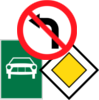
ExpresswaySwitzerland
 Traffic rules
 Switzerland
3. Expressway
An expressway is a road intended to carry through traffic efficiently, usually at higher speeds than ordinary roads. Expressways often have limited access, multiple lanes, separated carriageways or grade-separated junctions, but their design and legal status vary between countries.
An expressway is not always a motorway. It may have intersections, traffic lights or direct access, and the permitted road users, speed limits and special rules depend on local signs and regulations.
Wikimedia.org • Marc Mongenet • CC BY-SA
How can you recognise an expressway?
An expressway may be identified by a special road sign or by its road classification. It often has multiple lanes, limited access and junctions designed for faster traffic, but its exact appearance differs between countries.
Is an expressway the same as a motorway?
No. A motorway normally has full access control and stricter design and traffic rules. An expressway may have partial access control, ordinary intersections, traffic lights or direct entrances. The legal distinction varies between countries.
Is an expressway always divided?
Not necessarily. Many expressways have separate carriageways for opposing traffic, but some countries also classify undivided roads as expressways. Drivers should rely on local signs and road rules rather than the road’s appearance alone.
Who may use an expressway?
Expressways are generally intended for motorised traffic. Pedestrians, cyclists, animals, mopeds and slow vehicles may be restricted or prohibited, but the permitted road users depend on local law and traffic signs.
What is the speed limit on an expressway?
There is no universal expressway speed limit. The applicable limit depends on the country, road design, location, vehicle category and posted signs. An expressway sign does not always impose a particular speed by itself.
Can an expressway have intersections or traffic lights?
Yes. Unlike a motorway, an expressway may have level intersections, roundabouts, pedestrian crossings or traffic lights. Drivers must therefore remain prepared for crossing traffic and changes in priority.
How should you enter an expressway?
Use an entrance or acceleration lane where one is provided, observe approaching traffic and enter only when there is a safe gap. Where the road has an ordinary intersection, follow the applicable priority signs and local rules.
Which lane should you use on an expressway?
Follow the local keep-left or keep-right rule, lane arrows and traffic signs. Lanes nearer the centre are commonly used for overtaking, but special lane restrictions may apply to heavy vehicles or particular destinations.
Can you stop, park, reverse or make a U-turn?
These actions are often restricted on expressways because of the speed and flow of traffic. Stop or park only where permitted, and never reverse or make a U-turn unless the road design and local rules clearly allow it.
What should you do after a breakdown?
Move the vehicle away from moving traffic when this can be done safely, activate the hazard warning lights and follow the local breakdown procedures. Use a warning triangle or safety vest where required and wait in a protected location away from traffic.


