

Pedestrian crossingSwitzerland
 Traffic rules
 Switzerland
26. Pedestrian crossing
A pedestrian crossing is a designated place where pedestrians may cross a road. It is commonly indicated by road markings, traffic signs, signals or a combination of these measures.
Drivers must approach with appropriate caution and give way when required by local law. Pedestrians must also observe approaching traffic and follow any pedestrian signals or instructions from authorised traffic controllers.
Wikimedia.org • Marc Mongenet • CC BY-SA
When must drivers give way at a pedestrian crossing in Switzerland?
At an uncontrolled crossing, give way to pedestrians already crossing or waiting with a clear intention to cross. Reduce speed in time and stop if necessary. Pedestrians must not force priority when an approaching vehicle can no longer stop; trams are excepted from the normal crossing priority.
Are all pedestrian crossings controlled the same way in Switzerland?
No. At an uncontrolled crossing, the pedestrian-priority rules apply. At a signal-controlled crossing, follow the lights, which take precedence over the general priority rules. A warning sign simply announces the crossing ahead.
🔗 fedlex.admin.ch • Switzerland, OCR, articles 6, 12, 24 and 47, official Fedlex edition of 1 October 2026; 🔗 fedlex.admin.ch • Switzerland, OSR, articles 68 and 93, official Fedlex edition of 1 October 2026
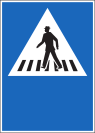 Crossing for pedestrians.
English • Traffic sign 4.11 • Location of a pedestrian crossing.
Deutsch • Verkehrssignal 4.11 • Standort eines Fussgängerstreifens.
Français • Signal 4.11 • Emplacement d’un passage pour piétons.
Italiano • Segnale 4.11 • Ubicazione di un passaggio pedonale.
Sources
🔗 Commons.wikimedia.org
🔗 Fedlex.admin.ch • SSV, Anhang 2 (DE)
🔗 Fedlex.admin.ch • OSR, annexe 2 (FR)
🔗 Fedlex.admin.ch • OSStr, allegato 2 (IT)
SVG source: Commons.wikimedia.org • Original SVG
Bundesamt für Strassen (ASTRA) • Public domain • Original revision 2017-06-30. Wikimedia original unmodified.
Artwork reviewed against the Swiss signalling ordinance, version 1 October 2026, annex 2: Fedlex.admin.ch • Signal 4.11, PDF page 114. Catalogue-equivalent illustration; intentional update from the previous PNG. This is an educational illustration, not a manufacturing specification.
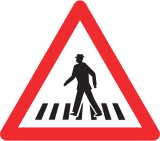 Warning for a pedestrian crossing.
English • Traffic sign 1.22 • Pedestrian crossing.
Deutsch • Verkehrssignal 1.22 • Fussgängerstreifen.
Français • Signal 1.22 • Passage pour piétons.
Italiano • Segnale 1.22 • Pedoni.
Sources
🔗 Commons.wikimedia.org
🔗 Fedlex.admin.ch • SSV, Anhang 2 (DE)
🔗 Fedlex.admin.ch • OSR, annexe 2 (FR)
🔗 Fedlex.admin.ch • OSStr, allegato 2 (IT)
SVG source: Bundesamt für Strassen (ASTRA) • Public domain • Original revision 2017-07-01. Wikimedia original unmodified.
May I enter a pedestrian crossing if the road beyond it is blocked in Switzerland?
Keep the crossing clear when traffic queues. You must not overtake a vehicle that has stopped before a pedestrian crossing to let someone cross.
🔗 fedlex.admin.ch • Switzerland, OCR, articles 6, 12, 24 and 47, official Fedlex edition of 1 October 2026; 🔗 fedlex.admin.ch • Switzerland, LCR, articles 28, 33–38, official Fedlex edition of 1 July 2026
Does a Swiss central refuge split a pedestrian crossing?
Yes, at an uncontrolled pedestrian crossing each part separated by a central refuge is independent. From the island, check again that the conditions for priority are met. At controlled crossings, obey the applicable signals.
Do Swiss pedestrians have crossing priority over trams?
No. The normal pedestrian-crossing priority does not extend to trams.
Must Swiss pedestrians give a hand signal before using a pedestrian crossing?
No. A hand signal is optional; make the intention to cross unambiguous.
May Swiss pedestrians force priority when a vehicle is too close to stop?
No. Crossing priority must not be forced if the approaching vehicle can no longer stop in time.


