

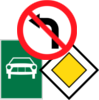
Residential areaSwitzerland
 Traffic rules
 Switzerland
4. Residential area
A residential area is a street or group of streets where housing and access to local properties are the main functions. Drivers should expect pedestrians, cyclists, children, parked vehicles and vehicles entering or leaving driveways.
Some countries identify particular residential areas with traffic signs and apply special low-speed and residential-area rules. The speed limit, pedestrian rights, parking rules and permitted road users therefore depend on local signs and regulations.
Wikimedia.org • Suzanne Michel • CC BY-SA
How can you recognise a residential area?
A residential area commonly contains homes, driveways, parked vehicles and local streets. It may also have special entrance signs, traffic-calming measures or shared road space, but its appearance and legal status differ between countries.
Is a residential area the same as a built-up area?
Not necessarily. A built-up area may include residential, commercial and industrial streets. A residential area is primarily associated with housing and local access and may form only one part of a larger built-up area.
Is every residential neighbourhood a legally designated residential zone?
No. In many countries, special residential-zone rules apply only where an official entrance sign is displayed. An ordinary neighbourhood may remain subject to the normal rules for the surrounding road or built-up area.
What is the speed limit in a residential area?
There is no universal residential-area speed limit. Some countries apply a very low limit in signposted residential or shared-space zones, while ordinary residential streets may follow the general built-up-area limit or a posted zone limit.
Do pedestrians have priority in a residential area?
The rights of pedestrians depend on the country and the type of residential area. In some signposted shared-space zones, pedestrians may use the whole road and drivers must give them special consideration. On ordinary residential streets, the normal pedestrian and crossing rules may apply.
May children play in a residential area?
Playing may be expressly permitted in certain legally designated residential or shared-space zones. This is not automatically allowed on every residential street. Drivers should nevertheless remain especially alert for children, who may enter the road unexpectedly.
Which road users may enter a residential area?
Residential areas are normally accessible to local motor traffic, cyclists and pedestrians, but additional signs may restrict certain vehicles or through traffic. A residential area is therefore not necessarily a pedestrian-only zone.
How should you drive in a residential area?
Drive at a speed that allows you to stop safely, watch both sides of the road and expect pedestrians, cyclists, children, pets and vehicles emerging from entrances. Leave enough space and avoid unnecessary acceleration, noise or aggressive overtaking.
May you overtake in a residential area?
Overtaking is not universally prohibited, but it may be restricted by local law, signs or road design. Even where it is permitted, drivers should not overtake when the limited space or presence of vulnerable road users makes it unsafe.
Where may you park in a residential area?
Follow the local parking signs, markings and general parking rules. Do not block entrances, pavements, crossings, sight lines or the passage of other road users. Special residential zones may permit parking only in designated spaces.
What is the difference between a residential area and a pedestrian zone?
Motor vehicles are normally still permitted in a residential area, although they may be subject to strict speed and parking rules. In a pedestrian zone, vehicle access is generally prohibited or limited to specific users, purposes or times.


