


Bike pathNetherlands
An introduction to the traffic rules and road signs of Netherlands. Learn about driving, road safety and much more in our illustrated book, with answers to frequently asked questions.
For informational purposes only. Always follow official regulations. Some content and images were created with AI assistance.
 Traffic rules
 Netherlands
8. Bike path
A bike path is a part of a road or a separate route intended primarily or exclusively for people riding bicycles. It may be physically separated from motor traffic, marked on the road surface or identified by traffic signs.
Bike paths may be one-way, two-way or shared with other road users. The permitted users, direction of travel, priority rules and obligation to use the path depend on local traffic signs and regulations.
🔗 Sources
Image credit: Wikimedia.org • Ulli Ticker • CC BY-SA
How do Dutch signs distinguish mandatory and optional cycle paths?
A round blue bicycle sign marks a compulsory fietspad. The rectangular sign with the word fietspad marks an optional path. A sign showing a bicycle and moped identifies a compulsory combined bicycle-and-moped path.
🔗 government.nl • Dutch Government, road rules and signs — RVV articles 2–6; Annex 1 G7/G8, G11–G14
🔗 wetten.overheid.nl • RVV 1990 — official Dutch legislative reference
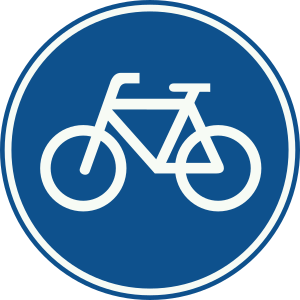 Mandatory path for cyclists.
Traffic sign G11 • Compulsory cycle track.
🔗 Sources
🔗 Github.com • NDW (MIT)
🔗 Commons.wikimedia.org
🔗 Wetten.overheid.nl • RVV 1990, bijlage 1
Nederlands • Verkeersbord G11 • Verplicht fietspad.
Must an ordinary cyclist use a provided Dutch compulsory path?
Yes. Cyclists use the compulsory cycle path or combined bicycle-and-moped path. If neither exists, they use the carriageway. Specified wide multi-wheel bicycles and bicycle-and-trailer combinations have an exception allowing carriageway use.
🔗 government.nl • Dutch Government, road rules and signs — RVV articles 2–6; Annex 1 G7/G8, G11–G14
🔗 wetten.overheid.nl • RVV 1990 — official Dutch legislative reference
May an ordinary moped use every Dutch bicycle path?
No. Ordinary moped riders use the combined bicycle-and-moped path, or the carriageway where none exists. An ordinary cycle-only path is a different facility. Special rules for low-speed mopeds and local relocation signs must be checked separately.
🔗 government.nl • Dutch Government, road rules and signs — RVV articles 2–6; Annex 1 G7/G8, G11–G14
🔗 wetten.overheid.nl • RVV 1990 — official Dutch legislative reference


