


Dead endNetherlands
An introduction to the traffic rules and road signs of Netherlands. Learn about driving, road safety and much more in our illustrated book, with answers to frequently asked questions.
For informational purposes only. Always follow official regulations. Some content and images were created with AI assistance.
 Traffic rules
 Netherlands
13. Dead end
A dead-end road is a road that does not provide a through route for some or all vehicles. It may end completely, terminate at a barrier or continue as a path that only certain road users may use.
Drivers may normally enter a dead-end road to reach homes, businesses, parking places or other destinations, but they must be prepared to turn around or leave by the same route. Signs may indicate that pedestrians or cyclists can continue beyond the point where motor traffic cannot.
🔗 Sources
Image credit: Wikimedia.org • Donaldb Trung • CC BY-SA
What does a dead-end indication mean in the Netherlands?
The Dutch term is doodlopende weg. The regulations distinguish the sign at the road from advance information about the dead end; neither should be confused with a closed-road sign.
🔗 government.nl • Dutch Government, road rules and signs — RVV articles 19, 54, 62; Annex 1 L8/L9
🔗 wetten.overheid.nl • RVV 1990 — official Dutch legislative reference
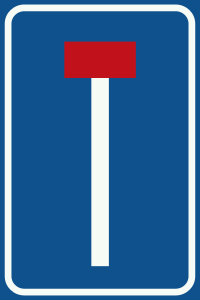 Dead end street.
Traffic sign L8 • No through road.
🔗 Sources
🔗 Github.com • NDW (MIT)
🔗 Commons.wikimedia.org
🔗 Wetten.overheid.nl • RVV 1990, bijlage 1
Nederlands • Verkeersbord L8 • Doodlopende weg.
Can pedestrians or cyclists continue beyond a motor-traffic dead end in the Netherlands?
Read any supplementary pedestrian or cycle information and the signs on the route. A motor-traffic dead end can still connect to a lawful path, but that access is not automatic for every vehicle.
🔗 government.nl • Dutch Government, road rules and signs — RVV articles 19, 54, 62; Annex 1 L8/L9
🔗 wetten.overheid.nl • RVV 1990 — official Dutch legislative reference
Does a dead-end indication change speed or priority rules in the Netherlands?
The no-through information itself does not assign junction priority or a numerical speed limit. Continue to obey the actual speed, access, parking and priority controls. If you need to turn around, use a suitable lawful place, check for pedestrians and cyclists, and do not obstruct the space needed for other vehicles to turn.
🔗 government.nl • Dutch Government, road rules and signs — RVV articles 19, 54, 62; Annex 1 L8/L9
🔗 wetten.overheid.nl • RVV 1990 — official Dutch legislative reference


