

ChevronWallonia
 Traffic rules
 Wallonia
33. Chevron
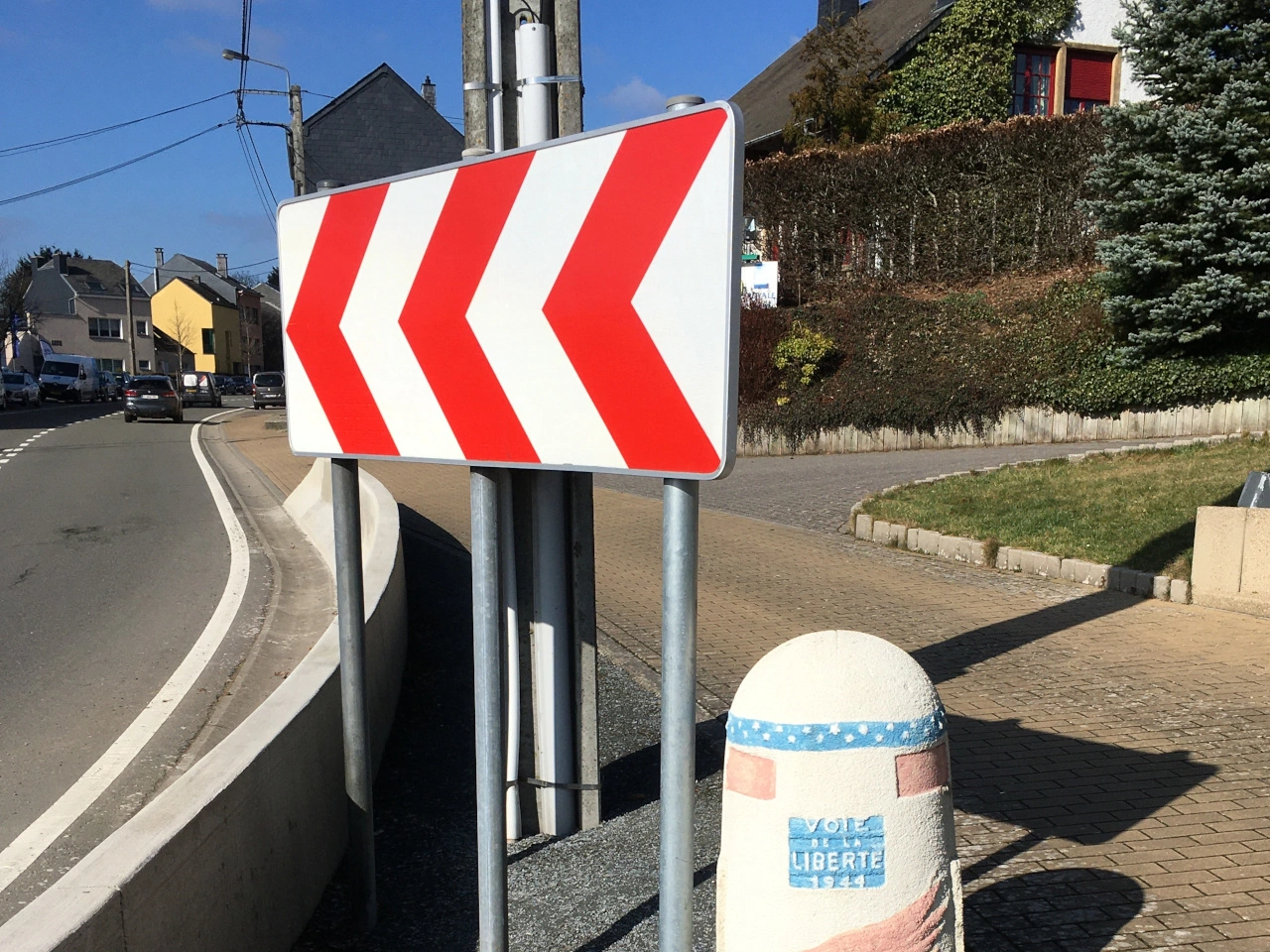
A chevron is a V-shaped or arrow-shaped road marker used to show a sharp change in the direction of a road. Chevron boards are normally placed along the outside of a curve so that their points indicate the direction in which the road continues.
Chevrons improve the visibility and alignment of a curve, especially in darkness or poor weather. They do not normally impose a speed limit or determine priority, so drivers must reduce speed before the curve and follow all other signs and road markings.
Wikimedia.org • ARLONVIRTON • CC BY-SA
What is a chevron board in Belgium?
A Belgian chevron board is a rectangular road-alignment panel displaying a large red chevron on a contrasting light background. It helps drivers follow the direction of a curve.
Which direction does a Belgian chevron point?
The point of the red chevron indicates the direction in which the curve continues. A left-pointing chevron marks a curve to the left and a right-pointing chevron marks a curve to the right.
Is a Belgian chevron an official A1 curve-warning sign?
No. The official dangerous-curve warning signs are A1a, A1b, A1c and A1d. Chevron boards are road-alignment devices used to make the curve itself more visible.
What is the difference between A1 and chevron boards?
An A1 sign warns before the dangerous curve. Chevron boards are placed in or around the curve to show its alignment and guide drivers while they negotiate it.
Do Belgian chevrons have a traffic-sign number?
No separate Highway Code number is assigned to them like A1a or A1b. They are technical road-signing and delineation equipment installed by the road authority.
Where are Belgian chevrons placed?
They are normally positioned along the outside of the curve so that approaching drivers can clearly see the direction of the road.
Must the first chevrons be visible before the curve?
Yes. Belgian regional guidance recommends that the first chevrons be visible while drivers are still approaching the curve.
Are chevrons normally repeated throughout the curve?
Yes. They generally guide drivers along the full length of the curve and continue towards its exit, unless the danger is limited to only part of it.
What is a single-chevron board?
A single-chevron board displays one large chevron. Several individual boards may be spaced along the curve to trace its alignment.
What is a multiple-chevron board?
A multiple-chevron board displays several chevrons on one longer panel. In Belgian regional practice, these are used less frequently than separate single-chevron boards.
When may a multiple-chevron board be useful?
It may be useful at a short curve, beside a particular obstacle or immediately before a critical tightening of the curve.
Does the spacing between Belgian chevrons remain constant?
Not always. Their spacing depends on the radius and layout of the curve. Sharper curves may require the boards to be placed closer together.
How large are Belgian single-chevron boards?
The normal basic format used in Walloon technical guidance is approximately 900 × 900 mm. Smaller formats may be used on lower-speed roads, inside built-up areas or where available space is limited.
Can Belgian chevrons have a fluorescent border?
Yes. On a particularly high-risk curve, a fluorescent yellow surround may be used to increase their visibility.
Can Belgian chevrons be illuminated?
Yes. Illuminated chevrons may be used as an additional measure at curves with a significant safety risk.
Do Belgian chevrons impose a speed limit?
No. They guide drivers through the curve. Only an applicable C43 sign, speed zone or general road rule establishes the legal maximum speed.
Must you still reduce speed?
Yes, when necessary. Belgian drivers must adapt their speed to the road layout, visibility, weather, traffic and vehicle condition and remain able to stop before a foreseeable obstruction.
Do chevrons give you priority?
No. They do not change priority at an intersection or against oncoming traffic.
May you cross a continuous centre line beside chevrons?
No. Drivers may not cross a continuous white line or drive to its left when it separates opposing directions of traffic.
May you overtake in a curve marked by chevrons?
Specified left-side overtaking is prohibited when visibility in the curve is insufficient. The chevrons themselves do not create the prohibition, but they often identify a location where overtaking would be unsafe.
May you stop or park in a chevron-marked curve?
Stopping and parking on the carriageway are prohibited where visibility in the curve is insufficient. A vehicle may also not create danger or unnecessary obstruction.
How should motorcyclists follow Belgian chevrons?
Look through the curve, select a suitable speed beforehand and maintain a stable line. Both the rider and motorcycle must remain within the correct part of the carriageway.
Does a chevron show the exact shape of the curve?
No. It provides directional guidance. Drivers must still observe the road because the curve may tighten, open out or change gradient.
Will Belgium’s new road code change the meaning of chevrons?
Chevron boards remain road-alignment equipment rather than a separate numbered regulatory sign. The general obligations to adapt speed, remain within the correct road position and obey curve signs and markings continue to apply.


