

Speed limitWallonia
 Traffic rules
 Wallonia
7. Speed limit
A speed limit is the maximum legal speed permitted on a road, lane or within a designated area. It may be established by general traffic law or indicated by fixed, variable or temporary traffic signs.
A speed limit is a maximum, not a target speed. Drivers must travel more slowly whenever traffic, visibility, weather, road conditions, vulnerable road users or the condition of the vehicle make the maximum permitted speed unsafe.
Wikimedia.org • Jeanhousen • CC BY-SA
How is a speed limit indicated in Belgium?
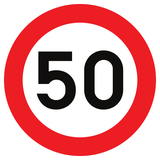
A local maximum speed is normally indicated by traffic sign C43, a circular sign displaying the permitted speed. It is prohibited to drive faster than the number shown. The end of a speed restriction imposed by sign C43 may be indicated by traffic sign C45.
🔗 codex.vlaanderen.be • Belgian Road Code — articles 10, 11, 22bis, 65.5 and 68.3 (C43/C45)
🔗 wegcode.be • Belgian Road Code of 1 December 1975 — 10, 11, 22bis, 65.5 and 68.3 (C43/C45)
🔗 be.brussels • Brussels Mobility — City 30 and residential-area speeds
🔗 securotheque.wallonie.be • SPW Sécurothèque — C43 and zonal validity
What are the general Belgian speed limits?
Built-up areas: The general limit is 30 km/h in the Brussels-Capital Region and 50 km/h in the Flemish and Walloon Regions. Traffic signs or special road rules may impose or permit another speed.
Flanders, outside built-up areas: For cars and other vehicles with a maximum authorised mass not exceeding 3.5 tonnes, the general limit on ordinary roads is 70 km/h. A C43 sign may impose or permit another limit. Physically divided roads with at least two lanes in each direction may allow up to 120 km/h.
Wallonia, outside built-up areas: For cars and other vehicles with a maximum authorised mass not exceeding 3.5 tonnes, the general limit on ordinary roads is 90 km/h. The limit is 70 km/h on a middle carriageway. Traffic signs and vehicle-specific rules may impose a lower limit.
Brussels, outside built-up areas: On ordinary roads outside built-up areas, the general maximum speed is 70 km/h. Physically divided roads with at least two lanes in each direction may legally allow up to 120 km/h, although lower signed limits are widely used.
Motorways: The general maximum for vehicles and combinations with a maximum authorised mass not exceeding 3.5 tonnes is 120 km/h. Lower signed, variable or vehicle-specific limits take precedence.
Vehicle-specific limits: Yes. Vehicle-specific limits apply to buses, coaches, heavy vehicles and certain other vehicles. For example, vehicles and combinations exceeding 3.5 tonnes and buses are generally limited to 90 km/h on motorways.
🔗 codex.vlaanderen.be • Belgian Road Code — articles 10, 11, 22bis, 65.5 and 68.3 (C43/C45)
🔗 wegcode.be • Belgian Road Code of 1 December 1975 — 10, 11, 22bis, 65.5 and 68.3 (C43/C45)
🔗 be.brussels • Brussels Mobility — City 30 and residential-area speeds
🔗 securotheque.wallonie.be • SPW Sécurothèque — C43 and zonal validity
Which limit applies when several speed rules apply?
First identify the speed limit legally applicable to the road and vehicle. A C43 sign may permit a higher speed than the ordinary regional default: for example, 90 km/h on a Flemish rural road that would otherwise have a 70 km/h limit. However, any lower vehicle-specific limit or other applicable special restriction must still be respected.
🔗 codex.vlaanderen.be • Belgian Road Code — articles 10, 11, 22bis, 65.5 and 68.3 (C43/C45)
🔗 wegcode.be • Belgian Road Code of 1 December 1975 — 10, 11, 22bis, 65.5 and 68.3 (C43/C45)
🔗 be.brussels • Brussels Mobility — City 30 and residential-area speeds
🔗 securotheque.wallonie.be • SPW Sécurothèque — C43 and zonal validity
When does a speed limit imposed by an ordinary sign end in Belgium?
An ordinary speed-limit sign applies through the next intersection, unless it ends earlier at another speed-limit sign, a zonal speed sign, a sign marking the beginning or end of a built-up area, residential area or pedestrian zone, or an end-of-speed-limit sign.
🔗 codex.vlaanderen.be • Belgian Road Code — articles 10, 11, 22bis, 65.5 and 68.3 (C43/C45)
🔗 wegcode.be • Belgian Road Code of 1 December 1975 — 10, 11, 22bis, 65.5 and 68.3 (C43/C45)
🔗 be.brussels • Brussels Mobility — City 30 and residential-area speeds
🔗 securotheque.wallonie.be • SPW Sécurothèque — C43 and zonal validity
Does an intersection end a Belgian speed zone?
No. A zonal speed limit continues across intersections until the corresponding end-of-zone sign is passed.
🔗 codex.vlaanderen.be • Belgian Road Code — articles 10, 11, 22bis, 65.5 and 68.3 (C43/C45)
🔗 wegcode.be • Belgian Road Code of 1 December 1975 — 10, 11, 22bis, 65.5 and 68.3 (C43/C45)
🔗 be.brussels • Brussels Mobility — City 30 and residential-area speeds
🔗 securotheque.wallonie.be • SPW Sécurothèque — C43 and zonal validity


