


Traffic rulesSpain
 Traffic rules
 Argentina
 Australia
 Austria
 Bangladesh
 Belgium
 Bosnia and Herzegovina
 Brazil
 Canada
 Chile
 China
 Colombia
 Czechia
 Denmark
 Finland
 France
 Germany
 Greece
 Hungary
 Iceland
 India
 Indonesia
 Ireland
 Italy
 Japan
 Malaysia
 Mexico
 Nepal
 Netherlands
 New Zealand
 Norway
 Panama
 Peru
 Philippines
 Poland
 Portugal
 Romania
 Russia
 Serbia
 Slovakia
 Slovenia
 South Africa
 Spain
 Sweden
 Switzerland
 Thailand
 Turkey
 Ukraine
 United Kingdom
 United States
 Uruguay
 Worldwide
1. Spain
Spain occupies most of the Iberian Peninsula in southwestern Europe, bordering Portugal, France and Andorra, and also includes the Balearic and Canary Islands. Traffic drives on the right. The road environment ranges from high-capacity motorways and dry interior plateaus to Pyrenean mountain roads and densely travelled Mediterranean coastal corridors. Spanish is used nationwide on road signs, while in autonomous communities with another official language, written road-sign information is also displayed in that co-official language.
Spain has an extensive network of autopistas and autovías, but there is no nationwide motorway vignette; most major routes are free, while tolls remain on certain motorway sections. Urban driving increasingly requires attention to low-emission zones (ZBE), whose access rules are determined locally. Spain also introduced an important safety change in 2026: since 1 January 2026, vehicles subject to Spanish equipment rules use a certified connected V16 emergency beacon instead of warning triangles when immobilised on the road.
AI-generated by Traffic-rules.com • WCIT • CC BY-SA
Which number can you call in an emergency in Spain?
Call 112 for urgent emergency assistance. Give the operator your location and explain what happened.
🔗 administracion.gob.es • Spanish Government, emergency services through 112
What alcohol limits apply to drivers in Spain?
General rule: The general maximum is 0.5 g/l in blood or 0.25 mg/l in breath. The DGT stresses that the only completely safe alcohol level for driving is zero.
Lower limits and exceptions: Novice and specified professional drivers are limited to 0.3 g/l in blood or 0.15 mg/l in breath. Drivers who are minors are subject to zero alcohol.
🔗 dgt.es • Spanish DGT, alcohol and drug checks, 13 July 2026
What speed limits apply to passenger cars in Spain?
Built-up areas: Spain uses different general urban limits according to the street layout: 20 km/h on streets where the carriageway and pavement form a single level, 30 km/h on streets with one traffic lane in each direction, and 50 km/h on streets with two or more lanes in each direction, unless signs establish another limit.
Conventional rural roads: For ordinary passenger cars and motorcycles, the general maximum on conventional roads outside built-up areas is 90 km/h, unless signs establish another limit.
Motorways: For ordinary passenger cars and motorcycles, the general maximum on autopistas and autovías is 120 km/h, unless a lower limit is signed.
What are the seat-belt and child-restraint rules in Spain?
Seat belts are compulsory for drivers and passengers in seats equipped with them, subject to limited legal exemptions.
Children 135 cm tall or shorter must use an approved child restraint suited to their height and weight and normally travel on a rear seat. Front-seat travel with the correct restraint is allowed only when there are no rear seats, all rear seats are occupied by children subject to the same rule, or the required restraints cannot all be installed there.
A rear-facing seat in front requires the frontal airbag to be deactivated. A limited taxi exemption permits rear-seat travel without a child restraint for children shorter than 135 cm on urban journeys; it does not cover travel on motorways or ordinary interurban roads.
Can you use a mobile phone while driving in Spain?
Handheld mobile-phone use while driving is prohibited. Ordinary hands-free communication must not involve headphones or similar devices. A separate exception permits certified or approved wireless devices integrated into motorcycle or moped helmets for intercommunication or navigation, provided they do not affect driving safety. All permitted use remains subject to the duty to pay attention and keep control.
What safety equipment must a Spanish car carry?
A Spanish-registered passenger car subject to these rules must carry a certified connected V16 beacon, a high-visibility reflective vest, and a spare wheel with the necessary tools or an acceptable alternative tyre-mobility system. Since 1 January 2026, a non-connected beacon is not the required warning device. Foreign-registered vehicles in international circulation may continue to comply using warning triangles under the applicable convention rules.
🔗 dgt.es • Official national authority, claim-specific guidance
Can a visitor use a driving licence issued in another EU country in Spain?
Yes. A valid, full EU driving licence is recognised for the vehicle categories it covers. You must meet the applicable minimum age. A learner licence or a temporary replacement certificate does not have the same automatic recognition.
Are motorcycle helmets compulsory in Spain?
Yes. On an ordinary, open motorcycle, both the rider and passenger must wear a protective helmet. Use a helmet that meets the applicable approval requirements and fasten it correctly. Check the specific rules before relying on an exemption for an enclosed or specially equipped vehicle.

2. Motorway
A motorway is a road specially designed and signposted for motor traffic. Motorways normally have separate carriageways for opposing traffic, controlled access through designated entrances and exits, no direct access to neighbouring properties, and no level crossings with other roads, railways or paths.
Special traffic rules apply on motorways. The permitted road users, speed limits, lane rules, tolls and emergency procedures vary between countries, so drivers must follow the local traffic signs and regulations.

Wikimedia.org • auriensano • CC BY-SA
How do people refer to a motorway in Spain?
Spanish rules distinguish autopista and autovía. Both have special high-speed-road rules, but their access provisions are not identical. Check the road category and signs.
🔗 boe.es • Spain: official sign catalogue, Royal Decree 465/2025
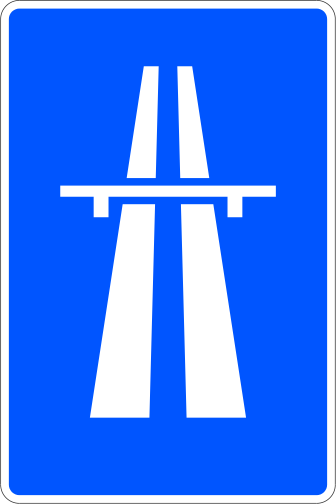 Start of a motorway.
English • Traffic sign S-1 • Motorway. Marks the beginning of a motorway and its special traffic rules. May also identify a junction branch leading to a motorway.
Español • S-1 • Autopista. Indica el principio de una autopista y, por tanto, el lugar a partir del cual se aplican las reglas especiales de circulación en este tipo de vía. Puede indicar también el ramal de un nudo que conduce a una autopista.
Sources
🔗 Commons.wikimedia.org
🔗 Boe.es • Reglamento General de Circulación • anexo I • catálogo vigente
🔗 Boe.es • Real Decreto 465/2025 • S-1 • página 72
SVG source: No machine-readable author provided. Benedicto16 assumed (based on copyright claims). • Public domain • Original revision 2026-01-11. Wikimedia original unmodified.
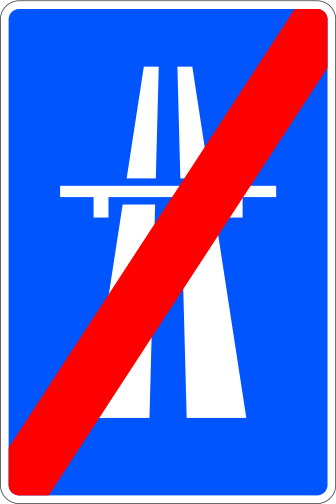 End of the motorway.
English • Traffic sign S-2 • End of motorway. Marks the end of a motorway.
Español • S-2 • Fin de autopista. Indica el final de una autopista.
Sources
🔗 Commons.wikimedia.org
🔗 Boe.es • Reglamento General de Circulación • anexo I • catálogo vigente
🔗 Boe.es • Real Decreto 465/2025 • S-2 • página 72
SVG source: No machine-readable author provided. Benedicto16 assumed (based on copyright claims). • Public domain • Original revision 2026-01-11. Wikimedia original unmodified.
What speed limit applies to cars on a motorway in Spain?
For an ordinary passenger car without a trailer, the general maximum outside built-up areas is 120 km/h on an autopista or autovía. Within a settlement, the general motorway or autovía maximum is 80 km/h unless an authorised signed change applies. Obey lower restrictions and reduce speed for the conditions.
🔗 boe.es • Spain: official sign catalogue, Royal Decree 465/2025
Can cyclists use Spanish motorways or expressways?
Cyclists cannot use an autopista. On an autovía, cyclists aged over 14 may use the shoulder unless a sign prohibits cycling. Pedestrians and mopeds cannot use these roads. Do not assume the two road categories have identical access rules.
🔗 boe.es • Spain: official sign catalogue, Royal Decree 465/2025
Is there a minimum driving speed on Spanish motorways?
The normal minimum on motorways and expressways is 60 km/h, subject to justified exceptions such as traffic or safety conditions. If an emergency forces abnormally slow driving, leave at the first exit rather than continuing along the high-speed road.
🔗 boe.es • Spain: official sign catalogue, Royal Decree 465/2025
3. Residential area
A residential area is a street or group of streets where housing and access to local properties are the main functions. Drivers should expect pedestrians, cyclists, children, parked vehicles and vehicles entering or leaving driveways.
Some countries identify particular residential areas with traffic signs and apply special low-speed and residential-area rules. The speed limit, pedestrian rights, parking rules and permitted road users therefore depend on local signs and regulations.
Wikimedia.org • Pacopac • CC BY-SA
How do people refer to a residential area in Spain?
The current Spanish sign catalogue distinguishes zona de estancia y juego and zona de coexistencia. Older material may use calle residencial; the current categories have different speed and play rules.
🔗 boe.es • Spain: official sign catalogue, Royal Decree 465/2025
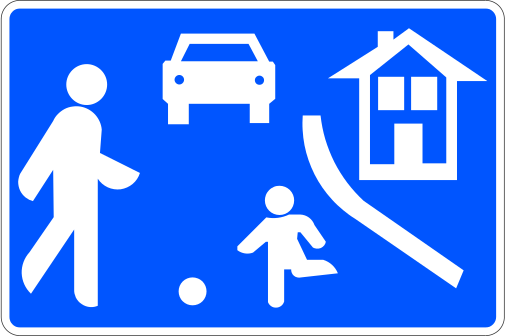 Start of a residential area.
English • Traffic sign S-28 • Residential area for staying and playing. Marks an area intended primarily for pedestrians, with these special rules: maximum vehicle speed is 10 km/h and drivers must give pedestrians priority; vehicles may park only in places designated by signs or markings; cycles and, where applicable, personal mobility vehicles (VMP) may travel in both directions unless the competent authority decides otherwise; pedestrians may use the entire traffic area, so pedestrian crossings are not marked; games and sports are permitted. Always accompanied by sign R-301 limiting speed to 10 km/h.
Español • S-28 • Zona de estancia y juego. Indica las zonas de circulación que están destinadas en primer lugar a los peatones y en las que se aplican las normas especiales de circulación siguientes: la velocidad máxima de los vehículos está fijada en 10 kilómetros por hora y los conductores deben conceder prioridad a los peatones; los vehículos pueden estacionarse únicamente en los lugares designados por señales o por marcas; los ciclos y, en su caso, los VMP, pueden circular en ambos sentidos, salvo que la autoridad competente establezca lo contrario; los peatones pueden utilizar toda la zona de circulación y por tanto no se señalizan los pasos peatonales; los juegos y los deportes están autorizados en ella. Irá siempre acompañada de la señal R-301 que limitará la velocidad a 10 km/h.
Sources
🔗 Commons.wikimedia.org
🔗 Boe.es • Reglamento General de Circulación • anexo I • catálogo vigente
🔗 Boe.es • Real Decreto 465/2025 • S-28 • página 80
SVG source: No machine-readable author provided. Benedicto16 assumed (based on copyright claims). • Public domain • Original revision 2025-11-30. Wikimedia original unmodified.
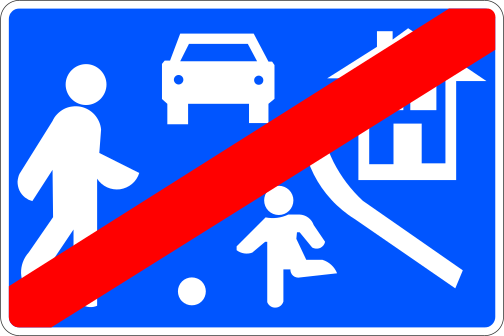 End of the residential area.
English • Traffic sign S-29 • End of residential area for staying and playing. The general traffic rules apply again.
Español • S-29 • Fin de zona de estancia y juego. Indica que se aplican de nuevo las normas generales de circulación.
Sources
🔗 Commons.wikimedia.org
🔗 Boe.es • Reglamento General de Circulación • anexo I • catálogo vigente
🔗 Boe.es • Real Decreto 465/2025 • S-29 • página 80
SVG source: No machine-readable author provided. Benedicto16 assumed (based on copyright claims). • Public domain • Original revision 2025-11-30. Wikimedia original unmodified.
What speed limit applies in a residential area in Spain?
The current category intended for staying and playing has a 10 km/h maximum and its entrance sign must be accompanied by a 10 km/h speed-limit sign. The separately signed coexistence category has a 20 km/h maximum. Read the actual entrance controls; ordinary residential streets follow the relevant urban limits.
🔗 boe.es • Spain: official sign catalogue, Royal Decree 465/2025
What rights do pedestrians have in a signposted residential area in Spain?
In both specially signposted categories, pedestrians have priority and may use the whole circulation area. Games and sports are allowed in the category intended for staying and playing, but not in the separately designated coexistence category.
🔗 boe.es • Spain: official sign catalogue, Royal Decree 465/2025
Where may I park in a residential area in Spain?
In both specially signposted categories, vehicles may park only in places designated by signs or markings. A low-speed surface is not unrestricted parking.
🔗 boe.es • Spain: official sign catalogue, Royal Decree 465/2025
4. Zone
A traffic zone is an area in which a traffic rule applies throughout all included roads or road sections. The rule normally begins at a zone-entry sign and remains applicable until the corresponding end-of-zone sign is passed.
Zones may regulate speed, parking, access, vehicle categories, emissions or other traffic behaviour. The signs used, the roads covered and the effect of intersections or local exceptions depend on local traffic law.

Wikimedia.org • Daniel Capilla • CC BY-SA
How do people refer to traffic zones in Spain?
Spanish traffic arrangements use terms such as zona peatonal for a pedestrian zone and zona de coexistencia for a zone with special rules for vehicles, cyclists and pedestrians. Read the current sign and any access conditions.
🔗 boe.es • Spain: official sign catalogue, Royal Decree 465/2025
🔗 boe.es • Spain: Royal Decree 465/2025, transitional clause and commencement
🔗 diba.cat • Spain: Barcelona road authority, official withdrawn-sign list, page 25
Where does a zone rule apply in Spain?
Apply the specific category shown at the entrance. A road with an ordinary 30 km/h limit is not automatically a pedestrian-priority zone, and a low-emission zone principally concerns vehicle access rather than one universal speed.
🔗 boe.es • Spain: official sign catalogue, Royal Decree 465/2025
🔗 boe.es • Spain: Royal Decree 465/2025, transitional clause and commencement
🔗 diba.cat • Spain: Barcelona road authority, official withdrawn-sign list, page 25
Can I rely on the older Spanish Zone 30 sign as the current national zone category?
The sign catalogue changed on 1 July 2025. The old Zone 30 sign was removed, and withdrawn signs had to be removed within one year. Follow the current speed and area signs; an older photograph does not establish today’s rules.
🔗 boe.es • Spain: official sign catalogue, Royal Decree 465/2025
🔗 boe.es • Spain: Royal Decree 465/2025, transitional clause and commencement
🔗 diba.cat • Spain: Barcelona road authority, official withdrawn-sign list, page 25
How do you know when a traffic zone ends in Spain?
Use the appropriate end sign or the stated boundary of the current restriction. Check speed, access and pedestrian arrangements separately: the end of one does not cancel every restriction on the adjoining street.
🔗 boe.es • Spain: official sign catalogue, Royal Decree 465/2025
🔗 boe.es • Spain: Royal Decree 465/2025, transitional clause and commencement
🔗 diba.cat • Spain: Barcelona road authority, official withdrawn-sign list, page 25
5. Speed limit
A speed limit is the maximum legal speed permitted on a road, lane or within a designated area. It may be established by general traffic law or indicated by fixed, variable or temporary traffic signs.
A speed limit is a maximum, not a target speed. Drivers must travel more slowly whenever traffic, visibility, weather, road conditions, vulnerable road users or the condition of the vehicle make the maximum permitted speed unsafe.
Wikimedia.org • Sukkoria • CC BY-SA
Which general speed limits should car drivers know in Spain?
For ordinary cars, urban defaults are 20 km/h where pavement and carriageway share one level, 30 km/h with one traffic lane in each direction, and 50 km/h with two or more in each direction. Rural defaults are 90 km/h on conventional roads and 120 km/h on motorways. Authorised signs and specific road-category exceptions can establish another limit.
🔗 boe.es • Spain: official sign catalogue, Royal Decree 465/2025
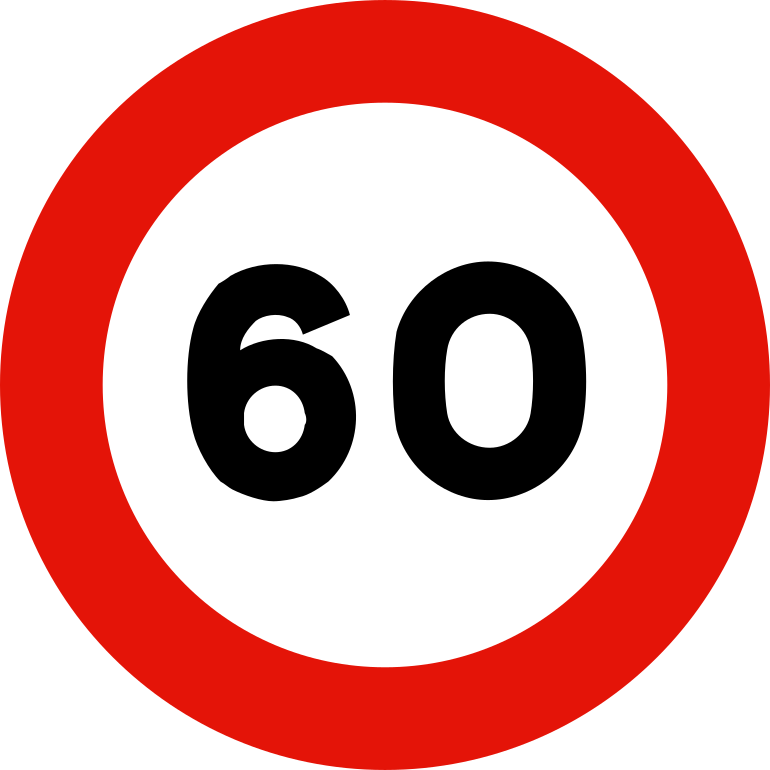 Start of a speed limit.
English • Traffic sign R-301 • Maximum speed. Drivers must not exceed the indicated speed in km/h. Applies from the sign to the next ‘End of speed limit’, ‘End of prohibitions’ or ‘Maximum speed’ sign. If mounted on the same post or panel as a danger warning sign, it ends when that danger ends. On a non-priority road, it ceases to apply after leaving a junction with a priority road. If the indicated limit matches the general limit for the road type, it serves as a general reminder not to exceed it.
Español • R-301 • Velocidad máxima. Prohibición de circular a velocidad superior, expresada en kilómetros por hora, a la indicada en la señal. Obliga desde el lugar en que esté situada hasta la próxima señal «Fin de limitación de velocidad», de «Fin de prohibiciones» u otra de «Velocidad máxima», salvo que esté colocada en el mismo poste que una señal de advertencia de peligro o en el mismo panel que esta, en cuyo caso la prohibición finaliza cuando termine el peligro señalado. Situada en una vía sin prioridad, deja de tener vigencia al salir de una intersección con una vía con prioridad. Si el límite indicado por la señal coincide con la velocidad máxima permitida para el tipo de vía, recuerda de forma genérica la prohibición de superarla.
Sources
🔗 Commons.wikimedia.org
🔗 Boe.es • Reglamento General de Circulación • anexo I • catálogo vigente
🔗 Boe.es • Real Decreto 465/2025 • R-301 • página 55
Image via Commons.wikimedia.org
Majafego • Public domain • Source revision 2011-02-26. Wikimedia original unmodified.
 End of the speed limit.
English • Traffic sign R-501 • End of speed limit. Marks where a previous maximum speed sign ceases to apply.
Español • R-501 • Fin de la limitación de velocidad. Señala el lugar desde donde deja de ser aplicable una señal anterior de velocidad máxima.
Sources
🔗 Commons.wikimedia.org (Gigillo83 • CC BY-SA 3.0)
🔗 Boe.es • Reglamento General de Circulación • anexo I • catálogo vigente
🔗 Boe.es • Real Decreto 465/2025 • R-501 • página 68
SVG source: Gigillo83 • CC BY-SA 3.0 • Original revision 2014-10-02. Wikimedia original unmodified.
May I exceed the Spanish limit by 20 km/h when overtaking?
No. The former 20 km/h allowance for cars and motorcycles overtaking on conventional roads was removed. An overtaking manoeuvre must remain within the applicable limit; an older handbook describing that allowance is out of date.
🔗 boe.es • Spain: official sign catalogue, Royal Decree 465/2025
Are reserved lanes counted when deciding Spain’s general urban limit?
Lanes reserved for particular users or public transport are not counted when deciding whether the urban default is based on one or two traffic lanes in each direction. Read the actual layout and signs; a bus lane does not automatically turn a 30 km/h street into a 50 km/h street.
🔗 boe.es • Spain: official sign catalogue, Royal Decree 465/2025
6. Bike path
A bike path is a part of a road or a separate route intended primarily or exclusively for people riding bicycles. It may be physically separated from motor traffic, marked on the road surface or identified by traffic signs.
Bike paths may be one-way, two-way or shared with other road users. The permitted users, direction of travel, priority rules and obligation to use the path depend on local traffic signs and regulations.
Wikimedia.org • Benjamín Núñez González • CC BY-SA
Must cyclists use every Spanish cycling facility?
The current Regulations specify preferential use of cycling infrastructure. The competent authority may make a particular facility compulsory using the round bicycle sign. Check that sign and local regulation instead of assuming every marked route is mandatory.
🔗 boe.es • General Traffic Regulations, Arts 152–153; cycle-facility definitions
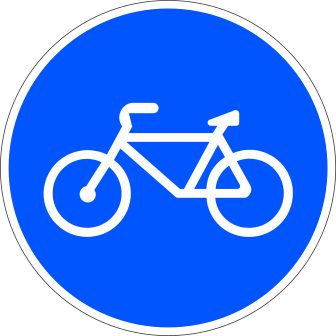 Mandatory path for cyclists.
English • Traffic sign R-407a • Reserved compulsory cycle route. Cycle riders must use the route at whose entrance the sign stands; other road users must not use it.
Español • R-407a • Vía reservada y obligatoria para ciclos. Obligación para los conductores de ciclos de circular por la vía a cuya entrada esté situada y prohibición a los demás usuarios de la vía de utilizarla.
Sources
🔗 Commons.wikimedia.org
🔗 Boe.es • Reglamento General de Circulación • anexo I • catálogo vigente
🔗 Boe.es • Real Decreto 465/2025 • R-407a • página 63
SVG source: NACLE2 • CC0 • Original revision 2025-09-17. Wikimedia original unmodified.
How does Spain distinguish a separate cycle track from a cycle lane?
A pista-bici is a cycle track independent of motor traffic. A carril-bici is a cycle lane running alongside the carriageway. A senda ciclable is a walking and cycling route separated from motor traffic.
🔗 boe.es • General Traffic Regulations, Arts 152–153; cycle-facility definitions
🔗 boe.es • Road Traffic Act 6/2015, Annex I, definitions 58–59 and 74–79, effective 1 October 2026
Does a Spanish cycle route make nearby pedestrian areas available for riding?
No. Pavements and other pedestrian areas have separate rules. Municipal ordinances govern permitted cycling in relevant pedestrian areas, and cyclists must respect pedestrian priority where access is allowed. Follow the designated cycling surface rather than treating the adjoining pavement as part of it.
🔗 boe.es • General Traffic Regulations, Arts 152–153; cycle-facility definitions
7. Pedestrian warning
A pedestrian warning is a traffic warning indicating that pedestrians may be crossing or entering the roadway ahead. It is commonly used near pedestrian crossings or other locations where drivers need advance notice of frequent pedestrian activity.
Drivers approaching a pedestrian warning should reduce speed when necessary, watch carefully for pedestrians and be prepared to stop. The design of the warning sign and the priority rules at the crossing vary between countries.

Wikimedia.org • Simon Burchell • CC BY-SA
How should I react to a pedestrian warning in Spain?
Reduce speed, look along both sides of the road and be ready to stop. The warning identifies a pedestrian hazard ahead; children, people with limited mobility or others may enter the road unexpectedly.
🔗 boe.es • Spain: General Traffic Regulation articles 45-46,65; catalogue P-20, S-13
🔗 boe.es • Spain: official sign catalogue, Royal Decree 465/2025
Does a pedestrian warning in Spain identify the crossing itself?
Not necessarily. An advance warning alerts you to danger ahead. The actual crossing is identified by its own signs, markings or signals. Apply the crossing rules when you reach it, and follow any supplementary distance information.
🔗 boe.es • Spain: General Traffic Regulation articles 45-46,65; catalogue P-20, S-13
🔗 boe.es • Spain: official sign catalogue, Royal Decree 465/2025
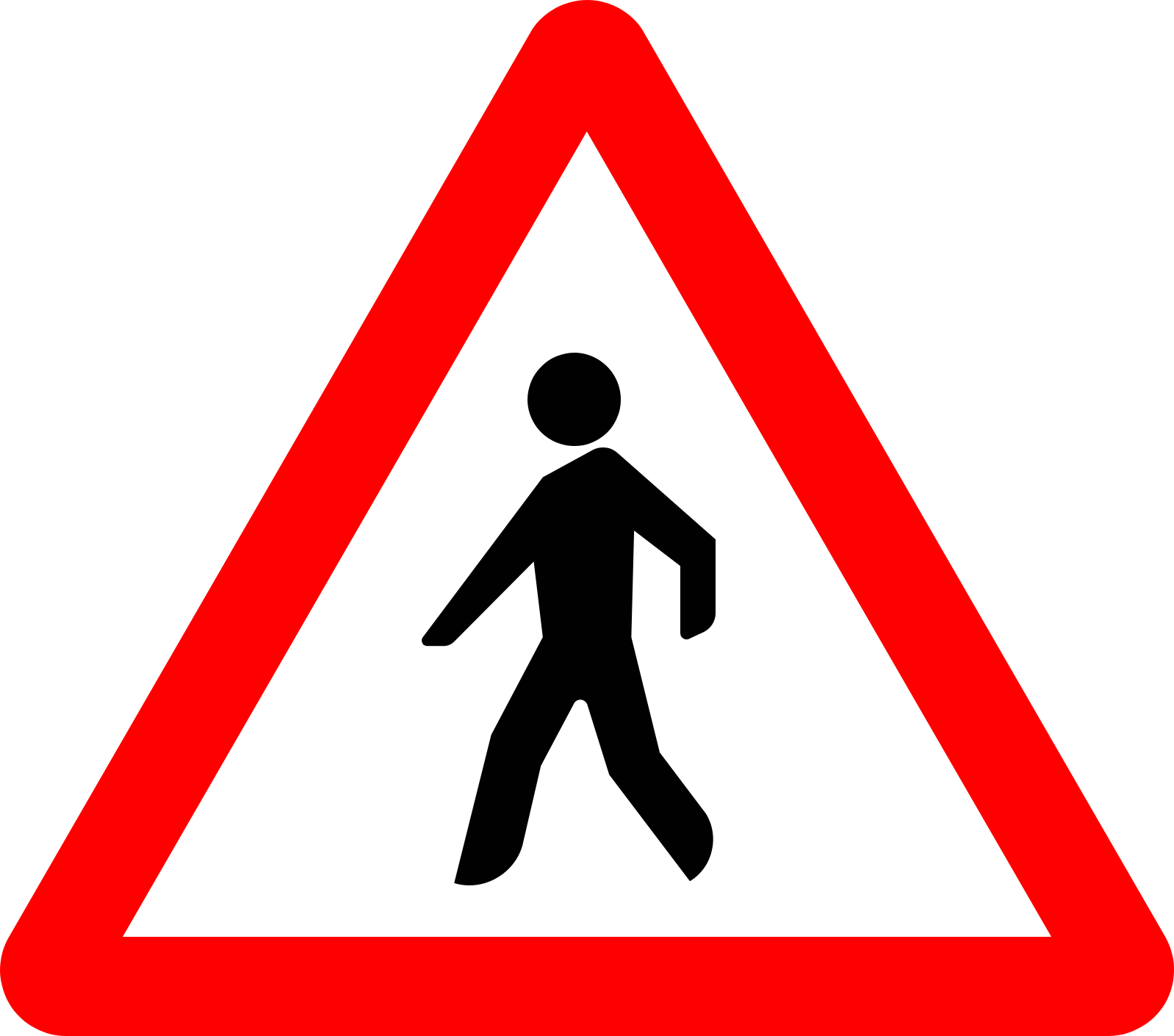 Warning for pedestrians.
English • Traffic sign P-20b • Pedestrians. Warns of a place or section with heavy pedestrian traffic.
Español • P-20b • Peatones. Peligro por la proximidad de un lugar o tramo con elevado tránsito de peatones.
Sources
🔗 Commons.wikimedia.org
🔗 Boe.es • Reglamento General de Circulación • anexo I • catálogo vigente
🔗 Boe.es • Real Decreto 465/2025 • P-20b • página 40
SVG source: No machine-readable author provided. Benedicto16 assumed (based on copyright claims). • Public domain • Original revision 2026-09-10. Wikimedia original unmodified.
What should drivers know about pedestrian crossings in Spain?
At a marked pedestrian crossing, drivers must give way to pedestrians. A turning driver must also yield to pedestrians crossing the road being entered, even when there is no marked crossing.
🔗 boe.es • Spain: General Traffic Regulation articles 45-46,65; catalogue P-20, S-13
🔗 boe.es • Spain: official sign catalogue, Royal Decree 465/2025
8. Tunnel
A tunnel is a covered passage that carries a road through or beneath an obstacle such as a hill, mountain, building, waterway or another transport route. Road tunnels may contain one or more traffic lanes and can carry traffic in one or both directions.
Driving in a tunnel requires particular attention because visibility, available escape routes and space for avoiding hazards are limited. Drivers should follow the applicable lighting, speed, lane and following-distance rules and pay attention to emergency exits, traffic signals and variable-message signs.

Wikimedia.org • Wouterhagens • CC BY-SA
What should I check before entering a tunnel in Spain?
Use dipped headlights, even in a lit tunnel. When not overtaking, keep at least 100 m or four seconds behind the vehicle ahead; for vehicles over 3.5 tonnes, the minimum is 150 m or six seconds.
🔗 boe.es • Spain: articles38,45-52,78-81,95-97,100-102; access restrictions
🔗 boe.es • Spain: official sign catalogue, RoyalDecree465/2025
Does a tunnel sign in Spain set a universal speed limit?
No single speed can be read from the tunnel pictogram. Apply the road’s relevant limit and any permanent or electronic speed restriction, and drive more slowly when visibility, queues or another hazard require it.
🔗 boe.es • Spain: articles38,45-52,78-81,95-97,100-102; access restrictions
🔗 boe.es • Spain: official sign catalogue, RoyalDecree465/2025
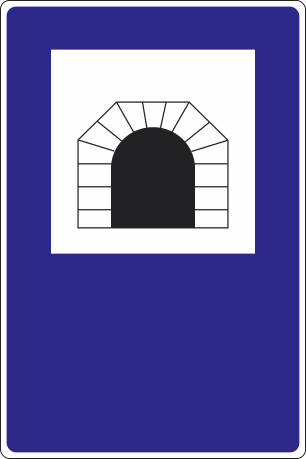 Start of a tunnel.
English • Traffic sign S-5 • Tunnel. Marks the beginning and, where applicable, the name of a tunnel, underpass or road section treated as a tunnel. Its length in metres may be shown at the bottom.
Español • S-5 • Túnel. Indica el principio y eventualmente el nombre de un túnel, de un paso inferior o de un tramo de vía equiparado a túnel. Podrá llevar en su parte inferior la indicación de la longitud del túnel en metros.
Sources
🔗 Commons.wikimedia.org
🔗 Boe.es • Reglamento General de Circulación • anexo I • catálogo vigente
🔗 Boe.es • Real Decreto 465/2025 • S-5 • página 73
SVG source: Original PNG by Benedicto16 • Public domain • Original revision 2015-07-26. Wikimedia original unmodified.
Is every tunnel in Spain open to pedestrians and cyclists?
No. Access depends on the road category and the signs at that tunnel. Check pedestrian, cycle and other vehicle restrictions before entering; a separate walking or cycling passage can have different controls. An emergency escape route does not by itself permit ordinary walking or cycling through the traffic tunnel.
🔗 boe.es • Spain: articles38,45-52,78-81,95-97,100-102; access restrictions
🔗 boe.es • Spain: official sign catalogue, RoyalDecree465/2025
9. Toll road
A toll road is a road, motorway, bridge, tunnel or other route for which users must pay a charge. The toll may apply to all vehicles or only to particular vehicle categories, and the amount can depend on factors such as distance travelled, vehicle type, weight or emissions.
Tolls may be collected at toll booths, electronically or through a vignette or distance-based charging system. Drivers should check the applicable payment rules before using a toll road, especially when travelling in another country.

Wikimedia.org • Adrián Estévez • CC BY-SA
Which road-charging system should I check in Spain?
Spain charges tolls on particular motorway sections rather than requiring a general passenger-car road vignette. A motorway’s status must be checked for the actual section; not every motorway is tolled.
🔗 administracion.gob.es • Spanish Government — motorway tolls and operator-specific charging
What should I check before using a charged road in Spain?
Use the route’s current operator and signs to identify the tariff and accepted manual or electronic payment. A toll paid on one section does not cover another concession or a separate local access charge.
🔗 administracion.gob.es • Spanish Government — motorway tolls and operator-specific charging
Does the absence of a toll booth prove that a road is free in Spain?
The absence of a payment booth is not proof that a charged road is free. A vignette, electronic account, vehicle-registration record or another payment procedure may be used where the actual scheme provides for it. Follow the responsible authority or operator’s instructions for that road.
🔗 administracion.gob.es • Spanish Government — motorway tolls and operator-specific charging
10. Quay
A quay is a constructed area beside a river, canal, harbour or other body of water, commonly used for loading, unloading, mooring vessels or providing waterside access. A road may run alongside the water or lead directly towards the quay edge.
In road traffic, a quay warning indicates a risk that a vehicle could leave the road and enter the water. Drivers should reduce speed, observe the road layout carefully and keep a safe distance from the waterside edge.

Wikimedia.org • Raimundo Pastor • CC BY-SA
What should I watch for near a quay or waterside road in Spain?
The quay warning identifies danger where the road leads into a quay or a body of water. Check where the carriageway ends or turns, watch the water edge and obey barriers and access controls. The warning gives no permission to enter or park in a restricted area.
🔗 boe.es • Spain: Regulation articles 45,90-94,132; catalogue P-27
🔗 boe.es • Spain: official sign catalogue, Royal Decree 465/2025
How should I choose a safe speed beside water in Spain?
Use the applicable road or local speed limit and slow further for the foreseeable waterside danger. A hazard warning is not a promise that driving at the maximum is safe. Keep enough visibility and control to avoid the edge, pedestrians, loading activity or a blocked route.
🔗 boe.es • Spain: Regulation articles 45,90-94,132; catalogue P-27
🔗 boe.es • Spain: official sign catalogue, Royal Decree 465/2025
Does a quay warning allow me to enter or park beside the water in Spain?
Check the actual access and parking restrictions, including any port or dock controls. A waterside warning does not provide permission to enter a restricted facility or park on the edge. Keep the required passage clear and use a permitted place without endangering traffic or people beside the water.
🔗 boe.es • Spain: Regulation articles 45,90-94,132; catalogue P-27
🔗 boe.es • Spain: official sign catalogue, Royal Decree 465/2025
11. Slope
A slope is a section of road that rises or descends noticeably. A steep slope can affect vehicle speed, braking distance, traction, visibility and the ability of heavy or low-powered vehicles to maintain a steady speed.
Warning signs may indicate a steep ascent or dangerous descent and may show the gradient as a percentage. Drivers should adjust their speed early, select a suitable gear and remain prepared for slow vehicles, bends and changing road conditions.

Wikimedia.org • Dura-Ace • CC BY-SA
What does a steep-slope warning mean in Spain?
Spanish warnings distinguish a dangerous descent and a steep ascent. A gradient shown as a percentage describes the road, while a speed-limit sign imposes a separate restriction.
🔗 boe.es • Spain: Regulation articles 45,60-63,87; catalogue P-16a,P-16b
🔗 boe.es • Spain: official sign catalogue, Royal Decree 465/2025
 Warning for a steep ascent.
English • Traffic sign P-16b • Steep ascent. Warns of a steep uphill section. The figure gives the gradient as a percentage.
Español • P-16b • Subida con fuerte pendiente. Peligro por la existencia de un tramo de vía con fuerte pendiente ascendente. La cifra indica la inclinación de la pendiente en porcentaje.
Sources
🔗 Commons.wikimedia.org
🔗 Boe.es • Reglamento General de Circulación • anexo I • catálogo vigente
🔗 Boe.es • Real Decreto 465/2025 • P-16b • página 39
Image via Commons.wikimedia.org
No machine-readable author provided. Benedicto16 assumed (based on copyright claims). • Public domain • Source revision 2006-09-07. Wikimedia original unmodified.
 Warning for a steep descent.
English • Traffic sign P-16a • Steep descent. Warns of a steep downhill section. The figure gives the gradient as a percentage.
Español • P-16a • Bajada con fuerte pendiente. Peligro por la existencia de un tramo de vía con fuerte pendiente descendente. La cifra indica la inclinación de la pendiente en porcentaje.
Sources
🔗 Commons.wikimedia.org
🔗 Boe.es • Reglamento General de Circulación • anexo I • catálogo vigente
🔗 Boe.es • Real Decreto 465/2025 • P-16a • página 39
Image via Commons.wikimedia.org
No machine-readable author provided. Benedicto16 assumed (based on copyright claims). • Public domain • Source revision 2006-09-07. Wikimedia original unmodified.
How should I approach a steep descent in Spain?
Reduce speed before the descent and select a suitable gear to help control the vehicle. Keep enough following distance and avoid building up speed that requires continuous heavy braking. A warning gives no fixed safe descent speed: the gradient, surface, visibility, load and vehicle can require a speed well below the legal maximum.
🔗 boe.es • Spain: Regulation articles 45,60-63,87; catalogue P-16a,P-16b
🔗 boe.es • Spain: official sign catalogue, Royal Decree 465/2025
What should I check when meeting or overtaking on a slope in Spain?
On a steep narrow section where vehicles cannot pass, priority normally belongs to the uphill vehicle unless it could reach a passing place first. The regulations treat a gradient of at least 7% as steep for this particular meeting rule; that is not a universal speed threshold.
🔗 boe.es • Spain: Regulation articles 45,60-63,87; catalogue P-16a,P-16b
🔗 boe.es • Spain: official sign catalogue, Royal Decree 465/2025
12. Dead end
A dead-end road is a road that does not provide a through route for some or all vehicles. It may end completely, terminate at a barrier or continue as a path that only certain road users may use.
Drivers may normally enter a dead-end road to reach homes, businesses, parking places or other destinations, but they must be prepared to turn around or leave by the same route. Signs may indicate that pedestrians or cyclists can continue beyond the point where motor traffic cannot.

Wikimedia.org • Basotxerri • CC BY-SA
What does a dead-end indication mean in Spain?
Spanish signs identify a calzada sin salida, including advance information before the junction. The sign describes the road layout rather than imposing a general entry ban.
🔗 boe.es • Spain: Regulation articles 45,78-81,90-94,132; catalogue S-15a-S-15e
🔗 boe.es • Spain: official sign catalogue, Royal Decree 465/2025
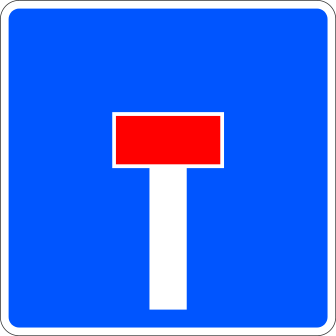 Dead end street.
English • Traffic sign S-15a • Dead-end carriageway. The carriageway shown with a red end has no through exit.
Español • S-15a • Calzada sin salida. Indica que la calzada que figura en la señal con un recuadro en rojo no tiene salida.
Sources
🔗 Commons.wikimedia.org
🔗 Boe.es • Reglamento General de Circulación • anexo I • catálogo vigente
🔗 Boe.es • Real Decreto 465/2025 • S-15a • página 76
SVG source: No machine-readable author provided. Benedicto16 assumed (based on copyright claims). • Public domain • Original revision 2026-01-11. Wikimedia original unmodified.
Can pedestrians or cyclists continue beyond a motor-traffic dead end in Spain?
Yes, where the actual route permits it. Spain has a dead-end variant that expressly excepts pedestrians or cycles and displays the relevant user pictograms. Follow those symbols and any controls on the continuation; they do not provide a through route for a car.
🔗 boe.es • Spain: Regulation articles 45,78-81,90-94,132; catalogue S-15a-S-15e
🔗 boe.es • Spain: official sign catalogue, Royal Decree 465/2025
Does a dead-end indication change speed or priority rules in Spain?
The no-through information itself does not assign junction priority or a numerical speed limit. Continue to obey the actual speed, access, parking and priority controls. If you need to turn around, use a suitable lawful place, check for pedestrians and cyclists, and do not obstruct the space needed for other vehicles to turn.
🔗 boe.es • Spain: Regulation articles 45,78-81,90-94,132; catalogue S-15a-S-15e
🔗 boe.es • Spain: official sign catalogue, Royal Decree 465/2025
13. Stop sign
A stop sign requires drivers to bring their vehicle to a complete stop and give way before entering or crossing the road ahead. The stop must be made at the stop line or another legally prescribed position.
After stopping, the driver may continue only when this can be done safely and without interfering with traffic that has priority. The sign does not create priority for the driver who has stopped.

Wikimedia.org • Joanbanjo • CC BY-SA
Must I stop completely at a stop sign in Spain?
Yes. Come to a complete stop when the applicable stop sign controls your approach, even when you cannot see another road user. Slowing to a crawl is not a stop. The stopping duty is separate from the duty to give way before continuing.
🔗 boe.es • General Traffic Regulation articles 56,58,132; catalogue R-2 and stop-line rules
 Stop and give way.
English • Traffic sign R-2 • Stop. Every driver must stop before the next stop line or, if none exists, immediately before the junction, and give way to vehicles on the road being approached. If exceptional circumstances mean visibility from the stopping point is insufficient, the driver must stop again where visibility is adequate without endangering any road user.
Español • R-2 • Detención obligatoria o stop. Obligación para todo conductor de detener su vehículo ante la próxima línea de detención o, si no existe, inmediatamente antes de la intersección, y ceder el paso en ella a los vehículos que circulen por la vía a la que se aproxime. Si, por circunstancias excepcionales, desde el lugar donde se ha efectuado la detención no existe visibilidad suficiente, el conductor deberá detenerse de nuevo en el lugar desde donde tenga visibilidad, sin poner en peligro a ningún usuario de la vía.
Sources
🔗 Commons.wikimedia.org
🔗 Boe.es • Reglamento General de Circulación • anexo I • catálogo vigente
🔗 Boe.es • Real Decreto 465/2025 • R-2 • página 45
Replacement SVG: Commons.wikimedia.org • Wikimedia Commons original • Fer1997 • CC BY-SA 3.0 • Original revision 2016-09-01. Wikimedia original unmodified.
Image via Commons.wikimedia.org
Fer1997 • CC BY-SA 3.0 • Source revision 2016-09-01. Wikimedia original unmodified.
Where must I stop at a stop-controlled junction in Spain?
Stop before the next stop line or, without a line, immediately before the junction. If exceptional circumstances leave insufficient visibility at that first stop, the Spanish rule requires a further stop where you can see, without endangering anyone.
🔗 boe.es • General Traffic Regulation articles 56,58,132; catalogue R-2 and stop-line rules
Does stopping first give me priority at a stop sign in Spain?
A complete stop does not, by itself, give you priority. Give way to the road users entitled to pass under the junction’s signs and rules, check pedestrians and cyclists, and proceed only when the gap is safe. Do not follow another stopped vehicle through without satisfying your own stopping and yielding duties.
🔗 boe.es • General Traffic Regulation articles 56,58,132; catalogue R-2 and stop-line rules
14. Give way
A give-way sign requires drivers to allow traffic with priority to proceed before entering, crossing or joining a road. Drivers must reduce speed, observe approaching traffic and stop when necessary.
Unlike a stop sign, a give-way sign does not always require a complete stop. The driver may continue without stopping only when the route is clearly safe and no road user with priority is forced to change speed or direction.

Wikimedia.org • Allpe • CC BY
What does giving way mean in Spain?
Do not begin, continue or resume your manoeuvre until you can do so without forcing a priority driver to change course or speed abruptly. Show that you will give way by reducing speed in good time, and stop whenever necessary.
🔗 boe.es • General Traffic Regulation articles 56,58,65; catalogue R-1
Must you always stop when giving way in Spain?
No. A give-way control requires stopping when necessary to yield or obtain a safe view. A stop sign requires a complete stop even if the road appears empty.
🔗 boe.es • General Traffic Regulation articles 56,58,65; catalogue R-1
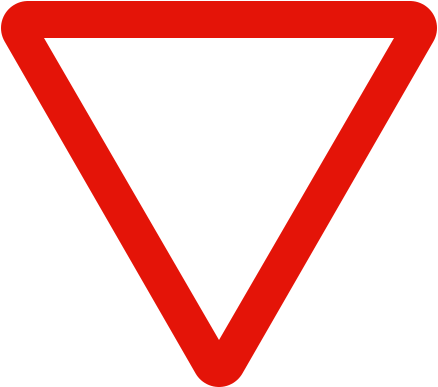 Give way.
English • Traffic sign R-1 • Give way. Every driver must give way at the next junction to vehicles on the road being approached or in the lane being joined.
Español • R-1 • Ceda el paso. Obligación para todo conductor de ceder el paso en la próxima intersección a los vehículos que circulen por la vía a la que se aproxime o al carril al que pretende incorporarse.
Sources
🔗 Commons.wikimedia.org
🔗 Boe.es • Reglamento General de Circulación • anexo I • catálogo vigente
🔗 Boe.es • Real Decreto 465/2025 • R-1 • página 45
SVG source: Unknown authorUnknown author • Public domain • Original revision 2013-05-31. Wikimedia original unmodified.
What should you check before proceeding after giving way in Spain?
Wait until the manoeuvre is safe. Check the priority traffic, the view in both directions and enough space to complete the entry. Giving way to one vehicle does not remove duties towards another driver, a cyclist or a pedestrian.
🔗 boe.es • General Traffic Regulation articles 56,58,65; catalogue R-1
15. Roundabout
A roundabout is a circular road arrangement in which traffic travels around a central island in one designated direction. Vehicles enter and leave through connecting roads, and traffic signs or local rules determine who has priority.
Drivers should reduce speed, choose a suitable lane, observe all road users and signal as required when leaving. The direction of travel, entry priority, lane use and rules for cyclists and pedestrians depend on local traffic signs and regulations.
Wikimedia.org • Enrique Íñiguez Rodríguez • CC BY-SA
Who has priority at a roundabout in Spain?
At a Spanish glorieta, vehicles already on the circular carriageway have priority over vehicles entering, subject to the controlling signs or signals. A divided circular junction with a road running through the island is not treated as an ordinary glorieta merely because of its shape.
🔗 boe.es • General Traffic Regulation articles 33,56-57,64-65,74-75,109; DGT roundabout guidance
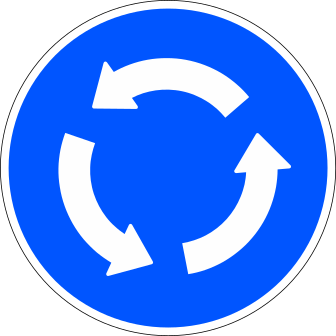 Mandatory roundabout direction.
English • Traffic sign R-402 • Compulsory direction at a roundabout. The arrows show the direction in which vehicles must circulate.
Español • R-402 • Sentido obligatorio en glorieta. Las flechas señalan la dirección y sentido del movimiento giratorio que los vehículos deben seguir.
Sources
🔗 Commons.wikimedia.org (Majafego • CC BY-SA 4.0)
🔗 Boe.es • Reglamento General de Circulación • anexo I • catálogo vigente
🔗 Boe.es • Real Decreto 465/2025 • R-402 • página 62
SVG source: Majafego • CC BY-SA 4.0 • Original revision 2025-09-17. Wikimedia original unmodified.
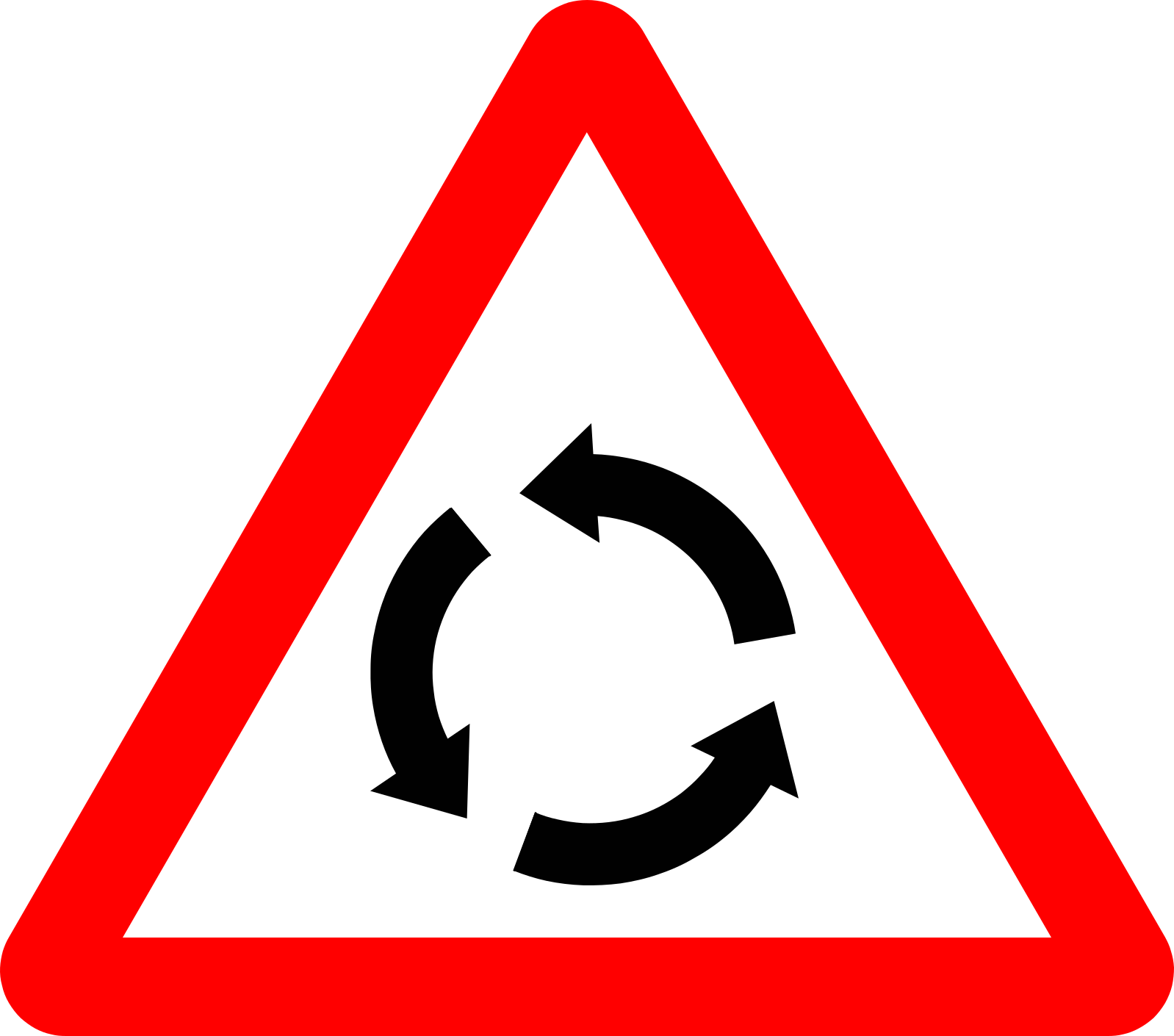 Warning for a roundabout.
English • Traffic sign P-4 • Roundabout. Warns of a roundabout with circulation in the direction shown by the arrows.
Español • P-4 • Glorieta. Peligro por la proximidad de una glorieta con circulación en el sentido indicado por las flechas.
Sources
🔗 Commons.wikimedia.org
🔗 Boe.es • Reglamento General de Circulación • anexo I • catálogo vigente
🔗 Boe.es • Real Decreto 465/2025 • P-4 • página 36
SVG source: No machine-readable author provided. Benedicto16 assumed (based on copyright claims). • Public domain • Original revision 2026-09-10. Wikimedia original unmodified.
How should you choose a roundabout lane in Spain?
Follow the lane signs and markings. On an ordinary roundabout, arrange to reach the outer lane before your exit, giving way to traffic already in any lane you wish to enter. Urban lane-choice rules and specially marked layouts can differ; do not cut across another vehicle to reach an exit.
🔗 boe.es • General Traffic Regulation articles 33,56-57,64-65,74-75,109; DGT roundabout guidance
What should you check when leaving a roundabout in Spain?
Normally leave from the outer right-hand lane and signal the exit. If you cannot move there safely in time, continue round rather than cut across another lane. Watch for pedestrians and cyclists at the exit and obey any special lane markings or signals.
🔗 boe.es • General Traffic Regulation articles 33,56-57,64-65,74-75,109; DGT roundabout guidance
16. Road narrowing
A road narrowing is a section where the available width of the road or carriageway becomes smaller. The narrowing may occur on both sides, on one side only, or because one or more traffic lanes end.
Drivers should reduce speed, observe approaching and adjacent traffic, maintain sufficient lateral clearance and merge when necessary. Warning signs do not always determine priority, so drivers must follow any priority signs, lane markings and local traffic rules.

Wikimedia.org • Diego Delso • CC BY-SA
What does a road-narrowing warning mean in Spain?
The warning identifies a significant reduction in carriageway width on both sides or on the indicated side. It does not itself allocate priority. A loss of a lane without reduced width in the remaining lanes or shoulders is not, by itself, the situation covered by the narrowing warning.
🔗 boe.es • General Traffic Regulation articles 60,74,109; catalogue P-17,P-17a,P-17b
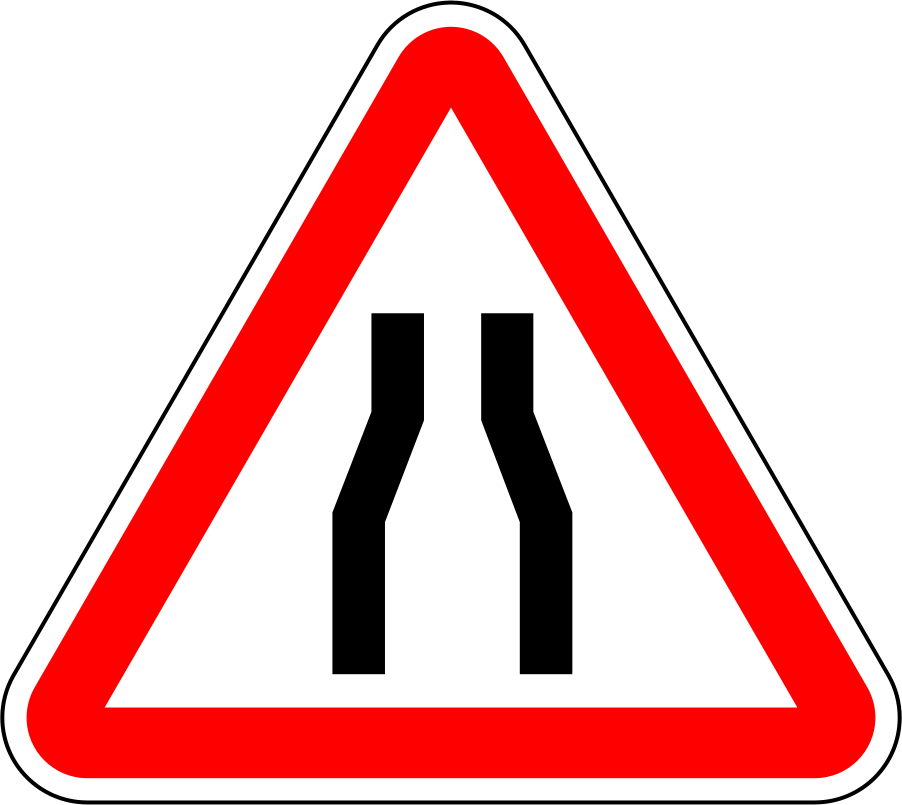 Warning for a road narrowing.
English • Traffic sign P-17 • Road narrows. Warns of a narrowing carriageway. May also be used where the shoulders become narrower. Must not be used where the number of lanes decreases but the remaining lanes and shoulders retain their widths.
Español • P-17 • Estrechamiento de calzada. Peligro por la proximidad de una zona de la vía en la que se estrecha la calzada. También puede ser utilizada cuando se reduzca la anchura de los arcenes de la calzada. No se utilizará cuando, tras una reducción del número de carriles de la calzada, la anchura de los carriles restantes y de los arcenes no haya variado.
Sources
🔗 Commons.wikimedia.org
🔗 Boe.es • Reglamento General de Circulación • anexo I • catálogo vigente
🔗 Boe.es • Real Decreto 465/2025 • P-17 • página 39
Replacement SVG: Commons.wikimedia.org • Wikimedia Commons original • Gigillo83 • CC BY-SA 4.0 • Original revision 2015-03-17. Wikimedia original unmodified.
Image via Commons.wikimedia.org
Gigillo83 • CC BY-SA 4.0 • Source revision 2015-03-17. Wikimedia original unmodified.
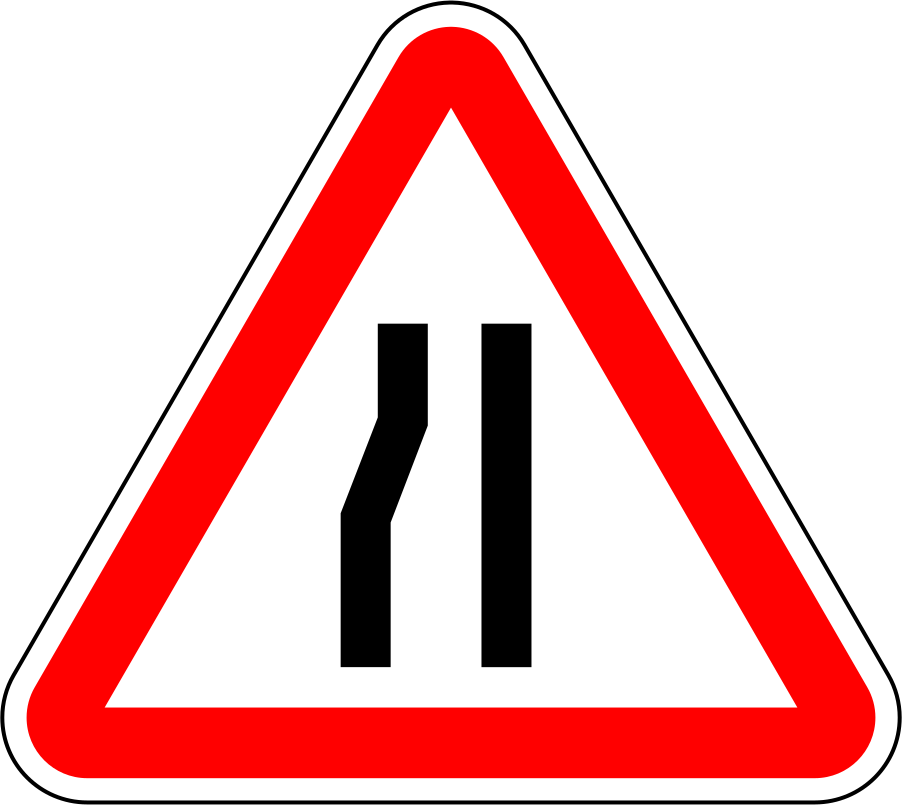 Warning for a road narrowing on the left.
English • Traffic sign P-17b • Road narrows on the left. Warns of a narrowing on the left side of the carriageway. May also be used where the left shoulder narrows on a one-way carriageway. Must not be used where lanes are removed on the left but the remaining lanes and shoulders retain their widths.
Español • P-17b • Estrechamiento de calzada por la izquierda. Peligro por la proximidad de una zona de la vía en la que la calzada se estrecha por el lado de la izquierda. También puede ser utilizada cuando se reduzca la anchura del arcén izquierdo de la calzada cuando esta sea de un solo sentido de circulación. No se utilizará cuando, tras una reducción del número de carriles de la calzada por la izquierda, la anchura de los carriles restantes y de los arcenes no haya variado.
Sources
🔗 Commons.wikimedia.org
🔗 Boe.es • Reglamento General de Circulación • anexo I • catálogo vigente
🔗 Boe.es • Real Decreto 465/2025 • P-17b • página 40
Replacement SVG: Commons.wikimedia.org • Wikimedia Commons original • Gigillo83 • CC BY-SA 4.0 • Original revision 2015-03-17. Wikimedia original unmodified.
Image via Commons.wikimedia.org
Gigillo83 • CC BY-SA 4.0 • Source revision 2015-03-17. Wikimedia original unmodified.
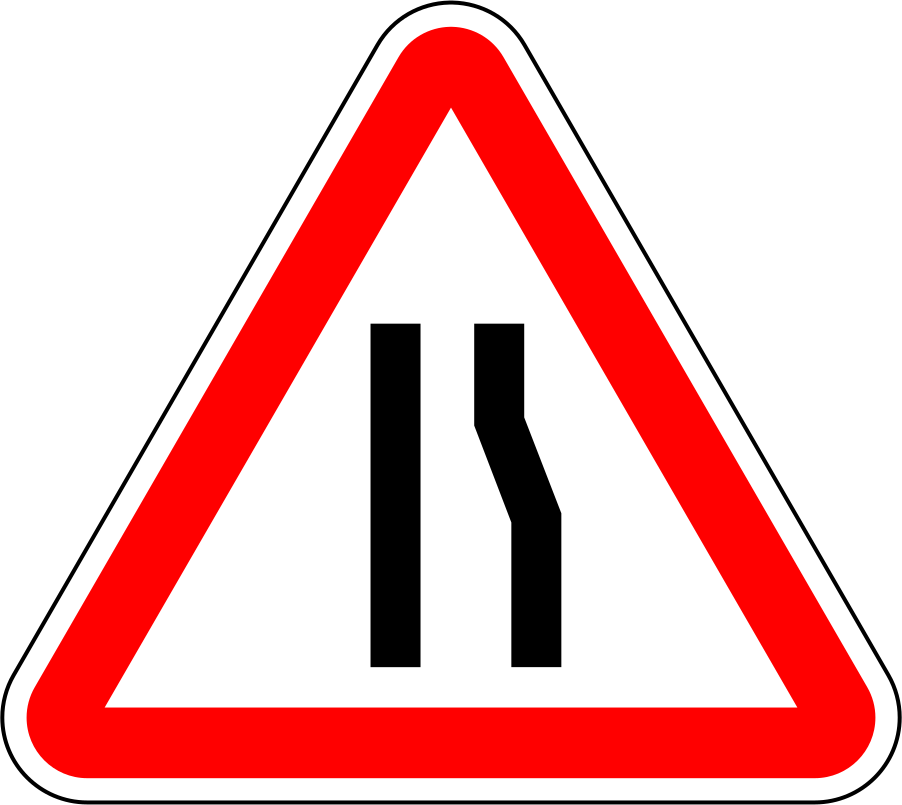 Warning for a road narrowing on the right.
English • Traffic sign P-17a • Road narrows on the right. Warns of a narrowing on the right side of the carriageway. May also be used where the right shoulder narrows. Must not be used where lanes are removed on the right but the remaining lanes and shoulders retain their widths.
Español • P-17a • Estrechamiento de calzada por la derecha. Peligro por la proximidad de una zona de la vía en la que la calzada se estrecha por el lado de la derecha. También puede ser utilizada cuando se reduzca la anchura del arcén derecho de la calzada. No se utilizará cuando, tras una reducción del número de carriles de la calzada por la derecha, la anchura de los carriles restantes y de los arcenes no haya variado.
Sources
🔗 Commons.wikimedia.org
🔗 Boe.es • Reglamento General de Circulación • anexo I • catálogo vigente
🔗 Boe.es • Real Decreto 465/2025 • P-17a • página 39
Replacement SVG: Commons.wikimedia.org • Wikimedia Commons original • Gigillo83 • CC BY-SA 4.0 • Original revision 2015-03-17. Wikimedia original unmodified.
Image via Commons.wikimedia.org
Gigillo83 • CC BY-SA 4.0 • Source revision 2015-03-17. Wikimedia original unmodified.
Does a narrowing warning give you priority in Spain?
No. A warning describes the reduced width, rather than allocating priority or setting a numerical speed limit. Follow any separate priority signs, signals and meeting rules, and slow enough to pass safely or wait before entering.
🔗 boe.es • General Traffic Regulation articles 60,74,109; catalogue P-17,P-17a,P-17b
What should you do if traffic lanes merge at a narrowing in Spain?
Follow lane-ending signs and markings, signal any lane change and give way to vehicles already in the lane you intend to enter. Do not force them to brake or change course abruptly. A road-narrowing warning does not create an automatic right to merge.
🔗 boe.es • General Traffic Regulation articles 60,74,109; catalogue P-17,P-17a,P-17b
17. Pedestrian crossing
A pedestrian crossing is a designated place where pedestrians may cross a road. It is commonly indicated by road markings, traffic signs, signals or a combination of these measures.
Drivers must approach with appropriate caution and give way when required by local law. Pedestrians must also observe approaching traffic and follow any pedestrian signals or instructions from authorised traffic controllers.

Wikimedia.org • Albergarri788 • CC BY-SA
When must drivers give way at a pedestrian crossing in Spain?
At a properly signed pedestrian crossing in Spain, drivers must give way to pedestrians. Drivers turning into another street must also yield to pedestrians already crossing it, even without a marked crossing.
Are all pedestrian crossings controlled the same way in Spain?
No. Pedestrians must obey pedestrian lights or an authorised officer. Where vehicle lights or an officer control the crossing without pedestrian lights, do not enter while vehicles are permitted to proceed. At an uncontrolled marked crossing, pedestrians have priority but must still check approaching vehicles.
May I enter a pedestrian crossing if the road beyond it is blocked in Spain?
Do not enter if traffic is likely to leave you stopped across the crossing and obstructing pedestrians. Overtaking at a pedestrian crossing or nearby is prohibited.
May Spanish pedestrians cross just beside an available pedestrian crossing?
No. In an area with pedestrian crossings, use the crossing itself.
Must Spanish pedestrians check approaching vehicles before using an uncontrolled marked crossing?
Yes. Enter only when their distance and speed allow safe crossing, despite pedestrian priority.
How should Spanish pedestrians walk across the carriageway?
Perpendicular to its axis, without unnecessary delay or stopping, and without obstructing others.
May Spanish pedestrians take a shortcut across a roundabout’s carriageway?
No. Go around squares and roundabouts unless a pedestrian crossing is provided for the route.
What must Spanish pedestrians check before crossing away from a crossing?
That they can do so without risk or undue obstruction.
18. Railway crossing
A railway crossing, also called a level crossing or railroad crossing, is a place where a road or path crosses railway tracks at the same level. It may be protected by barriers, warning lights, bells, traffic signs or a combination of these measures.
Road users must approach carefully and never enter when a train is approaching, warning signals are active or the exit is blocked. They should cross promptly and must never stop, wait or become trapped on the tracks.
Wikimedia.org • Zarateman • CC0
When must drivers stop at a railway level crossing in Spain?
Approach cautiously and reduce speed. Stop when the crossing is closed or its barrier is moving, and obey red warning lights and authorised stop instructions. Cross without delay only after checking you will not become stuck on the tracks.
Must I stop at every unguarded railway crossing in Spain?
Not solely because barriers are absent. Obey any STOP sign, red warning light or authorised instruction, and check for approaching trains. Enter only when the crossing is clear and you can drive completely across without stopping.
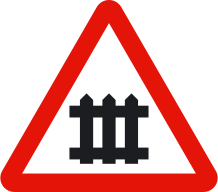 Warning for a railway crossing with barriers.
English • Traffic sign P-7 • Level crossing with barriers. Warns of a crossing with barriers or half-barriers.
Español • P-7 • Paso a nivel con barreras. Peligro por la proximidad de un paso a nivel provisto de barreras o semibarreras.
Sources
🔗 Commons.wikimedia.org
🔗 Boe.es • Reglamento General de Circulación • anexo I • catálogo vigente
🔗 Boe.es • Real Decreto 465/2025 • P-7 • página 36
SVG source: No machine-readable author provided. Benedicto16 assumed (based on copyright claims). • Public domain • Original revision 2013-08-14. Wikimedia original unmodified.
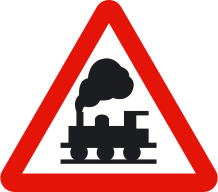 Warning for a railway crossing without barriers.
English • Traffic sign P-8 • Level crossing without barriers. Warns of a crossing without barriers or half-barriers.
Español • P-8 • Paso a nivel sin barreras. Peligro por la proximidad de un paso a nivel no provisto de barreras o semibarreras.
Sources
🔗 Commons.wikimedia.org
🔗 Boe.es • Reglamento General de Circulación • anexo I • catálogo vigente
🔗 Boe.es • Real Decreto 465/2025 • P-8 • página 36
SVG source: No machine-readable author provided. Benedicto16 assumed (based on copyright claims). • Public domain • Original revision 2013-08-14. Wikimedia original unmodified.
 Warning for a railway crossing with one track.
English • Traffic sign P-11 • Location of a level crossing without barriers. Warns of a crossing without barriers immediately ahead.
Español • P-11 • Situación de un paso a nivel sin barreras. Peligro por la presencia inmediata de un paso a nivel sin barreras
Sources
🔗 Commons.wikimedia.org
🔗 Boe.es • Reglamento General de Circulación • anexo I • catálogo vigente
🔗 Boe.es • Real Decreto 465/2025 • P-11 • página 37
Image via Commons.wikimedia.org
No machine-readable author provided. Benedicto16 assumed (based on copyright claims). • Public domain • Source revision 2006-09-07. Wikimedia original unmodified.
 Warning for a railway crossing with two or more tracks.
English • Traffic sign P-11a • Location of a level crossing without barriers with more than one track. Warns of a multi-track crossing without barriers immediately ahead.
Español • P-11a • Situación de un paso a nivel sin barreras de más de una vía férrea. Peligro por la presencia inmediata de un paso a nivel sin barreras con más de una vía férrea.
Sources
🔗 Commons.wikimedia.org
🔗 Boe.es • Reglamento General de Circulación • anexo I • catálogo vigente
🔗 Boe.es • Real Decreto 465/2025 • P-11a • página 38
Image via Commons.wikimedia.org
No machine-readable author provided. Benedicto16 assumed (based on copyright claims). • Public domain • Source revision 2006-09-07. Wikimedia original unmodified.
What if road traffic is queued beyond a railway crossing in Spain?
Wait before the tracks until there is room to take your entire vehicle off the crossing. Do not follow another vehicle onto the tracks without checking the exit. Keep the tracks clear even if no train is visible.
19. School area
A school area is a road or group of roads near a school where large numbers of children may walk, cycle, cross the road or enter and leave vehicles. It may be identified by warning signs, zone signs, road markings, traffic-calming measures or flashing lights.
Special speed limits, parking restrictions or access rules may apply permanently or only during school arrival and departure times. Drivers should reduce speed, watch carefully for children and be prepared to stop.
Wikimedia.org • Dorieo • CC BY-SA
What speed rules apply around schools in Spain?
Apply the urban limit for the road layout and any lower restriction. The general urban rules distinguish 20 km/h for a shared-level carriageway and pavement, 30 km/h for one lane per direction and 50 km/h for two or more lanes per direction, subject to the regulation’s qualifications and signed changes. School-area measures can impose additional restrictions.
🔗 boe.es • Spain: articles45-46,50,65,94,158; children-warning sign
🔗 boe.es • Spain: official sign catalogue, RoyalDecree465/2025
🔗 boe.es • Spain: RoyalDecree518/2026, effective1October2026
Does a school warning sign in Spain automatically set the speed limit?
A children or school warning alerts you to a potential hazard; the enforceable numerical speed limit depends on the applicable law, regulatory signs and any time or variable display. Slow further if children are near the road.
🔗 boe.es • Spain: articles45-46,50,65,94,158; children-warning sign
🔗 boe.es • Spain: official sign catalogue, RoyalDecree465/2025
🔗 boe.es • Spain: RoyalDecree518/2026, effective1October2026
 Warning for children.
English • Traffic sign P-21a • Children. Warns of a place frequented by children, such as a school or play area.
Español • P-21a • Niños. Peligro por la proximidad de un lugar frecuentado por niños, como una escuela, una zona de juegos, etc.
Sources
🔗 Commons.wikimedia.org
🔗 Boe.es • Reglamento General de Circulación • anexo I • catálogo vigente
🔗 Boe.es • Real Decreto 465/2025 • P-21a • página 41
Image via Commons.wikimedia.org
No machine-readable author provided. Benedicto16 assumed (based on copyright claims). • Public domain • Source revision 2006-09-07. Wikimedia original unmodified.
How should you pass a school entrance in Spain?
Watch for children stepping out from between parked vehicles, obey crossings and any school patrol, and follow stopping or parking restrictions. Do not obstruct visibility near a crossing or school entrance; approach at a speed that permits a safe stop.
🔗 boe.es • Spain: articles45-46,50,65,94,158; children-warning sign
🔗 boe.es • Spain: official sign catalogue, RoyalDecree465/2025
🔗 boe.es • Spain: RoyalDecree518/2026, effective1October2026
20. Overtaking
Overtaking is the act of passing another road user travelling in the same direction. It normally involves moving to another position or lane, passing the slower road user and returning to the appropriate position when it is safe.
Before overtaking, a driver should make sure there is sufficient visibility and space, check mirrors and blind spots, signal when required and ensure that no other road user is already overtaking. The manoeuvre must be completed without exceeding the speed limit or endangering other road users.
Wikimedia.org • P4K1T0 • CC BY-SA
On which side do drivers normally overtake in Spain?
As traffic normally keeps right, drivers ordinarily overtake on the left. This is the general rule, not permission to pass wherever a lane is available; exceptions and restrictions depend on the local law.
🔗 boe.es • Spain: articles45-52,82-89,85(4),153(5); RoyalDecree518/2026 effective1October2026
🔗 boe.es • Spain: official sign catalogue, RoyalDecree465/2025
🔗 boe.es • Spain: RoyalDecree518/2026, effective1October2026
When should you avoid overtaking in Spain?
Do not begin if approaching traffic, restricted visibility, road markings, an intersection, a crossing or another road user makes the manoeuvre unsafe or unlawful. Check behind and ahead, allow enough space and never exceed the speed limit to complete the pass.
🔗 boe.es • Spain: articles45-52,82-89,85(4),153(5); RoyalDecree518/2026 effective1October2026
🔗 boe.es • Spain: official sign catalogue, RoyalDecree465/2025
🔗 boe.es • Spain: RoyalDecree518/2026, effective1October2026
What extra care is needed when overtaking slower road users in Spain?
When passing cyclists, pedestrians and the other vulnerable road users covered by the rule, leave at least 1.5 m; where there is more than one lane per direction, change lane completely. Outside built-up areas, reduce speed to at least 20 km/h below the road’s limit before and throughout the pass. Do not endanger oncoming traffic, including users on its shoulder.
🔗 boe.es • Spain: articles45-52,82-89,85(4),153(5); RoyalDecree518/2026 effective1October2026
🔗 boe.es • Spain: official sign catalogue, RoyalDecree465/2025
🔗 boe.es • Spain: RoyalDecree518/2026, effective1October2026
21. Crossing animals
An animals-crossing warning indicates a place or road section where wild animals, livestock or ridden animals may enter or cross the road. Animals may appear suddenly, move unpredictably or be difficult to see in darkness, vegetation or poor weather.
Drivers should reduce speed, scan both sides of the road and remain prepared to stop. The warning sign does not itself give animals priority or impose a numerical speed limit, but drivers must avoid frightening, endangering or colliding with them.
Wikimedia.org • zejijunto • CC BY
Which animals might drivers encounter on roads in Spain?
Watch for livestock and wild animals crossing the road. Spain distinguishes livestock and general wildlife warnings, with a separate wildlife variant highlighting wild boar. Read the actual sign and watch the road edges for animals that may enter unexpectedly.
🔗 boe.es • Spain: Regulation articles 45-46,66,110; catalogue P-23,P-24,P-24a
🔗 boe.es • Spain: official sign catalogue, Royal Decree 465/2025
 Warning for cattle on the road.
English • Traffic sign P-23 • Domestic animals or livestock crossing. Warns of a place where domestic animals or livestock frequently cross the road.
Español • P-23 • Paso de animales domésticos o ganado. Peligro por la proximidad de un lugar donde frecuentemente la vía puede ser atravesada por animales domésticos o ganado.
Sources
🔗 Commons.wikimedia.org
🔗 Boe.es • Reglamento General de Circulación • anexo I • catálogo vigente
🔗 Boe.es • Real Decreto 465/2025 • P-23 • página 41
Image via Commons.wikimedia.org
No machine-readable author provided. Benedicto16 assumed (based on copyright claims). • Public domain • Source revision 2006-09-07. Wikimedia original unmodified.
 Warning for crossing deer.
English • Traffic sign P-24 • Free-roaming animals crossing. Warns of a place where free-roaming animals frequently cross the road.
Español • P-24 • Paso de animales en libertad. Peligro por la proximidad de un lugar donde frecuentemente la vía puede ser atravesada por animales en libertad.
Sources
🔗 Commons.wikimedia.org
🔗 Boe.es • Reglamento General de Circulación • anexo I • catálogo vigente
🔗 Boe.es • Real Decreto 465/2025 • P-24 • página 41
Image via Commons.wikimedia.org
No machine-readable author provided. Benedicto16 assumed (based on copyright claims). • Public domain • Source revision 2006-09-07. Wikimedia original unmodified.
Does an animal-crossing warning sign in Spain set a new speed limit?
A warning of animals is not, by itself, a numerical speed-limit sign. Continue to obey the applicable speed limit, but slow down whenever animals could enter the road or visibility is poor. A separate regulatory speed sign must also be obeyed.
🔗 boe.es • Spain: Regulation articles 45-46,66,110; catalogue P-23,P-24,P-24a
🔗 boe.es • Spain: official sign catalogue, Royal Decree 465/2025
What should you do if an animal enters the road in Spain?
Brake as necessary while keeping control and checking the surrounding traffic. Avoid swerving into opposing traffic or off the road. Give livestock and ridden animals room, avoid unnecessary horn use, and watch for more animals following.
🔗 boe.es • Spain: Regulation articles 45-46,66,110; catalogue P-23,P-24,P-24a
🔗 boe.es • Spain: official sign catalogue, Royal Decree 465/2025
22. Slippery road
A slippery road has reduced tyre grip and can make steering, braking and acceleration less effective. Roads may become slippery because of rain, ice, snow, mud, oil, loose material or other substances on the surface. Drivers should reduce speed, increase their following distance and avoid sudden steering, braking or acceleration. Extra caution is needed in bends, on bridges and wherever the road surface changes unexpectedly.

Wikimedia.org • TeWeBs • CC BY-SA
What can make roads slippery in Spain?
Rain, ice, snow, mud or other material can reduce grip. A surface can be slippery even when it looks clear, and grip can change within a short distance. Reduce speed and increase following distance for the actual conditions.
🔗 boe.es • Spain: Regulation articles 45-46,54; catalogue P-19
🔗 boe.es • Spain: official sign catalogue, Royal Decree 465/2025
How should you drive on a slippery road in Spain?
Reduce speed early, increase the gap to the vehicle ahead and use smooth steering, braking and acceleration. Do not rely on the posted maximum as a safe target when grip is poor.
🔗 boe.es • Spain: Regulation articles 45-46,54; catalogue P-19
🔗 boe.es • Spain: official sign catalogue, Royal Decree 465/2025
Does a slippery-road warning sign in Spain automatically impose a lower number?
The warning sign highlights a reduced-grip risk; it normally does not itself prescribe a new numerical speed limit. A separate speed-limit sign, temporary restriction or local condition may still apply. Travel below the legal maximum when necessary for safety.
🔗 boe.es • Spain: Regulation articles 45-46,54; catalogue P-19
🔗 boe.es • Spain: official sign catalogue, Royal Decree 465/2025
 Warning for a slippery road surface.
English • Traffic sign P-19 • Slippery surface. Warns of a carriageway section whose surface may be slippery.
Español • P-19 • Pavimento deslizante. Peligro por la proximidad de una zona de la calzada cuyo pavimento puede resultar deslizante.
Sources
🔗 Commons.wikimedia.org
🔗 Boe.es • Reglamento General de Circulación • anexo I • catálogo vigente
🔗 Boe.es • Real Decreto 465/2025 • P-19 • página 40
Image via Commons.wikimedia.org
No machine-readable author provided. Benedicto16 assumed (based on copyright claims). • Public domain • Source revision 2006-09-07. Wikimedia original unmodified.
23. Rockfall
A rockfall warning indicates a road section where rocks or stones may fall from a cliff, cutting or steep slope, or where fallen material may already be present on the road. The danger may affect the full carriageway and can appear suddenly.
Drivers should reduce speed, scan the road and slopes ahead, increase their following distance and remain prepared to stop. They should avoid unnecessary stopping in the exposed section and never attempt to move unstable rocks themselves.

Wikimedia.org • Frank Vincentz • CC BY-SA
Where might falling rocks be a hazard on roads in Spain?
Watch for loose rocks beside steep slopes, road cuttings and other exposed sections. A falling-rocks warning can identify rocks reaching or already lying on the carriageway. Look for debris and choose a speed that lets you stop within your view.
🔗 boe.es • Spain: Regulation articles 45-46,90-94; catalogue P-26; practical hazard precautions
🔗 boe.es • Spain: official sign catalogue, Royal Decree 465/2025
Does a falling-rocks warning sign in Spain impose a speed limit?
A falling-rocks sign is a hazard warning, not normally a numerical speed-limit sign. Follow any separate speed or closure signs, slow down to match visibility and conditions, and watch for material already on the road.
🔗 boe.es • Spain: Regulation articles 45-46,90-94; catalogue P-26; practical hazard precautions
🔗 boe.es • Spain: official sign catalogue, Royal Decree 465/2025
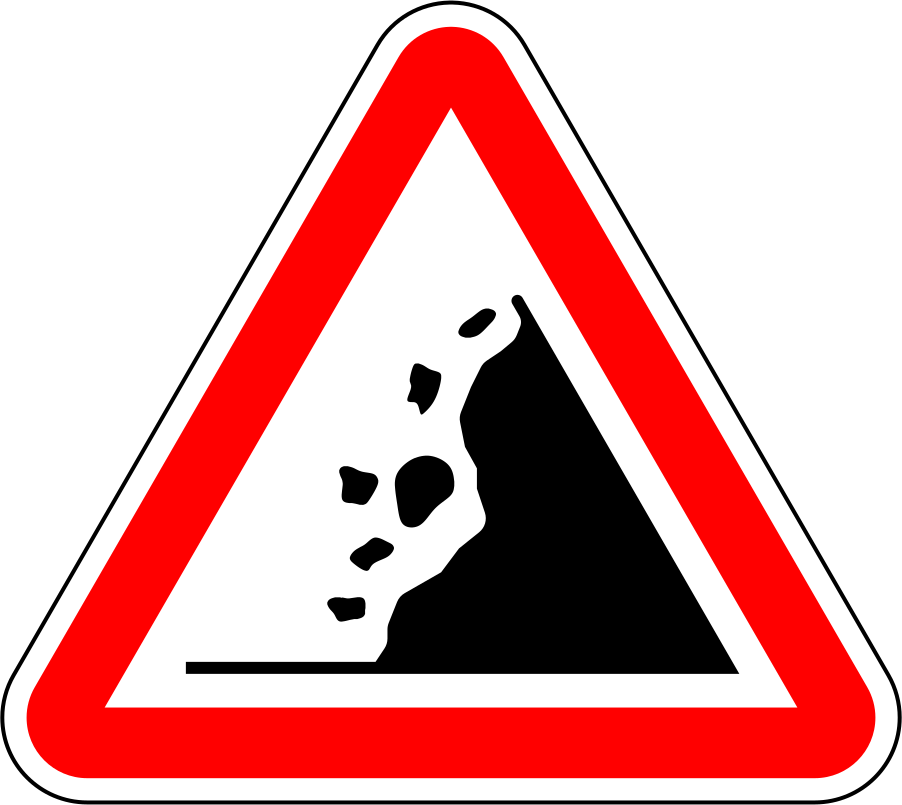 Warning for falling rocks.
English • Traffic sign P-26 • Falling rocks. Warns of an area with frequent rockfalls and possible obstacles on the carriageway as a result.
Español • P-26 • Desprendimiento. Peligro por la proximidad a una zona con desprendimientos frecuentes y la consiguiente posible presencia de obstáculos en la calzada.
Sources
🔗 Commons.wikimedia.org
🔗 Boe.es • Reglamento General de Circulación • anexo I • catálogo vigente
🔗 Boe.es • Real Decreto 465/2025 • P-26 • página 42
Replacement SVG: Commons.wikimedia.org • Wikimedia Commons original • Gigillo83 • CC BY-SA 4.0 • Original revision 2015-03-17. Wikimedia original unmodified.
Image via Commons.wikimedia.org
Gigillo83 • CC BY-SA 4.0 • Source revision 2015-03-17. Wikimedia original unmodified.
What should you do if rocks are blocking the road in Spain?
Slow or stop in a safe place away from the exposed slope if possible. Do not drive over unstable debris or stop beneath a cliff unnecessarily. Follow any closure or traffic-control instructions and report a dangerous obstruction through the appropriate road authority or emergency channel.
🔗 boe.es • Spain: Regulation articles 45-46,90-94; catalogue P-26; practical hazard precautions
🔗 boe.es • Spain: official sign catalogue, Royal Decree 465/2025
24. Curve
A curve is a section of road that changes direction to the left or right. A sharp, unexpected or poorly visible curve can reduce a driver’s view of approaching traffic, stopped vehicles, pedestrians and other hazards.
Drivers should reduce speed before entering the curve, remain within their lane and use smooth steering, braking and acceleration. Warning signs may indicate the direction of the first curve or a series of successive curves.

Wikimedia.org • Falk2 • CC BY-SA
What makes a bend dangerous in Spain?
A bend can hide traffic and shorten your stopping view. Watch for a tightening curve, changing grip and road users hidden beyond it. Slow before entering and choose a speed that lets you stop within the visible distance.
🔗 boe.es • Spain: Regulation articles 45-46,87(1)(a); catalogue P-13a-P-14b
🔗 boe.es • Spain: official sign catalogue, Royal Decree 465/2025
How should you approach a sharp curve in Spain?
Slow down before the bend, select the correct lane position, look through the curve and steer smoothly. Keep enough grip and visible stopping distance for the road and weather conditions.
🔗 boe.es • Spain: Regulation articles 45-46,87(1)(a); catalogue P-13a-P-14b
🔗 boe.es • Spain: official sign catalogue, Royal Decree 465/2025
Is overtaking safe on a blind bend in Spain?
Do not overtake at a bend or crest where visibility is insufficient to complete or abandon the manoeuvre safely. The regulation allows an exception where the directions are clearly separated and the manoeuvre can be completed without entering the opposing side. Obey other signs and markings and keep the required safe view.
🔗 boe.es • Spain: Regulation articles 45-46,87(1)(a); catalogue P-13a-P-14b
🔗 boe.es • Spain: official sign catalogue, Royal Decree 465/2025
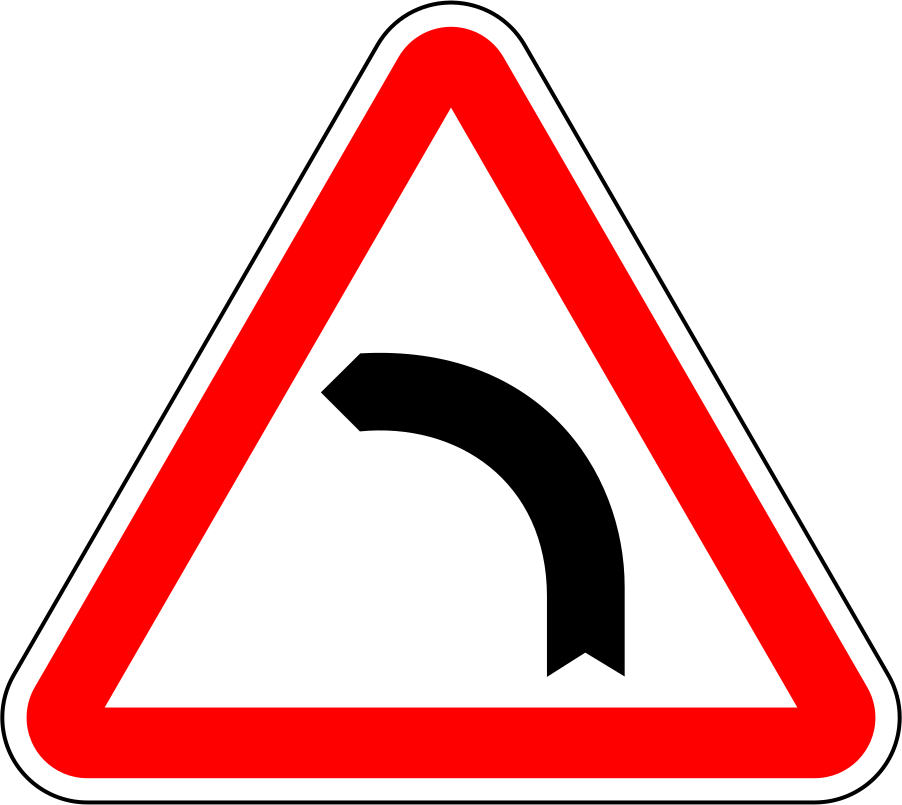 Warning for a curve to the left.
English • Traffic sign P-13b • Dangerous left-hand bend. Warns of a dangerous bend to the left ahead.
Español • P-13b • Curva peligrosa hacia la izquierda. Peligro por la proximidad de una curva peligrosa hacia la izquierda.
Sources
🔗 Commons.wikimedia.org
🔗 Boe.es • Reglamento General de Circulación • anexo I • catálogo vigente
🔗 Boe.es • Real Decreto 465/2025 • P-13b • página 38
Replacement SVG: Commons.wikimedia.org • Wikimedia Commons original • Gigillo83 • CC BY-SA 4.0 • Original revision 2015-03-16. Wikimedia original unmodified.
Image via Commons.wikimedia.org
Gigillo83 • CC BY-SA 4.0 • Source revision 2015-03-16. Wikimedia original unmodified.
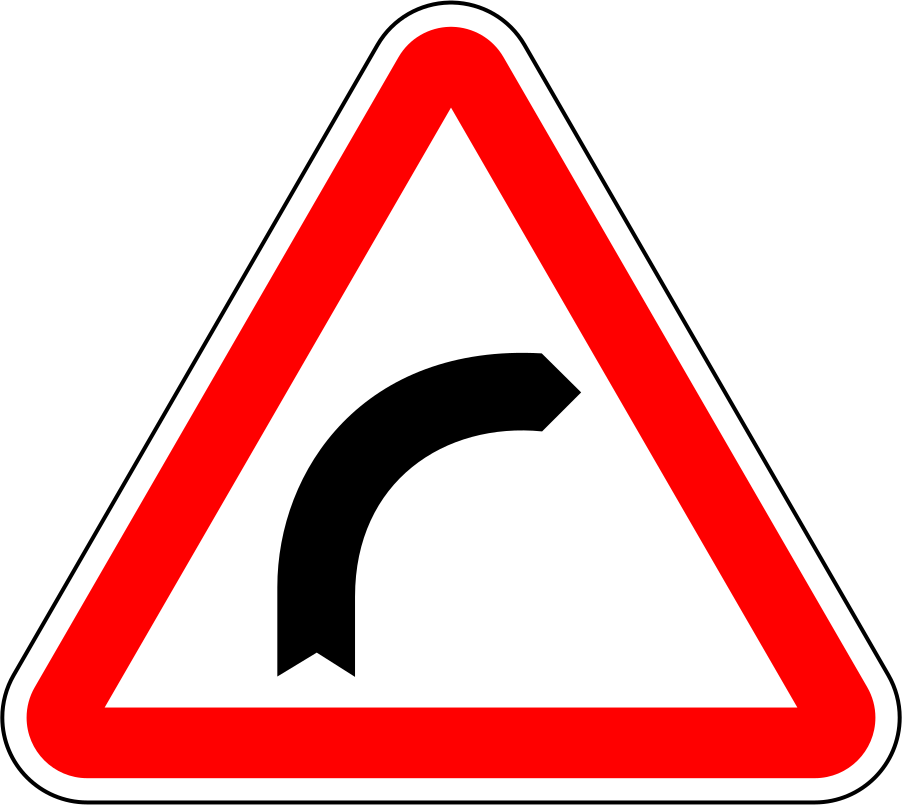 Warning for a curve to the right.
English • Traffic sign P-13a • Dangerous right-hand bend. Warns of a dangerous bend to the right ahead.
Español • P-13a • Curva peligrosa hacia la derecha. Peligro por la proximidad de una curva peligrosa hacia la derecha.
Sources
🔗 Commons.wikimedia.org
🔗 Boe.es • Reglamento General de Circulación • anexo I • catálogo vigente
🔗 Boe.es • Real Decreto 465/2025 • P-13a • página 38
Replacement SVG: Commons.wikimedia.org • Wikimedia Commons original • Gigillo83 • CC BY-SA 4.0 • Original revision 2015-03-16. Wikimedia original unmodified.
Image via Commons.wikimedia.org
Gigillo83 • CC BY-SA 4.0 • Source revision 2015-03-16. Wikimedia original unmodified.
25. Roadworks
Roadworks are construction, maintenance, repair or inspection activities carried out on or beside a road. They may temporarily change the road layout, lane widths, speed limits, priority, permitted directions and facilities for pedestrians or cyclists.
Drivers must follow the temporary signs, traffic lights, barriers, road markings and instructions from authorised personnel. They should reduce speed, increase their following distance and remain prepared for narrow lanes, stopped traffic, workers, machinery and sudden changes in the route.

Wikimedia.org • Pacopac • CC BY-SA
What should you watch for when approaching roadworks in Spain?
Look for temporary warnings, cones, barriers, narrow lanes and construction vehicles. Road layouts can change temporarily, including lane shifts, traffic-light control and short one-way sections. Expect workers and slow or stationary traffic near the worksite.
🔗 boe.es • Spain: official sign catalogue, Royal Decree 465/2025
Is a temporary speed limit at roadworks binding in Spain?
Where an authorised temporary regulatory speed limit is in force, you must obey it. A roadworks warning alone should not be mistaken for a new numerical limit, but conditions may require driving more slowly.
🔗 boe.es • Spain: official sign catalogue, Royal Decree 465/2025
What if only one lane remains open through roadworks in Spain?
Follow the temporary signals, stop/go instructions, lane arrows and priority signs. Do not enter an opposing traffic lane until permitted, and give vulnerable road users and road workers extra room.
🔗 boe.es • Spain: official sign catalogue, Royal Decree 465/2025