


Traffic rulesNew Zealand
 Traffic rules
 Argentina
 Australia
 Austria
 Bangladesh
 Belgium
 Bosnia and Herzegovina
 Brazil
 Canada
 Chile
Chile
 China
China
 Colombia
 Czechia
 Denmark
 Finland
 France
 Germany
 Greece
 Hungary
 Iceland
 India
India
 Indonesia
 Ireland
 Italy
Italy
 Japan
Japan
 Malaysia
 Mexico
 Nepal
Nepal
 Netherlands
 New Zealand
 Norway
 Panama
 Peru
Peru
 Philippines
 Poland
 Portugal
 Romania
 Russia
 Serbia
 Slovakia
 Slovenia
 South Africa
 Spain
Spain
 Sweden
 Switzerland
 Thailand
 Turkey
 Ukraine
 United Kingdom
 United States
 Uruguay
 Worldwide
1. New Zealand
New Zealand lies in the southwestern Pacific Ocean and consists mainly of the North Island and South Island. Traffic drives on the left. Although the country is relatively compact, journeys can take longer than expected because many roads are narrow, winding and hilly, with mountain passes, unsealed sections and one-lane bridges still forming part of the road network. Snow and ice can affect alpine routes in winter, particularly on the South Island.
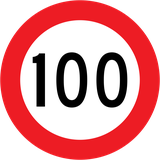
Most roads are free to use, and New Zealand has no nationwide vignette; there are currently only three toll roads, all on the North Island, using electronic number-plate-based collection without toll booths. The usual open-road maximum for light vehicles is 100 km/h, although 110 km/h applies on designated high-standard roads and many roads have lower posted limits. Road signs use standardised symbols and English, while te reo Māori and English increasingly appear together on bilingual signs.
AI-generated by Traffic-rules.com • WCIT • CC BY-SA
Which side of the road do you drive on in New Zealand?
Drive on the left-hand side of the road.
Which side should you overtake on in New Zealand?
Normally overtake on the right. Passing on the left is permitted in certain situations, including when vehicles are travelling in separate marked lanes.
What is the emergency telephone number in New Zealand?
Call 111 for Police, Fire or Ambulance in an emergency.
What is the alcohol limit for drivers in New Zealand?
Drivers aged 20 or older must not exceed 250 micrograms of alcohol per litre of breath or 50 milligrams per 100 millilitres of blood. Drivers under 20 have a zero-alcohol limit.
What is the default speed limit in built-up areas in New Zealand?
The usual unsigned urban default is 50 km/h, but many streets have posted limits of 30, 40 or another speed. Always follow the applicable speed-limit signs.
What is the default speed limit outside built-up areas in New Zealand?
The general open-road maximum for a light vehicle is 100 km/h unless a different limit is posted. Many rural roads have lower signed limits.
Can you drive at 110 km/h in New Zealand?
Yes, but only on designated roads signed at 110 km/h. These are high-standard motorway or expressway sections; the higher speed does not apply automatically to every motorway.
What is the speed limit on New Zealand motorways?
There is no separate universal motorway speed limit. Most motorway sections are signed at 100 km/h or lower, while selected high-standard sections are signed at 110 km/h.
What speed limits apply around schools in New Zealand?
Follow the school-zone signs. Many schools use a variable 30 km/h limit during school travel periods, while some rural schools use a variable 60 km/h limit.
Do you need a vignette to drive in New Zealand?
No. New Zealand does not have a national vignette. Most roads are free, with tolls charged only on specific roads.
How many toll roads are there in New Zealand?
There are currently three toll roads: the Northern Gateway Toll Road north of Auckland, the Tauranga Eastern Link Toll Road and the Takitimu Drive Toll Road.
How are road tolls paid in New Zealand?
Toll roads use electronic number-plate recognition and have no toll booths. Drivers can use an NZTA toll account or Pay & Go; unpaid trips should be paid promptly to avoid receiving a toll payment notice.
Are seat belts compulsory in New Zealand?
Yes. Everyone must wear a seat belt where one is provided. The driver is responsible for ensuring passengers under 15 are properly restrained.
Are child restraints compulsory in New Zealand?
Yes. Children under 7 years old must use an approved child restraint. A child aged 7 must use an approved child restraint if one is available; otherwise an available seat belt must be used.
What restraint must children aged 8 to 14 use in New Zealand?
Children aged 8 to 14 must use an available seat belt. The driver is responsible for ensuring passengers under 15 are properly restrained.
Are motorcycle helmets compulsory in New Zealand?
Yes. Motorcycle and moped riders and passengers must wear an approved safety helmet, subject to limited legal exemptions.
Must motorcycles use headlights during the daytime in New Zealand?
For motorcycles manufactured on or after 1 January 1980, the headlight on dipped beam or daytime running lamps must be used during daylight hours.
Do cars have to use headlights during the daytime in New Zealand?
There is no general daytime-headlight requirement for ordinary cars. Headlights must be used between sunset and sunrise and whenever you cannot clearly see a person or vehicle 100 metres away.
Can you use a mobile phone while driving in New Zealand?
You must not use a handheld mobile phone to call, text or access online services while driving. A phone may be used hands-free or in an appropriate fixed mounting within the permitted rules.
Who has priority at an uncontrolled intersection in New Zealand?
At an otherwise equal uncontrolled intersection, give way to traffic crossing your path from your right. Other give-way rules also apply, including that turning traffic must generally give way to traffic that is not turning and traffic on a terminating road must give way at a T-intersection.
Who has priority at roundabouts in New Zealand?
When entering a roundabout, give way to vehicles that will cross your path from your right, including vehicles already circulating where applicable.
Do drivers have to stop for pedestrians at zebra crossings in New Zealand?
Yes. Drivers must give way to pedestrians on a pedestrian crossing. Approach at a speed that allows you to stop safely.
What should you do when an emergency vehicle approaches in New Zealand?
If an emergency vehicle approaches using sirens or flashing red, blue, or red-and-blue lights, pull over and stop if necessary so it can pass.
How does priority work at a one-lane bridge in New Zealand?
Check the priority signs before entering. One direction will normally be required to give way to traffic coming from the opposite direction. Do not assume that the vehicle reaching the bridge first always has priority.
Can a visitor drive in New Zealand with a foreign driving licence?
Currently, a visitor with a valid overseas car licence may drive for up to 18 months from the date they last arrived in New Zealand. Overseas motorcycle and truck licences may generally be used for up to 12 months. Different rules apply once a New Zealand licence has been obtained.
Do you need an International Driving Permit in New Zealand?
Not always. If your overseas licence is in English, an IDP is generally unnecessary. If it is not in English, you must also carry an accurate English translation or an International Driving Permit.
Is vehicle insurance compulsory in New Zealand?
No. Motor-vehicle insurance is not legally compulsory in New Zealand, although at least third-party cover is strongly recommended.
Do vehicles need a Warrant of Fitness in New Zealand?
Vehicles used on New Zealand roads generally need a current Warrant of Fitness (WoF) or, for vehicles in the applicable categories, a Certificate of Fitness (CoF).
Are winter tyres compulsory in New Zealand?
There is no nationwide requirement to fit winter tyres. If winter tyres are fitted, they must be fitted to all four road wheels and meet the applicable tread requirements.
Are snow chains compulsory in New Zealand?
There is no general nationwide requirement to carry snow chains, but chains can be required on particular alpine roads when conditions demand them. Follow road signs and official instructions, especially on South Island mountain routes.
What should drivers know about railway crossings in New Zealand?
Not every railway crossing has flashing lights or barriers. Some crossings are controlled only by Stop or Give Way signs, so always check carefully for trains before crossing.
What languages are used on road signs in New Zealand?
Road signs use standardised symbols and predominantly English. Drivers will also increasingly see bilingual te reo Māori and English signs, including Kura/School signs and other signs introduced through the national bilingual-sign programme.

2. Motorway
A motorway is a road specially designed and signposted for motor traffic. Motorways normally have separate carriageways for opposing traffic, controlled access through designated entrances and exits, no direct access to neighbouring properties, and no level crossings with other roads, railways or paths.
Special traffic rules apply on motorways. The permitted road users, speed limits, lane rules, tolls and emergency procedures vary between countries, so drivers must follow the local traffic signs and regulations.
Wikimedia.org • Jayswipe • CC0
How can you recognise a motorway?
A motorway is normally identified by a special motorway sign at its entrance. It commonly has separate carriageways, controlled entrances and exits, and no ordinary intersections or direct access to neighbouring properties.
Who may use a motorway?
Motorways are primarily intended for motor vehicles capable of travelling safely at motorway speeds. Pedestrians, cyclists, animals and certain slow vehicles are generally prohibited, but the exact access requirements differ between countries.
What is the speed limit on a motorway?
There is no universal motorway speed limit. The applicable limit depends on the country, road section, vehicle category and driving conditions. Posted or variable speed-limit signs may replace the general national limit.
How should you enter a motorway?
Use the entrance or acceleration lane to observe motorway traffic and adjust your speed where possible. Enter only when there is a safe gap and follow the local priority and merging rules.
How should you leave a motorway?
Move into the correct lane in good time and signal when required. Enter the exit or deceleration lane before reducing your speed, unless traffic, signs or road conditions require you to slow down earlier.
Which lane should you use on a motorway?
Follow the local keep-left or keep-right rule and any lane-direction signs. Lanes closer to the centre of the motorway are commonly used for overtaking, but lane-use rules differ between countries and vehicle categories.
Can you stop on a motorway?
Voluntary stopping and parking are normally permitted only in designated parking or service areas. Drivers may still have to stop because of congestion, an emergency or another unavoidable situation.
Can you reverse or make a U-turn on a motorway?
Reversing, making a U-turn and driving against the direction of traffic are generally prohibited. If you miss an exit, continue to the next suitable exit.
What should you do if your vehicle breaks down?
Move the vehicle out of the traffic lanes when this can be done safely, activate the hazard warning lights and follow the local breakdown procedures. Leave the vehicle safely, keep away from moving traffic and use a warning triangle or safety vest where required by local law.
What is the difference between a motorway and an expressway?
A motorway normally has the highest level of access control and is governed by specific motorway rules. An expressway may have similar characteristics but may permit different road users or contain lower-standard junctions. The legal distinction varies between countries.
3. Speed limit
A speed limit is the maximum legal speed permitted on a road, lane or within a designated area. It may be established by general traffic law or indicated by fixed, variable or temporary traffic signs.
A speed limit is a maximum, not a target speed. Drivers must travel more slowly whenever traffic, visibility, weather, road conditions, vulnerable road users or the condition of the vehicle make the maximum permitted speed unsafe.
Wikimedia.org • Air55 • CC BY-SA
What is a speed limit?
A speed limit is the maximum legal speed permitted on a road, lane or within a designated area. It does not require drivers to travel at that speed.
How can you recognise a speed limit?
A speed limit is commonly displayed as a number on a regulatory traffic sign. General limits may also apply automatically because of the country, road category, vehicle type or surrounding area, even when no speed-limit sign is present.
Is the speed limit a recommended driving speed?
No. It is the highest speed legally permitted under suitable conditions. Drivers must reduce their speed whenever travelling at the limit would be unsafe.
Can you drive more slowly than the speed limit?
Yes. Drivers should travel more slowly when required by traffic, weather, visibility, road conditions or nearby vulnerable road users. Driving unnecessarily slowly may nevertheless be prohibited when it obstructs normal traffic.
Does the same speed limit apply to every vehicle?
Not always. Lower limits may apply to heavy vehicles, buses, vehicles towing trailers, novice drivers or other vehicle categories. The lowest applicable limit must be respected.
What is a default speed limit?
A default speed limit applies automatically to a particular road type or area when no traffic sign indicates another limit. Examples include general limits for motorways, built-up areas or roads outside built-up areas.
Does a posted speed limit replace the default limit?
Usually, yes. A legally placed speed-limit sign normally introduces another maximum speed, although lower vehicle-specific or special-road limits may continue to apply.
When does a speed-limit sign take effect?
A speed restriction normally begins at the location of the sign. Drivers should reduce their speed before passing the sign so that they are already travelling within the limit when it takes effect.
When does a speed limit end?
A signed limit may end at an intersection, an end-of-limit sign, another speed-limit sign or the beginning or end of a legally defined area. The exact rule differs between countries.
Does an intersection end a speed limit?
This depends on local law. An ordinary speed restriction may end at an intersection in some countries, while a zonal speed limit normally continues across intersections until an end-of-zone sign.
What is a speed zone?
A speed zone is an area in which the displayed maximum speed applies throughout all included roads. The limit normally remains in force until the corresponding end-of-zone sign.
What is a variable speed limit?
A variable speed limit is displayed on an electronic or changeable sign and may be adjusted according to congestion, weather, incidents or roadworks. When activated, it has the same legal importance as another applicable regulatory speed sign.
Can different lanes have different speed limits?
Yes. Signs positioned above individual lanes may impose different limits on those lanes. Drivers must observe the limit applying to the lane they use.
Can a temporary speed limit apply?
Yes. Temporary limits may be introduced near roadworks, collisions, hazards or special events. Drivers must follow the temporary traffic signs and instructions that are legally in force.
May you exceed the speed limit while overtaking?
No. Overtaking does not normally permit a driver to exceed the applicable maximum speed. The manoeuvre must be completed safely while respecting the speed limit.
Do poor conditions change the legal speed limit?
Some countries impose specific lower limits in rain, snow or other conditions. Even where the numerical limit does not change, drivers must reduce their speed sufficiently for the conditions.
4. Advisory speed
An advisory speed is a recommended speed for a particular road section or hazard rather than a legally imposed maximum speed. It may be shown near bends, junctions, steep gradients, roadworks or other locations where a lower speed can help drivers negotiate the road safely.
Drivers should treat an advisory speed as guidance for safe driving conditions and should travel even more slowly when weather, visibility, traffic or road conditions require it. A separate legally binding speed limit must still be obeyed.

Wikimedia.org • CC0
What is an advisory speed?
An advisory speed is a recommended speed intended to help drivers negotiate a road section or hazard safely.
Is an advisory speed the same as a speed limit?
No. An advisory speed normally provides guidance, while a regulatory maximum-speed sign establishes a legally enforceable speed limit.
Can you drive slower than an advisory speed?
Yes. Drivers should reduce their speed further whenever road, traffic, visibility or weather conditions make the recommended speed unsafe.
5. Bike path
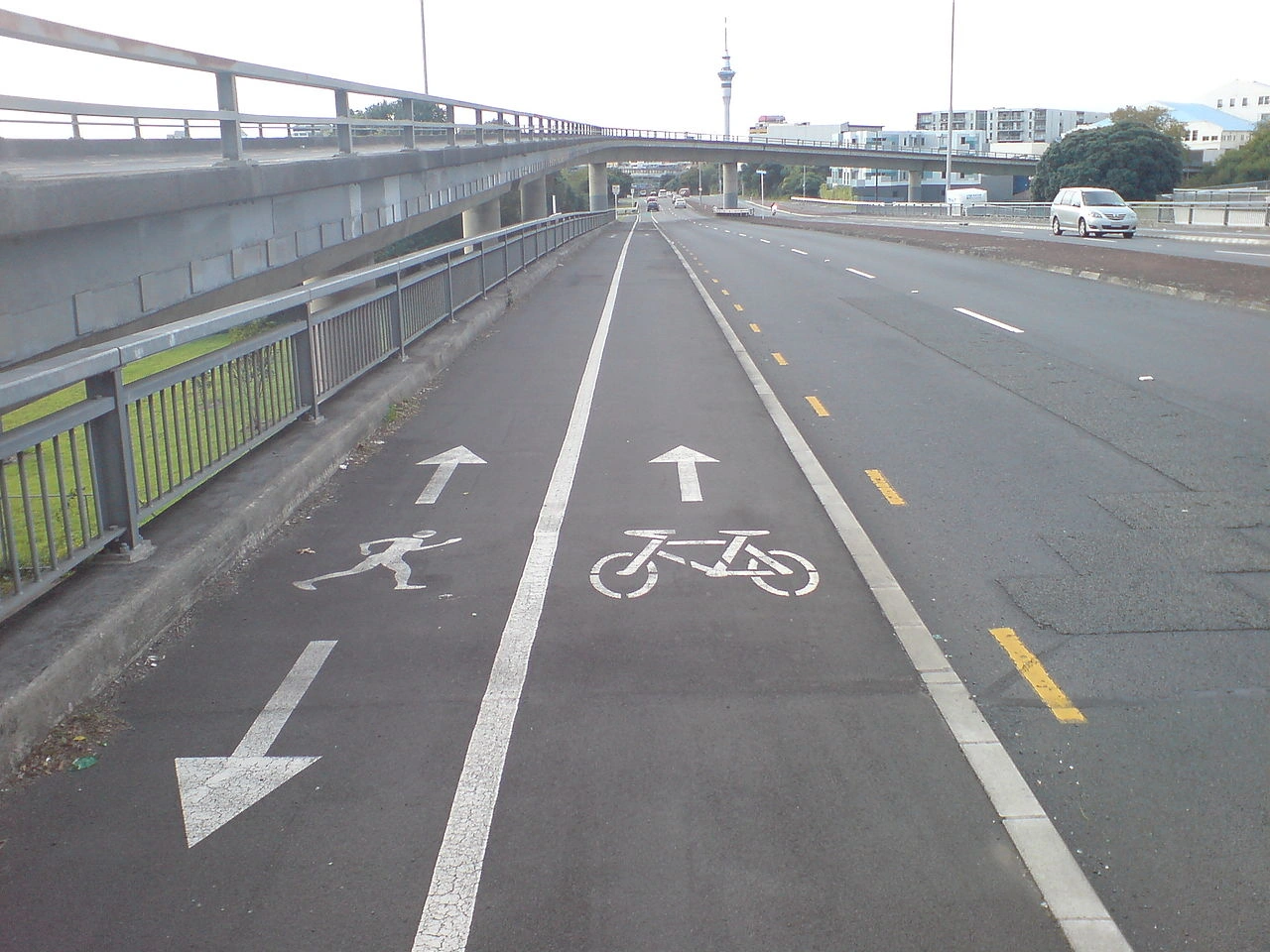
A bike path is a part of a road or a separate route intended primarily or exclusively for people riding bicycles. It may be physically separated from motor traffic, marked on the road surface or identified by traffic signs.
Bike paths may be one-way, two-way or shared with other road users. The permitted users, direction of travel, priority rules and obligation to use the path depend on local traffic signs and regulations.
Wikimedia.org • Ingolfson • CC0
How can you recognise a bike path?
A bike path may be identified by a bicycle traffic sign, bicycle symbols, coloured surfacing or road markings. It may run beside the carriageway or follow a completely separate route.
Is a bike path the same as a bike lane?
Not always. A bike lane is normally marked directly on or beside the carriageway, while a bike path may be physically separated from motor traffic. The terminology and legal distinction vary between countries.
Must cyclists use a bike path?
This depends on local law and the signs displayed. Some bike paths are mandatory, while others are optional. Cyclists may also be permitted to leave a path to turn, overtake or avoid an obstruction.
Can a bike path carry traffic in both directions?
Yes. Some bike paths are two-way, but others may be used only in the direction indicated by signs, markings or their position beside the road. Cyclists should not assume that every path permits travel in both directions.
May pedestrians use a bike path?
Pedestrians may use a bike path where it is designated as a shared-use path or where local law permits it. On a cycle-only path, pedestrians may be prohibited or permitted only when no suitable pedestrian facility is available.
May mopeds or speed pedelecs use a bike path?
This depends on the country, vehicle category, road speed and traffic signs. Some bike paths permit or require certain mopeds or speed pedelecs, while others are reserved exclusively for ordinary bicycles.
May motor vehicles use a bike path?
Normally not. Motor vehicles may cross a bike path to enter another road or property where this is permitted, but they must follow the applicable priority rules and must not endanger path users.
Who has priority where a vehicle crosses a bike path?
Priority depends on the road layout, signs, signals and local law. Drivers crossing a continuous bike path commonly have to give way to its users, but cyclists approaching a separate cycle crossing may not automatically have priority before entering it.
Does a cyclist always have priority at a cycle crossing?
No. A marked cycle crossing does not universally give an approaching cyclist priority. Cyclists should enter cautiously and observe approaching traffic unless signs, signals or local rules clearly give them priority.
Is there a speed limit on a bike path?
Some countries or local authorities impose specific limits, particularly on shared paths. Even without a posted limit, cyclists must travel at a safe and considerate speed for the width, visibility and number of other users.
May you stop or park on a bike path?
Normally not. Stopping or parking on a bike path can force cyclists into motor traffic and may be expressly prohibited by law.
What should cyclists do when passing pedestrians?
Reduce speed, give a clear warning where appropriate and leave sufficient space. Pedestrians may change direction unexpectedly, especially on a shared path.
What should cyclists do when a bike path is blocked?
Slow down and check surrounding traffic before leaving the path. Avoid the obstruction safely and return to the bike path when permitted and practical.
Can cyclists ride side by side on a bike path?
This depends on local law and the available width. Even where riding side by side is permitted, cyclists must not block, endanger or unnecessarily hinder other path users.
What is the difference between a bike path and a shared-use path?
A bike path is intended primarily or exclusively for cycling. A shared-use path is legally intended for cyclists together with pedestrians or other indicated road users, who must use the space considerately.
6. Pedestrian warning
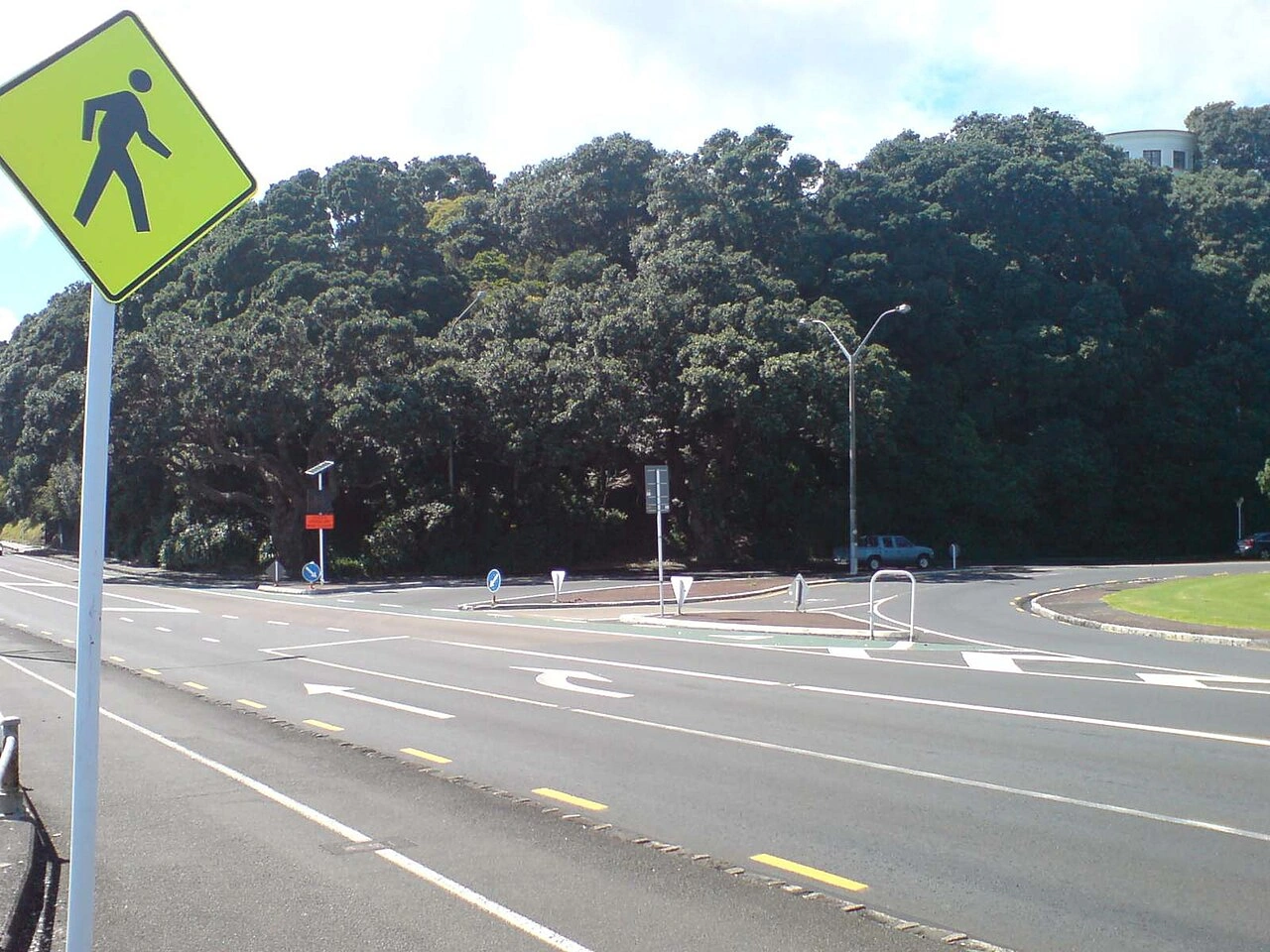
A pedestrian warning is a traffic warning indicating that pedestrians may be crossing or entering the roadway ahead. It is commonly used near pedestrian crossings or other locations where drivers need advance notice of frequent pedestrian activity.
Drivers approaching a pedestrian warning should reduce speed when necessary, watch carefully for pedestrians and be prepared to stop. The design of the warning sign and the priority rules at the crossing vary between countries.
Wikimedia.org • Ingolfson • CC0
What does a pedestrian warning mean?
A pedestrian warning alerts drivers that pedestrians may be crossing or entering the road ahead.
Where are pedestrian warning signs commonly used?
They are commonly placed near pedestrian crossings or other locations with significant pedestrian activity.
How should you react to a pedestrian warning?
Reduce speed when necessary, watch both sides of the road and be prepared to give way or stop for pedestrians according to the applicable traffic rules.
7. Bridge
A bridge is a structure that carries a road, path or railway over an obstacle such as a river, valley, railway line or another road. A road bridge may carry one or more roadways together with pedestrian or cycling facilities.
Drivers should follow any speed, weight, height, width or vehicle-access restrictions applying to the bridge. Particular care may be necessary on narrow, exposed or movable bridges and when weather conditions such as wind, rain or ice affect the road surface.

Wikimedia.org • Bruce Cran • CC BY
What is a bridge?
A bridge is a structure that carries a road, path or railway over an obstacle such as a river, valley, railway or another road.
Can a bridge carry several traffic lanes?
Yes. Road bridges may carry one or several traffic lanes and can also contain pavements, cycle facilities or public-transport infrastructure.
Can a bridge have a weight limit?
Yes. A bridge may have restrictions on the maximum vehicle mass or axle load that it can safely accommodate. Drivers of heavy vehicles must obey the applicable signs.
Can a bridge have a width or height restriction?
Yes. Narrow bridges or structures forming part of a bridge can have width, height or other dimensional restrictions indicated by traffic signs.
What is a movable bridge?
A movable bridge is a bridge that can open, lift, swing or otherwise move to allow ships or other traffic to pass beneath or through it.
What should you do when a movable bridge is opening?
Stop when required by the traffic lights, barriers or other signals and remain behind the designated stopping point until the crossing is reopened.
Can bridges become slippery?
Yes. Bridge surfaces can become wet, icy or slippery and may sometimes cool differently from the surrounding road. Drivers should adapt their speed to the actual conditions.
Can strong winds be dangerous on a bridge?
Yes. Exposed bridges can be affected by crosswinds, particularly for motorcycles, bicycles, high-sided vehicles and vehicles towing trailers.
Can you stop or park on a bridge?
This depends on the local traffic rules, road layout and signs. Stopping or parking may be prohibited where it would create danger, obstruct traffic or reduce the available road width.
Can pedestrians and cyclists use a bridge?
Yes, where permitted. Bridges may provide pavements, cycle paths or shared facilities, while high-speed or restricted bridges may prohibit certain road users.
Can traffic be restricted to one direction on a narrow bridge?
Yes. Priority signs, traffic lights or other traffic-management measures may control which direction passes first where two-way traffic cannot safely meet.
Should you overtake on a narrow bridge?
Only when overtaking is legal and clearly safe. Limited width or visibility can make overtaking inappropriate even where no specific prohibition is shown.
8. Speed bump
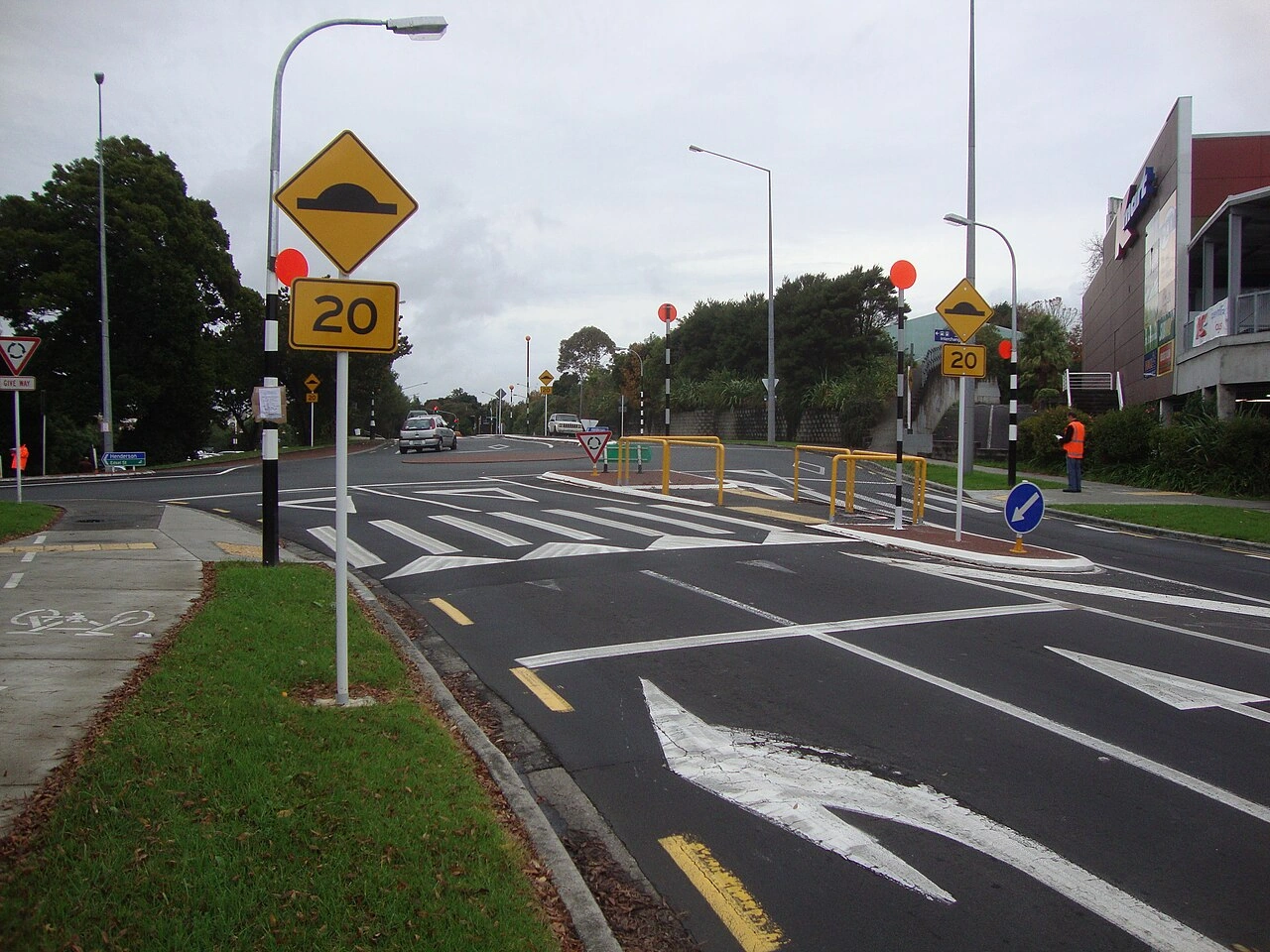
A speed bump is a raised traffic-calming device placed across all or part of a road to make drivers reduce their speed. It is commonly used near homes, schools, crossings, parking areas and other places where low vehicle speeds are important.
Speed bumps vary in shape, height and legal status. Drivers should approach them at a low, controlled speed and follow any warning signs or speed limits that apply.
Wikimedia.org • Schwede66 • CC BY-SA
What is the purpose of a speed bump?
A speed bump is intended to physically reduce vehicle speeds. It encourages drivers to slow down in places where pedestrians, cyclists, children or local traffic may be present.
How can you recognise a speed bump?
A speed bump is a raised section extending across all or part of the road. It may be marked with contrasting paint, road markings or warning signs to make it more visible.
Is a speed bump the same as a speed table?
No. A speed bump or speed hump normally has a rounded profile. A speed table has ramps leading to a longer, flat raised section that may contain an intersection or pedestrian crossing.
Is a speed cushion the same as a speed bump?
No. A speed cushion is a narrower raised device that does not cover the full width of a traffic lane. Its design may allow buses and emergency vehicles to pass with less disturbance while still slowing smaller vehicles.
Is there a universal speed limit over a speed bump?
No. The legal speed depends on the country, traffic signs and road type. Even when no special limit applies, drivers must cross the device at a speed that is safe for the road, vehicle and passengers.
How should you approach a speed bump?
Check surrounding traffic, reduce your speed smoothly and approach in a straight line where possible. Avoid sudden braking immediately before the bump.
Should you brake while crossing a speed bump?
Most of the necessary braking should be completed before reaching the raised surface. Cross at a steady, low speed and avoid harsh braking or acceleration while the wheels are on the device.
Should you drive across a speed bump at an angle?
Normally not. Cross in the normal direction of the traffic lane unless the road layout requires otherwise. Driving diagonally may place the vehicle in the path of approaching or overtaking traffic.
May motorcycles and bicycles use a speed bump?
Yes. Riders should reduce speed, keep the vehicle stable and cross as directly as possible. Painted or wet raised surfaces may provide less grip.
Do pedestrians have priority at a speed bump?
Not automatically. A speed bump does not by itself create a pedestrian crossing. Pedestrian priority depends on crossings, traffic signals, signs and local law.
Does a speed bump change priority at an intersection?
No. The presence of a raised surface does not normally change the priority rules. Drivers must continue to follow traffic signs, signals and the ordinary intersection rules.
May you overtake on a speed bump?
Overtaking may be restricted by local law or signs. Even where it is not expressly prohibited, drivers should avoid overtaking when the raised surface, limited space or nearby vulnerable road users make the manoeuvre unsafe.
May you stop or park on a speed bump?
This depends on local law. Stopping or parking may be prohibited because the vehicle could obstruct visibility, traffic flow or the purpose of the traffic-calming device.
Can a speed bump damage a vehicle?
A correctly designed speed bump should be crossed safely at an appropriate speed. Crossing too quickly may damage tyres, wheels, suspension, bodywork or cargo and may cause passengers discomfort.
Does the road speed limit change after a speed bump?
Not necessarily. A special limit may apply only to the raised device, while a signed speed restriction or speed zone may continue beyond it. Drivers must follow the applicable signs and local rules.
Why do buses and emergency vehicles sometimes avoid speed bumps?
Raised devices can affect passenger comfort, emergency response and large vehicles. Some roads therefore use speed tables, cushions or other traffic-calming measures designed to reduce these effects.
9. One-way traffic
One-way traffic means that vehicles on a road or carriageway may travel only in one designated direction. The permitted direction is normally indicated by traffic signs, lane arrows or road markings.
Some road users, such as cyclists or public-transport vehicles, may be allowed to travel in the opposite direction when signs expressly permit it. A one-way road does not by itself determine the speed limit, priority or parking rules.

Wikimedia.org • LincolnGroup11 • CC BY-SA
What is a one-way road?
A one-way road is a road or carriageway on which vehicles may travel only in the designated direction.
How can you recognise one-way traffic?
One-way traffic is normally indicated by a one-way sign at the entrance and a no-entry sign at the opposite end. Lane arrows and road markings may provide additional guidance.
Is a one-way sign the same as a no-entry sign?
No. A one-way sign confirms the permitted direction of travel. A no-entry sign prohibits drivers from entering from the opposite direction.
Does one-way traffic apply to the entire road?
It may apply to an entire road, one carriageway, a particular lane or only a designated section. Drivers must follow the signs and markings applying to the part of the road they use.
Can a divided road have one-way traffic on each carriageway?
Yes. On a divided road, each carriageway normally carries traffic in one direction even though the road as a whole carries traffic in both directions.
May cyclists travel against one-way traffic?
Only when traffic signs or local law expressly permit contraflow cycling. Drivers should check supplementary signs and remain alert for cyclists approaching from the opposite direction.
May buses travel against one-way traffic?
Public-transport vehicles may use a contraflow lane where signs and road markings permit it. Other drivers may not use that lane unless they are also authorised.
Does a one-way road have its own speed limit?
No. The applicable speed depends on the country, road type, surrounding area and traffic signs.
Does one-way traffic change priority at intersections?
No. Drivers must continue to follow traffic lights, priority signs and the ordinary local priority rules.
Does traffic on a one-way road always have priority?
No. The one-way designation regulates direction of travel, not priority. Traffic entering or crossing the road may still have priority under signs or local law.
Which lane should you use on a one-way road?
Follow the local lane-positioning rules, lane arrows and destination signs. Drivers commonly keep to the normal side of the road unless overtaking, turning or choosing a marked lane.
Where should you position yourself before turning?
Use the lane or side indicated for the intended direction. On many one-way roads, drivers turning towards the opposite side of the road may position themselves closer to that side before turning.
May you overtake on a one-way road?
Overtaking may be permitted where there is sufficient space and no sign or rule prohibits it. The normal overtaking side and safety requirements continue to apply unless local law provides otherwise.
May you reverse on a one-way road?
A short reversing manoeuvre may be permitted where local law allows it and it can be completed safely. Drivers must not use reversing to travel along the road in the prohibited direction.
May you make a U-turn on a one-way road?
You may not turn around and continue against the permitted direction. A U-turn may also be prohibited by signs or general traffic law.
May you park on both sides of a one-way road?
This depends on local law, signs, markings and the available width. Some countries permit parking along either side, while others retain stricter positioning rules.
Can pedestrians come from both directions?
Yes. One-way traffic restrictions normally apply to vehicles using the carriageway, not to pedestrians using pavements or other pedestrian facilities.
Should you still check both directions?
Yes. Cyclists, buses, emergency vehicles or other authorised users may approach from the opposite direction. Drivers should check both directions before turning, crossing or opening a vehicle door.
What should you do if you enter a one-way road incorrectly?
Do not continue against traffic. Stop somewhere safe without creating additional danger and follow lawful directions to leave or correct the situation. Do not reverse blindly into an intersection.
How does one-way traffic end?
The restriction may end at an end sign, an intersection, a change in road design or a sign warning that two-way traffic resumes. Follow the local signs and road layout.
10. Slope
A slope is a section of road that rises or descends noticeably. A steep slope can affect vehicle speed, braking distance, traction, visibility and the ability of heavy or low-powered vehicles to maintain a steady speed.
Warning signs may indicate a steep ascent or dangerous descent and may show the gradient as a percentage. Drivers should adjust their speed early, select a suitable gear and remain prepared for slow vehicles, bends and changing road conditions.
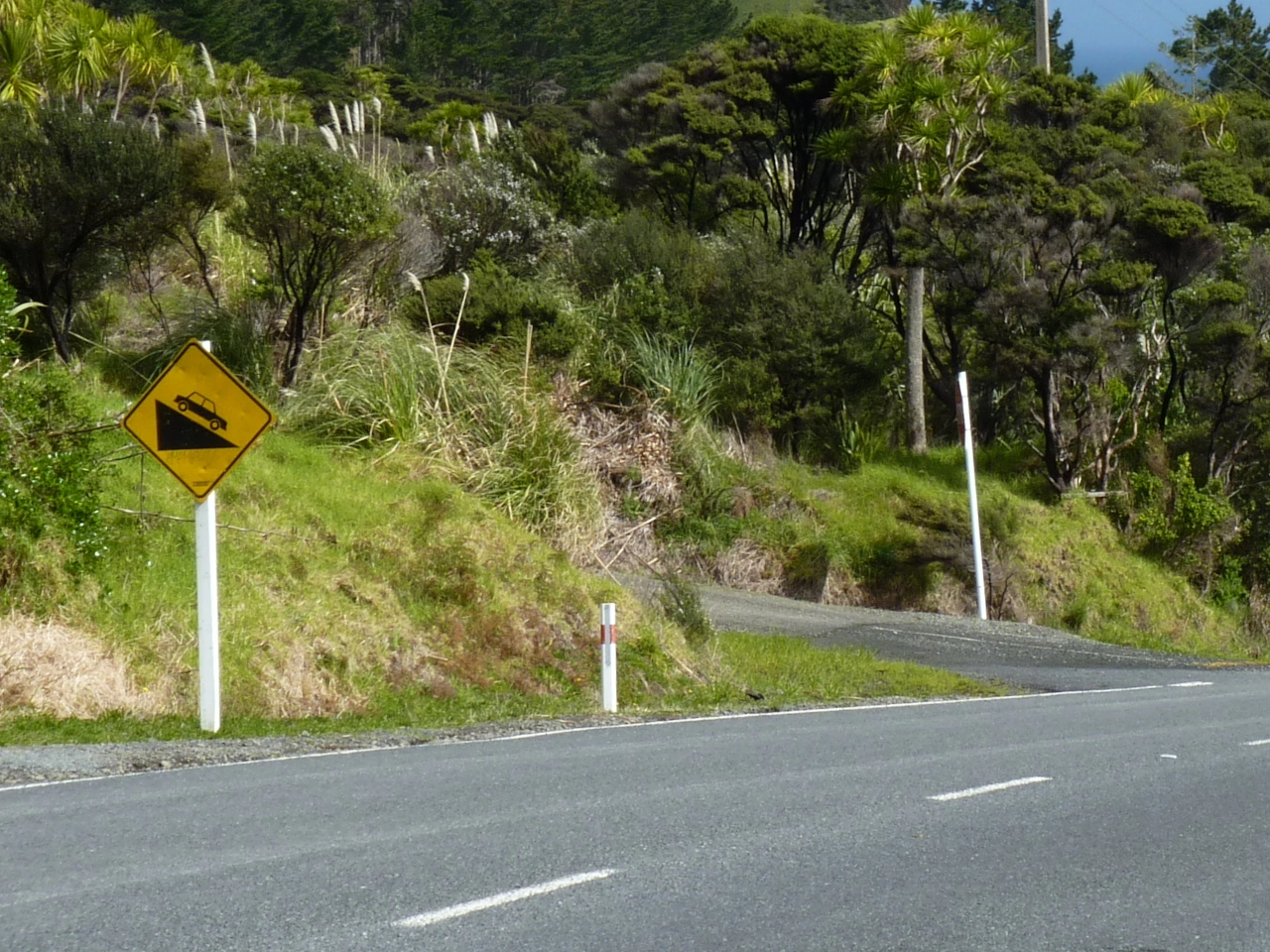
Wikimedia.org • Michal Klajban • CC BY-SA
What is a road slope?
A road slope is a section of road that rises or descends over a particular distance. It may also be called a gradient, incline or decline.
How can you recognise a steep slope?
A steep slope may be indicated by a warning sign showing an ascending or descending road. The sign may also display the gradient as a percentage.
What does a gradient of 10% mean?
A gradient of 10% means that the road rises or falls approximately 10 metres for every 100 metres travelled horizontally. It does not mean that the road is inclined at 10 degrees.
What is the difference between an ascent and a descent?
An ascent rises in the direction of travel, while a descent falls in the direction of travel. The same section of road is therefore an ascent in one direction and a descent in the other.
Does a slope warning sign impose a speed limit?
Not normally. It warns of a hazard rather than setting a numerical limit. Drivers must still respect the applicable speed limit and reduce their speed further when necessary.
How should you approach a steep descent?
Reduce speed before the descent, select a suitable gear and maintain a safe following distance. Avoid allowing the vehicle to gain excessive speed.
Which gear should you use when descending?
Use a gear that provides sufficient engine braking and helps keep the vehicle at a controlled speed. The appropriate gear depends on the vehicle, gradient and road conditions.
Should you coast downhill in neutral?
No. Coasting reduces engine braking and may make it harder to control the vehicle’s speed. Keep the transmission engaged while descending.
Why should you avoid continuous heavy braking?
Continuous braking on a long descent can cause the brakes to become excessively hot and lose effectiveness. Select a suitable gear, control speed early and use the brakes progressively when needed.
What is brake fade?
Brake fade is a reduction in braking performance caused by excessive heat. It can occur when the brakes are used continuously during a long or steep descent.
How should you drive uphill?
Select a suitable gear before the engine begins to struggle and maintain a steady speed where possible. Be prepared for heavy or low-powered vehicles travelling slowly ahead.
May a vehicle lose speed on a steep ascent?
Yes. Heavy vehicles, vehicles towing trailers and low-powered vehicles may slow considerably. Other drivers should maintain a safe distance and avoid impatient manoeuvres.
May you overtake near the top of a slope?
Do not overtake when the crest prevents you from seeing far enough ahead. Overtaking near a hilltop may also be expressly prohibited by local law, signs or road markings.
Why is visibility limited near the crest of a slope?
The road surface itself may hide approaching traffic, stopped vehicles, pedestrians or other hazards beyond the crest.
Who has priority on a narrow slope?
Some countries give priority to uphill traffic, while others rely on signs or ordinary obstruction rules. Drivers must follow local law and cooperate when passing is difficult.
How should you meet another vehicle on a narrow slope?
Reduce speed and use a passing place where available. The driver who can reverse or move aside more safely should cooperate, subject to any applicable priority signs or local rules.
How do rain, snow or ice affect a slope?
They reduce traction and make acceleration, braking and steering more difficult. Increase the following distance, use smooth controls and reduce speed before entering the slope.
Why are cyclists vulnerable on slopes?
Cyclists may travel slowly and move less steadily when climbing, while they may reach high speeds when descending. Drivers should leave sufficient space and avoid overtaking without a clear view.
How should you park on a slope?
Use the parking brake, select the appropriate gear or parking position and follow local rules concerning wheel position. Make sure the vehicle cannot roll into traffic.
Can a slope affect towing?
Yes. A trailer increases the load on the engine and brakes and may affect stability. Drivers should use a suitable gear, maintain additional distance and avoid excessive speed.
11. Bus lane
A bus lane is a traffic lane reserved primarily for buses or other authorised public-transport vehicles. It is intended to improve the reliability and flow of public transport by allowing authorised vehicles to avoid general traffic congestion.
Other road users, such as taxis, cyclists, motorcycles or vehicles carrying several occupants, may also be permitted when signs expressly allow them. The operating hours, permitted vehicles, direction of travel and rules for entering or crossing the lane depend on local traffic signs and regulations.
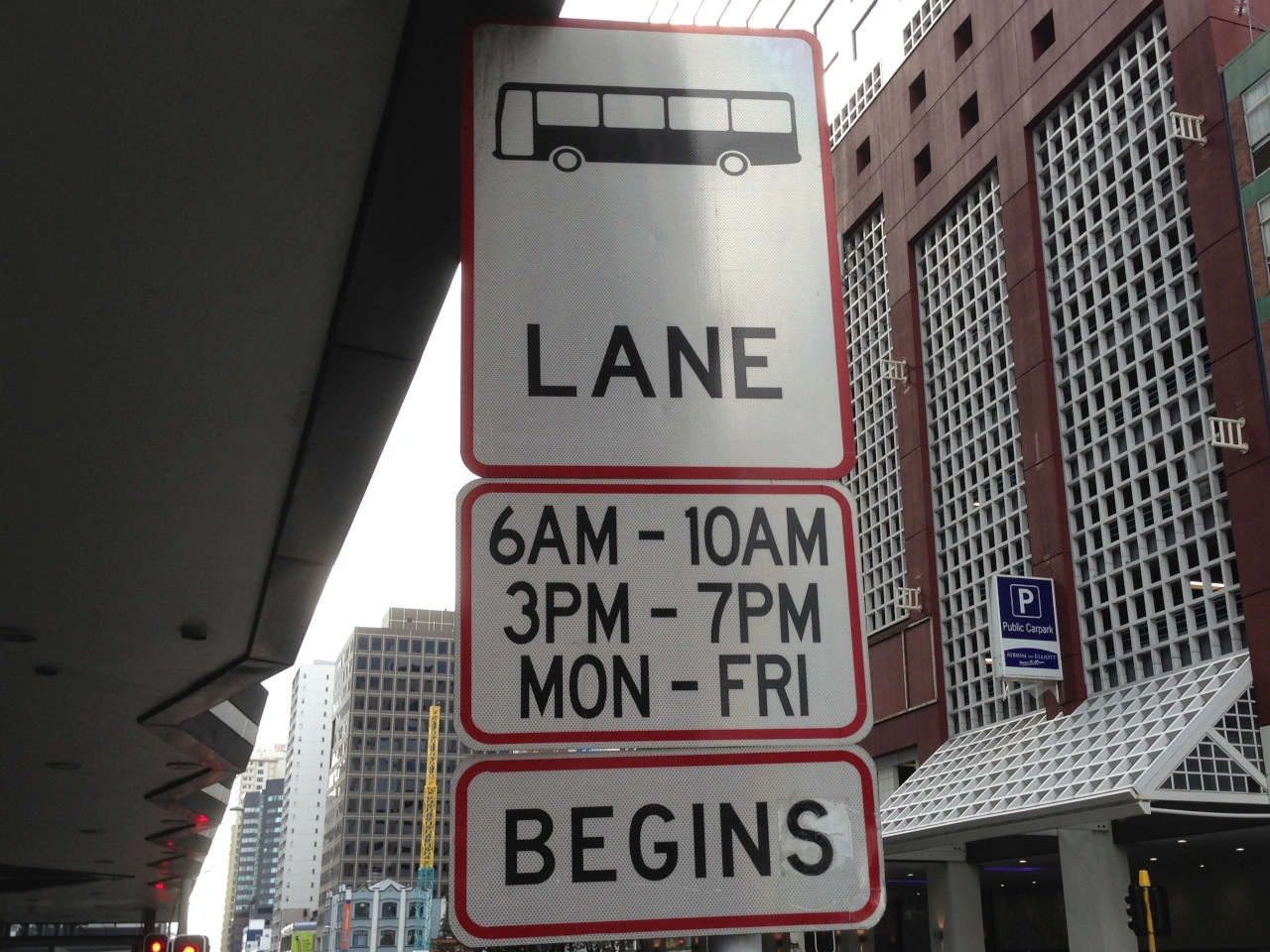
Wikimedia.org • LincolnGroup11 • CC BY-SA
What is a bus lane?
A bus lane is a lane reserved primarily for buses or other authorised public-transport vehicles. Its purpose is to help public transport move efficiently through traffic.
How can you recognise a bus lane?
A bus lane may be identified by a bus-lane sign, lane markings, coloured surfacing or the word BUS painted on the road. The markings and colours differ between countries.
Is a bus lane the same as a bus-only road?
No. A bus lane forms part of a wider road arrangement, while a bus-only road may reserve the entire road for buses and other authorised users.
Who may use a bus lane?
Buses operating authorised or scheduled services may normally use it. Other vehicles may enter only when the traffic signs or local regulations expressly permit them.
May taxis use a bus lane?
This depends on local law and the signs displayed. Some bus lanes permit licensed taxis, while others are reserved exclusively for buses.
May cyclists use a bus lane?
Cyclists may use a bus lane where signs or local law permit them. They should remain alert for large vehicles, stops, passengers and buses moving towards the kerb.
May motorcycles use a bus lane?
Only where motorcycles are expressly permitted. Permission may apply to all motorcycles, particular times or specific bus lanes.
Can a bus lane operate only at certain times?
Yes. A sign may show days or hours during which the restriction applies. Outside those periods, the lane may become available to general traffic, subject to the local rules.
Does a bus lane have a special speed limit?
Not necessarily. The normal road or posted speed limit generally applies unless a separate restriction is displayed.
May ordinary vehicles enter a bus lane to turn?
Some countries allow drivers to enter a bus lane shortly before a junction to make a turn. Drivers must follow the lane markings and enter only at the point where local rules permit it.
May you cross a bus lane?
Usually, where necessary and permitted. A driver may need to cross it at an intersection or to enter or leave a property, parking area or side road. The driver must check carefully for buses, cyclists and other authorised users.
May you use a bus lane to pass congestion?
No. An unauthorised driver may not use the bus lane simply to overtake a queue or reach the front of traffic.
May you stop or park in a bus lane?
Stopping and parking are normally prohibited unless a sign or marked bay expressly permits them. A stopped vehicle can obstruct buses and force authorised lane users into general traffic.
Do buses always have priority when leaving a stop?
Not universally. Some countries require drivers to allow a signalling bus to leave a stop, particularly inside built-up areas. Elsewhere, ordinary merging rules apply.
Does a bus lane change priority at an intersection?
No. Traffic lights, priority signs and the ordinary intersection rules continue to apply unless special public-transport signals indicate otherwise.
Can a bus lane run against the direction of general traffic?
Yes. A contraflow bus lane may carry authorised vehicles in the opposite direction from nearby general traffic. Drivers and pedestrians should check both directions before crossing.
What do special bus traffic lights mean?
Some countries use separate lights or symbols for public-transport vehicles. Only drivers authorised to use that lane should follow those signals, while other traffic follows its own lights.
What should you check before crossing a bus lane?
Check mirrors and blind spots and look for buses, taxis, cyclists, motorcycles or other authorised vehicles. Their lane may be moving even when general traffic is stationary.
How does a bus lane end?
It may end at a sign, a change in road markings, an intersection or the end of its stated operating period. Drivers should follow the lane arrows and merge safely where required.
12. Stop sign
A stop sign requires drivers to bring their vehicle to a complete stop and give way before entering or crossing the road ahead. The stop must be made at the stop line or another legally prescribed position.
After stopping, the driver may continue only when this can be done safely and without interfering with traffic that has priority. The sign does not create priority for the driver who has stopped.

Wikimedia.org • LincolnGroup11 • CC BY-SA
What does a stop sign mean?
A stop sign requires a driver to come to a complete stop and give way before proceeding.
How can you recognise a stop sign?
A stop sign is commonly a red octagonal sign displaying the word STOP. Some countries use another legally recognised design, so drivers must learn the signs used locally.
Must you stop when no other traffic is visible?
Yes. The obligation to stop applies even when the road appears completely clear.
What is a complete stop?
A complete stop means that the vehicle has ceased moving entirely. Merely slowing down or allowing the vehicle to continue rolling does not satisfy the requirement.
Where should you stop?
Stop before the stop line where one is provided. Without a line, stop at the legally prescribed position before entering the intersection, crossing or priority road.
May you stop beyond the stop line?
No. The required first stop must be made before the line. If visibility is limited, move forward cautiously after stopping and stop again where necessary before proceeding.
Must every vehicle in a queue stop separately?
Yes. Each driver must make an individual complete stop. Following another vehicle through without stopping is not permitted.
Does stopping give you priority?
No. After stopping, you must continue to give way to all road users who have priority.
Who must you give way to?
Give way to traffic on the road being entered or crossed and to pedestrians, cyclists or other road users who have priority under the applicable rules.
What is the difference between a stop sign and a give-way sign?
A stop sign always requires a complete stop. A give-way sign requires the driver to yield but normally allows continued movement when the road is clearly free.
May you turn after stopping?
Yes. After stopping and giving way, you may turn in any direction permitted by signs, signals, lane arrows and road markings.
May you turn right at a red traffic light after stopping?
This depends entirely on local law and traffic signs. A stop sign does not by itself permit a turn against a red light.
Does a stop sign impose a speed limit?
No. It imposes a stopping and yielding obligation. The normal posted or general speed limit remains applicable before and after the intersection.
Does a stop sign apply to cyclists?
In many countries, cyclists are drivers and must stop unless a specific sign or local rule provides an exception.
What happens at an all-way stop?
The order in which drivers may proceed depends on local rules, commonly involving arrival order, vehicle position and turning direction. Drivers should communicate cautiously and never assume another driver will yield.
What if two vehicles stop at the same time?
Apply the local priority rule and proceed only when the intentions of the other driver are clear. Avoid forcing the other vehicle to brake or change direction.
Do traffic lights override a stop sign?
Where functioning traffic lights control the same movement, they commonly take precedence over the stop sign. Local rules determine what applies when the lights are switched off or flashing.
Do instructions from a police officer override a stop sign?
Yes. Instructions from an authorised traffic officer normally take precedence over traffic signs and ordinary priority rules.
Can a temporary stop sign be legally binding?
Yes. A correctly placed temporary stop sign at roadworks, an event or another temporary traffic arrangement must be obeyed.
What should you do when the stop sign is partly hidden?
If you recognise that a stop sign applies, reduce speed and obey it. Report damaged, obscured or missing signs to the responsible road authority where appropriate.
13. Give way
A give-way sign requires drivers to allow traffic with priority to proceed before entering, crossing or joining a road. Drivers must reduce speed, observe approaching traffic and stop when necessary.
Unlike a stop sign, a give-way sign does not always require a complete stop. The driver may continue without stopping only when the route is clearly safe and no road user with priority is forced to change speed or direction.

Wikimedia.org • Phillip Capper • CC BY
What does a give-way sign mean?
A give-way sign requires drivers to allow traffic with priority to proceed first. The driver must slow down and stop when necessary.
How can you recognise a give-way sign?
It is commonly an inverted triangular sign with a red border and a light-coloured centre. In some countries, it is called a yield sign.
Must you always stop at a give-way sign?
No. You must stop only when necessary to give way or obtain a sufficiently clear view. You may continue slowly when the road is clearly free.
What does giving way mean?
Giving way means allowing another road user to continue without being forced to brake, accelerate, stop or change direction because of your movement.
Where should you stop when necessary?
Stop before the give-way line where one is provided. Without a line, stop before entering the intersection or priority road at a position where you can observe traffic safely.
May you cross the give-way line before stopping?
You may move beyond the line only when this does not interfere with traffic that has priority. Where visibility is limited, first slow or stop at the line and then move forward cautiously.
What is the difference between give way and stop?
A stop sign always requires a complete stop. A give-way sign permits the driver to continue without stopping when the road is clearly free and it is safe to proceed.
Does slowing down satisfy the give-way requirement?
Only when slowing down is sufficient to let all priority traffic proceed safely. If another road user would be hindered, the driver must slow further or stop.
Who must you give way to?
Give way to traffic travelling on the road being entered or crossed and to any pedestrians, cyclists or other road users who have priority under the applicable rules.
Does giving way apply only to vehicles approaching from one direction?
No. Check every direction from which lawful traffic may approach, including cycle paths, one-way roads with authorised contraflow traffic and separate carriageways.
Does a give-way sign give the other road permanent priority?
The sign determines priority at the particular location. The priority arrangement at later intersections may be different unless the road is separately identified as a priority road.
Does giving way give you priority afterwards?
No. You may proceed only when it is safe. Another driver’s hesitation or courtesy does not remove your responsibility to avoid danger.
Must every vehicle in a queue give way separately?
Yes. Each driver must observe the road and make an individual decision. You may not follow another vehicle through without checking that the way remains clear.
Does a give-way sign apply to cyclists?
Normally, yes. Cyclists are generally treated as drivers and must obey the sign unless a supplementary sign or local rule provides otherwise.
Can a give-way sign apply only to cyclists?
Yes. Some countries use supplementary signs or path-specific signs to require cyclists to give way while other traffic follows a different priority arrangement.
Does a give-way sign change the speed limit?
No. It regulates priority rather than speed. Drivers must still approach slowly enough to observe traffic and stop when necessary.
Does a give-way sign change turning rules?
No. Drivers must still obey traffic lights, lane arrows, mandatory-direction signs and turning prohibitions.
How does give way work at a roundabout?
Many roundabout entrances have give-way signs requiring entering traffic to yield to vehicles already circulating. Drivers must follow the actual signs because roundabout priority rules differ between countries.
Do traffic lights override a give-way sign?
Functioning traffic lights commonly take precedence over priority signs controlling the same movement. The give-way sign may apply again when the lights are switched off or flashing, depending on local law.
Do police instructions override a give-way sign?
Yes. Instructions from an authorised traffic officer normally take precedence over traffic signs and ordinary priority rules.
What should you do when visibility is limited?
Reduce speed substantially and stop when necessary. Move forward cautiously only after giving way and checking that the road can be entered without danger.
14. Roundabout
A roundabout is a circular road arrangement in which traffic travels around a central island in one designated direction. Vehicles enter and leave through connecting roads, and traffic signs or local rules determine who has priority.
Drivers should reduce speed, choose a suitable lane, observe all road users and signal as required when leaving. The direction of travel, entry priority, lane use and rules for cyclists and pedestrians depend on local traffic signs and regulations.

Wikimedia.org • Ingolfson • CC0
What is a roundabout?
A roundabout is a circular road arrangement where traffic travels in one direction around a central island before leaving through the chosen exit.
How can you recognise a roundabout?
A roundabout is normally identified by a circular-direction sign, a central island and entry roads controlled by signs, markings or local priority rules.
Which direction does traffic travel around a roundabout?
The direction depends on the country’s driving side. Traffic normally travels anticlockwise in right-hand-traffic countries and clockwise in left-hand-traffic countries.
Who has priority at a roundabout?
Priority differs between countries and roundabout designs. Entering traffic commonly gives way to traffic already circulating, but drivers must always follow the actual priority signs and signals.
Must you stop before entering a roundabout?
Not always. Stop when required by a stop sign, traffic light or approaching priority traffic. Otherwise, reduce speed and enter only when there is a safe gap.
Does a roundabout always have a give-way sign?
No. The sign arrangement depends on local law. Some circular intersections use ordinary priority rules or traffic lights instead.
How should you approach a roundabout?
Reduce speed, observe the signs and markings, choose the appropriate lane and check for pedestrians, cyclists and circulating traffic.
Which lane should you choose?
Follow the lane arrows and destination signs. As a general guide, use the lane appropriate for your exit, but exact lane-selection rules differ between countries and roundabout layouts.
May you use an inner lane?
Yes, where the road layout and local rules permit it. Before leaving, change lanes safely and give way to road users already travelling in the lane you wish to enter.
Do you need to signal when entering?
This depends on local law. Some countries require a signal for particular exits, while others require no signal when entering.
Do you need to signal when leaving?
Usually, yes. Signal in the direction of the exit early enough to inform other road users, but not so early that your intention becomes misleading.
Does signalling give you priority?
No. A direction indicator communicates your intention but does not permit you to force another road user to brake or change direction.
May you change lanes on a roundabout?
Only when the lane markings permit it and the manoeuvre can be completed safely. Check mirrors and blind spots, signal where required and give way to traffic already in the target lane.
What should you do if you miss your exit?
Continue around the roundabout and approach the exit again. Do not stop, reverse or cut suddenly across another lane.
May you drive over the central island?
Normally not. Some small roundabouts have a mountable central section intended only for vehicles that cannot otherwise negotiate the road safely.
Do cyclists have priority at a roundabout?
Priority depends on whether cyclists use the carriageway, a continuing bike path or a separate cycle crossing. Drivers and cyclists must follow the signs, markings and local priority rules.
What should drivers check before leaving?
Check mirrors and blind spots for cyclists, mopeds, motorcycles and vehicles beside you. Also check for pedestrians crossing the exit road.
Do pedestrians have priority at roundabout exits?
Pedestrian priority depends on crossings and local law. Drivers should approach exits slowly and be prepared to yield to pedestrians crossing or about to cross.
Does a roundabout have a special speed limit?
Not universally. The posted or general road limit applies, but drivers must travel slowly enough to negotiate the roundabout safely.
May you overtake on a roundabout?
Passing another vehicle may be permitted on a multilane roundabout, but drivers must remain within their lane and avoid unsafe lane changes. Local overtaking restrictions may apply.
May you stop or park on a roundabout?
Follow local signs and parking rules. Stopping or parking on the circulating roadway is commonly prohibited or unsafe because it obstructs traffic and reduces visibility.
Is every circular intersection a roundabout?
No. A circular junction may be governed by traffic lights, ordinary priority rules or another road design. Its legal status depends on its signs and local definition.
15. Road narrowing
A road narrowing is a section where the available width of the road or carriageway becomes smaller. The narrowing may occur on both sides, on one side only, or because one or more traffic lanes end.
Drivers should reduce speed, observe approaching and adjacent traffic, maintain sufficient lateral clearance and merge when necessary. Warning signs do not always determine priority, so drivers must follow any priority signs, lane markings and local traffic rules.
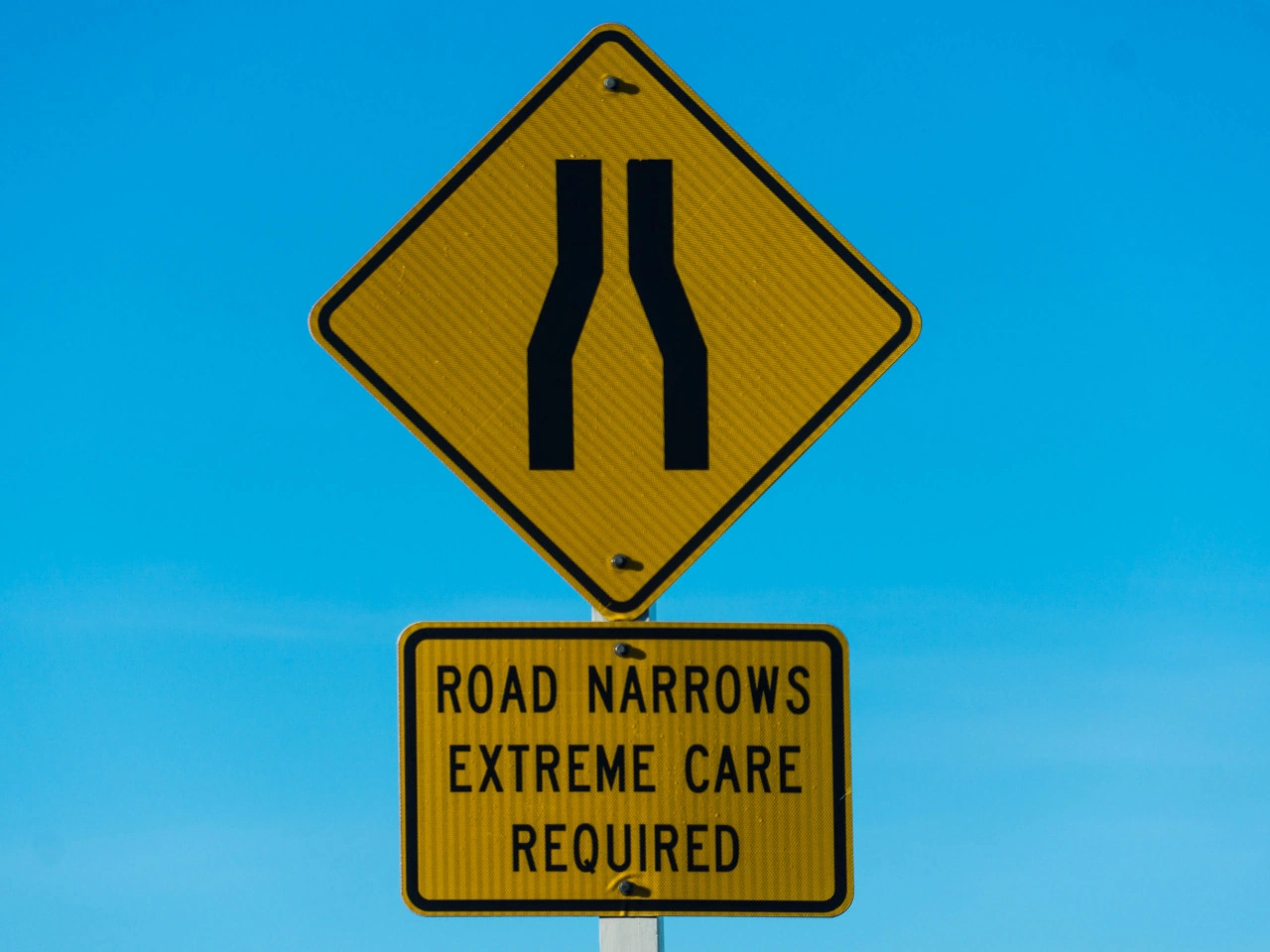
Wikimedia.org • itravelNZ • CC BY
What is a road narrowing?
A road narrowing is a section where the usable width of the road becomes smaller. Traffic may have less space to pass, merge or travel beside other road users.
How can you recognise a road narrowing?
It may be indicated by a triangular warning sign showing the road edges moving closer together. The symbol may show narrowing on both sides, the left side or the right side.
What can cause a road to narrow?
A road may narrow because of a bridge, tunnel, barrier, traffic-calming measure, roadworks, parked vehicles, landslide, damaged road edge or reduction in the number of lanes.
Does a narrowing sign impose a speed limit?
No. It normally warns of danger rather than setting a numerical speed limit. Drivers must still reduce speed when necessary to pass safely.
Does a narrowing sign determine who has priority?
Not by itself. Priority may be established by separate signs, signals or local rules. Without them, drivers should approach cautiously and cooperate.
Who has priority when the obstruction is on one side?
In many countries, the driver whose side is obstructed must give way to approaching traffic. The precise rule depends on local law and any priority signs displayed.
What if the road narrows equally from both sides?
Neither direction necessarily has automatic priority. Drivers should reduce speed, assess who can pass safely and avoid entering when doing so would block approaching traffic.
What do priority signs at a narrow section mean?
One sign may require you to give way to oncoming traffic, while the corresponding sign may indicate that you have priority. Drivers must still avoid entering when the passage is already occupied or blocked.
Does having priority mean you must continue?
No. Priority is not an obligation to proceed. Slow down or stop when another vehicle is already in the narrow section or when continuing would create danger.
What should you do when another vehicle is already in the narrowing?
Allow it enough room to leave the narrow section. Do not enter if the available width is insufficient for both vehicles to pass safely.
How should you approach a road narrowing?
Check mirrors, reduce speed smoothly and observe oncoming traffic, cyclists, pedestrians and vehicles beside you. Be prepared to stop or merge.
Must you use an indicator when the road narrows?
Use an indicator when you must change lanes or move laterally. Merely following a lane that bends with the road may not require a signal under local law.
What should you do when your lane ends?
Check the adjacent lane, signal and merge safely according to the local merging rules. Do not force another driver to brake or leave the road.
What is zipper merging?
Zipper merging means that vehicles from an ending or blocked lane merge alternately with vehicles in the continuing lane, usually immediately before the narrowing during congestion.
Should you merge early during heavy congestion?
Where zipper merging applies, continue using both lanes and merge alternately near the narrowing. In free-flowing traffic, change lanes safely when a suitable gap is available.
May you overtake near a road narrowing?
A narrowing sign does not always prohibit overtaking, but overtaking should be avoided when there is insufficient width, visibility or distance to complete the manoeuvre safely.
How should you pass cyclists at a narrowing?
Wait behind the cyclist when the required passing distance cannot be maintained. Do not squeeze past or force the cyclist towards a kerb, barrier or damaged road edge.
How should large vehicles use a narrow section?
Large vehicles may need additional width and may cross lane or centre markings where legally permitted. Other drivers should leave sufficient space and avoid passing alongside them in the narrowing.
May pedestrians be present at a road narrowing?
Yes. Pavements or verges may also become narrow or blocked. Drivers should expect pedestrians or wheelchair users to enter the carriageway to pass an obstruction.
May you stop or park in a road narrowing?
Only where it is permitted and enough width remains for traffic to pass safely. Never stop or park where the vehicle would create danger, obstruct visibility or prevent other vehicles from passing.
What should you do at a temporary roadworks narrowing?
Follow temporary signs, signals, barriers and instructions from authorised workers. Temporary traffic controls may replace the normal priority or lane arrangement.
What should you do in poor visibility?
Reduce speed further, increase the following distance and be prepared for a stopped vehicle beyond the narrowing. Use the required lights without dazzling approaching road users.
16. Pedestrian crossing
A pedestrian crossing is a designated place where pedestrians may cross a road. It is commonly indicated by road markings, traffic signs, signals or a combination of these measures.
Drivers must approach with appropriate caution and give way when required by local law. Pedestrians must also observe approaching traffic and follow any pedestrian signals or instructions from authorised traffic controllers.
Wikimedia.org • Krzysztof Golik • CC BY-SA
What is a pedestrian crossing?
A pedestrian crossing is a designated place for pedestrians to cross a road. It may be controlled by traffic lights or operate without signals.
How can you recognise a pedestrian crossing?
It may be indicated by white road markings, traffic signs, flashing lights, pedestrian signals or a raised crossing. Its appearance varies between countries.
Is a pedestrian crossing the same as a zebra crossing?
A zebra crossing is a type of pedestrian crossing marked by broad contrasting stripes or rectangles. Not every pedestrian crossing uses this design.
Do pedestrians always have priority?
Not universally. Priority depends on local law, traffic signals and whether the pedestrian is already crossing or clearly preparing to cross.
Must drivers stop for pedestrians waiting beside the crossing?
This depends on local law. In many countries, drivers must give way when a pedestrian is clearly intending or preparing to enter the crossing.
How should drivers approach a pedestrian crossing?
Reduce speed, observe both sides of the road and be prepared to stop. Pay particular attention to children, older people and persons with limited mobility.
May you enter a crossing when traffic is congested?
No. Do not enter when traffic ahead may force you to stop on the crossing and block pedestrians.
Where should you stop for a pedestrian?
Stop before the crossing or before the applicable stop line. Leave the crossing completely clear.
May you overtake near a pedestrian crossing?
Overtaking may be prohibited, particularly when another vehicle has stopped or slowed for the crossing. Even where no specific prohibition applies, overtaking is unsafe when pedestrians may be hidden from view.
May you stop or park on a pedestrian crossing?
Normally not. Stopping or parking on or immediately before a crossing can obstruct pedestrians and hide them from approaching drivers.
Does a pedestrian crossing impose a speed limit?
Not by itself. Drivers must respect the applicable speed limit and reduce their speed further when necessary to stop safely.
Do traffic lights change the priority rules?
Yes. Drivers and pedestrians must follow the signals applying to them. Drivers must still allow pedestrians who lawfully started crossing to finish safely.
May pedestrians cross when their signal is red?
No. Pedestrians must wait when the pedestrian signal prohibits them from entering the road.
What if the pedestrian signal changes while someone is crossing?
A pedestrian who entered lawfully should continue at a normal pace. Drivers must allow the crossing to be completed safely.
May cyclists ride across a pedestrian crossing?
This depends on local law. In many countries, a person riding a bicycle is treated as a driver and does not receive pedestrian priority. A cyclist walking beside the bicycle is normally treated as a pedestrian.
Is a pedestrian crossing also a cycle crossing?
Not automatically. A separate cycle crossing, cycle path or combined crossing may be indicated by additional markings or signs.
Must pedestrians use a nearby crossing?
Some countries require pedestrians to use a crossing when one is located within a specified distance. Other countries allow crossing elsewhere when it can be done safely.
May pedestrians remain standing on the crossing?
No. Pedestrians should cross without unnecessary delay and should not obstruct traffic by stopping or lingering on the road.
Does a raised pedestrian crossing change priority?
The raised surface itself does not necessarily determine priority. Drivers and pedestrians must follow the crossing markings, signs, signals and local rules.
What should drivers check when turning across a crossing?
Check for pedestrians approaching from both sides and give way where required. Turning drivers should not focus only on motor traffic.
What should pedestrians do before crossing?
Observe approaching traffic, make sure drivers have sufficient time to react and cross carefully. Priority does not remove the need to avoid stepping into the path of a vehicle that cannot stop safely.
17. Railway crossing
A railway crossing, also called a level crossing or railroad crossing, is a place where a road or path crosses railway tracks at the same level. It may be protected by barriers, warning lights, bells, traffic signs or a combination of these measures.
Road users must approach carefully and never enter when a train is approaching, warning signals are active or the exit is blocked. They should cross promptly and must never stop, wait or become trapped on the tracks.
Wikimedia.org • Reinhard Dietrich • CC0
What is a railway crossing?
A railway crossing is a place where a road or path crosses railway tracks at the same level.
What is another name for a railway crossing?
It may also be called a level crossing or, particularly in North America, a railroad crossing.
How can you recognise a railway crossing?
It may be indicated by warning signs, crossbuck signs, barriers, flashing lights, bells or road markings. The design differs between countries.
What is the difference between a crossing with and without barriers?
A protected crossing uses full or partial barriers to block road traffic when a train approaches. A crossing without barriers relies on signs, lights, bells or the road user’s own observation.
Must you always stop at a railway crossing?
Not necessarily. You must stop when required by lights, barriers, signs, an approaching train or an authorised person. At an unprotected crossing, slow down and proceed only after checking that no train is approaching.
What do flashing red lights mean?
Flashing red lights mean stop and do not enter the crossing. Remain stopped until the signal permits you to continue.
May you cross while a barrier is moving?
No. Do not enter while a barrier is lowering, rising or closed. Wait until the crossing is fully open and all prohibiting signals have stopped.
May you drive around a closed barrier?
No. Never drive, cycle or walk around or underneath a closed or moving barrier.
What does a warning bell mean?
A warning bell or audible signal normally means that the crossing is closing or that a train is approaching. Do not enter the crossing while it is sounding.
What does a flashing white light mean?
In some countries, a flashing white light indicates that the crossing equipment is operating and road users may pass when the route is clear. Its exact meaning depends on local law.
What should you do at a crossing without lights or barriers?
Reduce speed, look and listen carefully in both directions and cross only after making sure that no train or other rail vehicle is approaching.
May you cross immediately after a train has passed?
Not automatically. Another train may approach on a second track. Wait until all warning signals stop and the crossing is fully open.
What if traffic ahead is blocking the exit?
Do not enter the crossing unless there is enough room beyond the tracks for your entire vehicle. Never rely on traffic moving before a train arrives.
May you wait on the tracks?
No. Railway tracks must always remain clear. Do not stop because of congestion, traffic lights or another obstruction beyond the crossing.
May you overtake at a railway crossing?
Overtaking is often prohibited or restricted because another vehicle can obstruct the view of an approaching train or warning signal. Follow local signs and overtaking rules.
May you stop or park on a railway crossing?
No. Stopping or parking on the tracks creates an immediate and potentially fatal danger.
Do the crossing signals apply to pedestrians and cyclists?
Yes. Pedestrians and cyclists must obey barriers, lights, bells and authorised personnel in the same way as other road users.
Should cyclists ride across the tracks at an angle?
Where possible, cross the rails at an angle close to 90 degrees. Rails can trap a bicycle wheel, especially when they are wet or cross the road diagonally.
What should drivers of long vehicles check?
Make sure the entire vehicle and any trailer can clear the crossing without stopping. Consider the available space, road gradient, turning room and traffic beyond the tracks.
What should drivers of high vehicles check?
Observe all height restrictions and warning signs. Electrified railway lines may have overhead equipment that can be struck by an excessively high vehicle or load.
What should you do if the signals appear defective?
Treat the crossing with extreme caution. Do not assume that no train is approaching merely because the lights or barriers are not operating.
What should you do if your vehicle becomes stuck on the tracks?
Evacuate everyone immediately, move well away from the railway and contact the emergency services or railway operator. Do not remain in the vehicle or return for belongings.
Is a railway crossing the same as tram tracks in the road?
Not always. A railway crossing normally crosses tracks that are separate from the carriageway, while tram or street-running railway tracks may form part of the road itself.
18. Mandatory direction
A mandatory-direction sign requires drivers to travel only in the direction or one of the directions indicated by its arrow or arrows. It may require traffic to continue straight ahead, turn, or pass an obstacle on a specified side.
The sign does not itself determine priority or speed. Drivers must still use the appropriate lane, signal when required and give way according to local traffic signs and regulations.
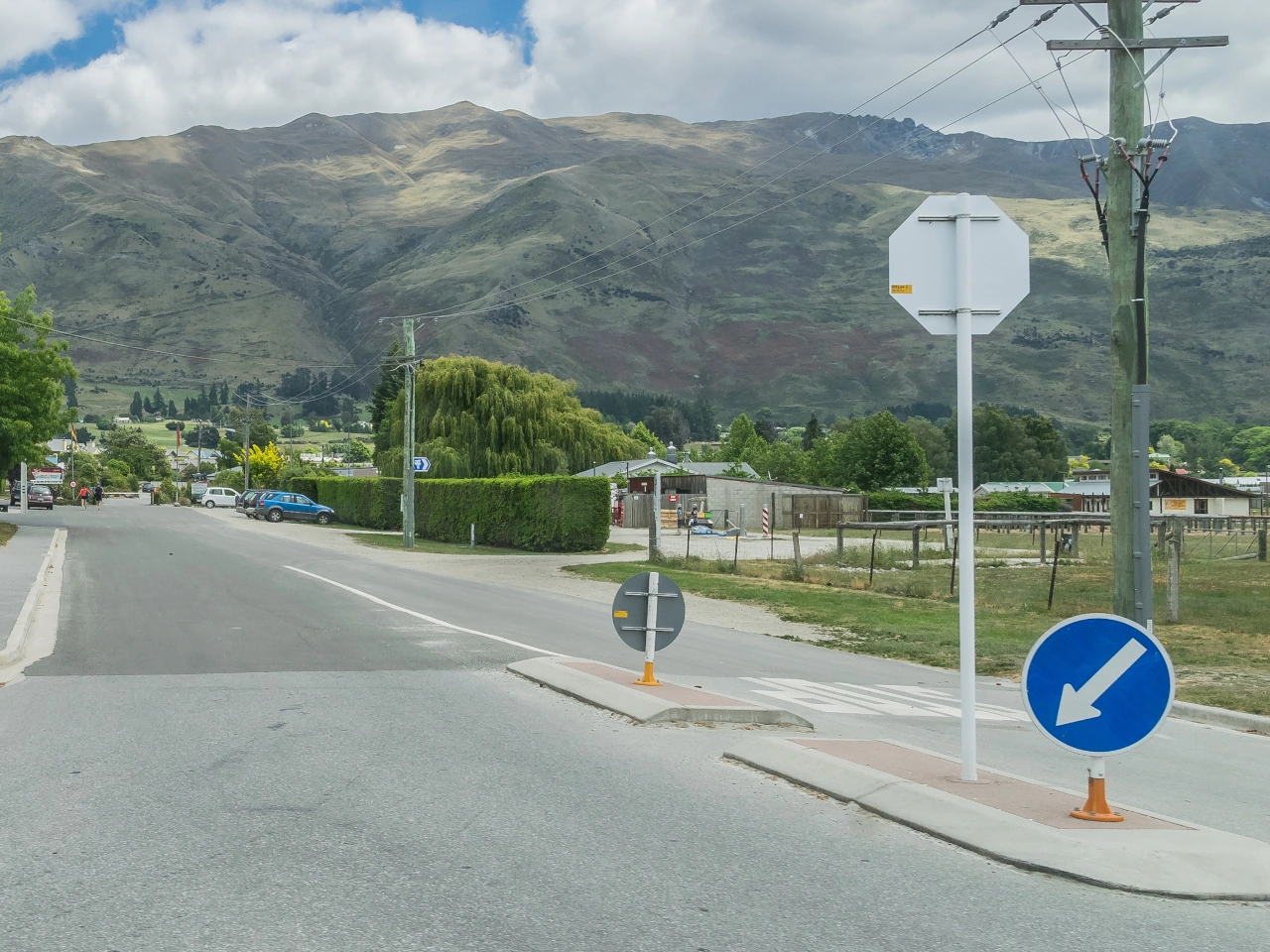
Wikimedia.org • Krzysztof Golik • CC BY-SA
What does a mandatory-direction sign mean?
It requires drivers to follow the direction or one of the directions shown by the arrow or arrows.
How can you recognise a mandatory-direction sign?
It is commonly a blue circular sign with one or more white arrows. Colours and designs may differ in some countries.
What does an upward arrow mean?
It normally means that drivers must continue straight ahead and may not turn in another direction at that location.
What does a left or right arrow mean?
It normally requires drivers to turn or proceed in the direction shown by the arrow.
What do two arrows mean?
Drivers may choose one of the displayed directions. Any direction not shown is prohibited.
What does an arrow beside an obstacle mean?
It requires drivers to pass the traffic island, barrier, roadworks equipment or other obstruction on the side indicated by the arrow.
Is a mandatory-direction sign the same as a one-way sign?
No. A mandatory-direction sign prescribes a movement at a particular location. A one-way sign indicates the permitted direction along a road or carriageway.
Is it the same as a no-turn sign?
No. A mandatory sign states which direction must be followed, while a prohibition sign states which movement is forbidden. Both may produce a similar practical result.
Does the sign impose a speed limit?
No. Drivers must follow the applicable general, zonal or posted speed limit and reduce speed when necessary to complete the required movement safely.
Does the sign give you priority?
No. You must still obey traffic lights, priority signs and the ordinary rules concerning oncoming traffic, pedestrians, cyclists and other road users.
When does the obligation begin?
It normally applies at the sign, intersection or obstacle associated with it. An advance sign may indicate that the obligation begins farther ahead.
Can a mandatory-direction sign apply to only one lane?
Yes. When it is positioned above a particular lane or clearly associated with that lane, it normally applies only to traffic using that lane.
Can road arrows also prescribe a direction?
Yes. Lane arrows may require drivers to use a particular lane and follow one of the directions displayed within that lane.
Must you use an indicator?
Yes, when the required movement involves turning or changing position and local law requires signalling. The sign does not replace the obligation to indicate.
Does signalling give you priority?
No. An indicator communicates your intention but does not allow you to force another road user to brake or change direction.
May you make a U-turn?
Not when doing so would conflict with the mandatory direction or another prohibition. Drivers must follow the permitted route shown by the signs and markings.
May you reverse to avoid following the sign?
No. Reversing must not be used to evade a mandatory direction. Continue along a lawful route and turn around later where permitted.
Does the sign apply to cyclists?
Cyclists are normally treated as drivers and must obey the sign unless a supplementary panel or local rule expressly exempts them.
Can other road users be exempted?
Yes. Supplementary signs may exempt or separately regulate cyclists, public transport or other specified categories where local law permits this.
What if the required route is blocked?
Do not enter a closed or unsafe route. Stop where safe and follow temporary signs, traffic lights or instructions from authorised personnel.
Do traffic lights cancel a mandatory-direction sign?
Not normally. Traffic lights determine when traffic may proceed, while the mandatory-direction sign determines which movement is permitted.
Do police instructions override the sign?
Yes. Instructions from an authorised traffic officer normally take precedence over traffic signs and ordinary traffic rules.
Can a temporary mandatory-direction sign be binding?
Yes. Properly placed temporary signs at roadworks, incidents or events must be obeyed.
What is a mandatory route for dangerous-goods vehicles?
It requires vehicles carrying specified dangerous goods to follow a designated route suitable for their cargo and any applicable tunnel restrictions.
When does the mandatory direction end?
The obligation is normally completed after the driver has followed the required direction at the intersection or passed the obstacle on the indicated side.
19. Turn prohibition
A turn prohibition prevents drivers from turning in the direction indicated by a traffic sign. It may prohibit a left turn, a right turn or a U-turn at an intersection or along a specified section of road.
Drivers must continue along a permitted route and follow any lane arrows or mandatory-direction signs. A turn prohibition does not itself determine priority or speed, and any exemption for cyclists, public transport or other road users must be expressly indicated.

Wikimedia.org • Mattinbgn • CC BY
What is a turn prohibition?
A turn prohibition prevents drivers from making a particular turn or change of direction indicated by a traffic sign.
How can you recognise a turn-prohibition sign?
It is commonly a circular sign with a red border showing a crossed or barred turning arrow. The arrow indicates the movement that is prohibited.
What does a no-left-turn sign mean?
It prohibits drivers from turning left at the location or intersection to which the sign applies.
What does a no-right-turn sign mean?
It prohibits drivers from turning right at the location or intersection to which the sign applies.
What does a no-U-turn sign mean?
It prohibits drivers from turning around to travel in the opposite direction.
Is a prohibited turn the same as a mandatory direction?
No. A prohibition sign identifies a movement that may not be made. A mandatory-direction sign identifies the direction or directions that must be followed.
Is a turn prohibition the same as a no-entry sign?
No. A turn prohibition prevents a particular approach from turning into a road. A no-entry sign prohibits vehicles from entering the road from the direction where it is displayed.
Is a turn prohibition the same as one-way traffic?
No. A one-way rule controls the permitted direction along a road. A turn prohibition controls a particular movement at or near an intersection.
When does a turn prohibition apply?
It may apply at the sign, at the next intersection or throughout a stated section. Drivers must follow the sign design and the rules of the country concerned.
Can a turn prohibition be announced in advance?
Yes. An advance sign or supplementary distance panel may warn drivers that the prohibited turn is farther ahead.
Can the sign apply to only one lane?
Yes. A sign positioned above or clearly associated with one lane may apply only to drivers using that lane.
Do lane arrows also restrict turning?
Yes. Drivers must choose the correct lane and follow one of the directions displayed by its legally binding arrows.
Does a green traffic light permit a prohibited turn?
No. A green light permits traffic to proceed, but drivers must still respect turn prohibitions, lane arrows and other regulatory signs.
Does a turn prohibition change priority?
No. Drivers making another permitted movement must still follow traffic lights, priority signs and the ordinary rules concerning pedestrians, cyclists and other vehicles.
Does a turn prohibition impose a speed limit?
No. The applicable general, zonal or posted speed limit remains in force.
Must you use an indicator for a permitted turn?
Yes, where local law requires it. Signal early enough to communicate your intention and stop signalling after completing the movement.
Does signalling make a prohibited turn legal?
No. An indicator communicates an intention but cannot authorise a movement prohibited by a traffic sign.
May cyclists be exempted?
Yes. A supplementary sign may allow cyclists or other specified road users to make a turn that remains prohibited for general traffic.
May buses or taxis be exempted?
Public transport, taxis or other authorised vehicles may be exempted where a supplementary sign or local rule expressly permits the movement.
Does a no-left-turn sign also prohibit a U-turn?
Not universally. Some countries treat these as separate prohibitions. Drivers must check whether a separate no-U-turn sign or general rule applies.
May you turn into a driveway before the prohibited intersection?
This depends on the exact legal scope of the sign. A sign applying specifically to the next intersection may not regulate an earlier property entrance, but another sign or road marking may still prohibit the movement.
May you reverse to avoid the turn prohibition?
No. Do not reverse through traffic or into an intersection to evade the sign. Continue along a permitted route and change direction later where it is legal and safe.
What should you do after entering the wrong lane?
Follow the movement permitted from that lane. Do not turn suddenly across another lane or ignore the sign; continue and choose another legal route.
Can a temporary turn prohibition be binding?
Yes. Properly placed temporary signs near roadworks, incidents or events must be obeyed.
Do instructions from an authorised officer override the sign?
Yes. Follow instructions from an authorised traffic officer even when they differ from the displayed turn prohibition.
20. School area
A school area is a road or group of roads near a school where large numbers of children may walk, cycle, cross the road or enter and leave vehicles. It may be identified by warning signs, zone signs, road markings, traffic-calming measures or flashing lights.
Special speed limits, parking restrictions or access rules may apply permanently or only during school arrival and departure times. Drivers should reduce speed, watch carefully for children and be prepared to stop.
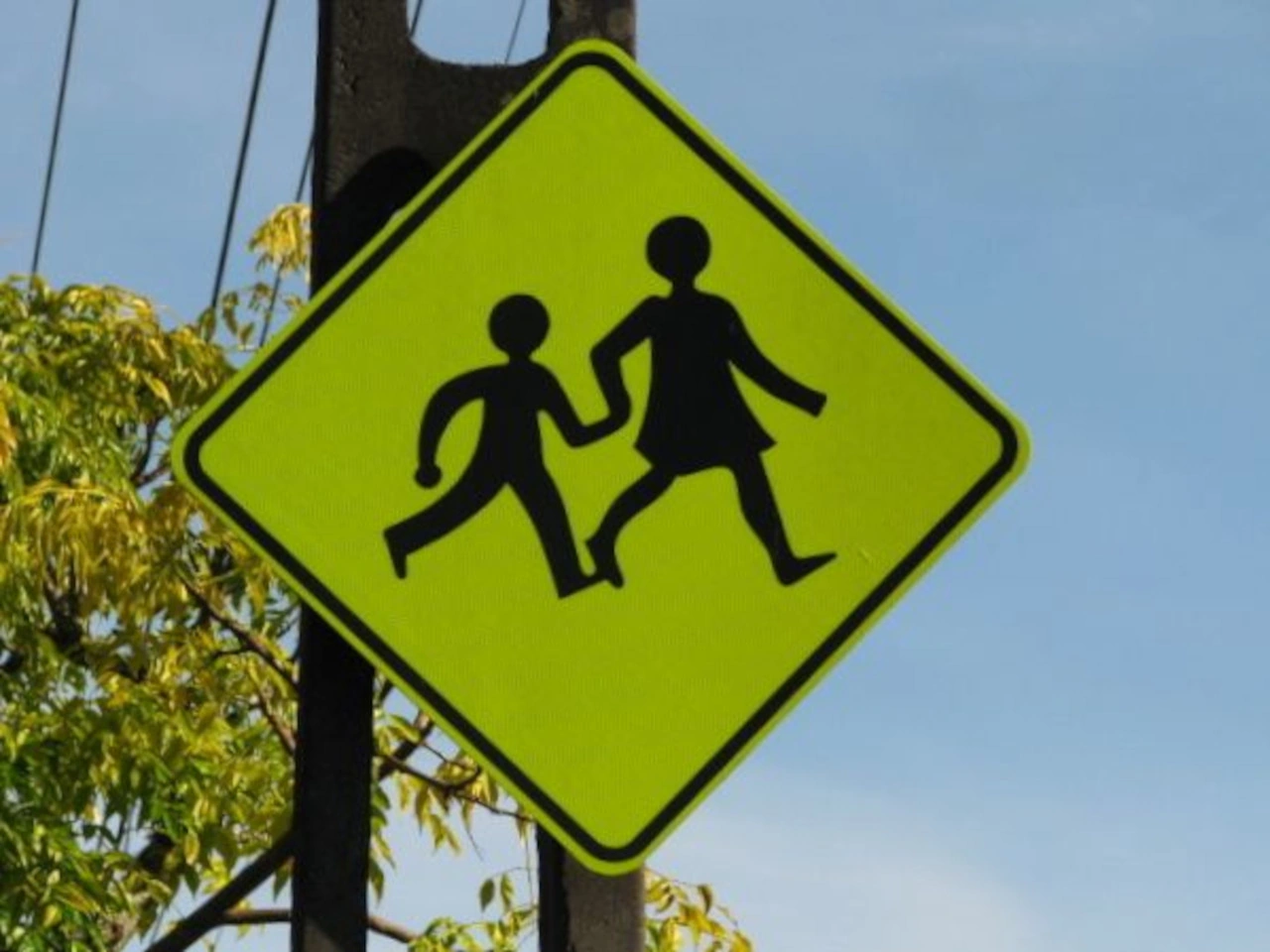
Wikimedia.org • Eleanor Bloomfield • CC0
What is a school area?
A school area is a road or group of roads near a school where drivers should expect large numbers of children, pedestrians, cyclists and stopping vehicles.
How can you recognise a school area?
It may be identified by school warning signs, speed-zone signs, flashing lights, road markings, coloured surfacing or traffic-calming measures. The signs differ between countries.
Does every road beside a school have special legal rules?
No. Special school-area rules normally apply only where signs, signals or local legislation establish them.
What is the speed limit in a school area?
There is no universal school-area speed limit. The applicable limit depends on the country, region, signs and whether a variable restriction is active.
Is the school-area speed limit always active?
Some limits apply permanently, while others apply only during displayed times or when flashing or variable signs are active. Drivers must observe the actual sign arrangement.
Must you drive below the displayed limit?
Yes, when necessary. The displayed speed is a maximum. Children, congestion, poor visibility or vehicles stopping near the school may require a much lower speed.
Why are children especially vulnerable in traffic?
Children may have difficulty judging speed and distance, may be hidden by parked vehicles and may enter the road unexpectedly.
How should you approach a school area?
Reduce speed early, increase your observation and be prepared for children crossing, cyclists changing direction, vehicle doors opening and cars stopping suddenly.
Do children automatically have priority everywhere?
No. Priority depends on crossings, traffic lights, authorised crossing supervisors and local rules. Drivers must nevertheless take exceptional care to avoid endangering children.
Must you obey a school crossing supervisor?
Yes. Drivers and other road users must follow lawful instructions given by an authorised person controlling traffic for children.
May children cross away from a pedestrian crossing?
This depends on local pedestrian rules. Drivers should remain prepared for children to cross unexpectedly, even where they are required to use a nearby crossing.
Does a school sign create pedestrian priority?
Not by itself. A school warning sign alerts drivers to children but does not normally create the legal effect of a pedestrian crossing.
Does a school area change intersection priority?
No. Traffic lights, priority signs and the ordinary intersection rules remain applicable unless another traffic arrangement provides otherwise.
May you overtake in a school area?
Overtaking may be restricted by signs or local law. Even where it is permitted, drivers should not overtake when children, crossings, limited visibility or stopped vehicles make the manoeuvre unsafe.
May you stop to drop off a child?
Only where stopping is permitted and can be completed safely. Do not stop on a crossing, pavement, bike path, bus stop or another prohibited or dangerous location.
May you park near a school entrance?
Follow the parking signs and markings. Do not block entrances, pavements, bike paths, crossings, visibility or access for buses and emergency vehicles.
Why is double parking dangerous near a school?
It blocks traffic and visibility and may force children to walk between moving vehicles or enter the road from behind an obstruction.
What should you watch for near school buses?
Expect children to enter or leave the vehicle and possibly cross the road. Reduce speed and follow any special warning lights, signs or local school-bus rules.
May cyclists ride through a school area?
Normally, yes. They must follow the applicable road, bike-path, speed and priority rules. Drivers should expect inexperienced young cyclists.
Is a school area the same as a school street?
No. A school area normally remains open to traffic under special caution or speed rules. A school street temporarily restricts or excludes motor traffic during specified periods.
Is a school area the same as a Zone 30?
Not universally. A school area may form part of a Zone 30, use another speed limit or have a variable restriction that applies only at particular times.
When do the school-area rules end?
They normally end at an end sign, at the end of the stated time period or when the variable signal is no longer active. The surrounding road rules then apply.
21. Crossing animals
An animals-crossing warning indicates a place or road section where wild animals, livestock or ridden animals may enter or cross the road. Animals may appear suddenly, move unpredictably or be difficult to see in darkness, vegetation or poor weather.
Drivers should reduce speed, scan both sides of the road and remain prepared to stop. The warning sign does not itself give animals priority or impose a numerical speed limit, but drivers must avoid frightening, endangering or colliding with them.
Wikimedia.org • AlasdairW • CC BY-SA
What does an animals-crossing sign mean?
It warns that animals may enter or cross the road in the area ahead.
Which animals may the sign refer to?
Depending on the symbol and local conditions, it may refer to deer, cattle, horses, sheep, goats, wild boar or other animals.
How can you recognise an animals-crossing sign?
It is commonly a triangular warning sign displaying the silhouette of an animal. The species shown may indicate the type of animal most likely to be encountered.
Does the sign mean animals are always present?
No. It indicates an increased likelihood of animals crossing, not that animals will be present every time.
Does the sign impose a speed limit?
No. The normal posted or general speed limit remains applicable, but drivers must reduce speed when necessary to react safely.
Do animals have priority because of the sign?
No automatic priority is created by the warning sign. Drivers must nevertheless avoid danger and allow animals already on the road to pass safely.
How should you approach an animal-crossing area?
Reduce speed, increase your following distance and scan the road, verges, fields and vegetation for movement or reflected eyes.
When are wild animals most likely to appear?
Animal activity is often greater around dawn, dusk and darkness, although animals may cross at any time.
Why should you expect more than one animal?
Many animals travel in groups. When one animal crosses, others may follow immediately from the same direction.
Should you sound the horn?
Avoid unnecessary horn use or engine revving because it may frighten an animal and make its movement less predictable. Use a warning only when reasonably necessary to prevent danger.
Should you use full-beam headlights?
Use the appropriate lights without dazzling other road users. When an animal is visible, reduce speed and avoid relying on full beam to make it move away.
What should you do when an animal is on the road?
Slow down smoothly, stop when necessary and allow it enough time and space to leave. Avoid sudden acceleration or aggressive steering.
Should you swerve to avoid an animal?
Avoid an uncontrolled swerve that could cause a collision with another vehicle, tree, barrier, cyclist or pedestrian. Brake firmly while maintaining control and steer only when a safe escape path is clearly available.
How should you pass livestock?
Pass only when the animals and their handlers have sufficient space. Drive slowly, avoid noise and be prepared for an animal to change direction unexpectedly.
How should you pass a horse and rider?
Reduce speed, leave a large lateral distance and pass quietly. Avoid sounding the horn, accelerating sharply or passing when oncoming traffic prevents sufficient clearance.
Must you follow instructions from an animal handler?
Follow lawful instructions from an authorised person and cooperate with handlers controlling animals on or across the road.
May you overtake near an animal crossing?
The warning sign does not necessarily prohibit overtaking, but overtaking should be avoided when animals, limited visibility or approaching traffic make the manoeuvre unsafe.
What if an animal appears behind another vehicle?
Maintain enough following distance to see beyond the vehicle ahead. Be prepared for it to brake suddenly when an animal enters the road.
What should motorcyclists and cyclists do?
Reduce speed, keep both hands firmly in control and avoid sudden movements. Animals may react unexpectedly to quiet or fast-approaching two-wheeled vehicles.
What should you do after hitting an animal?
Stop safely, activate the hazard warning lights and check for injured people. Contact the emergency services or police when necessary and do not approach a wounded wild animal, which may defend itself.
Should you move an injured or dead wild animal?
Normally not. Keep a safe distance and allow the police, wildlife authorities or an animal-rescue service to handle it.
Can animals be present without a warning sign?
Yes. Drivers remain responsible for observing the road and adjusting their speed even where no animal warning sign is displayed.
22. Slippery road
A slippery road has reduced tyre grip and can make steering, braking and acceleration less effective. Roads may become slippery because of rain, ice, snow, mud, oil, loose material or other substances on the surface. Drivers should reduce speed, increase their following distance and avoid sudden steering, braking or acceleration. Extra caution is needed in bends, on bridges and wherever the road surface changes unexpectedly.

Wikimedia.org • Karora • CC0
What makes a road slippery?
A road can become slippery because of rain, ice, snow, mud, oil, loose material or other substances that reduce tyre grip.
How should you drive on a slippery road?
Reduce speed, increase your following distance and use smooth steering, braking and acceleration. Sudden movements can cause the tyres to lose grip.
Why does braking distance increase on a slippery road?
Reduced tyre grip means the tyres cannot generate as much braking force, so the vehicle may need a longer distance to slow down or stop.
Can a road be slippery even when it looks dry?
Yes. Oil, dust, loose material or a thin layer of ice can reduce grip even when the road does not appear obviously wet or slippery.
Are bends more dangerous on slippery roads?
Yes. Turning requires tyre grip, so a slippery surface can make it easier for the vehicle to skid or leave its intended path, especially at higher speeds.
What should you do if your vehicle starts to skid?
Stay calm and avoid sudden braking or steering. Make smooth corrections and allow the tyres to regain grip. The correct response can depend on the vehicle and its safety systems.
23. Curve
A curve is a section of road that changes direction to the left or right. A sharp, unexpected or poorly visible curve can reduce a driver’s view of approaching traffic, stopped vehicles, pedestrians and other hazards.
Drivers should reduce speed before entering the curve, remain within their lane and use smooth steering, braking and acceleration. Warning signs may indicate the direction of the first curve or a series of successive curves.

Wikimedia.org • Krzysztof Golik • CC BY-SA
What is a road curve?
A road curve is a section where the road changes direction to the left or right.
How can you recognise a dangerous curve?
It may be indicated by a triangular warning sign showing a curved line. The symbol normally indicates whether the first curve turns left or right.
What is a double curve?
A double curve consists of two curves in opposite directions. The warning sign normally shows the direction of the first curve.
Can a sign warn of more than two curves?
Yes. A double-curve symbol may also warn of a longer sequence of successive curves. A supplementary panel may indicate the length of the winding section.
Does a curve-warning sign impose a speed limit?
No. It normally warns of danger rather than setting a numerical limit. Drivers must still reduce speed when the permitted maximum would be unsafe.
When should you reduce speed for a curve?
Reduce speed before entering the curve, while the vehicle is travelling straight and has maximum stability.
Should you brake heavily while cornering?
No. Harsh braking in a curve can reduce stability and grip. Complete most braking beforehand and use smooth adjustments where necessary.
Should you accelerate through a curve?
Maintain a controlled speed through the curve. Accelerate smoothly only when the exit becomes visible and the vehicle is stable.
Where should you look while driving through a curve?
Look towards the path you intend to follow and the visible exit of the curve. Continue checking the road surface, lane position and nearby traffic.
Must you remain in your lane?
Yes. Do not cross the centre line or cut across another lane, even when this would make the curve appear easier to negotiate.
Why is visibility limited in a curve?
Buildings, vegetation, slopes, barriers and the road alignment may hide oncoming traffic, cyclists, pedestrians, stopped vehicles or debris.
How fast should you drive through a curve?
Choose a speed that allows you to remain in your lane and stop within the distance you can see to be clear. The safe speed may be far below the legal maximum.
What is an advisory speed for a curve?
An advisory speed is a recommended safe speed for negotiating the curve under suitable conditions. It is not necessarily the legal maximum speed.
How do rain, snow or ice affect a curve?
They reduce tyre grip and increase the risk of skidding. Reduce speed earlier, use smooth controls and leave additional distance from other vehicles.
What should you do if gravel or debris is present?
Avoid sudden braking or steering. Reduce speed smoothly and follow a clear path without entering another traffic lane.
May you overtake in a curve?
Do not overtake when visibility is insufficient to see approaching traffic and complete the manoeuvre safely. Local law, signs and continuous road markings may also prohibit overtaking.
May you stop or park in a curve?
Only where it is permitted and the vehicle remains clearly visible. Stopping or parking in a poorly visible curve may create a serious hazard and is often prohibited.
Should you follow another vehicle closely through a curve?
No. Leave enough distance to react if the vehicle ahead brakes for a hidden obstruction or a sharper part of the curve.
Why should motorcyclists take extra care?
Motorcycles require grip for both cornering and braking. Riders should reduce speed before the curve, choose a stable line and avoid painted markings, gravel and slippery surfaces.
How can a curve affect a trailer or caravan?
A trailer may sway, track closer to the inside of the curve or become unstable when speed and steering inputs are excessive. Enter slowly and steer smoothly.
Why do large vehicles need more space?
Buses and trucks may move closer to lane boundaries because of their length and width. Other drivers should avoid travelling beside them through a tight curve.
What should you do if an oncoming vehicle crosses the centre line?
Reduce speed, move safely towards your side of the road and avoid a sudden manoeuvre that could cause another collision. Sound a warning only when reasonably necessary.
Does the absence of a warning sign mean every curve is safe at the speed limit?
No. Drivers must assess every curve and adapt their speed even when no warning sign is displayed.
24. Chevron
A chevron is a V-shaped or arrow-shaped road marker used to show a sharp change in the direction of a road. Chevron boards are normally placed along the outside of a curve so that their points indicate the direction in which the road continues.
Chevrons improve the visibility and alignment of a curve, especially in darkness or poor weather. They do not normally impose a speed limit or determine priority, so drivers must reduce speed before the curve and follow all other signs and road markings.

Wikimedia.org • Krzysztof Golik • CC BY-SA
What is a road chevron?
A road chevron is a V-shaped or arrow-shaped marker used to guide drivers through a curve or another sharp change in road direction.
How can you recognise a chevron?
It is normally displayed on a rectangular board using strongly contrasting colours. Several chevrons may be placed in sequence around a curve.
Which direction does a chevron indicate?
The point of the chevron indicates the direction in which the road continues. A chevron pointing left guides traffic through a left curve, while one pointing right guides traffic through a right curve.
Where are chevrons normally placed?
They are generally placed along the outside of a curve, facing approaching traffic so that drivers can clearly see the road alignment.
What is the purpose of a series of chevrons?
A series of chevrons visually traces the curve and helps drivers judge its direction, length and changing alignment.
Is a chevron the same as a curve-warning sign?
No. A curve-warning sign normally warns drivers before the curve. Chevron boards are usually positioned within or around the curve to guide drivers through it.
Does a chevron impose a speed limit?
No. It guides drivers through the change in direction but does not normally introduce a numerical speed limit.
Does a chevron show a recommended speed?
Not by itself. A separate advisory-speed or speed-limit sign may indicate an appropriate or legally required speed.
Does a chevron determine priority?
No. Traffic lights, priority signs and the ordinary priority rules remain applicable.
Does a chevron mean the curve is dangerous?
It normally indicates that the curve requires additional visual guidance. Drivers should expect a noticeable or potentially sharp change in direction.
Does the number of chevrons show how sharp the curve is?
Not directly. The number and spacing depend on the length, radius and design of the curve and on the road authority’s signing standards.
Does a larger chevron mean a sharper curve?
Not necessarily. Larger boards may be used where approach speeds are higher or where greater visibility is needed.
How should you approach chevrons?
Reduce speed before the curve, observe the direction of the boards and remain within your traffic lane.
Should you brake heavily after reaching the chevrons?
No. Complete most braking before entering the curve and use smooth steering, braking and acceleration while following it.
May you drive towards the chevron boards?
No. The boards normally mark the outside edge of the curve. Follow the road around them rather than steering towards them.
May you cut across the centre line to straighten the curve?
No. Remain within your lane and do not enter the path of oncoming traffic.
May you overtake beside chevrons?
The chevrons do not automatically prohibit overtaking, but overtaking is unsafe when the curve restricts visibility or available road width.
Why are chevrons reflective?
Reflective material makes the boards easier to see in darkness and poor weather when illuminated by vehicle headlights.
Can chevrons be illuminated?
Yes. Some high-risk curves use illuminated or flashing chevrons to make the change in direction more conspicuous.
Can chevrons have different colours?
Yes. Their colours and design vary between countries, but contrasting colours are used to make the direction clearly visible.
What should motorcyclists consider?
Reduce speed before the curve, choose a stable path and look through the turn. Do not focus exclusively on the chevrons or allow the motorcycle to cross the centre line while leaning.
Does the absence of chevrons mean a curve is safe at the speed limit?
No. Drivers must assess every curve and select a safe speed whether or not chevron boards are installed.
25. Wrong-way driving
Wrong-way driving occurs when a driver travels against the legally permitted direction of traffic. It may happen on a one-way road, divided road, motorway entrance or exit, or another road section reserved for traffic travelling in one direction.
Wrong-way driving creates an extreme risk of a head-on collision. Drivers must follow direction signs, no-entry signs, lane arrows and road markings. Anyone who accidentally enters a road in the wrong direction should slow down, warn other traffic, stop in the safest available place and contact the emergency services.
Wikimedia.org • LincolnGroup11 • CC BY
What is wrong-way driving?
Wrong-way driving means travelling against the legally permitted direction of traffic.
Where can wrong-way driving occur?
It can occur on one-way streets, divided roads, motorways, slip roads, tunnels, car parks and temporary traffic arrangements.
Why is wrong-way driving especially dangerous?
Other drivers do not expect approaching traffic in their lane, and the combined speeds can make a head-on collision extremely severe.
How can you recognise a prohibited direction?
Look for no-entry signs, one-way signs, mandatory-direction signs, lane arrows and road markings. Motorway exits may also have repeated signs or warning systems facing the wrong direction.
Is wrong-way driving the same as entering a no-entry road?
Entering past a no-entry sign can cause wrong-way driving, but the term also covers turning around on a divided road or using the wrong carriageway without passing such a sign.
Is driving against a one-way street always prohibited?
Normally, yes. However, signs may expressly permit certain road users, such as cyclists or public transport, to travel in the opposite direction.
Is authorised contraflow traffic wrong-way driving?
No. A cyclist, bus or other road user travelling in an expressly authorised contraflow lane or direction is using the road legally.
Can roadworks temporarily change the normal direction?
Yes. Temporary signs, barriers, lane signals and markings may redirect traffic onto another lane or carriageway. Follow the temporary arrangement rather than the usual road layout.
What should you do when you see a wrong-way driver?
Reduce speed immediately, keep as far as safely possible towards the outer edge of your carriageway and avoid sudden lane changes. Warn the police or emergency services as soon as this can be done safely.
Should you attempt to stop the wrong-way driver?
No. Do not block, chase or turn after the vehicle. Protect yourself and allow trained emergency services to intervene.
Should you flash your headlights?
A brief warning may help the driver recognise the error, but avoid prolonged or aggressive signalling that could cause panic or an unpredictable manoeuvre.
Should you sound the horn?
Use the horn only when reasonably necessary to warn of immediate danger. Your first priority is to reduce speed and create as much safe space as possible.
Should you stop in a live traffic lane?
Normally not. Sudden stopping may cause a rear-end collision. Slow down and move towards a safe shoulder, refuge or other protected location where possible.
What should you do after receiving a wrong-way-driver warning?
Reduce speed, stop overtaking, increase your following distance and remain in the lane or position recommended by the local authorities or warning system.
Should you continue using the overtaking lane?
Avoid unnecessary use of lanes nearest opposing or central traffic when a wrong-way driver has been reported. Follow local emergency guidance and electronic signs.
What should you do if you are driving in the wrong direction?
Slow down immediately, activate the hazard warning lights and use dipped headlights where required. Move to the safest available edge or shoulder and stop.
Should you accelerate to reach the next exit?
No. Increasing speed greatly increases the collision risk. Stop safely and wait for instructions from the police.
Should you make a U-turn across traffic?
No. Do not turn across live lanes, cross a central reservation or attempt to correct the mistake through another dangerous manoeuvre.
Should you reverse back to the entrance?
No. Reversing against traffic or along a motorway slip road creates additional danger. Stop safely and contact the emergency services.
Should you leave the vehicle after stopping?
This depends on the location and immediate danger. Remain protected from moving traffic and follow instructions from the emergency services. Do not stand in a live lane.
How should you contact the emergency services?
Stop safely before using a handheld phone. A passenger may call while the vehicle is moving when local law permits and this can be done without distracting the driver.
What information should you report?
Report the road name or number, direction, nearby exit or landmark, vehicle description and the wrong-way driver’s approximate location and direction.
What commonly causes wrong-way driving?
Possible causes include confusion at junctions, poor visibility, unfamiliar roads, impairment, navigation errors, turning around illegally or deliberately ignoring traffic signs.
How can drivers prevent entering the wrong direction?
Slow down at unfamiliar junctions, read signs before turning, verify the road layout and do not rely exclusively on navigation instructions.
Does a navigation system override traffic signs?
No. Traffic signs, signals, markings and instructions from authorised persons always take precedence over navigation guidance.