Bike pathWorldwide

An introduction to the traffic rules and road signs of Worldwide. Learn about driving, road safety and much more in our illustrated book, with answers to frequently asked questions.

For informational purposes only. Always follow official regulations. Some content and images were created with AI assistance.


11. Bike path

A bike path is a part of a road or a separate route intended primarily or exclusively for people riding bicycles. It may be physically separated from motor traffic, marked on the road surface or identified by traffic signs.

Bike paths may be one-way, two-way or shared with other road users. The permitted users, direction of travel, priority rules and obligation to use the path depend on local traffic signs and regulations.

Path for cyclists. (Auvergne-Rhône-Alpes, France)
Wikimedia.org • Tabl-trai • CC BY-SA
How can you recognise a bike path?

A bike path may be identified by a bicycle traffic sign, bicycle symbols, coloured surfacing or road markings. It may run beside the carriageway or follow a completely separate route.

🔗 wetten.overheid.nl • Vienna Convention on Road Signs and Signals, Annex 1, section D II.4–5 and II.11; sign-system reference

🔗 wetten.overheid.nl • Vienna Convention on Road Traffic, Articles 20–21 and 27(4); international framework subject to national law

🔗 gesetze-im-internet.de • Germany, StVO Annex 2, signs 239–241

🔗 gesetze-im-internet.de • Germany, StVO section 2(4)–(5), cycle tracks and footway exceptions
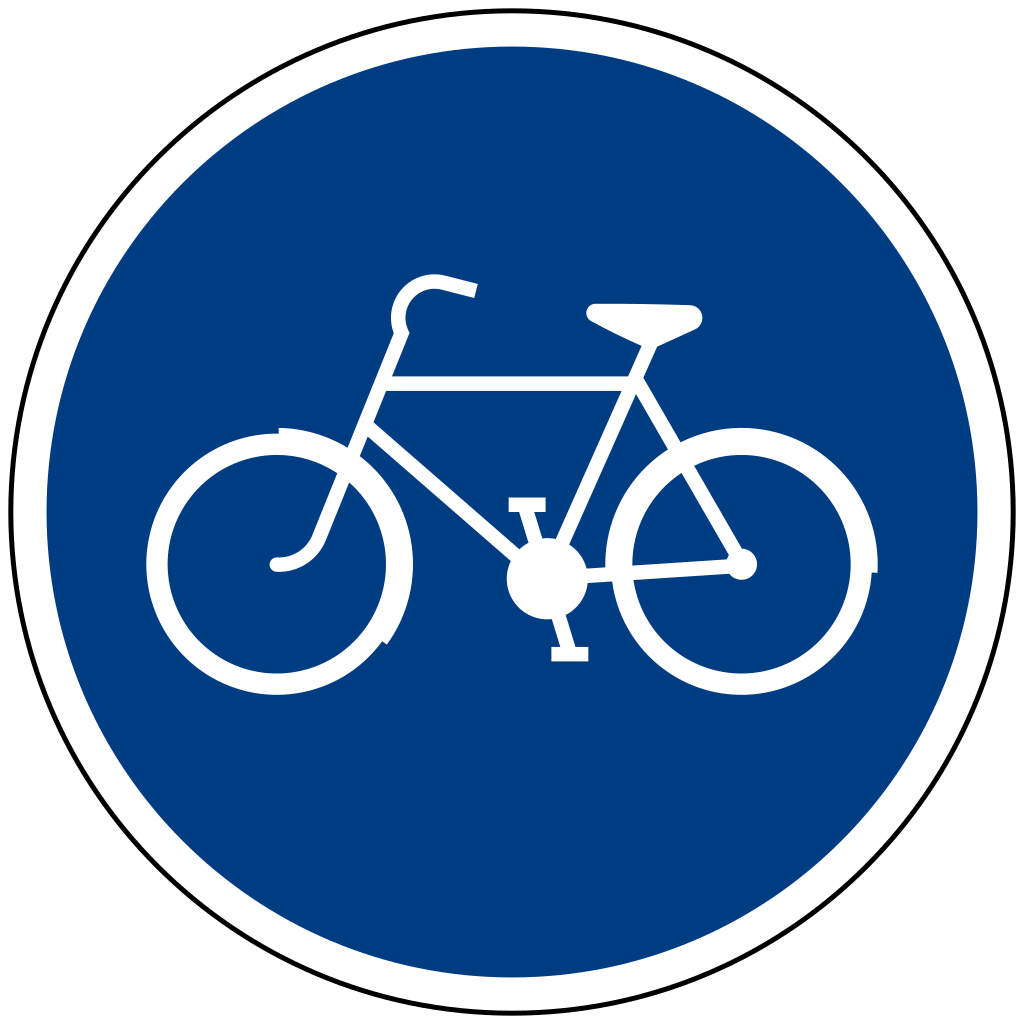
Mandatory path for cyclists. Mandatory path for cyclists.

Must cyclists use a bike path?

This depends on local law and the signs displayed. Some bike paths are mandatory, while others are optional. Cyclists may also be permitted to leave a path to turn, overtake or avoid an obstruction.

🔗 wetten.overheid.nl • Vienna Convention on Road Signs and Signals, Annex 1, section D II.4–5 and II.11; sign-system reference

🔗 wetten.overheid.nl • Vienna Convention on Road Traffic, Articles 20–21 and 27(4); international framework subject to national law

🔗 gesetze-im-internet.de • Germany, StVO Annex 2, signs 239–241

🔗 gesetze-im-internet.de • Germany, StVO section 2(4)–(5), cycle tracks and footway exceptions

May mopeds or speed pedelecs use a bike path?

This depends on the country, vehicle category, road speed and traffic signs. Some bike paths permit or require certain mopeds or speed pedelecs, while others are reserved exclusively for ordinary bicycles.

🔗 wetten.overheid.nl • Vienna Convention on Road Signs and Signals, Annex 1, section D II.4–5 and II.11; sign-system reference

🔗 wetten.overheid.nl • Vienna Convention on Road Traffic, Articles 20–21 and 27(4); international framework subject to national law

🔗 gesetze-im-internet.de • Germany, StVO Annex 2, signs 239–241

🔗 gesetze-im-internet.de • Germany, StVO section 2(4)–(5), cycle tracks and footway exceptions

Who has priority where a vehicle crosses a bike path?

Priority depends on the road layout, signs, signals and local law. Drivers crossing a continuous bike path commonly have to give way to its users, but cyclists approaching a separate cycle crossing may not automatically have priority before entering it.

🔗 wetten.overheid.nl • Vienna Convention on Road Signs and Signals, Annex 1, section D II.4–5 and II.11; sign-system reference

🔗 wetten.overheid.nl • Vienna Convention on Road Traffic, Articles 20–21 and 27(4); international framework subject to national law

🔗 gesetze-im-internet.de • Germany, StVO Annex 2, signs 239–241

🔗 gesetze-im-internet.de • Germany, StVO section 2(4)–(5), cycle tracks and footway exceptions

What is the difference between a bike path and a shared-use path?

A bike path is intended primarily or exclusively for cycling. A shared-use path is legally intended for cyclists together with pedestrians or other indicated road users, who must use the space considerately.

🔗 wetten.overheid.nl • Vienna Convention on Road Signs and Signals, Annex 1, section D II.4–5 and II.11; sign-system reference

🔗 wetten.overheid.nl • Vienna Convention on Road Traffic, Articles 20–21 and 27(4); international framework subject to national law

🔗 gesetze-im-internet.de • Germany, StVO Annex 2, signs 239–241

🔗 gesetze-im-internet.de • Germany, StVO section 2(4)–(5), cycle tracks and footway exceptions

1 Worldwide 2 Motorway 3 Expressway 4 Residential area 5 Built-up area 6 Zone 7 Speed limit 8 Minimum speed 9 Advisory speed 10 Footpath 11 Bike path 12 Shared-use path 13 Separated path 14 Pedestrian warning 15 Tunnel 16 Bridge 17 Cycling street 18 Pedestrian zone 19 Speed bump 20 Toll road 21 Customs 22 One-way traffic 23 Quay 24 Slope 25 Bus lane 26 Bus stop 27 Dead end 28 Stop sign 29 Give way 30 Roundabout 31 Priority road 32 Road narrowing 33 Priority over oncoming traffic 34 Give way to oncoming traffic 35 Pedestrian crossing 36 Railway crossing 37 Mandatory direction 38 Turn prohibition 39 School area 40 Overtaking 41 Crossing animals 42 Slippery road 43 Rockfall 44 Aircraft 45 Curve 46 Chevron 47 Wrong-way driving 48 Roadworks 49 Crosswind 50 Height limit 51 Width limit 52 Length limit 53 Weight limit 54 Radar speed sign 55 Selective barriers 56 Low-emission zone 57 Intersection direction sign 58 Priority at the next junction 59 Traffic lights 60 Traffic lights warning 61 Pedestrian lights 62 Road markings 63 All-way stop 64 Junction layout 65 Climbing lane 66 Bike box 67 Left-hand traffic 68 Speed feedback 69 Driving licence 70 Location marker 71 Road number 72 Countdown markers 73 Public toilet 74 Rest area 75 Traffic mirror 76 Emergency telephone 77 International border 78 Pedestrian underpass 79 Cycling route 80 End of restriction 81 Parking 82 No parking 83 No stopping 84 Parallel parking 85 Park and ride 86 Kiss and ride 87 Alternate-side parking 88 Parking meter 89 Parking disc 90 Disabled parking 91 Traffic management 92 Merging 93 Reversing 94 U-turn 95 Carpool 96 Traffic jam 97 Detour 98 Uncontrolled crossroad 99 Road surface 100 Advisory cycle lane ...