


Road narrowingWorldwide
An introduction to the traffic rules and road signs of Worldwide. Learn about driving, road safety and much more in our illustrated book, with answers to frequently asked questions.
For informational purposes only. Always follow official regulations. Some content and images were created with AI assistance.
 Traffic rules
 Worldwide
32. Road narrowing
A road narrowing is a section where the available width of the road or carriageway becomes smaller. The narrowing may occur on both sides, on one side only, or because one or more traffic lanes end.
Drivers should reduce speed, observe approaching and adjacent traffic, maintain sufficient lateral clearance and merge when necessary. Warning signs do not always determine priority, so drivers must follow any priority signs, lane markings and local traffic rules.
🔗 Sources
Image credit: Wikimedia.org • Florian Pépellin • CC BY-SA
What is a road narrowing?
A road narrowing is a section where the usable width of the road becomes smaller. Traffic may have less space to pass, merge or travel beside other road users.
🔗 gov.uk • Great Britain Highway Code, Rules 226–237; national guidance example
🔗 gov.uk • UK Department for Transport, Know Your Traffic Signs, warning signs
Does a narrowing sign impose a speed limit?
No. It normally warns of danger rather than setting a numerical speed limit. Drivers must still reduce speed when necessary to pass safely.
🔗 gov.uk • Great Britain Highway Code, Rules 226–237; national guidance example
🔗 gov.uk • UK Department for Transport, Know Your Traffic Signs, warning signs
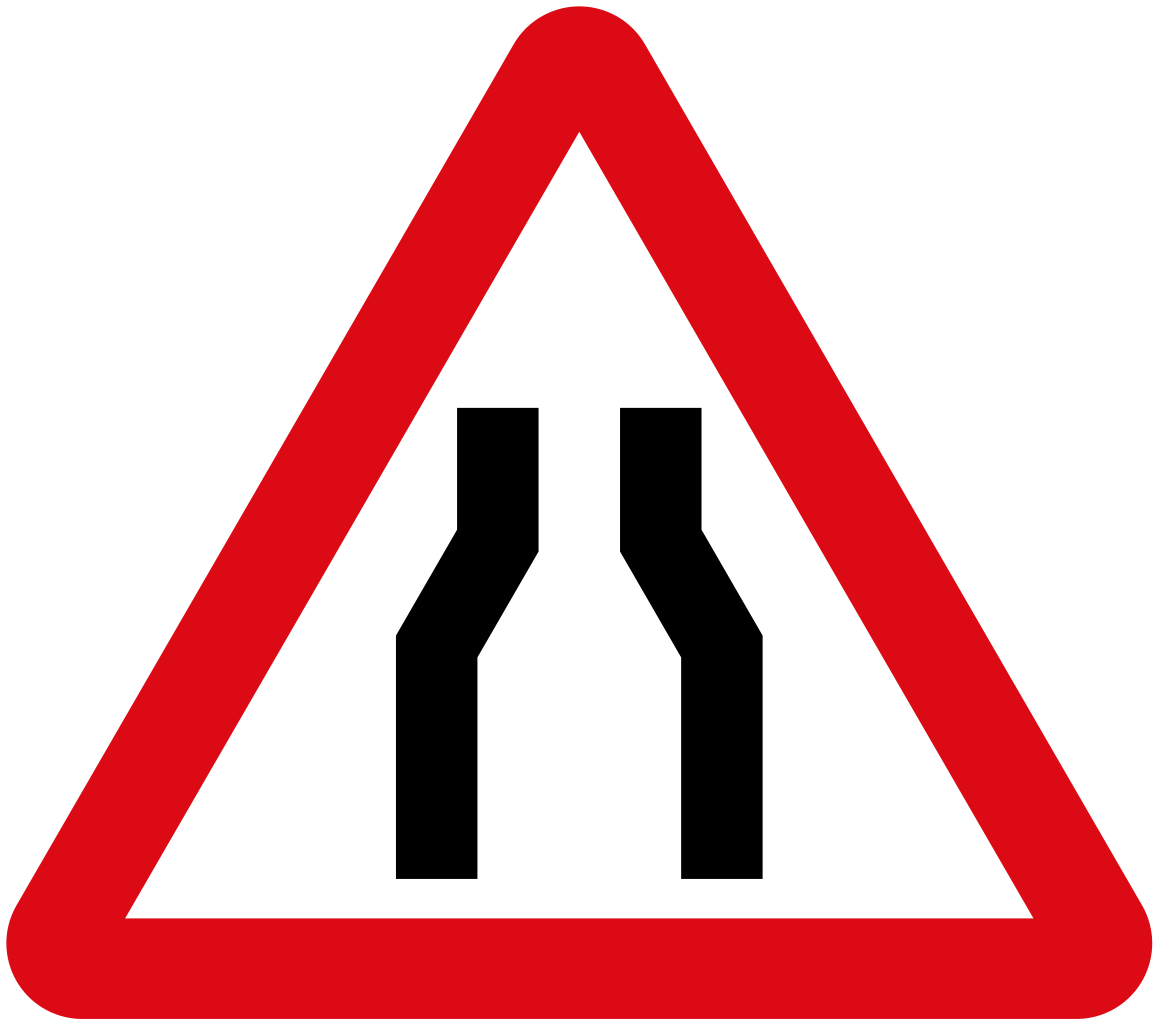 Warning for a road narrowing.
 Warning for a road narrowing on the left.
 Warning for a road narrowing on the right.
Does a narrowing sign determine who has priority?
Not by itself. Priority may be established by separate signs, signals or local rules. Without them, drivers should approach cautiously and cooperate.
🔗 gov.uk • Great Britain Highway Code, Rules 226–237; national guidance example
🔗 gov.uk • UK Department for Transport, Know Your Traffic Signs, warning signs
What should you do when another vehicle is already in the narrowing?
Allow it enough room to leave the narrow section. Do not enter if the available width is insufficient for both vehicles to pass safely.
🔗 gov.uk • Great Britain Highway Code, Rules 226–237; national guidance example
🔗 gov.uk • UK Department for Transport, Know Your Traffic Signs, warning signs
What should you do when your lane ends?
Check the adjacent lane, signal and merge safely according to the local merging rules. Do not force another driver to brake or leave the road.
🔗 gov.uk • Great Britain Highway Code, Rules 226–237; national guidance example
🔗 gov.uk • UK Department for Transport, Know Your Traffic Signs, warning signs


