Límite de pesoBruselas

Aprende normas de tráfico con explicaciones claras y ejemplos visuales en nuestro libro ilustrado, diseñado para que estudiar sea sencillo y ameno.


38. Límite de peso

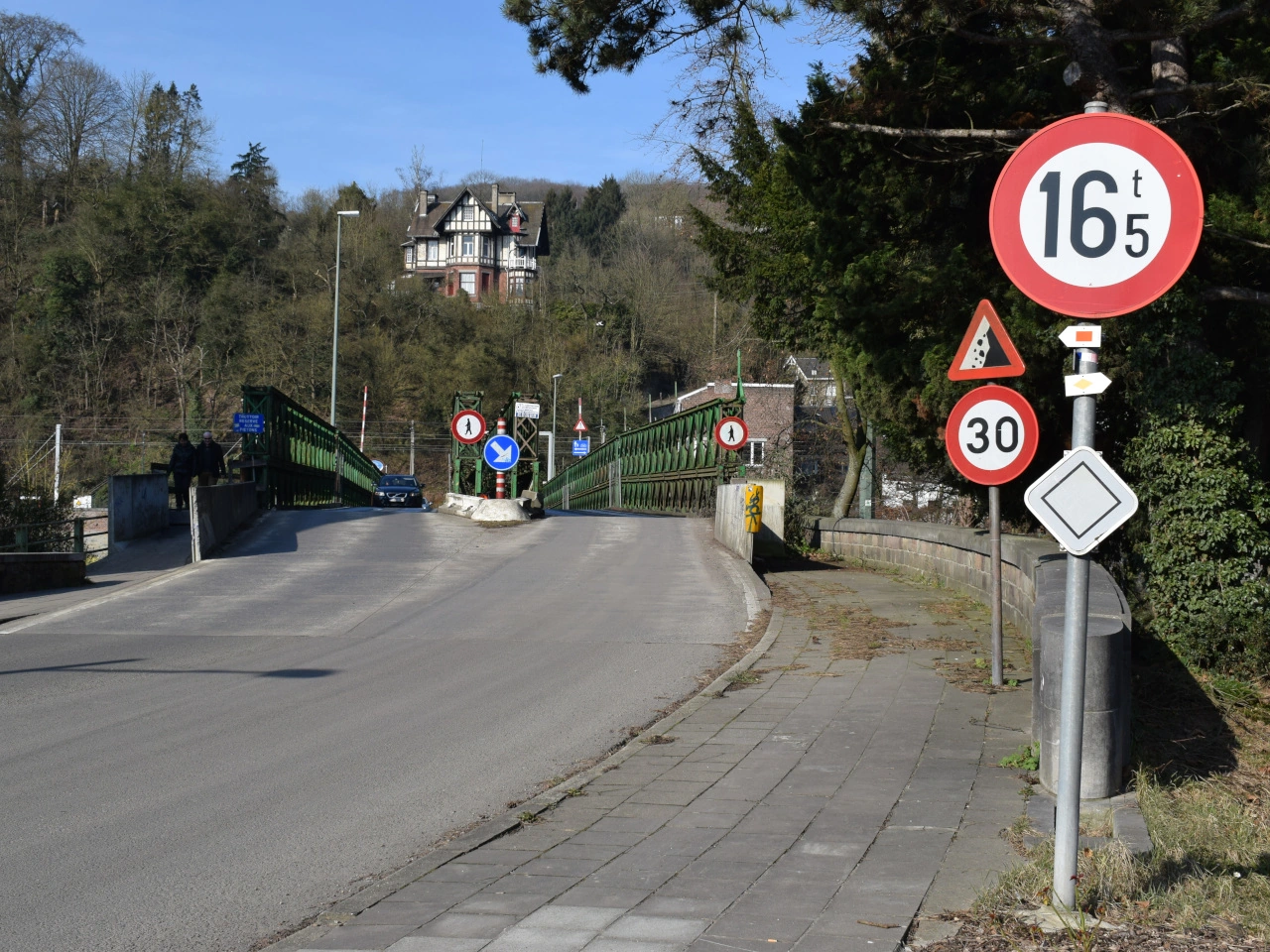
Un límite de peso prohíbe entrar o pasar por un tramo, puente, túnel u otra estructura a vehículos o conjuntos cuya masa supere el valor indicado. Según la legislación local, la restricción puede referirse a la masa real cargada, a la masa máxima autorizada o a la carga sobre un eje concreto.

Los conductores deben saber a qué tipo de masa se refiere la señal e incluir el vehículo, pasajeros, carga y cualquier remolque cuando corresponda. Un vehículo que supere el límite debe utilizar otra ruta adecuada.
Límite de peso
Which Belgian sign indicates a weight limit?

Traffic sign C21 prohibits access for drivers of vehicles whose actual loaded mass exceeds the mass displayed on the sign.

Vehículos más pesados de lo indicado prohibidos. Vehículos más pesados de lo indicado prohibidos.

Signal routier C21 • Accès interdit aux conducteurs de véhicules dont la masse en charge dépasse la masse indiquée.

Verkeersbord C21 • Verboden toegang voor bestuurders van voertuigen waarvan de massa in beladen toestand hoger is dan de aangeduide massa.

How can you recognise Belgian sign C21?

C21 is a circular prohibition sign displaying a maximum mass, normally expressed in tonnes.

What does actual loaded mass mean in Belgium?

The massa in beladen toestand is the combined mass of the vehicle itself, its load, the driver and every other person being transported.

Does the driver’s mass count for C21?

Yes. The driver and all passengers are included in the vehicle’s actual loaded mass.

Does cargo count for C21?

Yes. All goods, equipment and other load carried by the vehicle contribute to its actual loaded mass.

Is C21 based on the maximum authorised mass in the vehicle documents?

No. C21 concerns the vehicle’s actual mass while loaded, which may be lower than its maximum authorised mass.

What is the difference between actual mass and maximum authorised mass?

Actual loaded mass is what the vehicle currently weighs. Maximum authorised mass is the highest total mass for which the vehicle is legally approved.

Can an empty heavy truck pass a C21 sign?

It may pass when its actual loaded mass does not exceed the displayed value, unless another sign separately prohibits its vehicle category.

Can a small vehicle be prohibited by C21?

Yes. C21 applies to every vehicle whose actual loaded mass exceeds the displayed limit, not only to trucks.

Does the current C21 expressly refer to vehicle combinations?

The current sign description refers to vehicles. From 1 June 2027, the wording expressly includes vehicles and vehicle combinations.

What if a towing vehicle and trailer are used together?

The driver must consider how the applicable restriction treats the vehicle combination and must not continue when the relevant loaded mass exceeds the displayed limit.

What is the difference between C21 and C23?

C21 restricts every vehicle according to its actual loaded mass. C23 prohibits goods vehicles and combinations as a category and may use a supplementary mass inscription based on their maximum authorised mass.

Can a lightly loaded goods vehicle still be prohibited by C23?

Yes. Where C23 applies according to vehicle category or maximum authorised mass, reducing the current load may not remove the prohibition.

Does Belgium currently have a separate axle-load sign?

Under the current Highway Code, C22 is the sign prohibiting coaches, not an axle-load sign. A separate C22 axle-load restriction is introduced by the new Code of the Public Road from 1 June 2027.

What will the new Belgian C22 mean?

From 1 June 2027, C22 prohibits vehicles or vehicle combinations whose actual loaded mass per axle exceeds the value displayed.

Why can an axle-load restriction apply?

It may protect a bridge, road surface or other structure from a load concentrated too heavily on one axle, even when the vehicle’s total mass is otherwise permitted.

May a vehicle exactly equal to the C21 value pass?

C21 prohibits vehicles whose actual loaded mass is higher than the displayed mass. The driver must be certain that the limit is not exceeded.

How can a Belgian driver determine the actual mass?

The vehicle can be weighed on a suitable weighbridge. Registration documents normally provide technical and authorised limits rather than the current mass of the loaded vehicle.

Can redistributing cargo make a vehicle comply with C21?

Redistributing cargo does not reduce the vehicle’s total loaded mass. It may, however, change individual axle loads and become relevant to the new C22 axle restriction.

Can unloading cargo make the vehicle comply?

Yes. The vehicle may continue only after sufficient weight has been removed, the remaining load is secured and all other legal requirements are respected.

May an overloaded vehicle be required to unload?

Yes. When legal loading or technical mass requirements are violated, the driver may be required to unload, uncouple or move the vehicle to the nearest suitable place. The vehicle may otherwise be detained.

Does C21 apply only to permanent restrictions?

No. C21 may also be installed temporarily to protect a damaged bridge, weakened road or temporary roadworks structure.

Can C21 have zonal validity?

Yes. A zonal C21 restriction may prohibit vehicles above the displayed actual loaded mass throughout the signed area until the corresponding end-zone sign.

Does an intersection end a zonal C21 restriction?

No. The restriction continues across intersections until the end-zone sign is passed.

Must C21 be placed where another route is available?

Yes. Belgian placement rules require C21 to be installed at a location where affected drivers can still choose an alternative route.

What if no alternative route remains at the restriction itself?

A similar advance C21 sign with a supplementary distance panel must be placed earlier where the driver can still select another route.

Can C21 apply only to one lane?

Yes. A prohibition sign placed above or clearly associated with a particular lane applies to that lane or indicated part of the public road.

Does C21 impose a speed limit?

No. The applicable regional, zonal, posted and vehicle-specific speed limits remain in force.

Does C21 change priority?

No. Drivers must continue to obey traffic lights, priority signs and the ordinary priority rules.

What should you do when your vehicle exceeds C21?

Do not pass the sign. Stop where safe and use the indicated diversion or another route suitable for the vehicle’s actual loaded mass.

May you reverse away from C21?

Reversing is a manoeuvre, so the driver must give way to every other road user. Assistance may be necessary for a long or heavy vehicle combination.

Do priority vehicles have to respect the new C21 and C22 restrictions?

Yes. The Code of the Public Road retains C21 and the new axle-load sign C22 among the restrictions that priority vehicles may not disregard merely because they are carrying out a priority assignment.

What changes on 1 June 2027?

The new Belgian code expressly applies C21 to vehicles and vehicle combinations according to their actual loaded mass and introduces C22 for actual loaded mass per axle.

1 Bruselas 2 Autopista 3 Vía rápida 4 Zona residencial 5 Zona urbana 6 Zona 7 Límite de velocidad 8 Carril bici 9 Calle ciclista 10 Zona peatonal 11 Resalto 12 Aduana 13 Sentido único 14 Muelle 15 Pendiente 16 Carril bus 17 Calle sin salida 18 Señal de STOP 19 Ceda el paso 20 Glorieta 21 Vía con prioridad 22 Estrechamiento de calzada 23 Prioridad sobre el tráfico en sentido contrario 24 Ceda el paso al tráfico en sentido contrario 25 Paso de peatones 26 Paso a nivel 27 Dirección obligatoria 28 Prohibición de giro 29 Zona escolar 30 Cruce de animales 31 Desprendimiento de rocas 32 Curva 33 Panel direccional 34 Circulación en sentido contrario 35 Obras 36 Límite de altura 37 Límite de anchura 38 Límite de peso 39 Señal de control de velocidad 40 Barreras selectivas 41 Señal de dirección en intersección 42 Prioridad en la próxima intersección 43 Semáforos 44 Semáforos peatonales 45 Permiso de conducir 46 Marcador de ubicación 47 Espejo de tráfico 48 Frontera internacional 49 Ruta ciclista 50 Estacionamiento 51 Prohibido estacionar 52 Kiss and Ride 53 Parquímetro 54 Gestión del tráfico 55 Marcha atrás 56 Intersección sin regulación 57 Estado de la calzada 58 Circunvalación 59 Autopista ciclista 60 Matrícula 61 Estación de carga 62 Peligros 63 Giro con semáforo rojo 64 Documento de identidad 65 Riesgo de incendio 66 Peatón 67 Ciclomotor 68 Turismo 69 Camión 70 Autobús 71 Policía 72 Ambulancia 73 Semáforos para tranvías 74 Norma europea de emisiones 75 Bache 76 Plaza 77 Camino 78 Partículas 79 Contaminación del aire 80 Hora punta 81 Código de circulación 82 Canaleta de la calle 83 Bicicleta de carga 84 Vehículo forestal 85 Vehículo de construcción 86 Camión articulado 87 Trolebús 88 Speed pedelec 89 Vehículo de reparto 90 Motor al ralentí 91 Grúa 92 Tracción a las cuatro ruedas 93 Prohibido el paso de vehículos 94 Bicicleta 95 Equipamiento de motocicleta 96 Automotor ferroviario 97 Vía férrea 98 Transporte público 99 Caravana 100 Remolque ...