


Traffic rulesGermany
 Traffic rules
 Germany
1. Germany
Germany lies in Central Europe and shares borders with nine countries, including Denmark, Poland, the Czech Republic, Austria, Switzerland, France, Luxembourg, Belgium and the Netherlands. Traffic drives on the right. Germany is particularly known for its Autobahn network: some sections have no general maximum speed for passenger cars, although a recommended speed of 130 km/h applies where no lower limit is posted. Passenger cars do not need a nationwide motorway vignette, but drivers entering certain cities may need an environmental sticker.
German is the main language used on traffic signs, and destination signs use German place names. In the Sorbian settlement areas of Brandenburg and Saxony, drivers can also encounter bilingual German-Sorbian place names and road signs. Driving conditions vary considerably across the country, from busy urban and motorway traffic to rural roads and mountainous areas in the south. Germany also uses a condition-based winter-tyre rule, meaning suitable winter tyres are required when roads are affected by snow, slush, ice or frost rather than during a fixed calendar period.
AI-generated by Traffic-rules.com • WCIT • CC BY-SA
Which number can you call in an emergency in Germany?
Call 112 for urgent emergency assistance. Give the operator your location and explain what happened.
What is the legal alcohol limit for drivers in Germany?
The general blood-alcohol threshold is 0.5‰ (0.5 g/l). Drivers who are under 21 or still in their probationary driving period are subject to a zero-alcohol rule. Driving can also be punishable below 0.5‰ when alcohol affects the driver's ability to drive safely.
🔗 europa.eu • Your Europe / national authorities, Germany road rules, Alcohol limits
What speed limits apply to passenger cars in Germany?
Built-up areas: The general maximum speed is 50 km/h, unless signs indicate another limit. Lower limits such as 30 km/h are common in residential and other sensitive areas.
Outside built-up areas: For passenger cars and other qualifying vehicles up to 3.5 tonnes, the general maximum speed on ordinary roads outside built-up areas is 100 km/h, unless signs indicate another limit.
Autobahns: There is no general maximum speed for passenger cars on unrestricted Autobahn sections. A recommended speed of 130 km/h applies, and any posted speed limit must be followed.
What are the seat-belt and child-restraint rules in Germany?
Seat belts must be worn during a journey wherever they are required and fitted, subject to specific legal exceptions.
Children under 12 and shorter than 150 cm must normally use a suitable approved child restraint. Once either age 12 or 150 cm is reached, the fitted seat belt is sufficient under the main rule.
A child aged 3 or older may use a rear-seat belt when other child restraints leave no room to install another restraint. In a vehicle without seat belts, children under 3 may not travel; children aged 3 or older and shorter than 150 cm must sit in the rear. Special taxi and bus provisions also apply.
Can you use a mobile phone while driving in Germany?
A driver may not pick up or hold a mobile phone or similar electronic device while driving. A device may be used without holding it when permitted functions such as voice control are used or only a brief glance appropriate to the traffic conditions is required.
When are winter tyres mandatory in Germany?
Germany has a situational winter-tyre requirement. Suitable winter tyres must be fitted when driving in black ice, packed snow, slush, ice or frost. Qualifying winter tyres must carry the Alpine symbol.
What safety equipment must you carry in a car in Germany?
Passenger cars must generally carry a warning triangle, high-visibility safety vest and first-aid material that meets the applicable requirements.
Can a visitor use a driving licence issued in another EU country in Germany?
Yes. A valid, full EU driving licence is recognised for the vehicle categories it covers. You must meet the applicable minimum age. A learner licence or a temporary replacement certificate does not have the same automatic recognition.
Are motorcycle helmets compulsory in Germany?
Yes. On an ordinary, open motorcycle, both the rider and passenger must wear a protective helmet. Use a helmet that meets the applicable approval requirements and fasten it correctly. Check the specific rules before relying on an exemption for an enclosed or specially equipped vehicle.

2. Motorway
A motorway is a road specially designed and signposted for motor traffic. Motorways normally have separate carriageways for opposing traffic, controlled access through designated entrances and exits, no direct access to neighbouring properties, and no level crossings with other roads, railways or paths.
Special traffic rules apply on motorways. The permitted road users, speed limits, lane rules, tolls and emergency procedures vary between countries, so drivers must follow the local traffic signs and regulations.
Wikimedia.org • BahnfrAtamariend • CC BY-SA
How do people refer to a motorway in Germany?
The German term is Autobahn. A Kraftfahrstraße is a separate road category reserved for motor vehicles.
🔗 gesetze-im-internet.de • Germany StVO: §§3(1),(3),18(1),(7)–(10); Annex 3, signs 330.1–330.2
🔗 gesetze-im-internet.de • Autobahn-Richtgeschwindigkeits-V §§1–2: 130 km/h recommendation
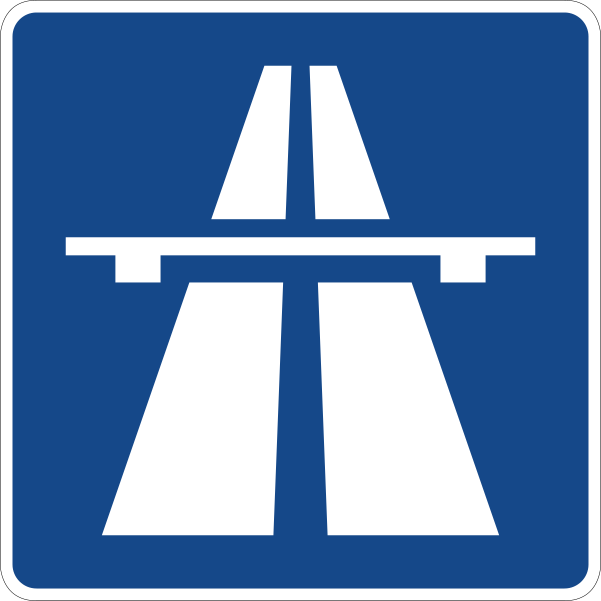 Start of a motorway.
English • Traffic sign 330.1 • Motorway.
Deutsch • Verkehrszeichen 330.1 • Autobahn.
Sources
🔗 Commons.wikimedia.org
🔗 Verwaltungsvorschriften-im-internet.de • VzKat, Anhang (Gesamtübersicht)
Image via Commons.wikimedia.org
vectorized by • Public domain • Source revision 2017-08-29. Wikimedia original unmodified.
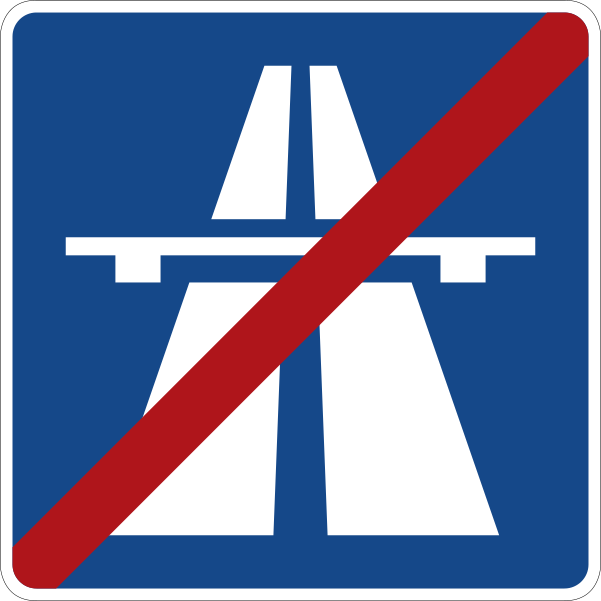 End of the motorway.
English • Traffic sign 330.2 • End of motorway.
Deutsch • Verkehrszeichen 330.2 • Ende der Autobahn.
Sources
🔗 Commons.wikimedia.org
🔗 Verwaltungsvorschriften-im-internet.de • VzKat, Anhang (Gesamtübersicht)
Image via Commons.wikimedia.org
vectorized by • Public domain • Source revision 2017-08-30. Wikimedia original unmodified.
What speed limit applies to cars on a motorway in Germany?
Ordinary passenger cars without trailers do not have a blanket motorway maximum on unrestricted sections. The recommended speed is 130 km/h. Posted and variable limits are binding, and traffic, weather and visibility can require a lower speed.
🔗 gesetze-im-internet.de • Germany StVO: §§3(1),(3),18(1),(7)–(10); Annex 3, signs 330.1–330.2
🔗 gesetze-im-internet.de • Autobahn-Richtgeschwindigkeits-V §§1–2: 130 km/h recommendation
Who may use a motorway in Germany?
Motor vehicles and their trailers must have a design maximum speed of more than 60 km/h. This is a vehicle-admission requirement, not a universal minimum driving speed. Pedestrians and cyclists are excluded.
🔗 gesetze-im-internet.de • Germany StVO: §§3(1),(3),18(1),(7)–(10); Annex 3, signs 330.1–330.2
🔗 gesetze-im-internet.de • Autobahn-Richtgeschwindigkeits-V §§1–2: 130 km/h recommendation
What should I do if I miss a motorway exit in Germany?
Continue to the next exit and choose a safe onward route. Do not reverse, make a U-turn or cross the central reservation to return to a missed exit.
🔗 gesetze-im-internet.de • Germany StVO: §§3(1),(3),18(1),(7)–(10); Annex 3, signs 330.1–330.2
🔗 gesetze-im-internet.de • Autobahn-Richtgeschwindigkeits-V §§1–2: 130 km/h recommendation
3. Expressway
An expressway is a road intended to carry through traffic efficiently, usually at higher speeds than ordinary roads. Expressways often have limited access, multiple lanes, separated carriageways or grade-separated junctions, but their design and legal status vary between countries.
An expressway is not always a motorway. It may have intersections, traffic lights or direct access, and the permitted road users, speed limits and special rules depend on local signs and regulations.
Wikimedia.org • KlausFoehl • CC BY-SA
How do people refer to an expressway in Germany?
The German term is Kraftfahrstraße, meaning road for motor vehicles. It is identified by a blue sign with a car symbol and is a separate designation from a motorway.
🔗 gesetze-im-internet.de • Germany StVO: §§3(3)(2)(c),18(1),(9); Annex 3, signs 331.1–331.2
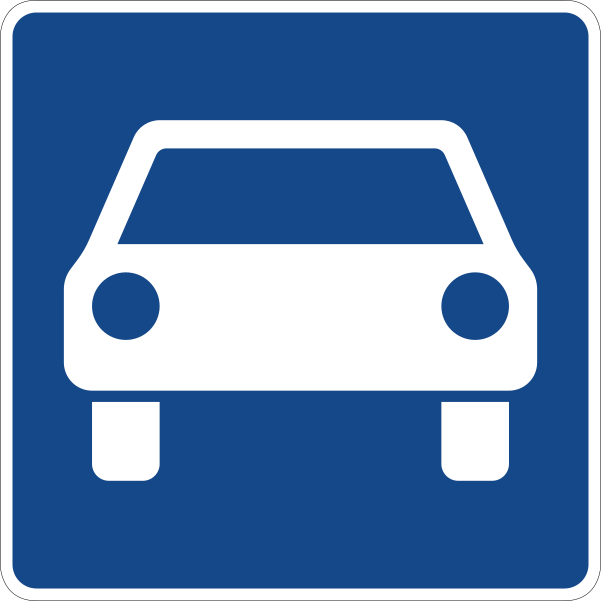 Start of an expressway.
English • Traffic sign 331.1 • Road for motor vehicles.
Deutsch • Verkehrszeichen 331.1 • Kraftfahrstraße.
Sources
🔗 Commons.wikimedia.org
🔗 Verwaltungsvorschriften-im-internet.de • VzKat, Anhang (Gesamtübersicht)
Image via Commons.wikimedia.org
vectorized by • Public domain • Source revision 2017-08-30. Wikimedia original unmodified.
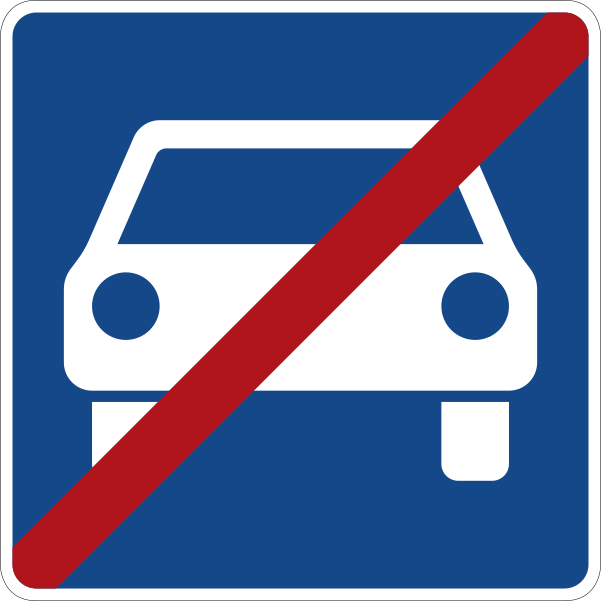 End of the expressway.
English • Traffic sign 331.2 • End of road for motor vehicles.
Deutsch • Verkehrszeichen 331.2 • Ende der Kraftfahrstraße.
Sources
🔗 Commons.wikimedia.org
🔗 Verwaltungsvorschriften-im-internet.de • VzKat, Anhang (Gesamtübersicht)
Image via Commons.wikimedia.org
vectorized by • Public domain • Source revision 2017-08-30. Wikimedia original unmodified.
Must a German expressway have separate carriageways?
No. A road for motor vehicles can have a single carriageway. Do not assume that the designation guarantees a central divider, motorway-style junctions or an unrestricted car speed.
🔗 gesetze-im-internet.de • Germany StVO: §§3(3)(2)(c),18(1),(9); Annex 3, signs 331.1–331.2
What speed limit applies to cars on an expressway in Germany?
There is no single maximum created by the road-for-motor-vehicles sign. On an ordinary single-carriageway road outside built-up areas, the car maximum is normally 100 km/h. Qualifying divided or multi-lane roads have different provisions; obey posted limits.
🔗 gesetze-im-internet.de • Germany StVO: §§3(3)(2)(c),18(1),(9); Annex 3, signs 331.1–331.2
Who may use an expressway in Germany?
Motor vehicles and their trailers must have a design maximum speed of more than 60 km/h. Cyclists cannot use the road. Pedestrians may cross a Kraftfahrstraße only at junctions or other places provided for crossing; they must not otherwise enter it. The design-speed condition is not a duty to maintain that speed in congestion.
🔗 gesetze-im-internet.de • Germany StVO: §§3(3)(2)(c),18(1),(9); Annex 3, signs 331.1–331.2
4. Residential area
A residential area is a street or group of streets where housing and access to local properties are the main functions. Drivers should expect pedestrians, cyclists, children, parked vehicles and vehicles entering or leaving driveways.
Some countries identify particular residential areas with traffic signs and apply special low-speed and residential-area rules. The speed limit, pedestrian rights, parking rules and permitted road users therefore depend on local signs and regulations.
Wikimedia.org • Zavijava2 • CC BY-SA
How do people refer to a residential area in Germany?
The legal German term is verkehrsberuhigter Bereich. It identifies a specially signposted category; a Tempo-30-Zone is different and does not automatically have the same pedestrian rights.
🔗 gesetze-im-internet.de • Germany StVO: §10; Annex 3, signs 325.1–325.2
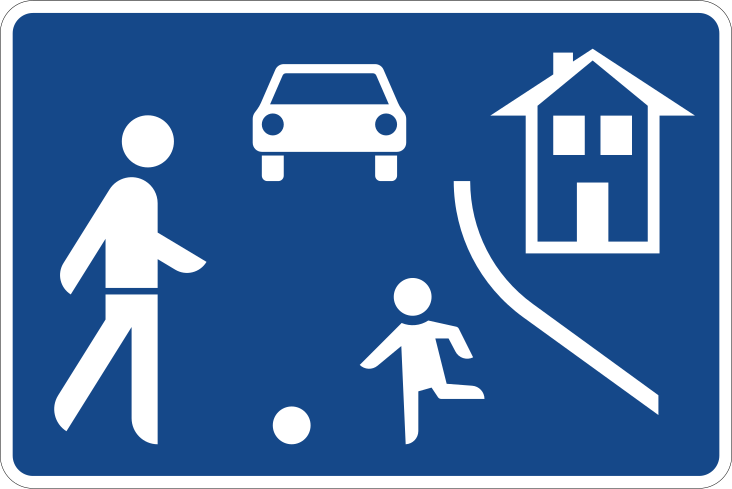 Start of a residential area.
English • Traffic sign 325.1 • Beginning of a residential area.
Deutsch • Verkehrszeichen 325.1 • Beginn eines verkehrsberuhigten Bereichs.
Sources
🔗 Commons.wikimedia.org
🔗 Verwaltungsvorschriften-im-internet.de • VzKat, Anhang (Gesamtübersicht)
Image via Commons.wikimedia.org
vectorized by • Public domain • Source revision 2017-12-12. Wikimedia original unmodified.
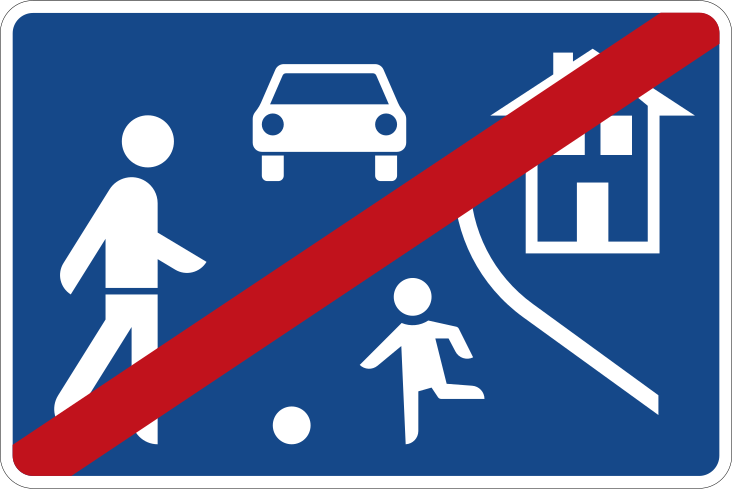 End of the residential area.
English • Traffic sign 325.2 • End of a residential area.
Deutsch • Verkehrszeichen 325.2 • Ende eines verkehrsberuhigten Bereichs.
Sources
🔗 Commons.wikimedia.org
🔗 Verwaltungsvorschriften-im-internet.de • VzKat, Anhang (Gesamtübersicht)
Image via Commons.wikimedia.org
erstes Hochladen einer Datei durch: Andreas 06; eine im Jahr 2017 nach dem Verkehrsblatt interpretierte und digital umgesetzte neue Datei entstand durch Mediatus • Public domain • Source revision 2017-12-12. Wikimedia original unmodified.
What speed limit applies in a residential area in Germany?
In the specially signposted residential-area category, vehicles must travel at walking pace. Do not replace that rule with a general 20 or 30 km/h limit.
🔗 gesetze-im-internet.de • Germany StVO: §10; Annex 3, signs 325.1–325.2
What rights do pedestrians have in a signposted residential area in Germany?
Pedestrians may use the whole width, and children may play anywhere in the area. Drivers must not endanger or obstruct pedestrians and must wait if necessary. Pedestrians must not obstruct traffic unnecessarily.
🔗 gesetze-im-internet.de • Germany StVO: §10; Annex 3, signs 325.1–325.2
Where may I park in a residential area in Germany?
Park only within designated spaces. The rule has exceptions for picking up or setting down passengers and loading or unloading; these do not permit obstructive parking.
🔗 gesetze-im-internet.de • Germany StVO: §10; Annex 3, signs 325.1–325.2
Who has priority when I leave a signposted German residential area?
When leaving the traffic-calmed category, you must ensure that other road users are not endangered and give way to them. Do not apply the ordinary priority-to-the-right rule to claim priority at the exit.
🔗 gesetze-im-internet.de • Germany StVO: §10; Annex 3, signs 325.1–325.2
5. Zone
A traffic zone is an area in which a traffic rule applies throughout all included roads or road sections. The rule normally begins at a zone-entry sign and remains applicable until the corresponding end-of-zone sign is passed.
Zones may regulate speed, parking, access, vehicle categories, emissions or other traffic behaviour. The signs used, the roads covered and the effect of intersections or local exceptions depend on local traffic law.
Wikimedia.org • Lukas Beck • CC BY-SA
How do people refer to traffic zones in Germany?
A speed zone is commonly called a Tempo-30-Zone. Germany also has parking-restriction zones and Umweltzonen, environmental zones. Each entrance sign establishes its own requirement.
Where does a zone rule apply in Germany?
The displayed zonal restriction applies throughout the signed zone. A normal junction does not end a Tempo-30-Zone; continue at no more than 30 km/h until its end, alongside any other applicable restrictions.
Who normally has priority at junctions inside a German 30 km/h zone?
The general arrangement is priority to traffic from the right. Observe the actual signs and layout at each junction: the speed-zone sign is not a give-way sign and does not excuse ignoring a specific priority rule.
How do you know when a traffic zone ends in Germany?
Look for the end of the particular zone you entered. Environmental, parking and speed zones can overlap, so an end sign for one does not automatically end the others.
6. Speed limit
A speed limit is the maximum legal speed permitted on a road, lane or within a designated area. It may be established by general traffic law or indicated by fixed, variable or temporary traffic signs.
A speed limit is a maximum, not a target speed. Drivers must travel more slowly whenever traffic, visibility, weather, road conditions, vulnerable road users or the condition of the vehicle make the maximum permitted speed unsafe.
Wikimedia.org • Heini Woldschläger • CC BY
Which general speed limits should car drivers know in Germany?
For an ordinary passenger car without a trailer, the general maxima are 50 km/h in built-up areas and 100 km/h on ordinary roads outside them. Qualifying unrestricted Autobahn sections have no general car maximum, but an advisory 130 km/h speed applies. Obey signed restrictions and drive more slowly whenever conditions require it.
🔗 gesetze-im-internet.de • Germany StVO: §§3(1),(3),18; Annex 2, sign 274 and wet-road panel
🔗 gesetze-im-internet.de • Autobahn-Richtgeschwindigkeits-V §§1–2: 130 km/h recommendation
Is Germany’s 130 km/h motorway advisory speed a mandatory maximum?
The official term Richtgeschwindigkeit means advisory speed. The 130 km/h recommendation is not itself a blanket legal maximum on an unrestricted qualifying section. A regulatory speed sign is binding, and the duty to choose a safe speed always applies.
🔗 gesetze-im-internet.de • Germany StVO: §§3(1),(3),18; Annex 2, sign 274 and wet-road panel
🔗 gesetze-im-internet.de • Autobahn-Richtgeschwindigkeits-V §§1–2: 130 km/h recommendation
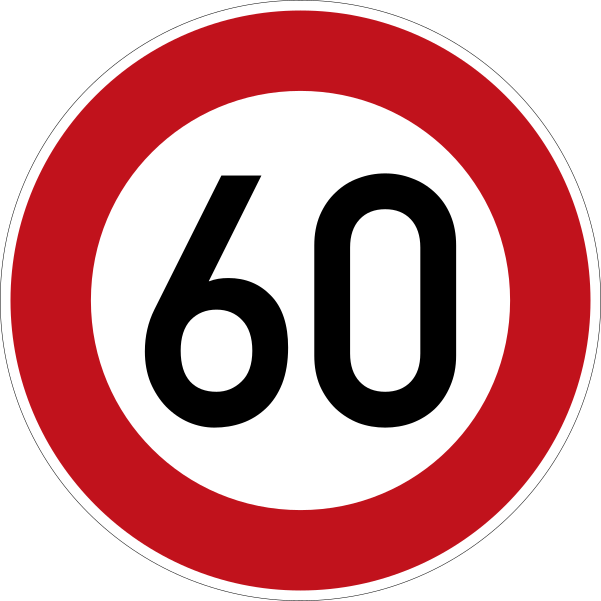 Start of a speed limit.
English • Traffic sign 274-60 • Maximum permitted speed of 60 km/h.
Deutsch • Verkehrszeichen 274-60 • Zulässige Höchstgeschwindigkeit 60 km/h.
Sources
🔗 Commons.wikimedia.org
🔗 Verwaltungsvorschriften-im-internet.de • VzKat, Anhang (Gesamtübersicht)
Image via Commons.wikimedia.org
Nach den amtlichen Vorgaben digital umgesetzt durch: Mediatus • Public domain • Source revision 2017-10-19. Wikimedia original unmodified.
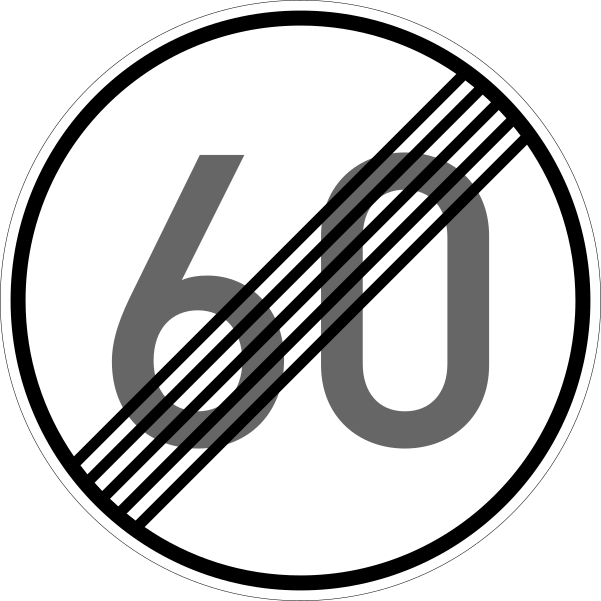 End of the speed limit.
English • Traffic sign 278-60 • End of the maximum permitted speed of 60 km/h.
Deutsch • Verkehrszeichen 278-60 • Ende der zulässigen Höchstgeschwindigkeit 60 km/h.
Sources
🔗 Commons.wikimedia.org
🔗 Verwaltungsvorschriften-im-internet.de • VzKat, Anhang (Gesamtübersicht)
Image via Commons.wikimedia.org
Nach den amtlichen Vorgaben digital umgesetzt durch: Mediatus • Public domain • Source revision 2017-08-20. Wikimedia original unmodified.
Can a German motorway restriction apply only in wet conditions?
Yes. A supplementary panel reading bei Nässe makes the displayed restriction applicable in wet conditions. Read time, weather or vehicle conditions together with the speed sign; a conditional restriction must not be treated as an unconditional number.
🔗 gesetze-im-internet.de • Germany StVO: §§3(1),(3),18; Annex 2, sign 274 and wet-road panel
🔗 gesetze-im-internet.de • Autobahn-Richtgeschwindigkeits-V §§1–2: 130 km/h recommendation
7. Footpath
A footpath is a path or part of a road intended primarily for pedestrian traffic. It may run alongside a road, through a park or residential area, or independently from roads used by motor vehicles.
A footpath may be reserved exclusively for pedestrians or may form part of a shared route with cyclists or other permitted users. Access, priority and permitted users depend on the traffic signs and local regulations applying to the path.
Wikimedia.org • Velopilger • CC BY-SA
What does Germany’s blue circular pedestrian-path sign mean?
It marks a Gehweg, reserved for pedestrians under the sign’s rules. Ordinary vehicle traffic must not use it unless an additional sign permits an exception. A combined walking and cycling sign or a divided-path sign has different rules.
🔗 gesetze-im-internet.de • Germany StVO: §§2(5),25; Annex 2, sign 239
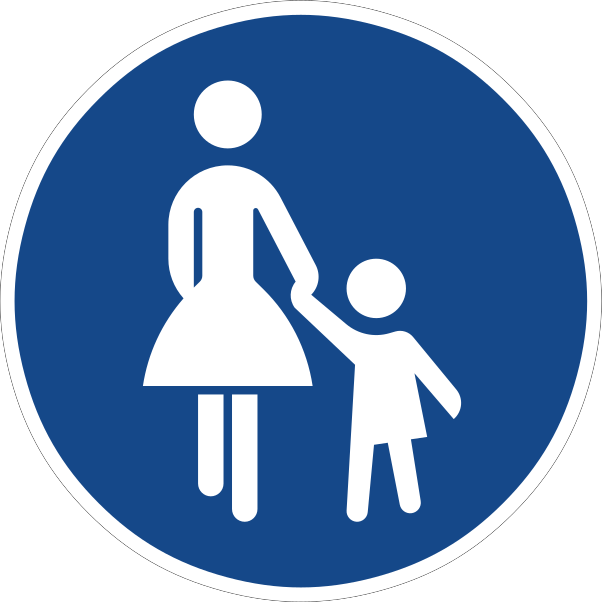 Mandatory path for pedestrians.
English • Traffic sign 239 • Footpath.
Deutsch • Verkehrszeichen 239 • Gehweg.
Sources
🔗 Commons.wikimedia.org
🔗 Verwaltungsvorschriften-im-internet.de • VzKat, Anhang (Gesamtübersicht)
Image via Commons.wikimedia.org
first datas: Andreas 06. Nach den amtlichen Vorgaben 2017 komplett neu digital umgesetzt durch: Mediatus • Public domain • Source revision 2017-09-01. Wikimedia original unmodified.
Can children and their supervisors cycle on German pavements?
Children under eight must use the pavement, or may use a physically separated cycle path. Children aged eight or nine may use the pavement. A suitable supervisor, normally at least 16, may accompany an under-eight child there. Protect pedestrians; dismount before crossing a carriageway from the pavement.
🔗 gesetze-im-internet.de • Germany StVO: §§2(5),25; Annex 2, sign 239
What if a German pedestrian path expressly permits cyclists?
The permission does not remove pedestrian protection. Permitted riders must yield to pedestrians, avoid endangering or obstructing them, and travel at walking pace. Wait if necessary. This supplementary permission is different from a path designated jointly for walking and cycling.
🔗 gesetze-im-internet.de • Germany StVO: §§2(5),25; Annex 2, sign 239
8. Bike path
A bike path is a part of a road or a separate route intended primarily or exclusively for people riding bicycles. It may be physically separated from motor traffic, marked on the road surface or identified by traffic signs.
Bike paths may be one-way, two-way or shared with other road users. The permitted users, direction of travel, priority rules and obligation to use the path depend on local traffic signs and regulations.
Wikimedia.org • Dontworry • CC BY-SA
Must cyclists use every German cycle path?
No. Use is compulsory where the relevant blue circular cycling or walking-and-cycling sign orders it. A cycle path on the right without those signs may be used voluntarily. The official term for a cycle path is Radweg.
🔗 gesetze-im-internet.de • Germany StVO: §2(4); Annex 2, signs 237,240–241
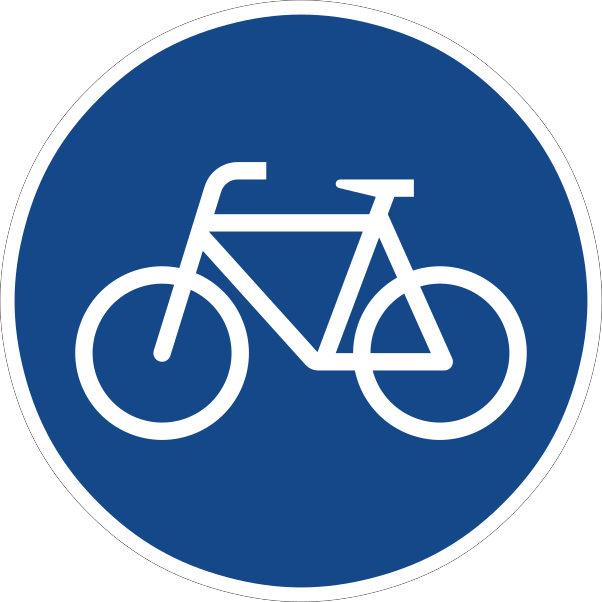 Mandatory path for cyclists.
English • Traffic sign 237 • Cycle track.
Deutsch • Verkehrszeichen 237 • Radweg.
Sources
🔗 Commons.wikimedia.org
🔗 Verwaltungsvorschriften-im-internet.de • VzKat, Anhang (Gesamtübersicht)
Image via Commons.wikimedia.org
MarianSigler {bla}, Mediatus • Public domain • Source revision 2020-01-28. Wikimedia original unmodified.
May I use a German cycle path on the left side of the road?
Only where its signs permit cycling in that direction. An unsigned left-side path is not automatically available. The Regulations also recognise an otherwise optional left-side path explicitly opened by the cycling-permitted supplementary sign.
🔗 gesetze-im-internet.de • Germany StVO: §2(4); Annex 2, signs 237,240–241
Do shared and divided German cycle paths have the same rules?
No. On a divided facility, use the cycling part. On a joint walking and cycling path, protect pedestrians and adjust speed when necessary. The sign’s arrangement shows whether the two groups share the surface or have separate parts.
🔗 gesetze-im-internet.de • Germany StVO: §2(4); Annex 2, signs 237,240–241
9. Shared-use path
A shared-use path is a path or part of a road intended for use by both pedestrians and cyclists. Unlike facilities where pedestrians and cyclists have clearly separated sections, users of a shared-use path normally travel within the same general space.
Because users may travel at very different speeds, cyclists should approach pedestrians carefully, adapt their speed and leave sufficient space when passing. The permitted users, priority rules and any speed restrictions depend on the local traffic signs and regulations.

What does Germany call a shared walking and cycling path?
The official term is gemeinsamer Geh- und Radweg. Its blue circular sign shows walking and cycling together. The sign with a vertical division indicates a getrennter Rad- und Gehweg, where the two groups use separate sections.
🔗 gesetze-im-internet.de • Germany StVO: §2(4); Annex 2, signs 240–241
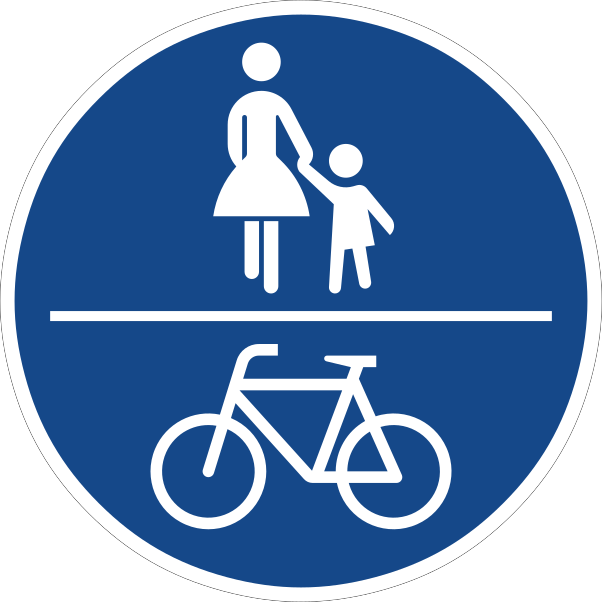 Mandatory shared pedestrian and cycle path.
English • Traffic sign 240 • Shared footpath and cycle path.
Deutsch • Verkehrszeichen 240 • Gemeinsamer Geh- und Radweg.
Sources
🔗 Commons.wikimedia.org
🔗 Verwaltungsvorschriften-im-internet.de • VzKat, Anhang (Gesamtübersicht)
Image via Commons.wikimedia.org
erstes Hochladen einer Datei durch Andreas 06; nach den Vorgaben 2017 korrekt interpretiert und digital umgesetzt durch Mediatus • Public domain • Source revision 2017-09-12. Wikimedia original unmodified.
How must cyclists treat pedestrians on German shared paths?
Cyclists must not endanger or obstruct pedestrians. Adjust speed to pedestrian traffic where necessary. Compulsory cycle-path use does not give riders a right to force pedestrians aside or pass through them at normal road-cycling speed.
🔗 gesetze-im-internet.de • Germany StVO: §2(4); Annex 2, signs 240–241
Does a German shared-path sign normally make cycle-path use compulsory?
Yes. The relevant blue circular sign normally requires cyclists to use the path rather than the carriageway. The statutory exceptions still matter. A shared-path obligation is separate from the duty to protect walkers on the facility.
🔗 gesetze-im-internet.de • Germany StVO: §2(4); Annex 2, signs 240–241
10. Pedestrian warning
A pedestrian warning is a traffic warning indicating that pedestrians may be crossing or entering the roadway ahead. It is commonly used near pedestrian crossings or other locations where drivers need advance notice of frequent pedestrian activity.
Drivers approaching a pedestrian warning should reduce speed when necessary, watch carefully for pedestrians and be prepared to stop. The design of the warning sign and the priority rules at the crossing vary between countries.

Wikimedia.org • Mark Voigt • CC BY
How should I react to a pedestrian warning in Germany?
Reduce speed, look along both sides of the road and be ready to stop. The warning identifies a pedestrian hazard ahead; children, people with limited mobility or others may enter the road unexpectedly.
🔗 gesetze-im-internet.de • Germany StVO: §§3(2a),26,40; Annex 1, signs 133,136
Does a pedestrian warning in Germany identify the crossing itself?
Not necessarily. An advance warning alerts you to danger ahead. The actual crossing is identified by its own signs, markings or signals. Apply the crossing rules when you reach it, and follow any supplementary distance information.
🔗 gesetze-im-internet.de • Germany StVO: §§3(2a),26,40; Annex 1, signs 133,136
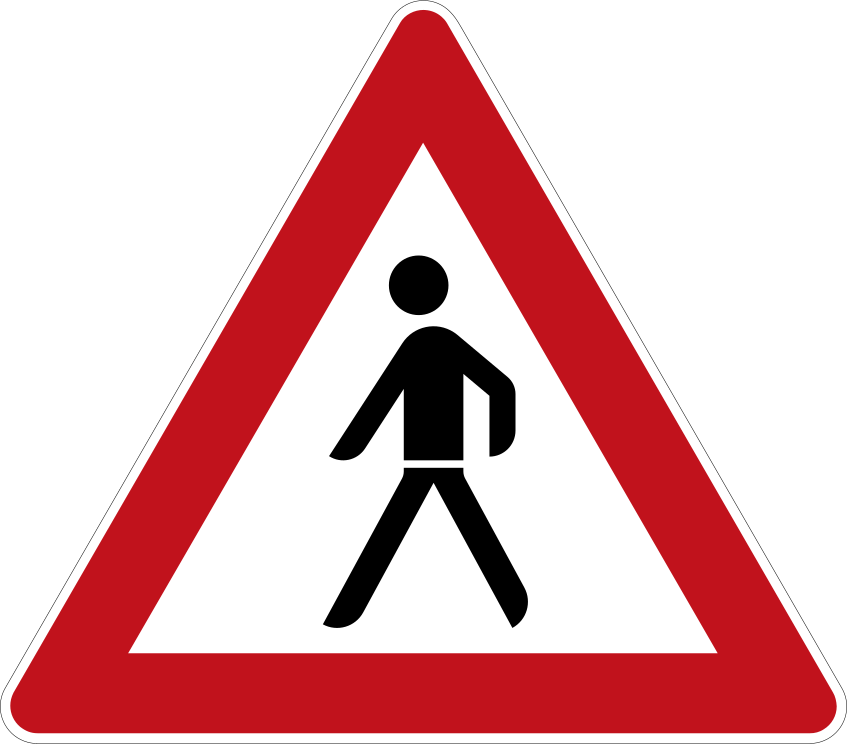 Warning for pedestrians.
English • Traffic sign 133-10 • Pedestrians — sign placed on the right.
Deutsch • Verkehrszeichen 133-10 • Fußgänger – Aufstellung rechts.
Sources
🔗 Commons.wikimedia.org
🔗 Verwaltungsvorschriften-im-internet.de • VzKat, Anhang (Gesamtübersicht)
Image via Commons.wikimedia.org
MarianSigler {bla}, Mediatus • Public domain • Source revision 2017-09-01. Wikimedia original unmodified.
What should drivers know about pedestrian crossings in Germany?
At a Fußgängerüberweg, allow pedestrians recognisably wishing to use it to cross, and stop if necessary. Approach at moderate speed. The zebra-crossing rule is distinct from traffic-light-controlled crossings and has a rail-vehicle exception.
🔗 gesetze-im-internet.de • Germany StVO: §§3(2a),26,40; Annex 1, signs 133,136
11. Tunnel
A tunnel is a covered passage that carries a road through or beneath an obstacle such as a hill, mountain, building, waterway or another transport route. Road tunnels may contain one or more traffic lanes and can carry traffic in one or both directions.
Driving in a tunnel requires particular attention because visibility, available escape routes and space for avoiding hazards are limited. Drivers should follow the applicable lighting, speed, lane and following-distance rules and pay attention to emergency exits, traffic signals and variable-message signs.

Wikimedia.org • WupperVideo • CC BY-SA
What should I check before entering a tunnel in Germany?
At a signed tunnel, use dipped headlights and do not turn around. Emergency or breakdown bays are intended for emergencies or breakdowns, rather than ordinary stops.
🔗 gesetze-im-internet.de • Germany StVO: §§3,18; Annex 3, signs 327–328
Does a tunnel sign in Germany set a universal speed limit?
No single speed can be read from the tunnel pictogram. Apply the road’s relevant limit and any permanent or electronic speed restriction, and drive more slowly when visibility, queues or another hazard require it.
🔗 gesetze-im-internet.de • Germany StVO: §§3,18; Annex 3, signs 327–328
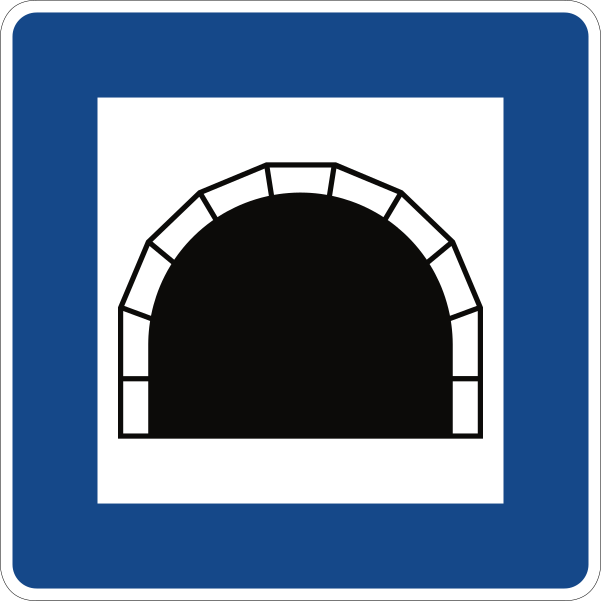 Start of a tunnel.
English • Traffic sign 327 • Tunnel.
Deutsch • Verkehrszeichen 327 • Tunnel.
Sources
🔗 Commons.wikimedia.org
🔗 Verwaltungsvorschriften-im-internet.de • VzKat, Anhang (Gesamtübersicht)
Image via Commons.wikimedia.org
erstes Hochladen einer Datei durch Andreas 06; nach den historischen Vorgaben interpretiert und digital umgesetzt durch Mediatus • Public domain • Source revision 2017-08-20. Wikimedia original unmodified.
Is every tunnel in Germany open to pedestrians and cyclists?
No. Check the road category and access signs before entering. A motorway tunnel, a vehicle-restricted tunnel and a purpose-built walking or cycling underpass have different access arrangements. Emergency evacuation routes do not establish ordinary public access.
🔗 gesetze-im-internet.de • Germany StVO: §§3,18; Annex 3, signs 327–328
12. Bridge
A bridge is a structure that carries a road, path or railway over an obstacle such as a river, valley, railway line or another road. A road bridge may carry one or more roadways together with pedestrian or cycling facilities.
Drivers should follow any speed, weight, height, width or vehicle-access restrictions applying to the bridge. Particular care may be necessary on narrow, exposed or movable bridges and when weather conditions such as wind, rain or ice affect the road surface.

Wikimedia.org • Oxfordian_Kissuth • CC BY-SA
What should I check before crossing a bridge in Germany?
Check the applicable weight, axle-load, width and height restrictions before committing to the crossing. Include the load, trailer and roof equipment when relevant. A bridge warning and a vehicle restriction serve different purposes; comply with both.
Who goes first on a narrow bridge in Germany?
Follow any traffic lights, give-way controls or signs allocating priority over oncoming traffic. Do not force your way onto a bridge that cannot accommodate both directions safely. A bridge warning alone does not give your direction priority.
May I stop or park on a bridge in Germany?
Apply the ordinary stopping and parking restrictions and any posted prohibition. Narrow sections, inadequate visibility and obstruction can prohibit a stop regardless of whether the road happens to be a bridge.
13. Cycling street
A cycling street is a street designed or legally designated to give cyclists a prominent position in mixed traffic. Motor vehicles may usually enter, but they must adapt their speed and driving behaviour to the presence of cyclists.
Depending on the country, cyclists may be permitted to use more of the carriageway and motor vehicles may be prohibited from overtaking them. The speed limit, priority rules, permitted vehicles and beginning and end of the street depend on local traffic signs and regulations.
Wikimedia.org • Michał Beim • CC BY-SA
How should I interpret a cycling-priority street in Germany?
A signed Fahrradstraße normally permits bicycles and the personal light-electric vehicles covered by the Regulations. Other vehicle traffic needs a supplementary permission, but may cross at a junction to reach a continuing road. A Fahrradzone applies related rules over a signed area.
🔗 gesetze-im-internet.de • Germany StVO: §§5(4),8–9; Annex 2, signs 244.1–244.4
Which driving rules matter on a mixed cycling street in Germany?
The limit is 30 km/h. Permitted motor traffic must not endanger or obstruct cyclists and must slow further if necessary. Cyclists may ride side by side; overtaking remains subject to safe-clearance rules.
🔗 gesetze-im-internet.de • Germany StVO: §§5(4),8–9; Annex 2, signs 244.1–244.4
Which priority rules apply on cycling streets in Germany?
The bicycle-street rules expressly retain the remaining road rules. There is no automatic priority at every junction from the designation alone. Obey priority signs and signals rather than assuming the cycling route takes precedence.
🔗 gesetze-im-internet.de • Germany StVO: §§5(4),8–9; Annex 2, signs 244.1–244.4
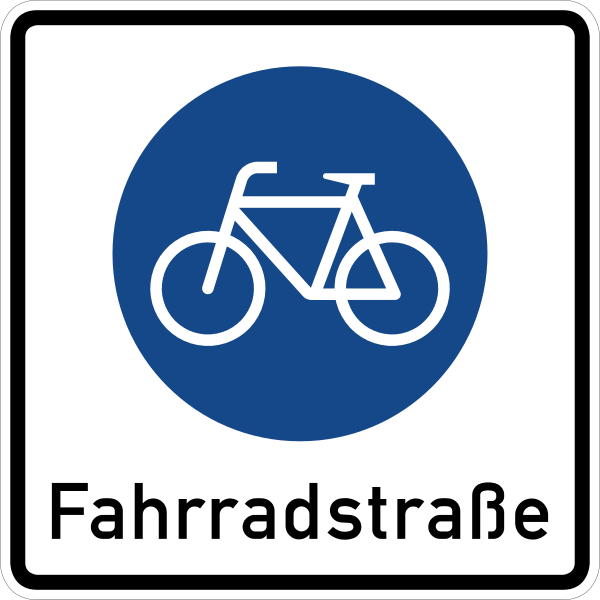 Lane for cyclists.
English • Traffic sign 244.1 • Beginning of a cycle street.
Deutsch • Verkehrszeichen 244.1 • Beginn einer Fahrradstraße.
Sources
🔗 Commons.wikimedia.org
🔗 Verwaltungsvorschriften-im-internet.de • VzKat, Anhang (Gesamtübersicht)
Image via Commons.wikimedia.org
Nach den amtlichen Vorgaben digital umgesetzt durch: Mediatus • Public domain • Source revision 2017-08-22. Wikimedia original unmodified.
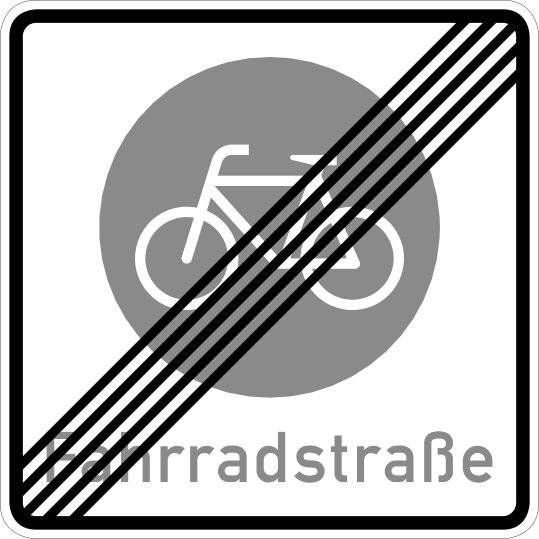 End of the lane for cyclists.
English • Traffic sign 244.2 • End of a cycle street.
Deutsch • Verkehrszeichen 244.2 • Ende einer Fahrradstraße.
Sources
🔗 Commons.wikimedia.org
🔗 Verwaltungsvorschriften-im-internet.de • VzKat, Anhang (Gesamtübersicht)
Image via Commons.wikimedia.org
see disciption • Public domain • Source revision 2017-03-06. Wikimedia original unmodified.
14. Pedestrian zone
A pedestrian zone is an area consisting of one or more streets that are reserved primarily for pedestrians. Motor-vehicle access is normally prohibited or restricted to authorised users, particular purposes or specified times.
Pedestrians may usually use the full width of the available road space. Rules concerning cyclists, deliveries, public transport, vehicle speed, stopping and parking depend on local traffic signs and regulations.

Wikimedia.org • CC BY-SA
How should I recognise pedestrian-only access in Germany?
The official term is Fußgängerzone. Other traffic may enter only when an additional sign permits it. A pedestrian zone is different from a 30 km/h zone or a traffic-calmed residential area.
🔗 gesetze-im-internet.de • Germany StVO: §10; Annex 2, signs 239(2),242.1–242.2
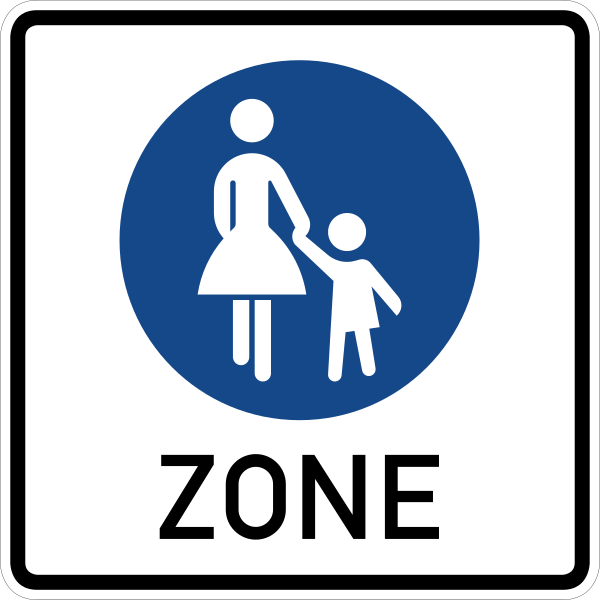 Start of a zone for pedestrians.
English • Traffic sign 242.1 • Beginning of a pedestrian zone.
Deutsch • Verkehrszeichen 242.1 • Beginn einer Fußgängerzone.
Sources
🔗 Commons.wikimedia.org
🔗 Verwaltungsvorschriften-im-internet.de • VzKat, Anhang (Gesamtübersicht)
Image via Commons.wikimedia.org
Nach den amtlichen Vorgaben digital umgesetzt durch: Mediatus • Public domain • Source revision 2022-04-22. Wikimedia original unmodified.
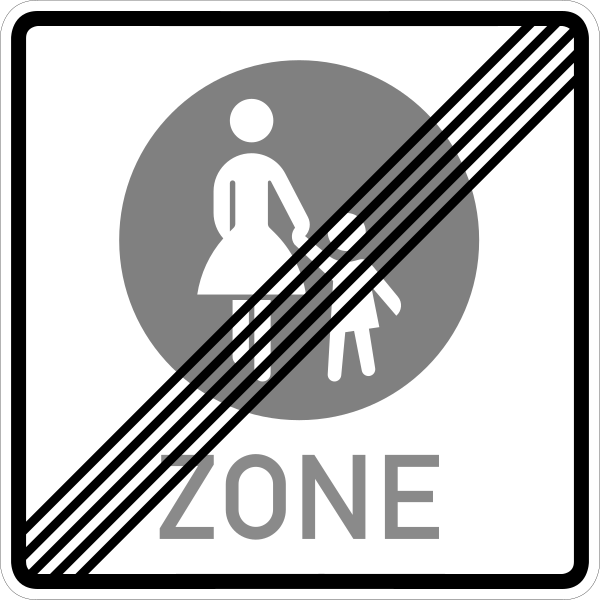 End of the zone for pedestrians.
English • Traffic sign 242.2 • End of a pedestrian zone.
Deutsch • Verkehrszeichen 242.2 • Ende einer Fußgängerzone.
Sources
🔗 Commons.wikimedia.org
🔗 Verwaltungsvorschriften-im-internet.de • VzKat, Anhang (Gesamtübersicht)
Image via Commons.wikimedia.org
Nach den amtlichen Vorgaben digital umgesetzt durch: Mediatus • Public domain • Source revision 2017-09-01. Wikimedia original unmodified.
May cyclists ride in pedestrian areas in Germany?
Cycling requires the relevant supplementary permission, such as Radverkehr frei. Permitted cyclists must use walking pace, give pedestrians priority and wait if necessary; permission does not turn the area into a cycle track.
🔗 gesetze-im-internet.de • Germany StVO: §10; Annex 2, signs 239(2),242.1–242.2
Which rules apply to vehicles admitted to pedestrian areas in Germany?
All admitted vehicle traffic must respect walking pace and must not endanger or obstruct pedestrians. Stop and wait when necessary; read any delivery or time exemption exactly as displayed.
🔗 gesetze-im-internet.de • Germany StVO: §10; Annex 2, signs 239(2),242.1–242.2
15. Toll road
A toll road is a road, motorway, bridge, tunnel or other route for which users must pay a charge. The toll may apply to all vehicles or only to particular vehicle categories, and the amount can depend on factors such as distance travelled, vehicle type, weight or emissions.
Tolls may be collected at toll booths, electronically or through a vignette or distance-based charging system. Drivers should check the applicable payment rules before using a toll road, especially when travelling in another country.
Wikimedia.org • Mateus2019 • CC BY-SA
Which road-charging system should I check in Germany?
Germany’s federal motorway and trunk-road toll concerns qualifying vehicles intended or used for goods transport with a technically permissible maximum laden mass over 3.5 tonnes. An ordinary passenger car is outside this goods-vehicle system.
What should I check before using a charged road in Germany?
Check the motor vehicle’s relevant permitted mass, use and any statutory exemption. Do not treat a caravan combination or a car as a lorry solely because its combined mass is higher; other facility-specific charges are separate.
Does the absence of a toll booth prove that a road is free in Germany?
The absence of a payment booth is not proof that a charged road is free. A vignette, electronic account, vehicle-registration record or another payment procedure may be used where the actual scheme provides for it. Follow the responsible authority or operator’s instructions for that road.
16. Customs
Customs is the government authority responsible for controlling goods entering or leaving a country or customs territory. In road traffic, a customs checkpoint is a place where drivers may be required to stop so officers can inspect the vehicle, luggage, cargo and relevant documents.
Customs controls may take place at borders, ports, ferry terminals, airports or inland control locations. Drivers must follow all traffic signs, lane signals, barriers and instructions from customs officers. Declaration requirements depend on the countries involved and on the type, value, quantity and intended use of the goods being carried.
Wikimedia.org • Mattes • CC BY
Which customs authority should drivers consult for travel to Germany?
Consult German Customs, Zoll for the goods, luggage and vehicle-related customs requirements of the journey. Customs controls concern goods and declarations; they must be distinguished from passport checks, a road toll or ordinary traffic control.
🔗 zoll.de • German Customs — traveller allowances and declaration duties
Do customs requirements depend on the route and goods when entering Germany?
Yes. Travel within the EU customs territory is treated differently from bringing goods from outside it. Personal use, commercial use, restricted goods and tax or customs special territories can change the requirements. Schengen passport arrangements do not replace customs rules.
🔗 zoll.de • German Customs — traveller allowances and declaration duties
What should motorists check before declaring goods in Germany?
Check the official declaration requirements for goods over your applicable allowance, commercial goods, controlled articles and cash or other monetary instruments. These categories have different rules and thresholds. Declare as required and ask customs if unsure; do not assume a duty-free purchase is exempt from all controls.
🔗 zoll.de • German Customs — traveller allowances and declaration duties
17. One-way traffic
One-way traffic means that vehicles on a road or carriageway may travel only in one designated direction. The permitted direction is normally indicated by traffic signs, lane arrows or road markings.
Some road users, such as cyclists or public-transport vehicles, may be allowed to travel in the opposite direction when signs expressly permit it. A one-way road does not by itself determine the speed limit, priority or parking rules.

Wikimedia.org • Andreas_Schwarzkopf • CC BY-SA
How should I read a one-way restriction in Germany?
A signed Einbahnstraße sets the permitted road direction. Its information sign and the opposite-end no-entry restriction must be read together with any supplementary panels.
🔗 gesetze-im-internet.de • Germany StVO: §§8–9; Annex 2, signs 220,267 and cycle exceptions
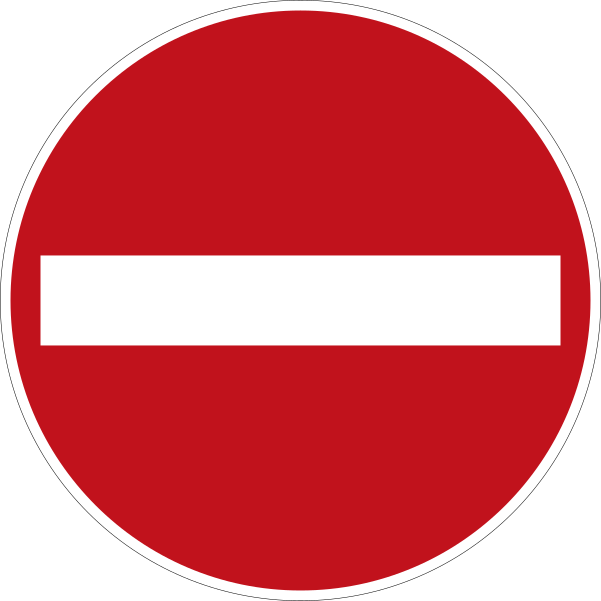 No entry.
English • Traffic sign 267 • No entry.
Deutsch • Verkehrszeichen 267 • Verbot der Einfahrt.
Sources
🔗 Commons.wikimedia.org
🔗 Verwaltungsvorschriften-im-internet.de • VzKat, Anhang (Gesamtübersicht)
Image via Commons.wikimedia.org
Hochladen der ursprünglichen Version: MarianSigler; nach den historischen Vorgaben digital neu umgesetzt durch: Mediatus • Public domain • Source revision 2022-08-28. Wikimedia original unmodified.
May cyclists travel against the general traffic direction in Germany?
Cycling in the opposite direction needs the legally indicated permission. When counterflow cycling is allowed, motorists must expect it both while turning into the street and while travelling along it; a cycle pictogram elsewhere is not enough to exempt the whole road.
🔗 gesetze-im-internet.de • Germany StVO: §§8–9; Annex 2, signs 220,267 and cycle exceptions
Does one-way traffic give me priority or a different speed limit in Germany?
A one-way restriction concerns direction. Continue to follow the applicable speed limit, signals, give-way or stop controls and junction-priority rules. Where authorised counterflow traffic exists, check for it before turning or crossing; your permitted direction is not automatic junction priority.
🔗 gesetze-im-internet.de • Germany StVO: §§8–9; Annex 2, signs 220,267 and cycle exceptions
18. Quay
A quay is a constructed area beside a river, canal, harbour or other body of water, commonly used for loading, unloading, mooring vessels or providing waterside access. A road may run alongside the water or lead directly towards the quay edge.
In road traffic, a quay warning indicates a risk that a vehicle could leave the road and enter the water. Drivers should reduce speed, observe the road layout carefully and keep a safe distance from the waterside edge.

Wikimedia.org • Pelikana • CC BY-SA
What should I watch for near a quay or waterside road in Germany?
Look for an unprotected or poorly protected water’s edge, bends leading towards the water, barriers and local access controls. A quay can be an operational port area or a public waterside road; do not infer the traffic arrangement from the presence of water alone.
How should I choose a safe speed beside water in Germany?
Use the applicable road or local speed limit and slow further for the foreseeable waterside danger. A hazard warning is not a promise that driving at the maximum is safe. Keep enough visibility and control to avoid the edge, pedestrians, loading activity or a blocked route.
Does a quay warning allow me to enter or park beside the water in Germany?
Check the actual access and parking restrictions, including any port or dock controls. A waterside warning does not provide permission to enter a restricted facility or park on the edge. Keep the required passage clear and use a permitted place without endangering traffic or people beside the water.
19. Slope
A slope is a section of road that rises or descends noticeably. A steep slope can affect vehicle speed, braking distance, traction, visibility and the ability of heavy or low-powered vehicles to maintain a steady speed.
Warning signs may indicate a steep ascent or dangerous descent and may show the gradient as a percentage. Drivers should adjust their speed early, select a suitable gear and remain prepared for slow vehicles, bends and changing road conditions.
Wikimedia.org • LepoRello • CC BY-SA
What does a steep-slope warning mean in Germany?
German signs distinguish Gefälle, a descent, from Steigung, an ascent. The warning and any gradient information do not set a numerical speed limit.
🔗 gesetze-im-internet.de • Germany StVO: §§3,5–6,40; Annex 1, signs 108,110
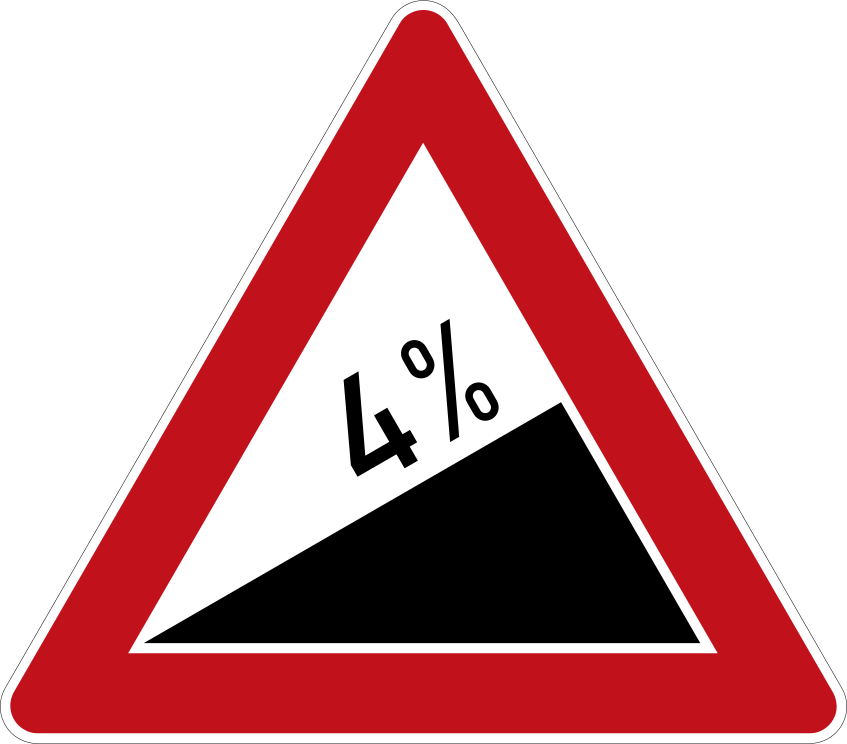 Warning for a steep ascent.
English • Traffic sign 110-4 • Uphill gradient of 4%.
Deutsch • Verkehrszeichen 110-4 • Steigung 4 %.
Sources
🔗 Commons.wikimedia.org
🔗 Verwaltungsvorschriften-im-internet.de • VzKat, Anhang (Gesamtübersicht)
Image via Commons.wikimedia.org
Nach den amtlichen Vorgaben digital umgesetzt durch: Mediatus • Public domain • Source revision 2021-10-19. Wikimedia original unmodified.
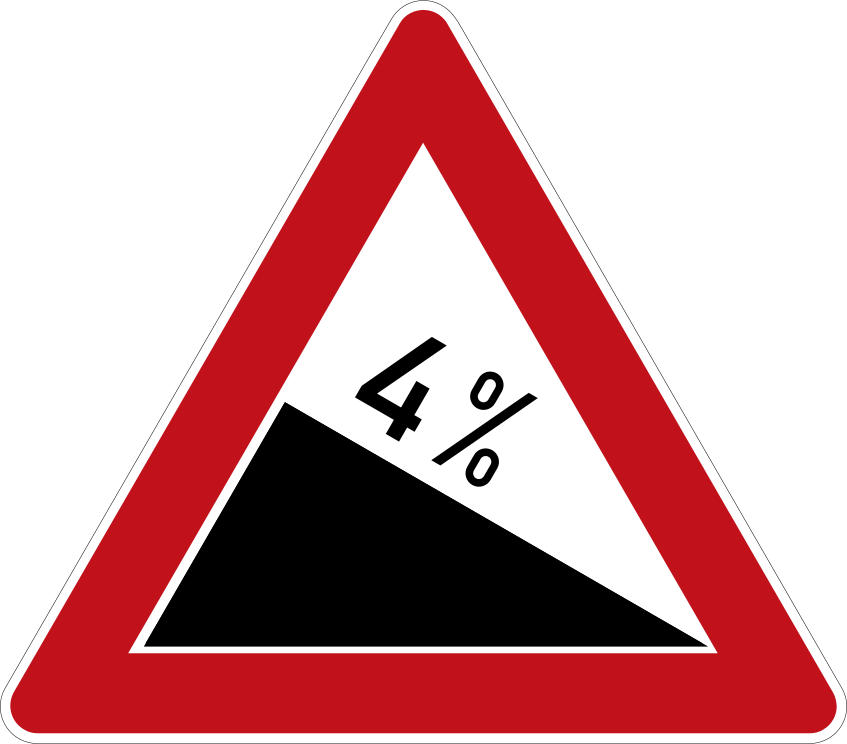 Warning for a steep descent.
English • Traffic sign 108-4 • Downhill gradient of 4%.
Deutsch • Verkehrszeichen 108-4 • Gefälle 4 %.
Sources
🔗 Commons.wikimedia.org
🔗 Verwaltungsvorschriften-im-internet.de • VzKat, Anhang (Gesamtübersicht)
Image via Commons.wikimedia.org
Nach den amtlichen Vorgaben digital umgesetzt durch: Mediatus • Public domain • Source revision 2021-10-18. Wikimedia original unmodified.
How should I approach a steep descent in Germany?
Reduce speed before the descent and select a suitable gear to help control the vehicle. Keep enough following distance and avoid building up speed that requires continuous heavy braking. A warning gives no fixed safe descent speed: the gradient, surface, visibility, load and vehicle can require a speed well below the legal maximum.
🔗 gesetze-im-internet.de • Germany StVO: §§3,5–6,40; Annex 1, signs 108,110
What should I check when meeting or overtaking on a slope in Germany?
Follow the priority signs and the rules for meeting traffic and passing an obstruction. The steep-slope warning itself gives no right to force your way through a narrow section; enter only with sufficient room and visibility.
🔗 gesetze-im-internet.de • Germany StVO: §§3,5–6,40; Annex 1, signs 108,110
20. Bus lane
A bus lane is a traffic lane reserved primarily for buses or other authorised public-transport vehicles. It is intended to improve the reliability and flow of public transport by allowing authorised vehicles to avoid general traffic congestion.
Other road users, such as taxis, cyclists, motorcycles or vehicles carrying several occupants, may also be permitted when signs expressly allow them. The operating hours, permitted vehicles, direction of travel and rules for entering or crossing the lane depend on local traffic signs and regulations.

Wikimedia.org • Martin Hawlisch • CC BY-SA
Which vehicles may use a bus lane in Germany?
Germany’s Bussonderfahrstreifen is reserved for scheduled buses and the specified school and disability-transport services. Taxis, bicycles, other buses and other listed vehicle categories need the authorising additional sign.
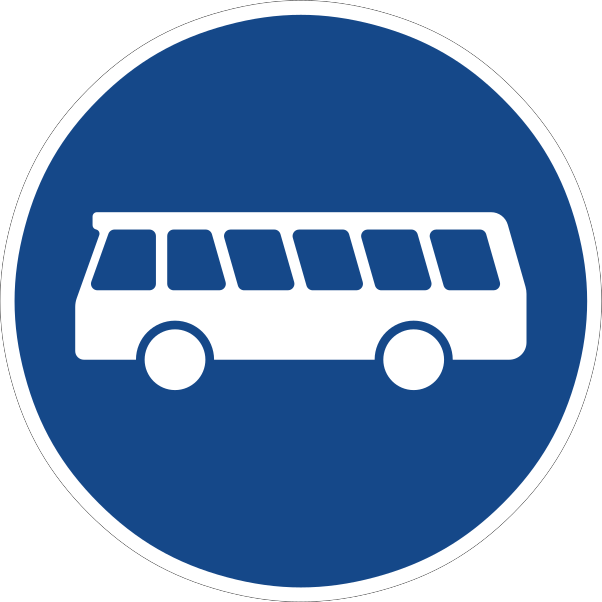 Mandatory lane for buses.
English • Traffic sign 245 • Bus lane.
Deutsch • Verkehrszeichen 245 • Bussonderfahrstreifen.
Sources
🔗 Commons.wikimedia.org
🔗 Verwaltungsvorschriften-im-internet.de • VzKat, Anhang (Gesamtübersicht)
Image via Commons.wikimedia.org
Nach den amtlichen Vorgaben digital umgesetzt durch: Mediatus • Public domain • Source revision 2017-08-31. Wikimedia original unmodified.
May bicycles and motorcycles use a bus lane in Germany?
Bicycles may use the lane when the additional sign allows them. A motorcycle or private car has no general permission merely because the lane appears empty.
Does bus-lane access also allow stopping or parking in Germany?
The bus-lane sign does not provide a parking permission. Germany separately permits taxis to stop at bus stops for immediate passenger boarding or alighting; that exception does not give every vehicle access to the bus lane.
21. Bus stop
A bus stop is a designated place where buses stop to allow passengers to board or leave. It may be identified by a sign, shelter, raised platform, road marking or other public-transport infrastructure and can be located beside the road or in a specially constructed stopping area.
Drivers approaching a bus stop should watch carefully for buses, pedestrians and passengers crossing or entering the roadway. Parking or stopping restrictions may apply around bus stops to keep the area accessible and visible.

Wikimedia.org • Geoprofi_Lars • CC BY-SA
What stopping or parking restrictions apply at bus stops in Germany?
Germany prohibits parking within 15 metres before and after the bus-stop sign. That sign’s parking rule must not be described as a blanket prohibition on every brief stop.
🔗 gesetze-im-internet.de • Germany StVO: §§12(2),20(1)–(6); Annex 2, sign 224
May I briefly drop off a passenger at a bus stop in Germany?
A brief passenger stop is different from parking, but it must comply with other restrictions and must not obstruct or endanger road users. Do not use the 15-metre rule as permission to block a bus.
🔗 gesetze-im-internet.de • Germany StVO: §§12(2),20(1)–(6); Annex 2, sign 224
What should I do near a stopped bus in Germany?
Allow scheduled buses and marked school buses to leave a marked stop, waiting if necessary. Pass a stopped bus using hazard lights only at walking pace, with enough clearance to avoid endangering passengers; stop if necessary. The walking-speed rule also applies to opposing traffic on the same carriageway. Such a bus approaching the stop with hazard lights must not be overtaken.
🔗 gesetze-im-internet.de • Germany StVO: §§12(2),20(1)–(6); Annex 2, sign 224
May German drivers overtake buses approaching stops with hazard lights?
No, for scheduled buses and marked school buses approaching marked stops.
🔗 gesetze-im-internet.de • Germany StVO: §§12(2),20(1)–(6); Annex 2, sign 224
22. Dead end
A dead-end road is a road that does not provide a through route for some or all vehicles. It may end completely, terminate at a barrier or continue as a path that only certain road users may use.
Drivers may normally enter a dead-end road to reach homes, businesses, parking places or other destinations, but they must be prepared to turn around or leave by the same route. Signs may indicate that pedestrians or cyclists can continue beyond the point where motor traffic cannot.
Wikimedia.org • Geoprofi Lars • CC BY-SA
What does a dead-end indication mean in Germany?
Germany calls a dead-end road a Sackgasse. The information sign must be distinguished from a vehicle-entry prohibition.
🔗 gesetze-im-internet.de • Germany StVO: §§1,3,8–9; Annex 3, sign 357 and through-route symbols
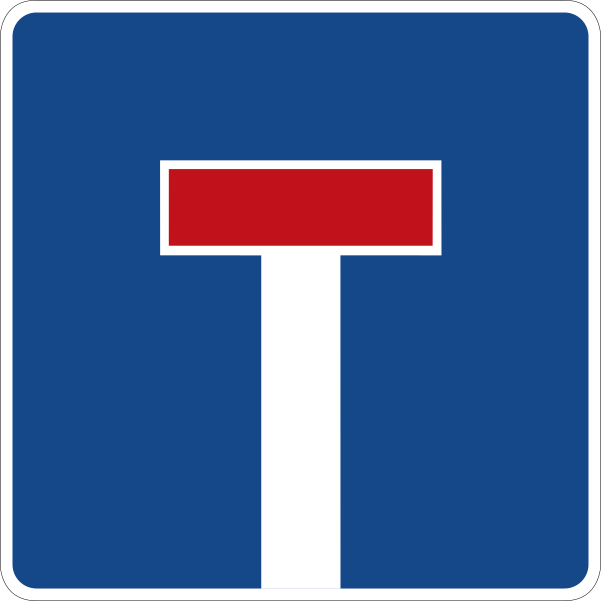 Dead end street.
English • Traffic sign 357 • No through road.
Deutsch • Verkehrszeichen 357 • Sackgasse.
Sources
🔗 Commons.wikimedia.org
🔗 Verwaltungsvorschriften-im-internet.de • VzKat, Anhang (Gesamtübersicht)
Image via Commons.wikimedia.org
vectorized by • Public domain • Source revision 2017-08-30. Wikimedia original unmodified.
Can pedestrians or cyclists continue beyond a motor-traffic dead end in Germany?
German dead-end signs can include pictograms showing passage for pedestrians, cyclists or both. Follow that indicated continuation and the controls on the path; it is not a motor-vehicle through route.
🔗 gesetze-im-internet.de • Germany StVO: §§1,3,8–9; Annex 3, sign 357 and through-route symbols
Does a dead-end indication change speed or priority rules in Germany?
The no-through information itself does not assign junction priority or a numerical speed limit. Continue to obey the actual speed, access, parking and priority controls. If you need to turn around, use a suitable lawful place, check for pedestrians and cyclists, and do not obstruct the space needed for other vehicles to turn.
🔗 gesetze-im-internet.de • Germany StVO: §§1,3,8–9; Annex 3, sign 357 and through-route symbols
23. Stop sign
A stop sign requires drivers to bring their vehicle to a complete stop and give way before entering or crossing the road ahead. The stop must be made at the stop line or another legally prescribed position.
After stopping, the driver may continue only when this can be done safely and without interfering with traffic that has priority. The sign does not create priority for the driver who has stopped.
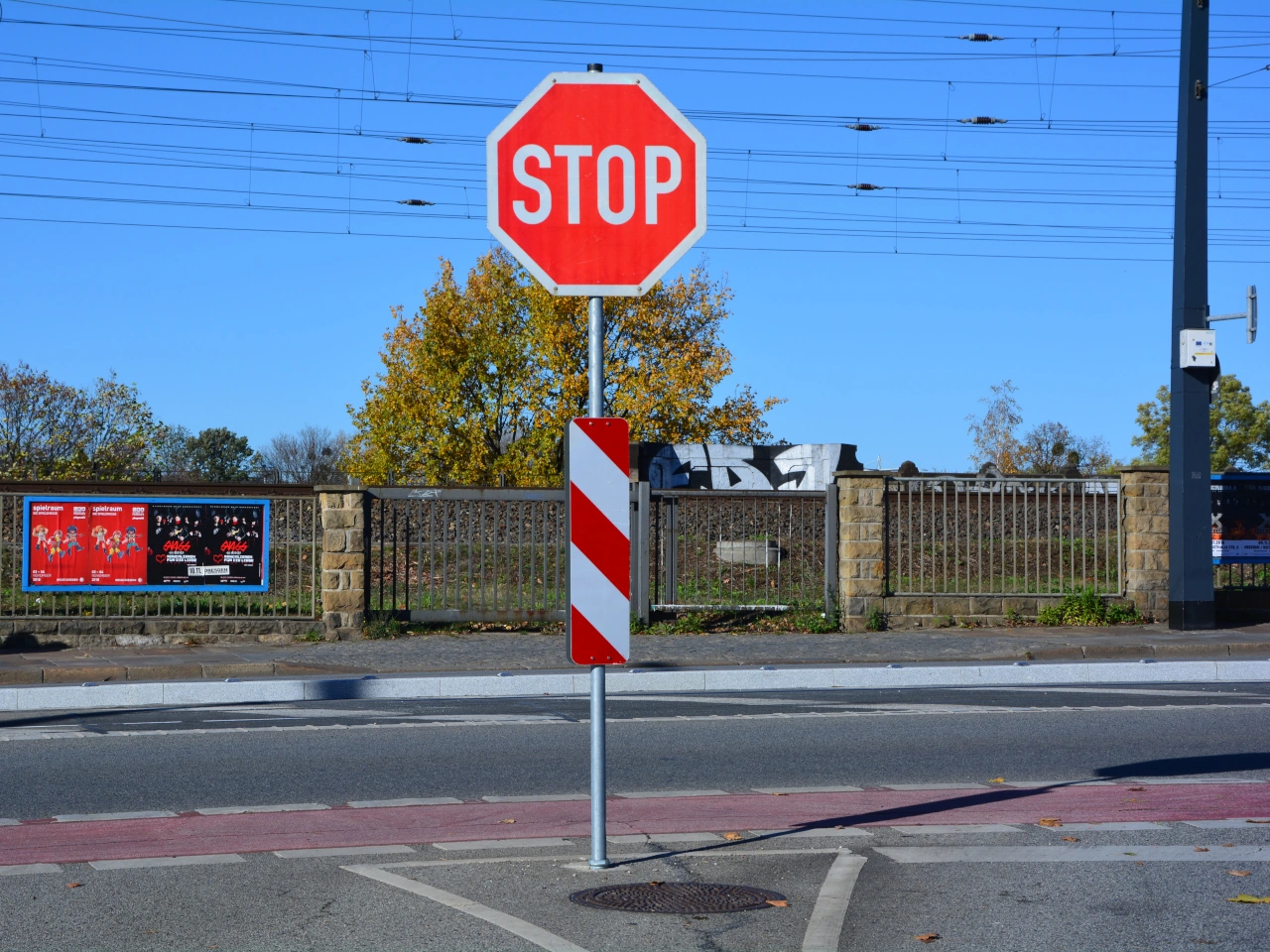
Wikimedia.org • Bybbisch94 • CC BY-SA
Must I stop completely at a stop sign in Germany?
Yes. Come to a complete stop when the applicable stop sign controls your approach, even when you cannot see another road user. Slowing to a crawl is not a stop. The stopping duty is separate from the duty to give way before continuing.
🔗 gesetze-im-internet.de • Germany StVO: §8; Annex 2, signs 206,294
 Stop and give way.
English • Traffic sign 206 • Stop. Give way.
Deutsch • Verkehrszeichen 206 • Halt. Vorfahrt gewähren.
Sources
🔗 Commons.wikimedia.org
🔗 Verwaltungsvorschriften-im-internet.de • VzKat, Anhang (Gesamtübersicht)
Image via Commons.wikimedia.org
nach den historischen Vorgaben digital gezeichnet und interpretiert von Mediatus. • Public domain • Source revision 2023-07-24. Wikimedia original unmodified.
Where must I stop at a stop-controlled junction in Germany?
Stop before the stop line. If there is no line, stop where you can see the other road. After stopping at a line with a restricted view, approach any further observation point cautiously and continue to give way.
🔗 gesetze-im-internet.de • Germany StVO: §8; Annex 2, signs 206,294
Does stopping first give me priority at a stop sign in Germany?
A complete stop does not, by itself, give you priority. Give way to the road users entitled to pass under the junction’s signs and rules, check pedestrians and cyclists, and proceed only when the gap is safe. Do not follow another stopped vehicle through without satisfying your own stopping and yielding duties.
🔗 gesetze-im-internet.de • Germany StVO: §8; Annex 2, signs 206,294
24. Give way
A give-way sign requires drivers to allow traffic with priority to proceed before entering, crossing or joining a road. Drivers must reduce speed, observe approaching traffic and stop when necessary.
Unlike a stop sign, a give-way sign does not always require a complete stop. The driver may continue without stopping only when the route is clearly safe and no road user with priority is forced to change speed or direction.
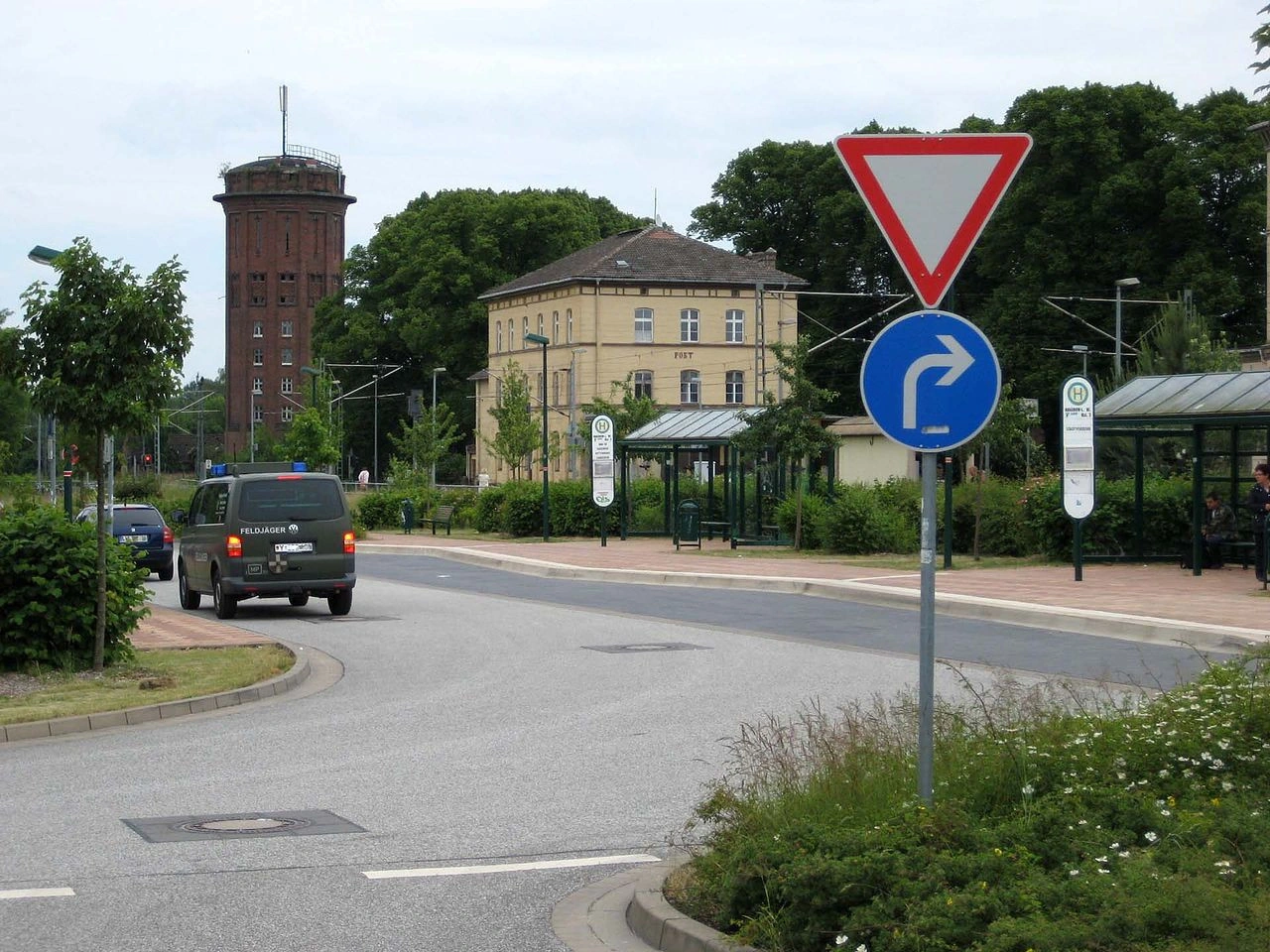
Wikimedia.org • Jo.Fruechtnicht • CC0
What does giving way mean in Germany?
The German sign is called Vorfahrt gewähren. It requires yielding at the junction or entry concerned; a supplementary diagram may identify a priority road that changes direction.
🔗 gesetze-im-internet.de • Germany StVO: §§8–9; Annex 2, sign 205 and priority-route panel
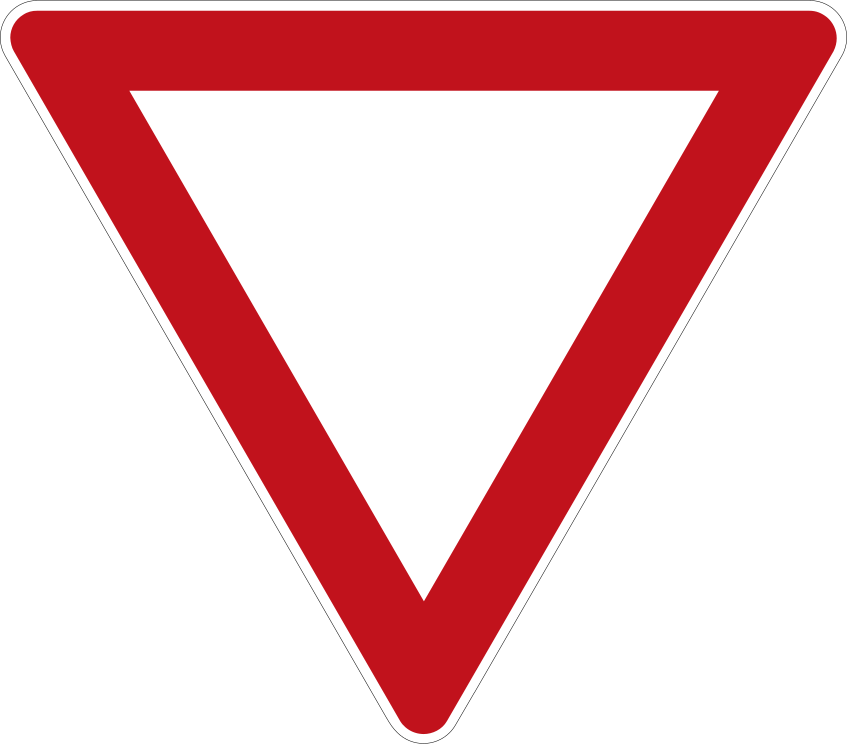 Give way.
English • Traffic sign 205 • Give way.
Deutsch • Verkehrszeichen 205 • Vorfahrt gewähren.
Sources
🔗 Commons.wikimedia.org
🔗 Verwaltungsvorschriften-im-internet.de • VzKat, Anhang (Gesamtübersicht)
Image via Commons.wikimedia.org
first sign: Andreas 06; new datas: Mediatus • Public domain • Source revision 2017-04-30. Wikimedia original unmodified.
Must you always stop when giving way in Germany?
No. A give-way control requires stopping when necessary to yield or obtain a safe view. A stop sign requires a complete stop even if the road appears empty.
🔗 gesetze-im-internet.de • Germany StVO: §§8–9; Annex 2, sign 205 and priority-route panel
What should you check before proceeding after giving way in Germany?
Wait until the manoeuvre is safe. Check the priority traffic, the view in both directions and enough space to complete the entry. Giving way to one vehicle does not remove duties towards another driver, a cyclist or a pedestrian.
🔗 gesetze-im-internet.de • Germany StVO: §§8–9; Annex 2, sign 205 and priority-route panel
25. Roundabout
A roundabout is a circular road arrangement in which traffic travels around a central island in one designated direction. Vehicles enter and leave through connecting roads, and traffic signs or local rules determine who has priority.
Drivers should reduce speed, choose a suitable lane, observe all road users and signal as required when leaving. The direction of travel, entry priority, lane use and rules for cyclists and pedestrians depend on local traffic signs and regulations.
Wikimedia.org • Bene16 • CC BY-SA
Who has priority at a roundabout in Germany?
At a German Kreisverkehr, circulating traffic has priority when the roundabout sign is displayed beneath the give-way sign. The roundabout sign alone does not establish that priority; ordinary priority rules apply without a different control.
🔗 gesetze-im-internet.de • Germany StVO: §§7(5),8(1a),9; Annex 2, signs 205,215
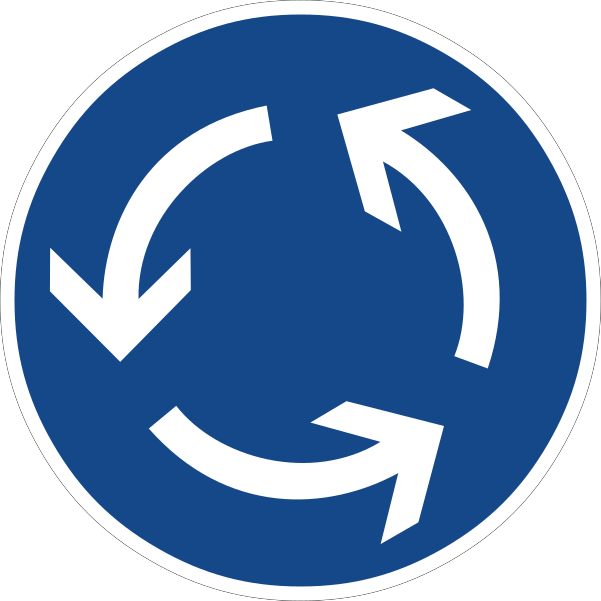 Mandatory roundabout direction.
English • Traffic sign 215 • Roundabout.
Deutsch • Verkehrszeichen 215 • Kreisverkehr.
Sources
🔗 Commons.wikimedia.org
🔗 Verwaltungsvorschriften-im-internet.de • VzKat, Anhang (Gesamtübersicht)
Image via Commons.wikimedia.org
Erstes Hochladen: Andreas06. Neue erstellt nach den amtlichen Vorgaben durch: Mediatus • Public domain • Source revision 2017-08-21. Wikimedia original unmodified.
How should you choose a roundabout lane in Germany?
Choose your intended exit before entering and follow the lane arrows and destination signs. Keep to the marked route and make any permitted lane change only when safe; having priority over entering traffic does not give you priority to change lanes.
🔗 gesetze-im-internet.de • Germany StVO: §§7(5),8(1a),9; Annex 2, signs 205,215
What should you check when leaving a roundabout in Germany?
At the roundabout-and-give-way sign combination, indicating on entry is prohibited. Signal when leaving and check cyclists and pedestrians crossing your exit. Do not treat an exit signal as permission to cut across another road user.
🔗 gesetze-im-internet.de • Germany StVO: §§7(5),8(1a),9; Annex 2, signs 205,215