


Built-up areaPoland
 Traffic rules
 Poland
5. Built-up area
A built-up area is an area containing concentrated buildings, streets and regular local activity. Drivers should expect more pedestrians, cyclists, intersections, parked vehicles, public transport and vehicles entering or leaving properties.
Many countries apply special traffic rules and lower default speed limits within built-up areas. The area may be identified by entrance and exit signs, street lighting or other legal criteria, so drivers must follow local signs and regulations.
Wikimedia.org • Damianwiszowaty12 • CC BY-SA
How do people refer to a built-up area in Poland?
The official Polish term is obszar zabudowany. Its beginning and end are marked by the built-up-area traffic signs.
🔗 eli.gov.pl • Poland, Road Traffic Law — articles 2(15)–(16), 19–21; Signs 27, 32, 58–60
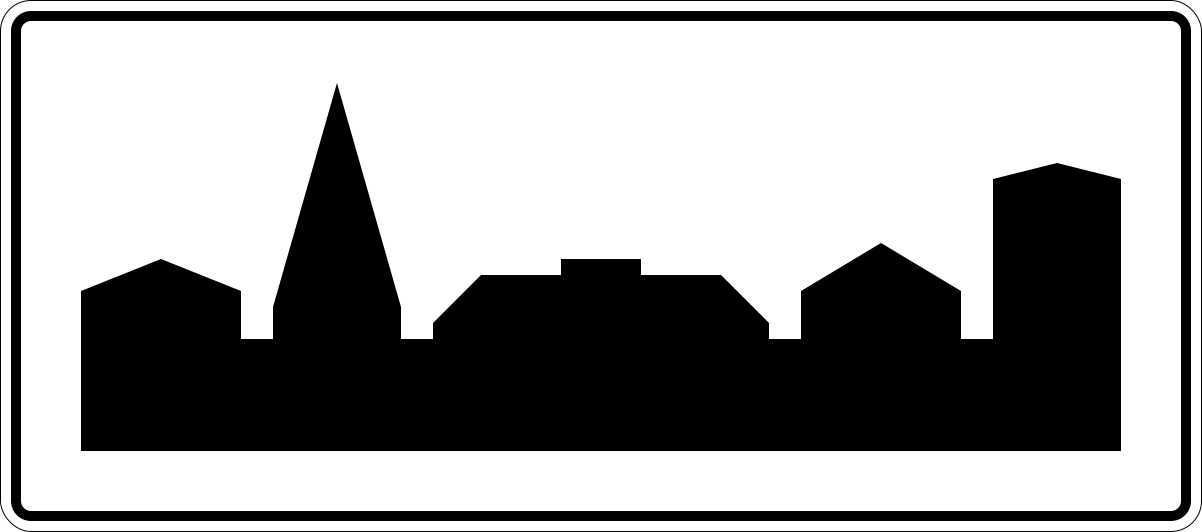 Start of a built-up area.
English • Traffic sign D-42 • Built-up area. Sign D-42 marks entry to a built-up area. Sign D-43, End of the built-up area, marks the exit.
Polski • D-42 • obszar zabudowany. Znak D-42 „obszar zabudowany” oznacza wjazd na obszar zabudowany. Znak D-43 „koniec obszaru zabudowanego” oznacza wyjazd z obszaru zabudowanego.
Sources
🔗 Commons.wikimedia.org
🔗 Eli.gov.pl • § 58 ust. 3
SVG source: Commons.wikimedia.org • Original SVG
Julo • Public domain • Original revision 2025-10-13. Wikimedia original unmodified.
Artwork reviewed against the Polish official sign catalogue, Dz.U. 2019 poz. 2310: Eli.gov.pl • D-42, PDF page 44, with amendments 2021/433, 2021/2065, 2022/2372 and 2026/133 checked. Catalogue-equivalent illustration; intentional update from the previous PNG. This is an educational illustration, not a manufacturing specification.
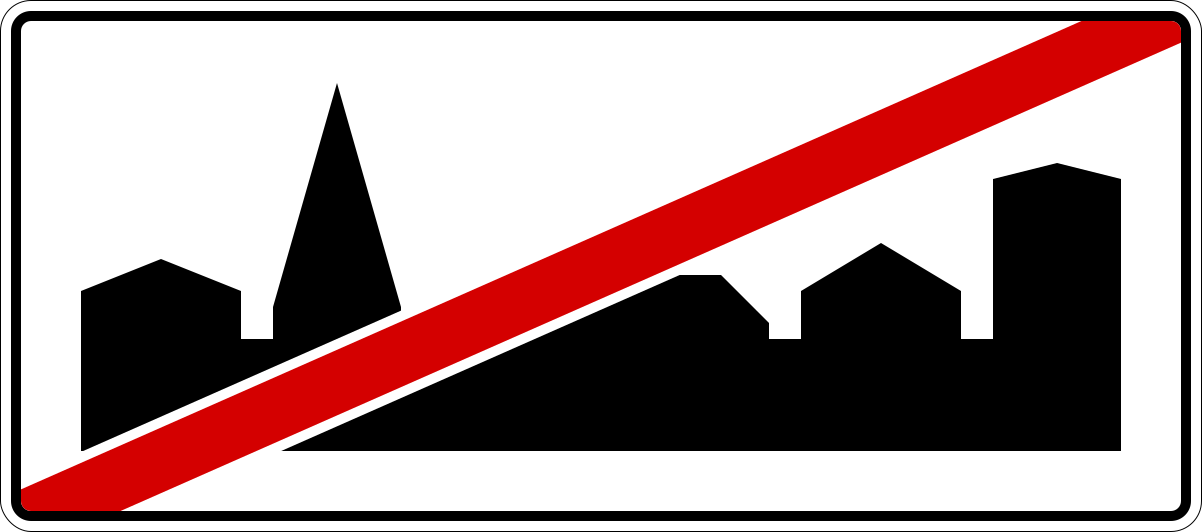 End of the built-up area.
English • Traffic sign D-43 • End of the built-up area. Sign D-42, Built-up area, marks entry to a built-up area. Sign D-43 marks the exit.
Polski • D-43 • koniec obszaru zabudowanego. Znak D-42 „obszar zabudowany” oznacza wjazd na obszar zabudowany. Znak D-43 „koniec obszaru zabudowanego” oznacza wyjazd z obszaru zabudowanego.
Sources
🔗 Commons.wikimedia.org
🔗 Eli.gov.pl • § 58 ust. 3
SVG source: Commons.wikimedia.org • Original SVG
Julo • Public domain • Original revision 2025-10-13. Wikimedia original unmodified.
Artwork reviewed against the Polish official sign catalogue, Dz.U. 2019 poz. 2310: Eli.gov.pl • D-43, PDF page 44, with amendments 2021/433, 2021/2065, 2022/2372 and 2026/133 checked. Catalogue-equivalent illustration; intentional update from the previous PNG. This is an educational illustration, not a manufacturing specification.
How can you recognise a built-up area in Poland?
Look for the white sign with a black silhouette of buildings and its crossed-out end sign. A green town-name sign identifies the locality but does not itself mark entry into the built-up-area speed category.
🔗 eli.gov.pl • Poland, Road Traffic Law — articles 2(15)–(16), 19–21; Signs 27, 32, 58–60
What speed limit applies to cars in a built-up area in Poland?
The ordinary maximum is 50 km/h throughout the day and night, unless another limit applies. Older advice describing a higher urban limit at night is no longer current.
🔗 eli.gov.pl • Poland, Road Traffic Law — articles 2(15)–(16), 19–21; Signs 27, 32, 58–60
Is a Polish built-up area the same as a residential area?
No. A specially signposted strefa zamieszkania has a 20 km/h maximum and additional pedestrian and parking rules. Those rules do not apply throughout every ordinary built-up area.
🔗 eli.gov.pl • Poland, Road Traffic Law — articles 2(15)–(16), 19–21; Signs 27, 32, 58–60


