


One-way trafficPoland
 Traffic rules
 Poland
17. One-way traffic
One-way traffic means that vehicles on a road or carriageway may travel only in one designated direction. The permitted direction is normally indicated by traffic signs, lane arrows or road markings.
Some road users, such as cyclists or public-transport vehicles, may be allowed to travel in the opposite direction when signs expressly permit it. A one-way road does not by itself determine the speed limit, priority or parking rules.

Wikimedia.org • MOs810 • CC BY-SA
How should I read a one-way restriction in Poland?
Follow the direction designated by the street’s one-way signs and any entrance restrictions or lane arrows. A compulsory turn at one junction is different from a restriction applying along the street.
🔗 eli.gov.pl • Poland, Road Traffic Law — articles 16, 22–23; Signs 17, 44
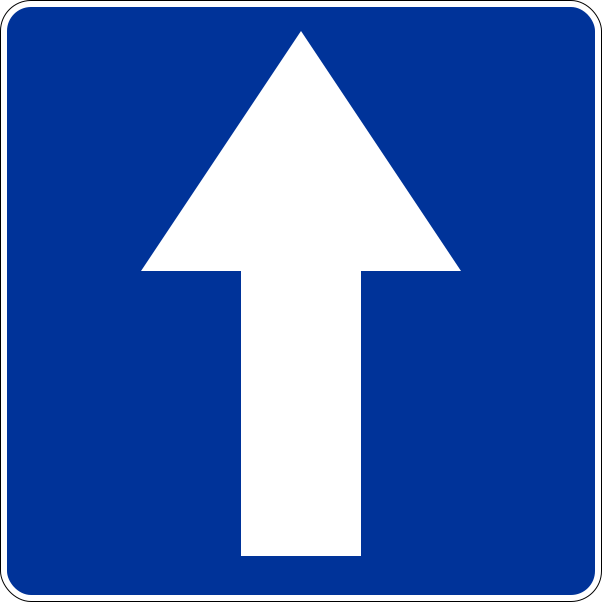 Road with one-way traffic.
English • Traffic sign D-3 • One-way road. Sign D-3 marks the beginning or continuation of a road or carriageway where traffic travels in one direction.
Polski • D-3 • droga jednokierunkowa. Znak D-3 „droga jednokierunkowa” oznacza początek lub kontynuację drogi lub jezdni, na której ruch odbywa się w jednym kierunku.
Sources
🔗 Commons.wikimedia.org
🔗 Eli.gov.pl • § 44 ust. 1
SVG source: Commons.wikimedia.org • Original SVG
Szczepan dyskusja Mail 18:29, 31 December 2006 (UTC) • Public domain • Original revision 2025-10-10. Wikimedia original unmodified.
Artwork reviewed against the Polish official sign catalogue, Dz.U. 2019 poz. 2310: Eli.gov.pl • D-3, PDF page 44, with amendments 2021/433, 2021/2065, 2022/2372 and 2026/133 checked. Catalogue-equivalent illustration; intentional update from the previous PNG. This is an educational illustration, not a manufacturing specification.
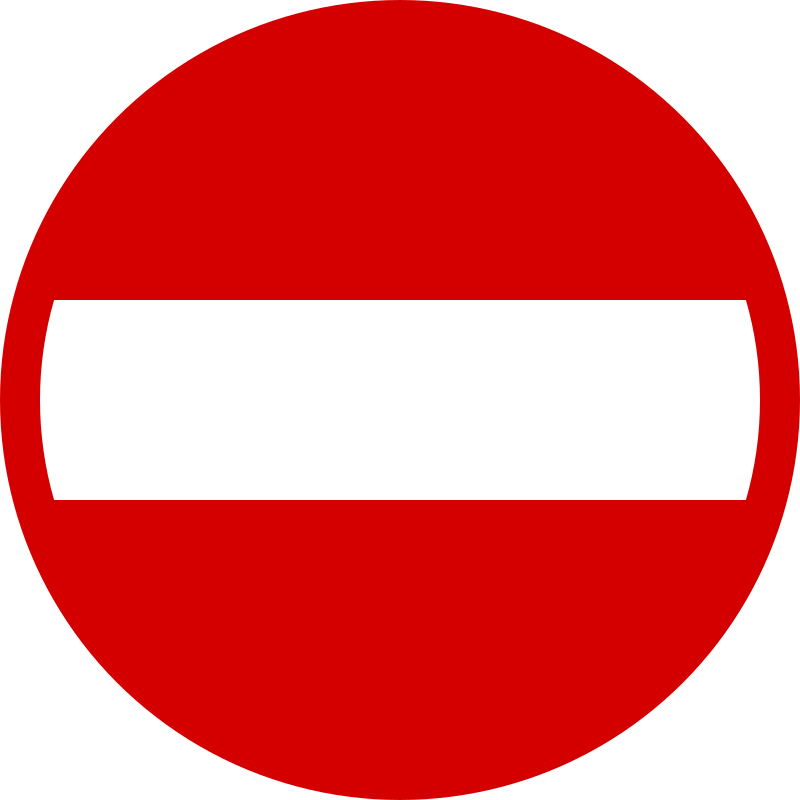 No entry.
English • Traffic sign B-2 • No entry. Sign B-2 prohibits vehicles from entering the road or carriageway from the side where it is installed. The prohibition also applies to organised groups of pedestrians and to people riding or driving animals.
Polski • B-2 • zakaz wjazdu. Znak B-2 „zakaz wjazdu” oznacza zakaz wjazdu pojazdów na drogę lub jezdnię od strony jego umieszczenia; zakaz dotyczy również kolumn pieszych oraz jeźdźców i poganiaczy.
Sources
🔗 Commons.wikimedia.org
🔗 Eli.gov.pl • § 17 ust. 1
SVG source: Commons.wikimedia.org • Original SVG
Author not stated on source page • Public domain • Original revision 2025-09-24. Wikimedia original unmodified.
Artwork reviewed against the Polish official sign catalogue, Dz.U. 2019 poz. 2310: Eli.gov.pl • B-2, PDF page 42, with amendments 2021/433, 2021/2065, 2022/2372 and 2026/133 checked. Catalogue-equivalent illustration; intentional update from the previous PNG. This is an educational illustration, not a manufacturing specification.
May cyclists travel against the general traffic direction in Poland?
Do not assume cyclists are exempt from a road’s direction restriction. Check whether the applicable signs, local traffic arrangement or separately designated cycle facility actually authorise movement in the opposite direction; an ordinary bicycle-route sign is not enough.
🔗 eli.gov.pl • Poland, Road Traffic Law — articles 16, 22–23; Signs 17, 44
Does one-way traffic give me priority or a different speed limit in Poland?
A one-way restriction concerns direction. Continue to follow the applicable speed limit, signals, give-way or stop controls and junction-priority rules. Where authorised counterflow traffic exists, check for it before turning or crossing; your permitted direction is not automatic junction priority.
🔗 eli.gov.pl • Poland, Road Traffic Law — articles 16, 22–23; Signs 17, 44


