


Speed bumpPoland
 Traffic rules
 Poland
14. Speed bump
A speed bump is a raised traffic-calming device placed across all or part of a road to make drivers reduce their speed. It is commonly used near homes, schools, crossings, parking areas and other places where low vehicle speeds are important.
Speed bumps vary in shape, height and legal status. Drivers should approach them at a low, controlled speed and follow any warning signs or speed limits that apply.

Wikimedia.org • MOs810 • CC BY-SA
How should I recognise and approach a speed bump in Poland?
Look for a raised surface, approach warnings, road markings and any separate speed instruction. A traffic-calming device can be part of a raised crossing or junction, so identify the layout and the road users who may use it.
🔗 eli.gov.pl • Poland, Road Traffic Law — articles 13–14, 19, 26; Signs 8, 47, 88
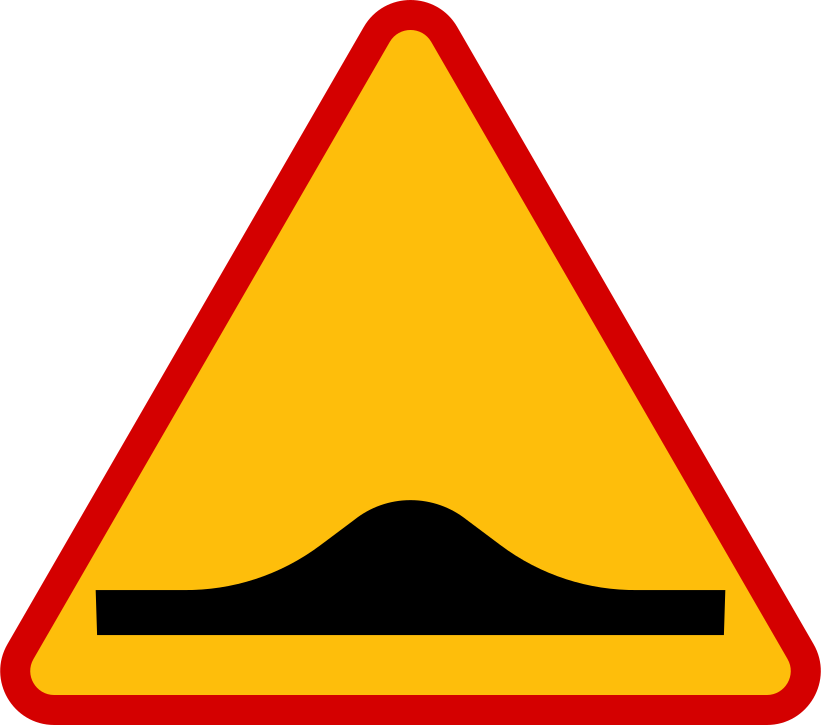 Warning for a speed bump.
English • Traffic sign A-11a • Speed hump. Sign A-11a warns of a raised part of the carriageway intended to slow vehicles.
Polski • A-11a • próg zwalniający. Znak A-11a „próg zwalniający” ostrzega o wypukłości na jezdni zastosowanej w celu spowolnienia ruchu pojazdów.
Sources
🔗 Commons.wikimedia.org
🔗 Eli.gov.pl • § 7 ust. 2
SVG source: Commons.wikimedia.org • Original SVG
Author not stated on source page • Public domain • Original revision 2025-10-07. Wikimedia original unmodified.
Artwork reviewed against the Polish official sign catalogue, Dz.U. 2019 poz. 2310: Eli.gov.pl • A-11a, PDF page 41, with amendments 2021/433, 2021/2065, 2022/2372 and 2026/133 checked. Catalogue-equivalent illustration; intentional update from the previous PNG. This is an educational illustration, not a manufacturing specification.
Which speed should I use at a raised device in Poland?
Obey the applicable speed restriction and slow further for the device, visibility and other road users. Do not assume that a raised device carries the same numerical rule as one in another country; a safe approach can be well below the road’s maximum.
🔗 eli.gov.pl • Poland, Road Traffic Law — articles 13–14, 19, 26; Signs 8, 47, 88
Does a raised road surface give pedestrians priority in Poland?
A raised device alone does not identify pedestrian priority. If it incorporates a crossing, apply the crossing’s controls and the national rules. At a przejście dla pieszych, use special caution, reduce speed and give way to pedestrians on or entering it. The rule for pedestrians entering a crossing has a tram exception.
🔗 eli.gov.pl • Poland, Road Traffic Law — articles 13–14, 19, 26; Signs 8, 47, 88


