


ExpresswayPoland
 Traffic rules
 Poland
3. Expressway
An expressway is a road intended to carry through traffic efficiently, usually at higher speeds than ordinary roads. Expressways often have limited access, multiple lanes, separated carriageways or grade-separated junctions, but their design and legal status vary between countries.
An expressway is not always a motorway. It may have intersections, traffic lights or direct access, and the permitted road users, speed limits and special rules depend on local signs and regulations.

Wikimedia.org • Crusier • CC BY-SA
How do people refer to an expressway in Poland?
The Polish term is droga ekspresowa. An expressway can have one or two carriageways, which affects its general car speed limit.
🔗 eli.gov.pl • Poland, Road Traffic Law — articles 2(3)–(4), 16, 19–20, 31, 49
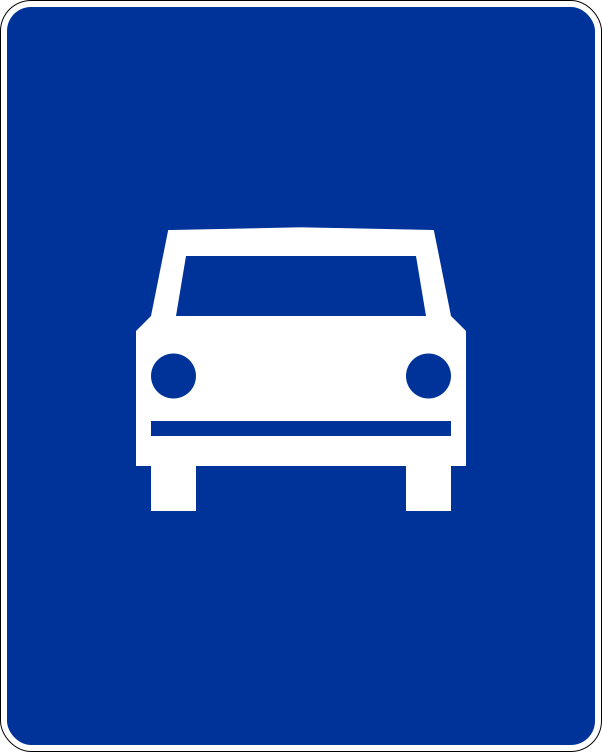 Start of an expressway.
English • Traffic sign D-7 • Expressway. Sign D-7 marks the beginning or continuation of an expressway. Its end is marked by D-8, End of expressway.
Polski • D-7 • droga ekspresowa. Znak D-7 „droga ekspresowa” oznacza początek lub kontynuację drogi ekspresowej; koniec drogi ekspresowej oznaczony jest znakiem D-8 „koniec drogi ekspresowej”.
Sources
🔗 Commons.wikimedia.org
🔗 Eli.gov.pl • § 48 ust. 1
SVG source: Commons.wikimedia.org • Original SVG
Author not stated on source page • Public domain • Original revision 2025-10-11. Wikimedia original unmodified.
Artwork reviewed against the Polish official sign catalogue, Dz.U. 2019 poz. 2310: Eli.gov.pl • D-7, PDF page 44, with amendments 2021/433, 2021/2065, 2022/2372 and 2026/133 checked. Catalogue-equivalent illustration; intentional update from the previous PNG. This is an educational illustration, not a manufacturing specification.
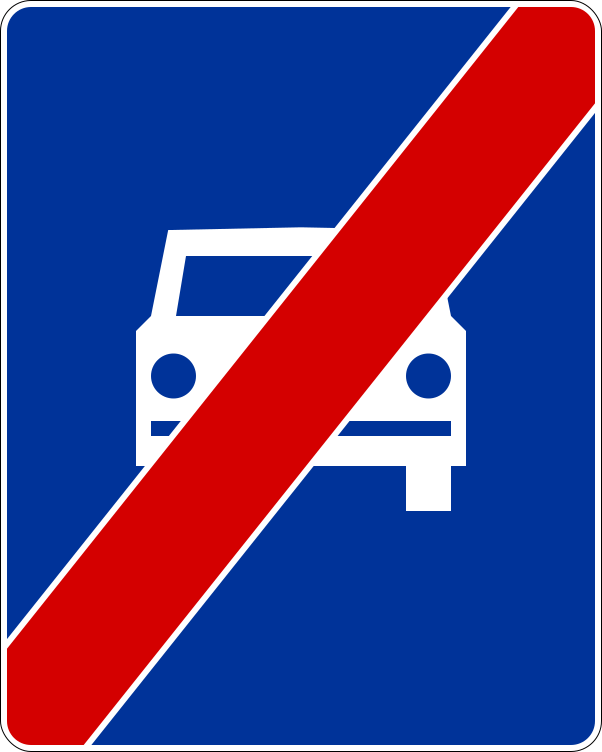 End of the expressway.
English • Traffic sign D-8 • End of expressway. Sign D-7, Expressway, marks the beginning or continuation of an expressway. Its end is marked by D-8.
Polski • D-8 • koniec drogi ekspresowej. Znak D-7 „droga ekspresowa” oznacza początek lub kontynuację drogi ekspresowej; koniec drogi ekspresowej oznaczony jest znakiem D-8 „koniec drogi ekspresowej”.
Sources
🔗 Commons.wikimedia.org
🔗 Eli.gov.pl • § 48 ust. 1
SVG source: Commons.wikimedia.org • Original SVG
Szczepan dyskusja Mail 18:29, 31 December 2006 (UTC) • Public domain • Original revision 2025-10-11. Wikimedia original unmodified.
Artwork reviewed against the Polish official sign catalogue, Dz.U. 2019 poz. 2310: Eli.gov.pl • D-8, PDF page 44, with amendments 2021/433, 2021/2065, 2022/2372 and 2026/133 checked. Catalogue-equivalent illustration; intentional update from the previous PNG. This is an educational illustration, not a manufacturing specification.
What speed limit applies to cars on an expressway in Poland?
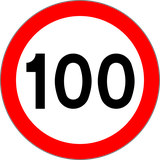
For an ordinary car, the maximum is 120 km/h on a dual-carriageway expressway and 100 km/h on a single-carriageway expressway. Lower signs and vehicle-specific restrictions apply.
🔗 eli.gov.pl • Poland, Road Traffic Law — articles 2(3)–(4), 16, 19–20, 31, 49
Who may use an expressway in Poland?
Expressways are reserved for motor vehicles, excluding quadricycles. Pedestrians and bicycles cannot use them. The motorway’s specific design-speed admission wording should not be assumed to be the expressway definition.
🔗 eli.gov.pl • Poland, Road Traffic Law — articles 2(3)–(4), 16, 19–20, 31, 49
Can I reverse on a Polish expressway after missing an exit?
No. Reversing on an expressway is prohibited. Continue to the next permitted exit and choose another route; do not use the shoulder to return to the missed exit.
🔗 eli.gov.pl • Poland, Road Traffic Law — articles 2(3)–(4), 16, 19–20, 31, 49


