Semi-trailer truckPoland

An introduction to the traffic rules and road signs of Poland. Learn about driving, road safety and much more in our illustrated book, with answers to frequently asked questions.

For informational purposes only. Always follow official regulations. Some content and images were created with AI assistance.


97. Semi-trailer truck

A semi-trailer truck is a combination consisting of a road tractor and a semi-trailer used primarily for transporting goods. The semi-trailer is coupled to the tractor so that a significant part of its weight is supported by the tractor rather than entirely by its own wheels.

Semi-trailer trucks are commonly used for long-distance freight transport and may carry containers, refrigerated goods, liquids, bulk materials or other cargo. Special rules can apply concerning driving licences, maximum dimensions and masses, speed limits, lane use, overtaking, loading and driving and rest periods.
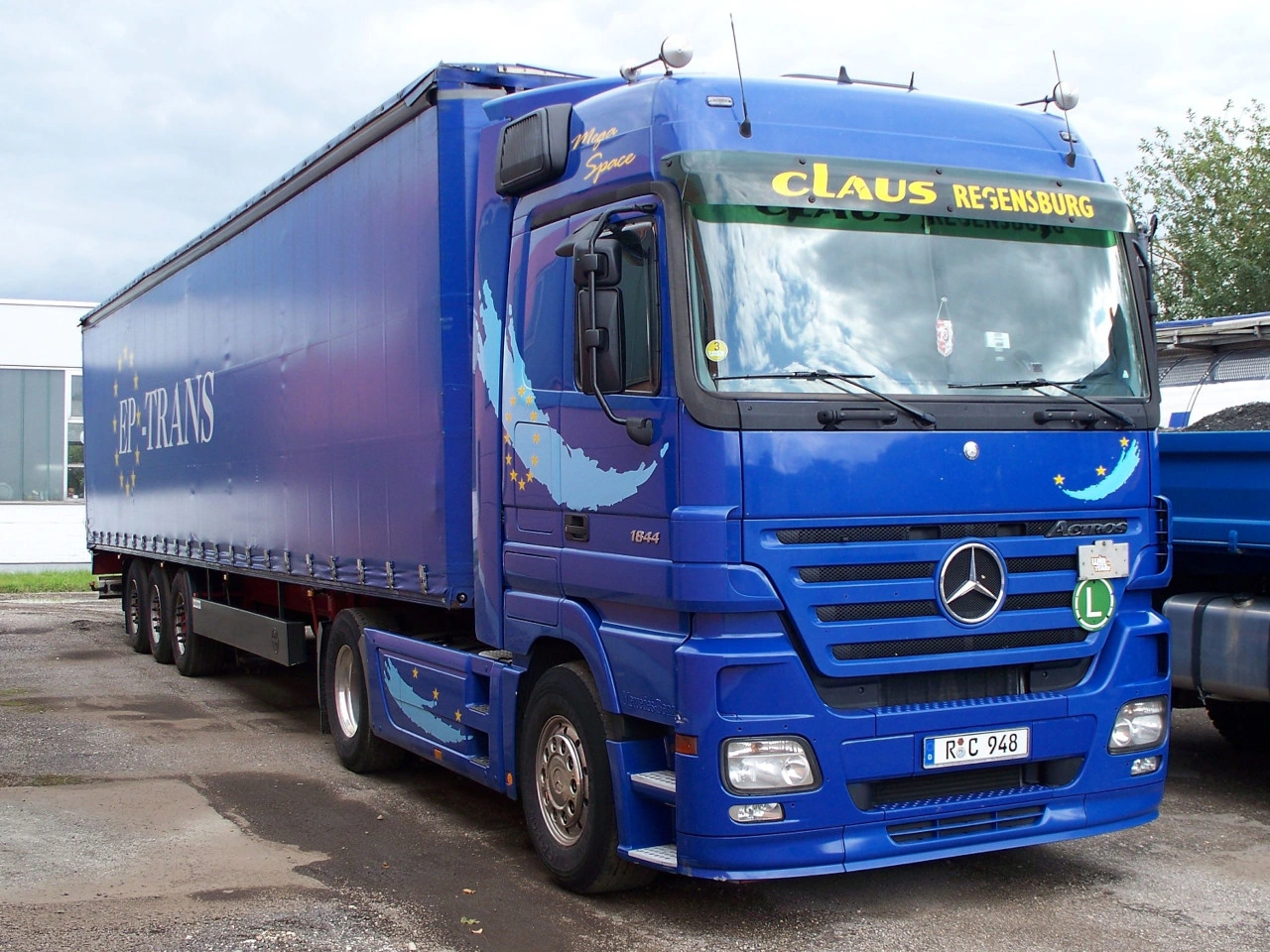
Semi-trailer truck
A Mercedes semi-trailer truck. (Regensburg, Germany)
Wikimedia.org • High Contrast • CC BY
What is a semi-trailer truck?

A semi-trailer truck consists of a powered road tractor coupled to a semi-trailer primarily used to transport goods.

🔗 wegcode.be • Belgium, Technical Requirements Decree of 15 March 1968, Article 1, vehicle/machinery classifications; national example

🔗 wegcode.be • Belgium, Driving Licence Decree of 23 March 1998, Article 2, vehicle categories including G; national example

🔗 wetten.overheid.nl • Vienna Convention on Road Traffic, Articles 1, 13 and 30; international framework subject to national law

🔗 gov.uk • Great Britain Highway Code, Rules 124–126, vehicle-specific speeds; national guidance example

What is the difference between a semi-trailer and an ordinary trailer?

A semi-trailer is designed so that a substantial part of its own weight and load is supported by the towing vehicle. Other trailer designs support the load differently; some also impose a vertical load on the towing vehicle. Check the actual trailer and coupling ratings.

🔗 wegcode.be • Belgium, Technical Requirements Decree of 15 March 1968, Article 1, vehicle/machinery classifications; national example

🔗 wegcode.be • Belgium, Driving Licence Decree of 23 March 1998, Article 2, vehicle categories including G; national example

🔗 wetten.overheid.nl • Vienna Convention on Road Traffic, Articles 1, 13 and 30; international framework subject to national law

🔗 gov.uk • Great Britain Highway Code, Rules 124–126, vehicle-specific speeds; national guidance example

Do semi-trailer trucks have lower speed limits?

They often do. Many countries impose vehicle-specific maximum speeds on heavy goods vehicles, particularly on motorways and other high-speed roads.

🔗 wegcode.be • Belgium, Technical Requirements Decree of 15 March 1968, Article 1, vehicle/machinery classifications; national example

🔗 wegcode.be • Belgium, Driving Licence Decree of 23 March 1998, Article 2, vehicle categories including G; national example

🔗 wetten.overheid.nl • Vienna Convention on Road Traffic, Articles 1, 13 and 30; international framework subject to national law

🔗 gov.uk • Great Britain Highway Code, Rules 124–126, vehicle-specific speeds; national guidance example

1 Poland 2 Motorway 3 Expressway 4 Residential area 5 Built-up area 6 Zone 7 Speed limit 8 Footpath 9 Bike path 10 Shared-use path 11 Separated path 12 Pedestrian warning 13 Tunnel 14 Speed bump 15 Toll road 16 Customs 17 One-way traffic 18 Quay 19 Slope 20 Bus lane 21 Bus stop 22 Dead end 23 Stop sign 24 Give way 25 Roundabout 26 Priority road 27 Road narrowing 28 Priority over oncoming traffic 29 Give way to oncoming traffic 30 Pedestrian crossing 31 Railway crossing 32 Mandatory direction 33 Turn prohibition 34 School area 35 Overtaking 36 Crossing animals 37 Curve 38 Chevron 39 Wrong-way driving 40 Roadworks 41 Height limit 42 Weight limit 43 Radar speed sign 44 Priority at the next junction 45 Traffic lights 46 Traffic lights warning 47 Pedestrian lights 48 Road markings 49 Junction layout 50 Driving licence 51 Traffic mirror 52 International border 53 Pedestrian underpass 54 Cycling route 55 Parking 56 No parking 57 No stopping 58 Park and ride 59 Kiss and ride 60 Disabled parking 61 Traffic management 62 Merging 63 Reversing 64 U-turn 65 Road surface 66 Provisional licence 67 Hazardous cargo 68 Radio service 69 Tourist attraction 70 Horn 71 Licence plate 72 Charging station 73 Dangers 74 Rail safety 75 Pedestrian 76 Cyclist 77 Car 78 Truck 79 Bus 80 Police 81 Ambulance 82 Taxi 83 European emission standard 84 Public road 85 Pothole 86 Private property 87 Path 88 Particulates 89 Air pollution 90 Rush hour 91 Road code 92 Two-way traffic 93 Street gutter 94 Cargo bike 95 Forestry vehicle 96 Construction vehicle 97 Semi-trailer truck 98 Trolleybus 99 Speed pedelec 100 Delivery vehicle ...