RichtungstafelSchweiz

Lerne Verkehrsregeln mit klaren Erklärungen und visuellen Beispielen in unserem illustrierten Buch – einfach, verständlich und anschaulich.


37. Richtungstafel

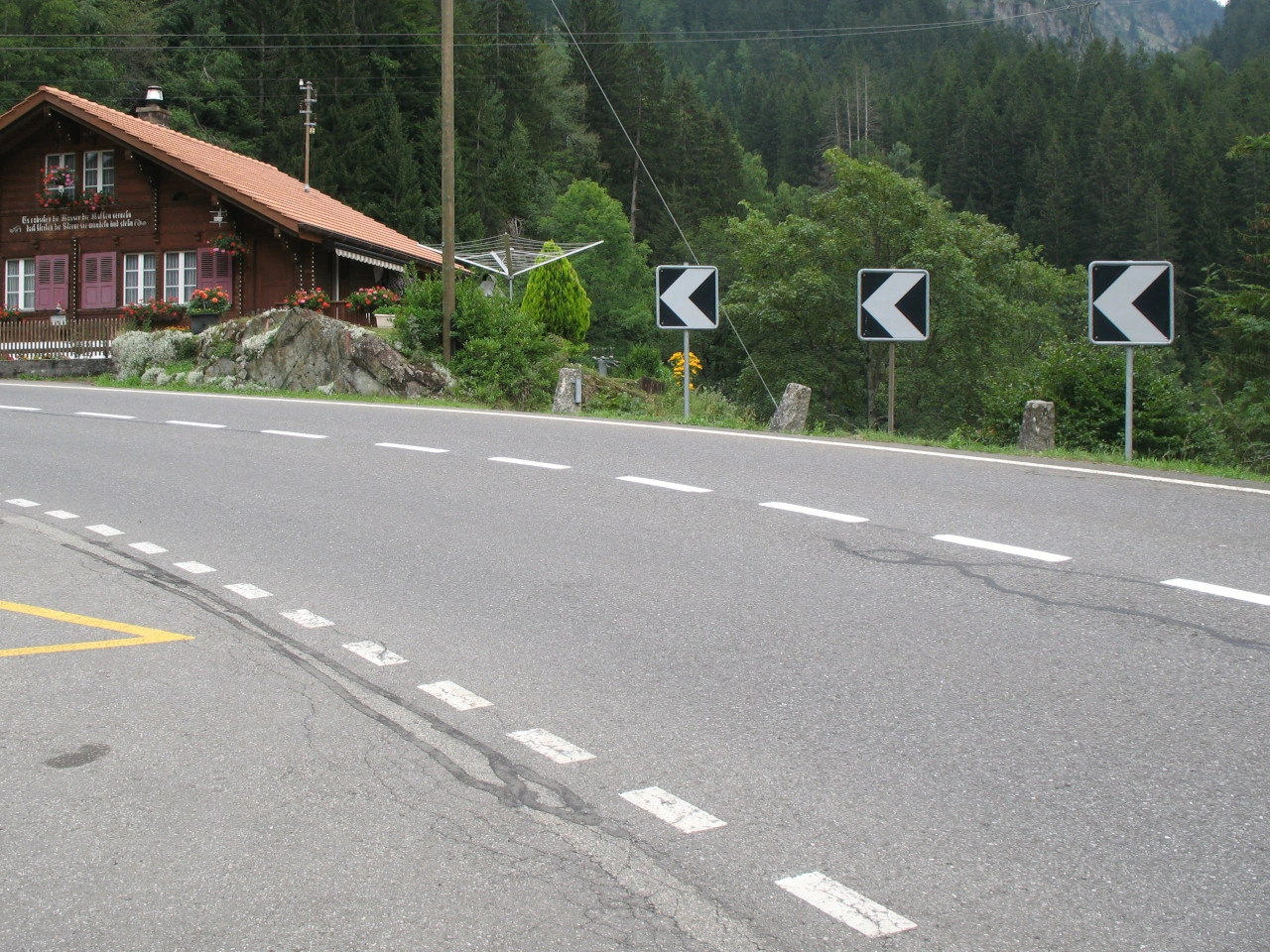
Eine Richtungstafel ist eine V- oder pfeilförmige Straßenmarkierung bzw. Tafel, die eine starke Richtungsänderung der Straße hervorhebt. Solche Tafeln stehen normalerweise entlang der Außenseite einer Kurve, wobei ihre Spitzen in die Richtung zeigen, in der die Straße weiterführt.

Richtungstafeln verbessern Sichtbarkeit und Verlauf einer Kurve, insbesondere bei Dunkelheit oder schlechtem Wetter. Sie legen normalerweise weder eine Geschwindigkeitsbegrenzung noch Vorfahrt fest; Fahrer müssen daher vor der Kurve die Geschwindigkeit verringern und alle übrigen Verkehrszeichen und Fahrbahnmarkierungen beachten.
Richtungstafel
What is a road chevron?

A road chevron is a V-shaped or arrow-shaped marker used to guide drivers through a curve or another sharp change in road direction.

How can you recognise a chevron?

It is normally displayed on a rectangular board using strongly contrasting colours. Several chevrons may be placed in sequence around a curve.

Which direction does a chevron indicate?

The point of the chevron indicates the direction in which the road continues. A chevron pointing left guides traffic through a left curve, while one pointing right guides traffic through a right curve.

Where are chevrons normally placed?

They are generally placed along the outside of a curve, facing approaching traffic so that drivers can clearly see the road alignment.

What is the purpose of a series of chevrons?

A series of chevrons visually traces the curve and helps drivers judge its direction, length and changing alignment.

Is a chevron the same as a curve-warning sign?

No. A curve-warning sign normally warns drivers before the curve. Chevron boards are usually positioned within or around the curve to guide drivers through it.

Does a chevron impose a speed limit?

No. It guides drivers through the change in direction but does not normally introduce a numerical speed limit.

Does a chevron show a recommended speed?

Not by itself. A separate advisory-speed or speed-limit sign may indicate an appropriate or legally required speed.

Does a chevron determine priority?

No. Traffic lights, priority signs and the ordinary priority rules remain applicable.

Does a chevron mean the curve is dangerous?

It normally indicates that the curve requires additional visual guidance. Drivers should expect a noticeable or potentially sharp change in direction.

Does the number of chevrons show how sharp the curve is?

Not directly. The number and spacing depend on the length, radius and design of the curve and on the road authority’s signing standards.

Does a larger chevron mean a sharper curve?

Not necessarily. Larger boards may be used where approach speeds are higher or where greater visibility is needed.

How should you approach chevrons?

Reduce speed before the curve, observe the direction of the boards and remain within your traffic lane.

Should you brake heavily after reaching the chevrons?

No. Complete most braking before entering the curve and use smooth steering, braking and acceleration while following it.

May you drive towards the chevron boards?

No. The boards normally mark the outside edge of the curve. Follow the road around them rather than steering towards them.

May you cut across the centre line to straighten the curve?

No. Remain within your lane and do not enter the path of oncoming traffic.

May you overtake beside chevrons?

The chevrons do not automatically prohibit overtaking, but overtaking is unsafe when the curve restricts visibility or available road width.

Why are chevrons reflective?

Reflective material makes the boards easier to see in darkness and poor weather when illuminated by vehicle headlights.

Can chevrons be illuminated?

Yes. Some high-risk curves use illuminated or flashing chevrons to make the change in direction more conspicuous.

Can chevrons have different colours?

Yes. Their colours and design vary between countries, but contrasting colours are used to make the direction clearly visible.

What should motorcyclists consider?

Reduce speed before the curve, choose a stable path and look through the turn. Do not focus exclusively on the chevrons or allow the motorcycle to cross the centre line while leaning.

Does the absence of chevrons mean a curve is safe at the speed limit?

No. Drivers must assess every curve and select a safe speed whether or not chevron boards are installed.

1 Schweiz 2 Autobahn 3 Schnellstraße 4 Wohngebiet 5 Zone 6 Geschwindigkeitsbegrenzung 7 Mindestgeschwindigkeit 8 Gehweg 9 Radweg 10 Gemeinsamer Geh- und Radweg 11 Tunnel 12 Fußgängerzone 13 Zoll 14 Einbahnverkehr 15 Steigung oder Gefälle 16 Busspur 17 Bushaltestelle 18 Sackgasse 19 Stoppschild 20 Vorfahrt gewähren 21 Kreisverkehr 22 Vorfahrtstraße 23 Fahrbahnverengung 24 Vorrang vor dem Gegenverkehr 25 Gegenverkehr Vorrang gewähren 26 Fußgängerüberweg 27 Bahnübergang 28 Vorgeschriebene Fahrtrichtung 29 Abbiegeverbot 30 Schulbereich 31 Überholen 32 Wild- oder Viehwechsel 33 Rutschige Fahrbahn 34 Steinschlag 35 Flugzeuge 36 Kurve 37 Richtungstafel 38 Falschfahrt 39 Straßenarbeiten 40 Seitenwind 41 Höhenbegrenzung 42 Breitenbegrenzung 43 Längenbegrenzung 44 Gewichtsbeschränkung 45 Wegweiser an einer Kreuzung 46 Vorfahrt an der nächsten Kreuzung 47 Ampeln 48 Warnung vor Ampeln 49 Fußgängerampeln 50 Fahrbahnmarkierungen 51 Kreuzungsverlauf 52 Führerschein 53 Kilometrierungsmarkierung 54 Straßennummer 55 Entfernungstafeln 56 Verkehrsspiegel 57 Notruftelefon 58 Staatsgrenze 59 Fußgängerunterführung 60 Radroute 61 Aufhebung einer Beschränkung 62 Parken 63 Parkverbot 64 Halteverbot 65 Parkscheibe 66 Rückwärtsfahren 67 Wenden 68 Stau 69 Umleitung 70 Ungeregelte Kreuzung 71 Fahrbahnschäden 72 Ausfahrt 73 Informationsstelle 74 Reiten 75 Notausgang 76 Notfall-Auslaufspur 77 Verkehrsfunk 78 Überbreite oder übergroße Ladung 79 Ortsgrenze 80 Krankenhaus 81 Parkhaus 82 Ausweichstelle 83 Fußgängerbrücke 84 Achslastbegrenzung 85 Kennzeichen 86 Ladestation 87 Allgemeine Gefahr 88 Wetter 89 Abbiegen bei Rot 90 Fußgänger 91 Radfahrer 92 Moped 93 Motorrad 94 Pkw 95 Lkw 96 Bus 97 Polizei 98 Krankenwagen 99 Zu dichtes Auffahren 100 Europäische Abgasnorm ...