

Book
 Traffic rules
 Priority signs
 Warning signs
 Prohibitory signs
 Mandatory signs
 Information signs
 Additional signs
Warning signs
A warning sign is a traffic sign that alerts drivers to a potential danger or change in road conditions ahead, giving them enough time to slow down and react safely. These signs warn about hazards such as sharp bends, pedestrian crossings, slippery surfaces, merging traffic, animals on the road, or upcoming intersections. Their purpose is not to forbid or command anything, but simply to prepare drivers for situations that require extra attention.








31. Warning for roadworks
This traffic sign indicates a warning for roadworks. It alerts drivers to construction or maintenance work taking place on or near the roadway. Drivers should reduce speed and be prepared for lane changes, narrowings, or temporary signals. Watch for construction workers, equipment, or uneven surfaces.
© via Wikimedia.org

32. Warning for a slippery road surface
This traffic sign indicates a warning for a slippery road surface. It alerts drivers that the road ahead may be slippery, increasing the risk of skidding—especially in wet, icy, or greasy conditions. Drivers should reduce speed and avoid sudden braking or steering. Be cautious on wet, icy, or newly treated surfaces. Common Locations: bridges, tunnels, or sharp bends.
© via Wikimedia.org
33. Warning for a soft verge
This traffic sign indicates a warning for a soft verge. The verge might be worn out, soft, slippery or uneven.
© via Wikimedia.org
34. Warning for a steep ascent
This traffic sign indicates a warning for a steep ascent. It alerts drivers to a steep uphill gradient ahead, which may require lower gears and more engine power to climb safely. Drivers should shift to a lower gear before the climb and be cautious with heavier vehicles or trailers. Maintain steady throttle control to avoid stalling. Common Locations: mountain roads, hilly terrain.
© via Wikimedia.org
35. Warning for a steep descent
This traffic sign indicates a warning for a steep descent. It alerts drivers to a steep downhill slope ahead, which may require extra braking and lower gears to maintain control. Drivers should reduce speed and shift to a lower gear before the descent to use engine braking. Be especially cautious with heavy or towed vehicles, which may require more braking distance. Common Locations: mountain roads, hilly areas, bridges or elevated routes.
© via Wikimedia.org
36. Warning for a traffic light
This traffic sign indicates a warning for a traffic light. It alerts drivers to the presence of a traffic signal ahead, especially in areas where the light might be unexpected or hard to see. Drivers should be prepared to stop at a signal-controlled intersection. Common Locations: hidden or unexpected intersections, after bends or hills, temporary traffic signals in roadwork zones.
© via Wikimedia.org
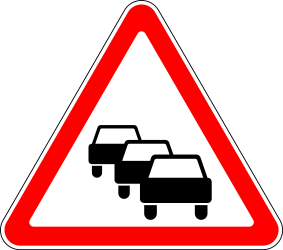
37. Warning for traffic jams
This traffic sign indicates a warning for traffic jams. It alerts drivers to the possibility of sudden or frequent traffic congestion ahead, often requiring reduced speed and increased attention. Drivers should be alert for suddenly stopped or slow-moving traffic.
© via Wikimedia.org
38. Warning for a railroad crossing without barriers
This traffic sign indicates a warning for a railroad crossing without barriers. It alerts drivers to an upcoming level crossing where railway tracks cross the road and no barriers or gates are present to stop traffic. Drivers should slow down and look both ways for trains.
© via Wikimedia.org
39. Warning for a railroad crossing with barriers
This traffic sign indicates a warning for a railroad crossing with barriers. It alerts drivers to an upcoming level crossing with gates or barriers that close when a train approaches. Drivers should be ready to stop when the barriers are down or flashing lights activate. Never attempt to cross when gates are closing or closed.
© via Wikimedia.org
40. Warning for a railroad crossing with 1 railway
This traffic sign indicates a warning for a railroad crossing with 1 railway. It alerts drivers to a level crossing where a single set of train tracks crosses the road. Drivers should approach with caution and be prepared to stop, even if no barriers or lights are present.
© via Wikimedia.org