
A warning sign is a traffic sign that alerts drivers to a potential danger or change in road conditions ahead, giving them enough time to slow down and react safely. These signs warn about hazards such as sharp bends, pedestrian crossings, slippery surfaces, merging traffic, animals on the road, or upcoming intersections. Their purpose is not to forbid or command anything, but simply to prepare drivers for situations that require extra attention.

Warning for a danger with no specific traffic sign.

Warning for low-flying aircrafts.

Warning for cattle on the road.

Warning for crossing deer.

Warning for a movable bridge.

Warning for a speed bump.

Warning for a bad road surface.

Warning for children.

Warning for an uncontrolled crossroad.

Give way to all drivers.

Warning for a roundabout.

Warning for a crossroad with a side road on the left.

Warning for a crossroad with side road on the right.

Warning for a crossroad side roads on the left and right.

Warning for a crossroad where the roads are not opposite to each other.
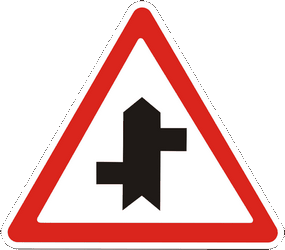
Warning for a crossroad where the roads are not opposite to each other.

Stop and give way to all drivers.

Warning for heavy crosswind.

Warning for a curve to the left.

Warning for a double curve, first left then right.

Warning for a curve to the right.

Warning for a double curve, first right then left.

Warning for cyclists.

Warning for a dip in the road.

Warning for falling rocks.

Warning for loose chippings on the road surface.

Warning for a crossing for pedestrians.

Warning for a quayside or riverbank.

Warning for a road narrowing.

Warning for a road narrowing on the left.

Warning for a road narrowing on the right.

Warning for an unpaved road surface.

Warning for roadworks.

Warning for a slippery road surface.

Warning for a soft verge.

Warning for a steep ascent.

Warning for a steep descent.

Warning for a traffic light.

Warning for traffic jams.
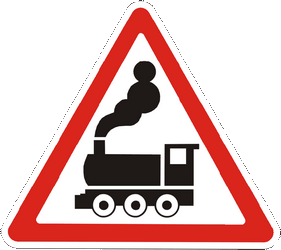
Warning for a railroad crossing without barriers.

Warning for a railroad crossing with barriers.

Warning for a railroad crossing with 1 railway.

Warning for a railroad crossing with more than 1 railway.

Warning for trams.

Warning for a tunnel.

Warning for a road with two-way traffic.
This traffic sign indicates a warning for a curve to the right. It alerts drivers to an upcoming gentle or moderate curve to the right in the road. Drivers should reduce speed and be prepared to steer smoothly to the right. Stay alert, especially in poor visibility or slippery conditions.
© via Wikimedia.org
This traffic sign indicates a warning for a double curve ahead, first to the right and then to the left. It alerts drivers of two successive curves, starting with a right-hand bend followed by a left-hand bend. Drivers should reduce speed and be prepared for two changes in direction. Maintain steady control through the curves.
© via Wikimedia.org
This traffic sign indicates a warning for cyclists. It alerts drivers to the presence of cyclists on or near the road. Drivers should slow down and expect cyclists crossing or riding along the road. Share the road and maintain a safe passing distance. Common Locations: school zones, cycling routes, near parks, sports facilities, or bike paths.
© via Wikimedia.org
This traffic sign indicates a warning for a dip in the road. It alerts drivers to a sudden depression or dip in the road surface ahead. Drivers should reduce speed to avoid bouncing or loss of control. Avoid sudden braking while driving through the dip and be prepared for water accumulation in the dip during rain.
© via Wikimedia.org
This traffic sign indicates a warning for falling rocks. It alerts drivers to the risk of rocks falling onto the roadway from adjacent slopes or cliffs. Drivers should reduce speed and stay alert. Be ready for rocks on the road, especially after rain or freezing weather. Avoid stopping near cliffs or slopes. Common Locations: mountain roads, cliffside routes, coastal or hilly terrain.
© via Wikimedia.org
This traffic sign indicates a warning for loose chippings. It alerts drivers to road surfaces covered with loose gravel or stones, which can affect traction and pose a risk of flying debris. Drivers should reduce speed to avoid skidding and keep a safe distance from other vehicles. Be cautious of stone chips that may damage paint or windshields. Common Locations: freshly resurfaced roads, rural or under-maintenance road sections.
© via Wikimedia.org
This traffic sign indicates a warning for a pedestrian crossing. It alerts drivers to an upcoming pedestrian crossing on the road. Drivers should reduce speed and be prepared to yield to pedestrians at the crossing. Common Locations: near bus stops, stations, shopping areas, school zones.
© via Wikimedia.org
This traffic sign indicates a warning for a quayside or riverbank. It alerts drivers to a waterfront edge, such as a quay, canal, riverbank, or ferry dock, where there is a risk of falling into water if not careful. Drivers should slow down and stay alert, especially at night or in poor visibility. Be cautious in unfenced or unfloodlit quayside areas. Common Locations: riverbanks, canals, harbors, ferry terminals, industrial docks or marinas.
© via Wikimedia.org
This traffic sign indicates a warning for a road narrowing. It alerts drivers the road ahead becomes narrower, reducing the available lane width. Drivers should reduce speed and be cautious of limited space, especially in two-way traffic. Common Locations: construction zones, bridges, underpasses, rural roads or tight curves.
© via Wikimedia.org
This traffic sign indicates a warning for a road narrowing on the left. It alerts drivers the road will narrow from the left side ahead. Drivers should reduce speed and be cautious of oncoming or merging traffic. Be prepared for obstacles, reduced shoulder, or construction.
© via Wikimedia.org

 Traffic rules
 Priority signs
 Warning signs
 Prohibitory signs
 Mandatory signs
 Information signs
 Additional signs