
A prohibitory sign is a traffic sign that tells drivers what is not allowed on that specific road or in that situation. These signs impose restrictions such as no entry, no overtaking, no parking, speed limits, or bans on certain types of vehicles. Their purpose is to clearly indicate actions that are forbidden to ensure safety, maintain traffic flow, and protect vulnerable road users.

Access prohibited.

Buses prohibited.

Caravans prohibited.

Cyclists prohibited.

Direction prohibited (road with one-way traffic).

Handcarts prohibited.

Horsecarts prohibited.

Mopeds prohibited.

Mopeds, motorcycles and cars prohibited.

Motorcycles prohibited.

Motorcycles and cars prohibited.

Pedestrians prohibited.

Tractors prohibited.

Trucks prohibited.

Prohibited access zone.

End of prohibited access zone.

Leaving less distance than indicated prohibited.

Using the horn prohibited.

End of the prohibition to use the horn.

Overtaking prohibited.

End of the overtaking prohibition.

Overtaking prohibited for trucks.

End of the overtaking prohibition for trucks.

Begin of a speed limit.

End of the speed limit.

Begin of a zone with speed limit.

End of the zone with speed limit.

Turning left prohibited.

Turning right prohibited.

Turning around prohibited (U-turn).

Vehicles with dangerous goods prohibited.

Vehicles with explosive materials prohibited.

Vehicles higher than indicated prohibited.

Vehicles longer than indicated prohibited.

Vehicles with polluted fluids prohibited.

Vehicles heavier than indicated prohibited.

Vehicles with an axle weight heavier than indicated prohibited.
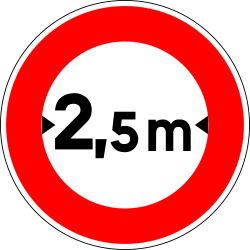
Vehicles wider than indicated prohibited.

Entry prohibited (checkpoint).

Passing without stopping prohibited (Customs).

Entry prohibited without payment (Toll road).

Parking prohibited.

Parking prohibited first half of the month (days 1-15).

Parking prohibited second half of the month (days 16-31).

Parking and stopping prohibited.

Zone with a limited parking time.

End of the zone with limited parking time.

Begin of zone where parking is prohibited.

End of the zone where parking is prohibited.

Begin of zone with paid parking.

End of zone with paid parking.

Road narrowing, give way to oncoming drivers.
This traffic sign indicates vehicles transporting dangerous good are prohibited. It means that vehicles transporting dangerous goods are not allowed to enter or continue past the sign.
© via Wikimedia.org
This traffic sign indicates vehicles transporting explosive materials are prohibited. It means that vehicles transporting explosive substances (such as ammunition, fireworks, or blasting materials) are not allowed beyond this point.
© via Wikimedia.org
This traffic sign indicates vehicles higher than indicated prohibited. It means that vehicles exceeding the specified height are not allowed beyond this point due to clearance limits, such as: bridges, tunnels, overpasses or low-hanging structures. Vehicles equal to or shorter than the limit are allowed.
© via Wikimedia.org
This traffic sign indicates vehicles longer then indicated are prohibited. It means that vehicles exceeding a specific length are not allowed beyond this point. It’s used to prevent long vehicles from entering roads that can't accommodate their turning radius, width, or safety requirements. Vehicles equal to or shorter than the indicated length may enter.
© via Wikimedia.org
This traffic sign indicates vehicles transporting polluted fluids are prohibited. It means that vehicles transporting polluted or environmentally hazardous fluids are not allowed beyond this point. Other vehicles, including those with non-hazardous cargo, may be allowed unless otherwise restricted.
© via Wikimedia.org
This traffic sign indicates vehicles heavier then indicated are prohibited. It means that vehicles with a total weight exceeding the indicated limit are not allowed beyond this point. It is usually used at bridges and other structures which cannot safely support heavy vehicles or to keep heavy trucks off unsuitable roads. Lighter vehicles (at or under the limit) are allowed.
© via Wikimedia.org
This traffic sign indicates vehicles with an axle weight heavier than indicated prohibited. It means that vehicles with an axle load exceeding the specified limit are not allowed beyond this point. Vehicles with axle loads equal to or under the limit may pass. It's used to protect roads, bridges, or tunnels from structural damage due to concentrated loads.
© via Wikimedia.org
This traffic sign vehicles wider than indicated are prohibited. It means that vehicles exceeding the specified width are not allowed beyond this point, usually to prevent blockage or damage in narrow spaces. Vehicles with a width equal to or narrower than the limit are allowed. Common in: narrow streets, historic towns, tunnels or lanes with limited clearance.
© via Wikimedia.org
This traffic sign indicates a checkpoint. It means that entry is not allowed at a checkpoint — such as a border control, customs post, military zone, or security-controlled area. Entry prohibited to all unauthorised vehicles and persons. Access may be allowed only with permission, such as: valid ID or passport, cargo documents (for customs), security clearance.
© via Wikimedia.org
This traffic sign indicates a customs checkpoint. It means that drivers must stop at a customs checkpoint. It is prohibited to pass without stopping, even if you have nothing to declare. All vehicles must stop and wait for clearance, it's used at: International borders, Ports and airports.
© via Wikimedia.org

 Traffic rules
 Priority signs
 Warning signs
 Prohibitory signs
 Mandatory signs
 Information signs
 Additional signs