

Book
 Traffic rules
 Priority signs
 Warning signs
 Prohibitory signs
 Mandatory signs
 Information signs
Mandatory signs
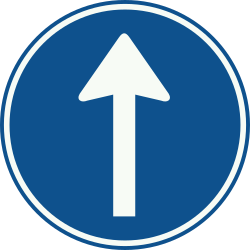
A mandatory sign is a traffic sign that tells drivers what they must do. Instead of prohibiting actions, these signs impose obligations such as following a specific direction, using a particular lane, or keeping a minimum speed. Their purpose is to guide traffic safely and efficiently by ensuring that all road users follow the same required behavior in places where it is necessary for order and safety.






11. End of the lane for buses and trams
This traffic sign indicates the end of the lane for buses and trams. It means that the dedicated lane reserved for buses and trams is ending. After this point, the lane is no longer reserved exclusively for public transport vehicles. Other vehicles may enter or use the lane beyond this sign. Helps manage transitions between public transport-only zones and mixed traffic areas.
© via Wikimedia.org

12. Mandatory lane for trucks and buses
This traffic sign indicates the begin of a lane for trucks and buses. It means that a specific traffic lane is exclusively reserved for trucks and buses. These vehicles must use that lane, and other vehicles are prohibited from entering it. Passenger cars, motorcycles, and other vehicles may not enter this lane.
© via Wikimedia.org
13. End of the lane for buses and trucks
This traffic sign indicates the end of the lane for buses and trucks.
© via Wikimedia.org
14. Mandatory path for cyclists
This traffic sign indicates the begin of a path for cyclists. It means that cyclists must use the designated cycle path and are not allowed to ride on the main road alongside motor vehicles. Ensures the safety of cyclists and smooth traffic flow.
© via Wikimedia.org
15. End of the path for cyclists
This traffic sign indicates the end of the path for cyclists. It means that the designated cycle path ends at that point. After this sign, cyclists must rejoin the general roadway and follow regular traffic rules. Cyclists must continue in mixed traffic or on another designated route, if available. Motorists should be alert as cyclists may merge with traffic.
© via Wikimedia.org
16. Mandatory path for cyclists and mopeds
This traffic sign indicates the begin of a path for cyclists and mopeds. It means that a specific path is exclusively reserved for bicycles and class A mopeds (low-powered mopeds), and they must use it. Other vehicles and pedestrians are not allowed on this path.
© via Wikimedia.org
17. End of the path for cyclists and mopeds
This traffic sign indicates the end of the path for cyclists and mopeds. It means that the designated path for bicycles and mopeds (Class A) has ended. After this point, cyclists and mopeds must merge with general traffic or follow other indicated routes. Drivers should be aware of merging slow-moving vehicles.
© via Wikimedia.org
18. Mandatory path for equestrians
This traffic sign indicates the begin of a path for equestrians. It means that a specific path is reserved for equestrians (horseback riders) and are required to use it. Other types of traffic (pedestrians, cyclists, vehicles) are not allowed on this path unless otherwise indicated. Ensures safe separation from motorized or pedestrian traffic
© via Wikimedia.org
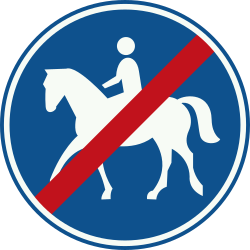
19. End of the path for equestrians
This traffic sign indicates the end of the path for equestrians. It means that the designated bridle path for horseback riders ends at this point. Alerts both equestrians and other road/path users of a change in regulation.
© via Wikimedia.org
20. Mandatory path for pedestrians
This traffic sign indicates the begin of a path for pedestrians. It means that pedestrians must use the designated path (such as a sidewalk or footpath), and may not walk on the adjacent road or other areas. Other users (bicycles, mopeds, etc.) are not allowed, unless explicitly permitted. Common Locations: urban sidewalks, school zones, parks, underpasses.
© via Wikimedia.org