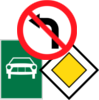
Señal de dirección en intersecciónSuiza

Aprende normas de tráfico con explicaciones claras y ejemplos visuales en nuestro libro ilustrado, diseñado para que estudiar sea sencillo y ameno.


45. Señal de dirección en intersección

Una señal de dirección en intersección muestra los destinos y rutas disponibles en una intersección próxima o actual. Las flechas, números de carretera, símbolos y nombres de lugares ayudan al conductor a elegir la dirección correcta y, cuando se indica, el carril adecuado.

La señal ofrece orientación de ruta, pero normalmente no establece prioridad, permiso para girar ni límite de velocidad. Los conductores deben seguir respetando semáforos, señales reglamentarias, flechas de carril, marcas viales y normas locales.

What is an intersection direction sign?

It is a sign that shows the destinations and routes available at an intersection.

What is an advance direction sign?

An advance direction sign is placed before an intersection so drivers can identify their route and choose the correct lane in good time.

What is a direction sign?

A direction sign is normally placed at or close to the intersection and points towards a particular destination or route.

How can you recognise an intersection direction sign?

It commonly displays place names, arrows, road numbers, route symbols or diagrams of the intersection.

What do the arrows mean?

The arrows show which direction drivers should follow to reach the displayed destinations.

Does an upward arrow always mean straight ahead?

Usually, yes. Arrow design and orientation can vary, especially on signs positioned above traffic lanes.

What does a schematic intersection diagram show?

It shows the approximate arrangement of the roads and exits at the approaching intersection without necessarily reproducing every island, verge or road detail.

Does the diagram show the exact shape of the intersection?

No. It simplifies the layout to make the available directions easier to understand.

Can the sign show road numbers?

Yes. Road numbers help drivers follow a numbered national, regional, international or motorway route.

Can the sign show motorway or expressway symbols?

Yes. A symbol may indicate that the displayed route leads to or continues over a motorway, expressway or another particular road category.

Can the sign show local facilities?

Yes. Separate direction signs may indicate hospitals, railway stations, airports, parking areas, ports, tourist attractions and other destinations.

Does the sign require you to follow the displayed route?

No, unless another regulatory sign or lane marking makes that direction mandatory. A route-guidance sign normally provides information rather than imposing a movement.

Does the sign give you permission to turn?

No. A displayed destination does not override a no-turn sign, mandatory direction, traffic light or lane arrow.

Does the sign determine priority?

No. Priority is determined by traffic lights, priority signs and the applicable intersection rules.

Does it impose a speed limit?

No. Drivers must follow the applicable general, zonal, posted or vehicle-specific speed limit.

When should you choose your lane?

Choose the appropriate lane as early as reasonably possible after reading the sign and checking the lane arrows and road markings.

May you change lanes after reading the sign?

Yes, when the movement is legal and safe. Check mirrors and blind spots, signal where required and give way to traffic already using the target lane.

What if the destination appears above one lane?

The indication normally relates to that lane or group of lanes. Follow the lane arrows and overhead signs carefully.

What if the route sign conflicts with a regulatory sign?

Follow the regulatory sign, traffic light or authorised officer. Route guidance does not override a prohibition or obligation.

What if temporary roadworks signs show another route?

Follow the temporary diversion and traffic arrangement that is legally in force, even when permanent direction signs still show the usual route.

What should you do after missing the indicated turn?

Continue safely and find another legal route. Do not reverse, stop suddenly or cut across traffic lanes.

Should you rely only on navigation software?

No. Navigation instructions may be outdated or unsuitable for the vehicle. Traffic signs and current road conditions take precedence.

Can a route be unsuitable for certain vehicles?

Yes. A route may include height, width, weight, access or dangerous-goods restrictions. Drivers must observe every applicable sign.

Can destinations be written in more than one language?

Yes. The language or languages used depend on the country, region and local signing rules.

Does the order of destinations have a meaning?

Often, yes. Destinations may be grouped or ordered according to direction, importance or distance, but the exact convention differs between countries.

1 Suiza 2 Autopista 3 Vía rápida 4 Zona residencial 5 Zona 6 Límite de velocidad 7 Velocidad mínima 8 Senda peatonal 9 Carril bici 10 Vía compartida 11 Túnel 12 Zona peatonal 13 Aduana 14 Sentido único 15 Pendiente 16 Carril bus 17 Parada de autobús 18 Calle sin salida 19 Señal de STOP 20 Ceda el paso 21 Glorieta 22 Vía con prioridad 23 Estrechamiento de calzada 24 Prioridad sobre el tráfico en sentido contrario 25 Ceda el paso al tráfico en sentido contrario 26 Paso de peatones 27 Paso a nivel 28 Dirección obligatoria 29 Prohibición de giro 30 Zona escolar 31 Adelantamiento 32 Cruce de animales 33 Calzada deslizante 34 Desprendimiento de rocas 35 Aeronaves 36 Curva 37 Panel direccional 38 Circulación en sentido contrario 39 Obras 40 Viento lateral 41 Límite de altura 42 Límite de anchura 43 Límite de longitud 44 Límite de peso 45 Señal de dirección en intersección 46 Prioridad en la próxima intersección 47 Semáforos 48 Advertencia de semáforos 49 Semáforos peatonales 50 Marcas viales 51 Esquema de intersección 52 Permiso de conducir 53 Marcador de ubicación 54 Número de carretera 55 Paneles de aproximación 56 Espejo de tráfico 57 Teléfono de emergencia 58 Frontera internacional 59 Paso inferior peatonal 60 Ruta ciclista 61 Fin de restricción 62 Estacionamiento 63 Prohibido estacionar 64 Prohibido parar 65 Disco de estacionamiento 66 Marcha atrás 67 Cambio de sentido 68 Atasco 69 Desvío 70 Intersección sin regulación 71 Estado de la calzada 72 Salida 73 Punto de información 74 Equitación 75 Salida de emergencia 76 Rampa de frenado de emergencia 77 Servicio de radio 78 Carga sobredimensionada 79 Límite de población 80 Hospital 81 Aparcamiento cubierto 82 Apartadero 83 Pasarela peatonal 84 Límite de carga por eje 85 Matrícula 86 Estación de carga 87 Peligros 88 Condiciones meteorológicas 89 Giro con semáforo rojo 90 Peatón 91 Ciclista 92 Ciclomotor 93 Motocicleta 94 Turismo 95 Camión 96 Autobús 97 Policía 98 Ambulancia 99 Circular demasiado cerca 100 Norma europea de emisiones ...